Paper I — Q8
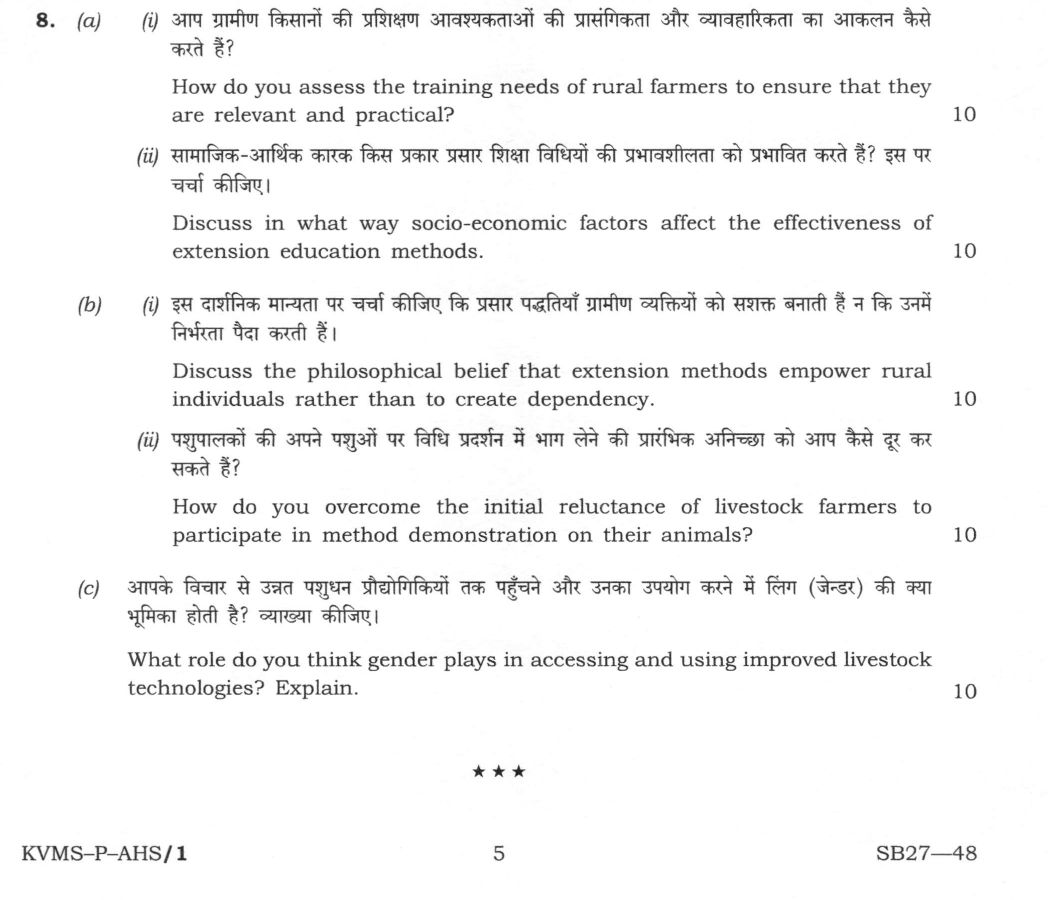
(a) (i) How do you assess the training needs of rural farmers to ensure that they are relevant and practical? (10 marks) (ii)…
How do you assess the training needs of rural farmers to ensure that they are relevant and practical? 10 marks
Discuss in what way socio-economic factors affect the effectiveness of extension education methods. 10 marks
Discuss the philosophical belief that extension methods empower rural individuals rather than to create dependency. 10 marks
How do you overcome the initial reluctance of livestock farmers to participate in method demonstration on their animals? 10 marks
What role do you think gender plays in accessing and using improved livestock technologies? Explain. 10 marks
हिंदी में प्रश्न पढ़ें
आप ग्रामीण किसानों की प्रशिक्षण आवश्यकताओं की प्रासंगिकता और व्यावहारिकता का आकलन कैसे करते हैं? (10 अंक)
सामाजिक-आर्थिक कारक किस प्रकार प्रसार शिक्षा विधियों की प्रभावशीलता को प्रभावित करते हैं? इस पर चर्चा कीजिए। (10 अंक)
इस दार्शनिक मान्यता पर चर्चा कीजिए कि प्रसार पद्धतियाँ ग्रामीण व्यक्तियों को सशक्त बनाती हैं न कि उनमें निर्भरता पैदा करती हैं। (10 अंक)
पशुपालकों की अपने पशुओं पर विधि प्रदर्शन में भाग लेने की प्रारंभिक अनिच्छा को आप कैसे दूर कर सकते हैं? (10 अंक)
आपके विचार से उन्नत पशुधन प्रौद्योगिकियों तक पहुँचने और उनका उपयोग करने में लिंग (जेन्डर) की क्या भूमिका होती है? व्याख्या कीजिए। (10 अंक)
Model answer
Drafted with AI by UPSC Answer Check against this question's marking rubric, to the expected length. UPSC does not publish answers for Mains — this is one way to score well, not an official key. How we build rubrics and answers.
(a)(i) Assessing the training needs of rural farmers so that training is relevant and practical (10 marks)
A training need is the gap between the knowledge, skill and attitude a farmer needs to do a job well and what he or she already has. To assess it:
- Define the target group (dairy, small ruminant or poultry keepers, women, youth) and the purpose of the training.
- Collect data with participatory tools: village meetings, participatory rural appraisal, focus groups, interviews and surveys of farmers, observation of practices, farm and health records, and views of local key informants, veterinarians, dairy cooperatives and Krishi Vigyan Kendras.
- Analyse the gap: compare present with desired practice, and separate real training needs from problems of inputs, credit or markets, which training cannot solve.
- Rank the needs by their importance, number of farmers affected and feasibility, together with the farmers.
- Design training around the ranked needs: local language, a suitable season and time, hands-on, low-cost, locally tested technology, and demonstrations.
- Pre-test, take feedback and revise. Involving farmers throughout keeps the content practical.
(a)(ii) How socio-economic factors affect the effectiveness of extension education methods (10 marks)
The effect of any extension method depends on the audience, so socio-economic characteristics decide which method works.
- Education and literacy: literate farmers can use written material, posters and mobile messages; illiterate farmers need demonstrations, group meetings, films and radio.
- Age and experience: young farmers accept new ideas faster and use digital media, while older farmers rely on personal contact and trusted persons.
- Size of holding, income and resources: poor and small farmers cannot adopt costly technology, so methods must offer low-cost options, credit or subsidy, and results in a short time.
- Social status and caste, and social participation: marginal groups may be missed by mass methods; leaders and groups spread ideas within the community.
- Risk orientation, and cultural beliefs and attitudes to the technology, affect adoption.
Extension therefore uses a mix of methods (individual, group and mass) suited to the group.
(b)(i) Extension methods empower rural individuals rather than create dependency (10 marks)
Extension is an out-of-school education process that helps farmers to help themselves. Its aim is to build their knowledge, skills, confidence and ability to make decisions, and so empower them.
- Participatory methods (farmer field schools, group discussions, farmer-to-farmer learning, demonstrations on the farmer's own animals) develop the farmer's own analysis and problem-solving.
- Groups such as self-help groups, dairy cooperatives and farmer producer organisations build collective strength and access to markets and credit; local para-professionals (for example Pashu Sakhi) build local capacity.
- Information access through demand-driven and digital services lets farmers choose for themselves.
Evidence: cooperative dairying (Amul) and women's self-help groups show self-reliant institutions.
Dependency arises when extension is top-down, gives free inputs and doses without explanation, or keeps farmers dependent on the worker. So it should be participatory, build local skills and institutions, and phase out support gradually (an exit strategy). Well designed, extension empowers.
(b)(ii) Overcoming farmers' initial reluctance to take part in method demonstrations on their animals (10 marks)
Reluctance arises from fear that the animal, a valuable asset, may be harmed or lost, from lack of trust in the worker, from risk aversion, lack of time, superstition, and earlier bad experience.
- Build rapport first through village leaders, progressive farmers and local groups; explain the purpose and benefits in the local language.
- Start with simple, low-risk, visible practices (deworming, mineral supplementation, hygienic milking) and with a volunteer's or the institution's own animals, and show results.
- Ensure safety: the demonstration is done by a qualified veterinarian, with insurance or compensation for a loss.
- Involve the farmer actively (learning by doing), and use farmer-to-farmer visits and results of earlier demonstrations to build credibility.
- Choose a convenient time and place (at the farmer's door, in a group), and involve women and youth.
- Follow up with visits, so that trust builds and the practice spreads.
(c) Role of gender in accessing and using improved livestock technologies (10 marks)
Women do a large share of livestock work, such as feeding, watering, cleaning, milking and fodder collection, and they often own small ruminants and poultry, but men usually control large animals, marketing, income, credit and decisions. This shapes access to technology.
- Barriers for women: lower literacy, restricted mobility, heavy work load, social norms, lack of land, credit and ownership, and extension services with few women staff, and with meetings at times and places that they cannot attend.
- Effects: technologies (AI, improved feeding, vaccination, cattle sheds) are designed and taught to men, though women carry them out, so adoption and benefit are lower; women's tasks get no labour-saving equipment.
- Remedies: gender-sensitive extension with women workers (Pashu Sakhi, women's groups and dairy cooperatives), training near home and at suitable times, drudgery-reducing tools (chaff cutters), women's access to credit and ownership, and sex-disaggregated data.
Involving women in the design and use of technology improves adoption, productivity, nutrition and household income.
How this answer will be evaluated
Evaluation rubric
Each sub-part is marked on its own, against the marks and word limit printed on the paper.
- (a)(i) (a)(i) How do you assess the training needs of rural farmers to ensure that they are relevant and practical (10). 10 marks
Must cover
- Training need as the gap in knowledge, skill or attitude
- Participatory data collection: PRA, surveys, focus groups, observation, key informants
- Gap analysis, separating training from non-training problems, and ranking needs with farmers
- Design: local language, timing, hands-on, low-cost technology; pre-test and feedback
Loses marks
- Describing the training programme instead of the assessment.
- Top-down assumption of needs.
- No method of data collection.
Earns more
- Felt, expressed and unfelt needs.
- Role of KVKs and cooperatives.
Extra mark
- Periodic reassessment
- (a)(ii) (a)(ii) Discuss in what way socio-economic factors affect the effectiveness of extension education methods (10). 10 marks
Must cover
- Education and literacy determine choice of written, audiovisual or demonstration methods
- Age, experience and receptiveness
- Farm size, income and resources determine affordability of technology
- Social status, participation, risk orientation and culture; mix of individual, group and mass methods
Loses marks
- Listing factors without their effect on methods.
- Discussing only economic factors.
- No suggestion of method choice.
Earns more
- Examples for each factor.
- Role of leaders and groups.
Extra mark
- Adopter categories
- (b)(i) (b)(i) Discuss the belief that extension methods empower rural individuals rather than create dependency (10). 10 marks
Must cover
- Extension as education for self-help: knowledge, skills, confidence and decision-making
- Participatory methods, groups (SHGs, cooperatives, FPOs) and local para-professionals (Pashu Sakhi)
- Conditions under which dependency arises: top-down, free inputs, no exit strategy
- A reasoned conclusion supported by an example
Loses marks
- One-sided answer.
- Confusing extension with input supply.
- No example or conclusion.
Earns more
- Digital and demand-driven information.
- Amul and women's SHGs as evidence.
Extra mark
- Exit strategy
- (b)(ii) (b)(ii) How do you overcome the initial reluctance of livestock farmers to participate in method demonstration on their animals (10). 10 marks
Must cover
- Diagnosis of reasons: fear of harm, low trust, risk aversion, past experience
- Building rapport through leaders and progressive farmers; explaining benefits
- Starting with low-risk, visible practices, volunteer or institutional animals; safety by a qualified veterinarian, with insurance or compensation
- Active participation, farmer-to-farmer visits, convenient time and place, follow-up
Loses marks
- Forcing participation.
- Ignoring the cause of reluctance.
- Demonstration without safety assurance.
Earns more
- Involving women and youth.
- Showing results of earlier demonstrations.
Extra mark
- Local language communication
- (c) (c) What role does gender play in accessing and using improved livestock technologies (10). 10 marks
Must cover
- Women do a large share of livestock work but men control large animals, income, credit and decisions
- Barriers: literacy, mobility, workload, social norms, ownership and credit, few women extension staff
- Effects: lower adoption and benefit; technologies designed for men
- Remedies: women workers (Pashu Sakhi), groups, timing and venue, drudgery-reducing tools, credit and ownership
Loses marks
- Stereotyped statements without evidence.
- Discussing only women's problems without technology access.
- Inaccurate statistics.
Earns more
- Women's ownership of small ruminants and poultry.
- Sex-disaggregated data.
Extra mark
- Improved productivity and nutrition through inclusion
What "How" is asking you to do
Set out the route by which the outcome comes about, step by step. Many how stems ask how one thing affects another, and there the channel of transmission is precisely what is being marked.
Structure that answers it
Starting condition → step → step → outcome reached → the conditions the route depends on
Where marks are lost
Answering why it happens instead of how, the commonest single misread in the paper. An answer full of causes and significance that never traces the mechanism has answered a different question.
Practice this exact question
Write your answer and it is marked point by point against the model answer above — what you covered, what you missed, what you got wrong.
Evaluate my answer →More from Animal Husbandry & Veterinary Science 2026 Paper I
- Q5 Write notes on/Answer the following in about 150 words each : (a) Impact of genetic drift…
- Q6 (a) Explain the genetic mechanism behind inbreeding depression. Why does continuous inbre…
- Q7 (a) How do you estimate the cost of milk production in organised and unorganised dairy se…
- Q8 (a) (i) How do you assess the training needs of rural farmers to ensure that they are rel…