Paper I — Q7
(a) How do you estimate the cost of milk production in organised and unorganised dairy sector in India? (15 marks) (b) Explain…
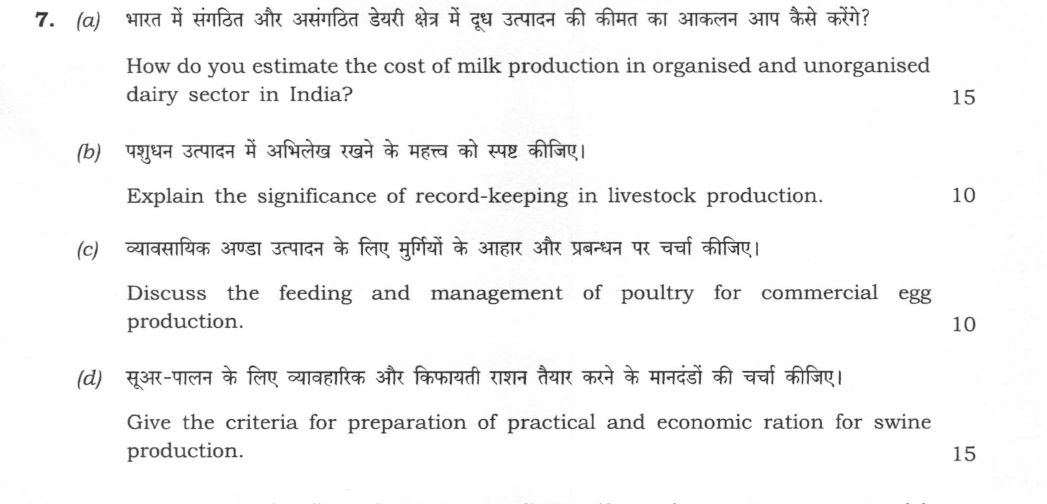
How do you estimate the cost of milk production in organised and unorganised dairy sector in India? 15 marks
Explain the significance of record-keeping in livestock production. 10 marks
Discuss the feeding and management of poultry for commercial egg production. 10 marks
Give the criteria for preparation of practical and economic ration for swine production. 15 marks
हिंदी में प्रश्न पढ़ें
भारत में संगठित और असंगठित डेयरी क्षेत्र में दूध उत्पादन की कीमत का आकलन आप कैसे करेंगे? (15 अंक)
पशुधन उत्पादन में अभिलेख रखने के महत्व को स्पष्ट कीजिए। (10 अंक)
व्यावसायिक अंडा उत्पादन के लिए मुर्गियों के आहार और प्रबन्धन पर चर्चा कीजिए। (10 अंक)
सूअर-पालन के लिए व्यावहारिक और किफायती राशन तैयार करने के मानदंडों की चर्चा कीजिए। (15 अंक)
Model answer
Drafted with AI by UPSC Answer Check against this question's marking rubric, to the expected length. UPSC does not publish answers for Mains — this is one way to score well, not an official key. How we build rubrics and answers.
(a) Estimating the cost of milk production in the organised and unorganised dairy sector in India (15 marks)
The cost of milk production is estimated by adding all the costs of keeping the animals for a defined period, deducting the value of by-products, and dividing by the milk produced, to give cost per litre (usually for fat-corrected milk, 4% fat). Herds are sampled by size class and data are taken from farm records or a year-long survey.
Cost structure:
- Variable (operating) costs: feed and fodder (concentrates, green and dry fodder), which is 60 to 70% of the total; hired labour and the imputed value of family labour; veterinary, medicine and artificial insemination; electricity, water and milking expenses; and interest on working capital.
- Fixed costs: depreciation on animals, sheds and equipment; interest on fixed capital; insurance; rent of land (actual or imputed); and overheads.
- Credits: the value of dung and manure, and of calves, and other by-products, are subtracted.
Cost concepts used in farm surveys: A₁ (all paid-out costs), B₁ (A₁ plus interest on owned fixed capital), C₁ (B₁ plus imputed family labour), C₂ (C₁ plus rental value of owned land) and C₃ (C₂ plus 10% for management).
Organised and unorganised sectors: in the organised sector (commercial dairies, cooperative-linked herds) there are records, hired labour, purchased feed and higher productivity, so actual costs can be read from books. In the unorganised sector (holders of one to three animals) feed is largely crop residue, grazing and home-grown fodder and labour is the family's, so these costs are imputed at market or opportunity cost. The cost is worked out over the whole lactation and calving interval, including the dry period.
(b) Significance of record-keeping in livestock production (10 marks)
Records are the written data on each animal and the herd, and they are the basis of scientific management. Main types: identification and inventory (herd register), production (milk yield, fat per cent, egg production, body weight, wool), reproduction (heat, service, pregnancy, calving), breeding and pedigree, health (vaccination, disease, treatment, mortality), feeding, and financial records.
Significance:
- Selection and culling: to identify high and low producers and to choose breeding stock.
- Breeding programmes: pedigree and performance records permit progeny testing and estimation of breeding values, and avoid inbreeding.
- Management: heat detection, expected calving and dry-off dates, the calving interval, and feeding according to production.
- Disease control: vaccination and treatment schedules, and tracing of outbreaks.
- Economics: cost of production and profit for each animal or enterprise, and decisions on expansion.
- Marketing, pedigree registration, insurance, credit and traceability, and research and planning.
(c) Feeding and management of poultry for commercial egg production (10 marks)
Feeding by phase: chick starter (0 to 8 weeks) with about 20% crude protein and 2,800 to 2,900 kcal ME/kg; grower (8 to 18 weeks) with about 16% protein and lower energy, to prevent early fattening; and layer feed from about 18 weeks, with 16 to 18% protein, about 2,600 to 2,750 kcal ME, calcium 3.5 to 4% (limestone and shell grit), available phosphorus about 0.4%, and balanced lysine and methionine, with vitamins and minerals. A layer eats about 100 to 115 g a day, and clean water is always available.
Management:
- Housing: cages (about 450 cm² a bird) or deep litter (about 0.15 to 0.2 m² a bird), well-ventilated, with temperature about 18 to 27 °C.
- Lighting: 16 hours of light a day by 18 to 22 weeks, and never reduced in lay.
- Beak trimming, vaccination (Marek's, Newcastle, infectious bursal disease, fowl pox), and biosecurity.
- Culling of poor layers, and moulting or disposal at about 72 to 80 weeks.
Egg collection is done two or three times a day, and peak production comes at about 24 to 28 weeks.
(d) Criteria for preparing a practical and economic ration for swine (15 marks)
A ration should be at the same time nutritionally balanced, practical to feed, and cheap. The criteria:
- Nutrient requirements by stage: creep and starter, grower, finisher, gestating and lactating sow, and boar. Crude protein falls with age (about 20 to 22% in creep feed to 14% in finishers, and 12 to 16% for sows). Digestible energy about 3,200 to 3,400 kcal/kg for growing pigs.
- Protein quality: balance the essential amino acids, especially lysine (first limiting in maize-soybean rations), methionine and tryptophan, and not just the crude protein.
- Minerals and vitamins: Ca:P about 1.2 to 1.5:1, with salt, trace minerals and vitamin premix.
- Fibre: limited to about 5 to 7% for growing pigs, since pigs digest fibre poorly, but higher for sows.
- Palatability and digestibility of the ingredients, and physical form; no spoilt, mouldy or mycotoxin-contaminated feed.
- Anti-nutritional factors: raw soybean, gossypol in cottonseed cake, mustard cake and high rice bran must be limited or treated.
- Availability and cost: use local, cheap ingredients and agro-industrial by-products (rice and wheat bran, oil cakes, maize, broken rice), and formulate by Pearson's square or least-cost linear programming, since feed is about 70 to 80% of the cost of production.
- Safety: kitchen waste (swill) must be cooked before feeding, since raw waste can carry African swine fever and other diseases.
How this answer will be evaluated
Evaluation rubric
Each sub-part is marked on its own, against the marks and word limit printed on the paper.
- (a) (a) How do you estimate the cost of milk production in the organised and unorganised dairy sector in India (15). 15 marks
Must cover
- Cost per litre = (total cost − by-product credit) ÷ milk output, on fat-corrected milk
- Variable costs (feed 60–70%, labour, veterinary, AI) and fixed costs (depreciation, interest, insurance, rent)
- Imputation of family labour and home-grown feed in the unorganised sector; cost concepts A₁, B₁, C₁, C₂, C₃
- Organised versus unorganised sector differences, and costing over the lactation and calving interval
Loses marks
- Listing costs without a method.
- Ignoring imputed costs.
- No distinction between the two sectors.
Earns more
- Credit for dung and calves.
- Sampling by herd size.
Extra mark
- Joint-cost apportionment with crops
- (b) (b) Explain the significance of record-keeping in livestock production (10). 10 marks
Must cover
- Types of records: identification, production, reproduction, health, feeding, financial
- Selection, culling and breeding decisions (pedigree, progeny testing)
- Management, disease control and economic analysis
- Uses in marketing, registration, insurance, credit, traceability and research
Loses marks
- Listing types without significance.
- Only financial records.
- Generic answer for agriculture.
Earns more
- Examples (milk records, calving dates, vaccination schedules).
- Avoiding inbreeding.
Extra mark
- Herd register and digital systems
- (c) (c) Discuss the feeding and management of poultry for commercial egg production (10). 10 marks
Must cover
- Phase feeding with protein and energy levels: starter, grower, layer
- Layer ration: protein 16–18%, calcium 3.5–4%, intake 100–115 g
- Housing (cage or deep litter, space), 16 h lighting, temperature
- Vaccination, beak trimming, culling, egg handling and peak production timing
Loses marks
- Broiler management.
- Lighting reduced in lay.
- Feeding without the management part.
Earns more
- Water and biosecurity.
- Moulting or disposal age.
Extra mark
- Light never reduced in lay
- (d) (d) Give the criteria for preparation of practical and economic ration for swine production (15). 15 marks
Must cover
- Nutrient requirements by stage (protein, energy) and amino acid balance (lysine)
- Minerals and vitamins (Ca:P), limits on fibre
- Palatability, digestibility, freedom from moulds and anti-nutritional factors
- Least-cost formulation with local and by-product ingredients (Pearson's square, linear programming); safe feeding of kitchen waste (ASF)
Loses marks
- Ration for poultry or cattle.
- Ignoring cost.
- Recommending raw swill.
Earns more
- Cost share of feed (70–80%).
- Physical form and feeding method.
Extra mark
- Feed additives
What "Calculate" is asking you to do
Apply the standard formula or schedule to data the question has already supplied — a table of readings, cost records, a balance sheet — and produce the number. The method is rarely in doubt; the marks sit in the named intermediate quantities, each of which has to appear as a labelled line.
Structure that answers it
Data as given → formula or standard treatment, named → substitution → each intermediate, labelled → result with units
Where marks are lost
Omitting an intermediate the marking scheme pays for separately, or rounding at an intermediate line so the final figure drifts. In commerce and accountancy, any figure in a statement that no numbered working note supports is treated as unearned.
Practice this exact question
Write your answer and it is marked point by point against the model answer above — what you covered, what you missed, what you got wrong.
Evaluate my answer →More from Animal Husbandry & Veterinary Science 2026 Paper I
- Q4 (a) “Silent heat is not a disease, but a failure of management.” Critically evaluate this…
- Q5 Write notes on/Answer the following in about 150 words each : (a) Impact of genetic drift…
- Q6 (a) Explain the genetic mechanism behind inbreeding depression. Why does continuous inbre…
- Q7 (a) How do you estimate the cost of milk production in organised and unorganised dairy se…
- Q8 (a) (i) How do you assess the training needs of rural farmers to ensure that they are rel…