Paper I — Q4
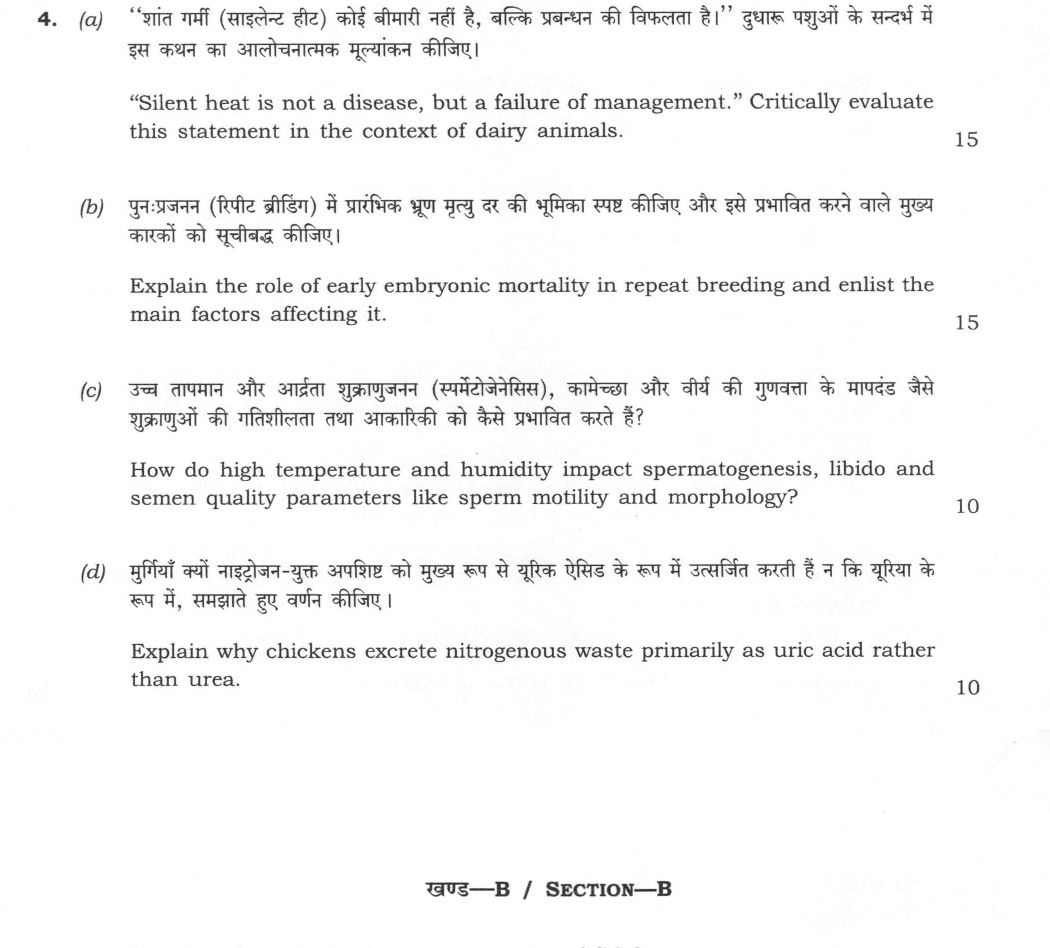
(a) “Silent heat is not a disease, but a failure of management.” Critically evaluate this statement in the context of dairy…
“Silent heat is not a disease, but a failure of management.” Critically evaluate this statement in the context of dairy animals. 15 marks
Explain the role of early embryonic mortality in repeat breeding and enlist the main factors affecting it. 15 marks
How do high temperature and humidity impact spermatogenesis, libido and semen quality parameters like sperm motility and morphology? 10 marks
Explain why chickens excrete nitrogenous waste primarily as uric acid rather than urea. 10 marks
हिंदी में प्रश्न पढ़ें
“शांत गर्मी (साइलेन्ट हीट) कोई बीमारी नहीं है, बल्कि प्रबन्धन की विफलता है।” दुधारू पशुओं के सन्दर्भ में इस कथन का आलोचनात्मक मूल्यांकन कीजिए। (15 अंक)
पुनःप्रजनन (रिपीट ब्रीडिंग) में प्रारंभिक भ्रूण मृत्यु दर की भूमिका स्पष्ट कीजिए और इसे प्रभावित करने वाले मुख्य कारकों को सूचीबद्ध कीजिए। (15 अंक)
उच्च तापमान और आर्द्रता शुक्राणुजनन (स्पर्मेटोजेनेसिस), कामेच्छा और वीर्य की गुणवत्ता के मापदंड जैसे शुक्राणुओं की गतिशीलता तथा आकारिकी को कैसे प्रभावित करते हैं? (10 अंक)
मुर्गियाँ क्यों नाइट्रोजन-युक्त अपशिष्ट को मुख्य रूप से यूरिक एसिड के रूप में उत्सर्जित करती हैं न कि यूरिया के रूप में, समझाते हुए वर्णन कीजिए। (10 अंक)
Model answer
Drafted with AI by UPSC Answer Check against this question's marking rubric, to the expected length. UPSC does not publish answers for Mains — this is one way to score well, not an official key. How we build rubrics and answers.
(a) "Silent heat is not a disease, but a failure of management" in dairy animals (15 marks)
Silent heat (sub-oestrus) is a cycle in which the ovary functions normally and ovulation occurs, but the behavioural signs of oestrus are weak or absent. The statement is partly right, and partly not.
Support for the statement:
- Most silent heat is a failure of heat detection, not of the animal: oestrus is short (cows about 12 to 18 hours, with more standing heat at night), so infrequent observation, absent records, slippery floors, tie stalls and understaffing miss it.
- Management causes: negative energy balance and low body condition, and deficiencies of phosphorus, copper, zinc and vitamin A, which reduce oestradiol; lameness; and heat stress in summer, which shortens and weakens oestrus, especially in buffaloes and high-yielding cows.
- It is solved by management: observing three times a day for 20 to 30 minutes, using tail paint, heat-mount detectors, pedometers or activity monitors, teaser bulls, milk progesterone tests, and by timed AI protocols.
Against the statement:
- Some silent heat is physiological: the first postpartum ovulation is normally silent, since oestrus needs priming by progesterone, and buffaloes and heifers show weak signs by nature, with low oestradiol.
- Endocrine and pathological causes (ovarian cysts, low oestradiol, and uterine disease) can also suppress signs.
Verdict: silent heat is a phenomenon of physiology, but its cost is mainly a management failure, because it becomes an economic loss only when unrecorded and undetected. Better detection and nutrition, cooling and synchronisation (PGF₂α, Ovsynch) largely remove the loss.
(b) Role of early embryonic mortality in repeat breeding, and factors affecting it (15 marks)
A repeat breeder is a cow or buffalo with regular cycles and a normal genital tract, that fails to conceive after three or more services. In most of these, fertilisation occurs (about 90%), but the embryo dies before or during maternal recognition of pregnancy (about day 16 to 17 in the cow, by interferon-tau) and before about day 42. Early embryonic mortality (EEM) is thus the main cause of pregnancy failure in repeat breeders, and up to 30 to 40% of embryos are lost. The animal returns to oestrus at a normal or slightly lengthened interval, so the loss is not detected, and it appears to be a failed insemination.
Factors:
- Genetic and chromosomal abnormalities of the embryo, and ageing gametes (mistimed insemination).
- Poor semen quality, and errors in AI technique.
- Uterine environment: subclinical endometritis, and inadequate uterine secretions.
- Hormonal: inadequate progesterone (luteal deficiency), delayed LH surge.
- Nutrition: negative energy balance, excess degradable protein (high urea in blood and uterus), deficiencies of selenium, vitamin E, vitamin A and minerals.
- Heat stress, and high milk yield.
- Infections: Campylobacter, Trichomonas, BVD virus, Brucella, Leptospira and others.
- Immunological and management stress.
(c) Effect of high temperature and humidity on spermatogenesis, libido and semen quality (10 marks)
The testes work best about 2 to 6 °C below body temperature, maintained by the scrotum, the pampiniform plexus and sweating. High ambient temperature with high humidity (a high temperature-humidity index) reduces evaporative cooling, so testicular temperature rises.
- Spermatogenesis: heat damages the developing spermatocytes and spermatids, and the seminiferous epithelium, so sperm production falls and testes shrink. The effect appears with a lag of about two to eight weeks, and recovery takes about two to three months (the cycle is about two months).
- Libido: heat stress lowers testosterone and LH, and feed intake, so sexual desire and mounting fall.
- Semen quality: lower volume and concentration, decreased motility and viability, more abnormal sperm (head and tail defects, proximal droplets, coiled tails), acrosome and DNA damage, mainly by oxidative stress, and poorer freezability and fertility.
Bos indicus and buffalo bulls are less affected than Bos taurus. Shade, sprinklers, fans, antioxidants (vitamin E, selenium, zinc) and collection during cool hours reduce the effects.
(d) Why chickens excrete nitrogenous waste mainly as uric acid (10 marks)
Chickens are uricotelic: they excrete about 60 to 80% of their nitrogenous waste as uric acid, for several reasons.
- Egg development: the embryo develops in a closed, shelled egg (cleidoic egg) with a limited water supply. Ammonia is highly toxic and needs a lot of water for dilution, and urea is very soluble and would accumulate in the fluids of the egg and disturb osmotic balance. Uric acid is almost insoluble in water and precipitates as crystals in the allantois, so it is harmless and takes almost no space.
- Water conservation: adult birds conserve water, since uric acid leaves as a semi-solid white paste with little water, and birds have no urinary bladder, which also saves weight for flight.
- Nitrogen efficiency: one uric acid molecule (C₅H₄N₄O₃) carries four nitrogen atoms, twice the two in urea.
Biochemistry: the avian liver lacks a functional urea cycle (for example carbamoyl phosphate synthetase I), and instead forms purines de novo from glycine, glutamine, aspartate, formate and CO₂ to inosine monophosphate. This is degraded to hypoxanthine, xanthine and uric acid by xanthine dehydrogenase. Uric acid is secreted into the renal tubules by active transport, and is passed to the cloaca. Synthesis costs more energy than urea, a price paid for saving water.
How this answer will be evaluated
Evaluation rubric
Each sub-part is marked on its own, against the marks and word limit printed on the paper.
- (a) (a) Critically evaluate: 'Silent heat is not a disease, but a failure of management' in dairy animals (15). 15 marks
Must cover
- Definition: ovulation with absent or weak behavioural signs
- Support: detection failure, short oestrus, observation and record gaps, nutrition and heat stress
- Against: physiological silent first ovulation, buffalo and heifer, endocrine and pathological causes
- A reasoned verdict and remedies (frequent observation, aids, timed AI, cooling, nutrition)
Loses marks
- One-sided answer.
- Confusing silent heat with anoestrus.
- No conclusion.
Earns more
- Detection aids (tail paint, pedometers, milk progesterone).
- Species differences.
Extra mark
- Ovsynch or PGF₂α use
- (b) (b) Explain the role of early embryonic mortality in repeat breeding and enlist the main factors affecting it (15). 15 marks
Must cover
- Definition of repeat breeder (regular cycles, normal tract, three or more services)
- EEM: fertilisation occurs but the embryo dies before maternal recognition of pregnancy, so the animal returns to heat
- Genetic, gamete-age, semen and AI factors; uterine environment; hormonal (progesterone)
- Nutrition, heat stress, infections and management stress
Loses marks
- Confusing repeat breeding with anoestrus or infertility due to a blocked tract.
- Listing factors without explaining the role.
- Missing infections or nutrition.
Earns more
- Time frame (before about day 16–17 or 42).
- Extent of loss.
Extra mark
- Interferon-tau
- (c) (c) How do high temperature and humidity affect spermatogenesis, libido and semen quality (10). 10 marks
Must cover
- Thermoregulation of testis (2–6 °C below body); humidity reduces evaporative cooling
- Spermatogenesis: damage to spermatocytes and spermatids with lag and slow recovery
- Libido: lower testosterone and LH, less feed intake
- Semen: lower volume, motility and viability, more abnormal forms, acrosome and DNA damage
Loses marks
- Describing female heat stress.
- Ignoring humidity.
- Missing libido or morphology.
Earns more
- Species differences (Bos indicus versus Bos taurus).
- Mitigation measures.
Extra mark
- Oxidative stress
- (d) (d) Explain why chickens excrete nitrogenous waste mainly as uric acid rather than urea (10). 10 marks
Must cover
- Cleidoic egg: closed system with limited water; ammonia toxic, urea soluble
- Uric acid insoluble, precipitates in allantois, harmless
- Water conservation and weight saving in birds; semi-solid paste, no bladder
- Four nitrogen atoms per molecule; purine synthesis in liver, xanthine dehydrogenase; energy cost
Loses marks
- Stating that chickens excrete urea.
- Reasons without the egg argument.
- Wrong formula or nitrogen count.
Earns more
- Absence of functional urea cycle in the avian liver.
- Tubular secretion of uric acid.
Extra mark
- Comparison with ureotelic mammals
What "Critically evaluate" is asking you to do
Judge how well something has performed against the standard it set for itself — its stated aim, mandate or promise — and commit to a verdict. Name the yardstick before you judge; an unanchored judgement reads as opinion. “Critically” is not a section added at the end: name the yardstick you are judging by — the evidence, the stated objective, a constitutional principle, a rival explanation — and let a verdict close each part of the body. Where the question quotes a claim, that verdict must land on the claim itself, accepted, qualified or rejected, and not on the theme in general.
Structure that answers it
Name the yardstick — stated aim, mandate or benchmark → performance against it → shortfall against it → why the gap exists → verdict
Where marks are lost
Merits in one paragraph, demerits in the next, and a conclusion calling for a balanced and holistic approach. That is a survey with the judgement left out and it holds the answer in the middle band. The opposite error is reading “critically” as permission to attack — and with the odd pairings, critically describe or critically explain, the exposition still carries most of the marks, the judgement being a layer on it rather than a substitute for it.
Practice this exact question
Write your answer and it is marked point by point against the model answer above — what you covered, what you missed, what you got wrong.
Evaluate my answer →More from Animal Husbandry & Veterinary Science 2026 Paper I
- Q1 Answer the following in about 150 words each : (a) Classify the minerals required by anim…
- Q2 (a) Discuss the salient features of feeding broiler chicks for meat production. (20 marks…
- Q3 (a) Explain why animals with high metabolic rate require more complex excretory and circu…
- Q4 (a) “Silent heat is not a disease, but a failure of management.” Critically evaluate this…
- Q5 Write notes on/Answer the following in about 150 words each : (a) Impact of genetic drift…
- Q6 (a) Explain the genetic mechanism behind inbreeding depression. Why does continuous inbre…
- Q7 (a) How do you estimate the cost of milk production in organised and unorganised dairy se…