Paper I — Q1
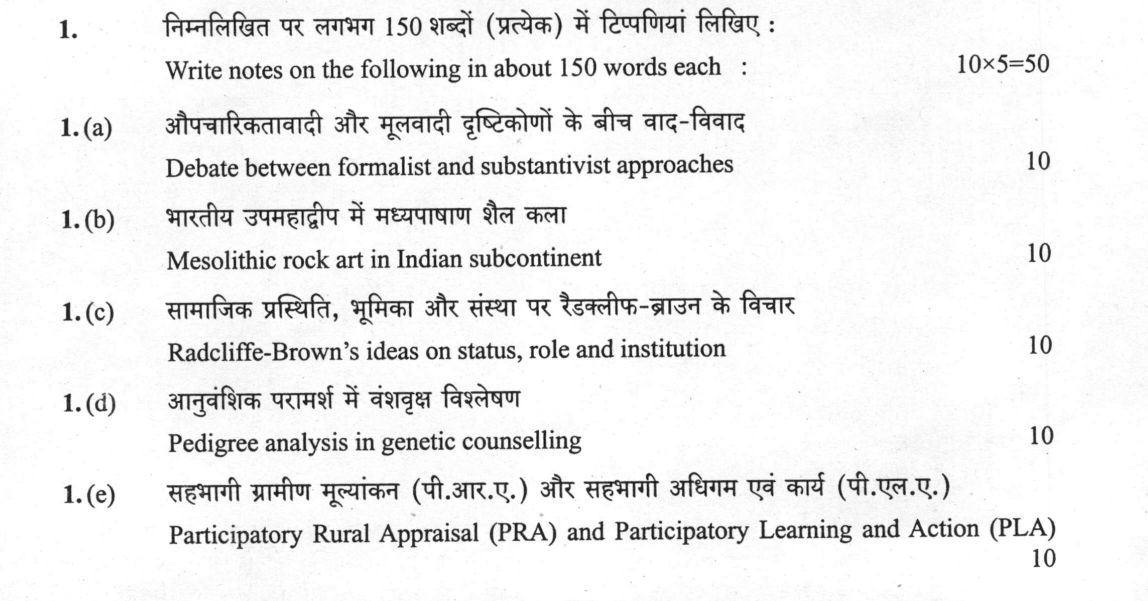
Write notes on the following in about 150 words each: (a) Debate between formalist and substantivist approaches (10 marks) (b)…
Write notes on the following in about 150 words each: Debate between formalist and substantivist approaches 10 marks
Mesolithic rock art in Indian subcontinent 10 marks
Radcliffe-Brown's ideas on status, role and institution 10 marks
Pedigree analysis in genetic counselling 10 marks
Participatory Rural Appraisal (PRA) and Participatory Learning and Action (PLA) 10 marks
हिंदी में प्रश्न पढ़ें
निम्नलिखित पर लगभग 150 शब्दों (प्रत्येक) में टिप्पणियाँ लिखिए : औपचारिकतावादी और मूलवादी दृष्टिकोणों के बीच वाद-विवाद 10 marks
भारतीय उपमहाद्वीप में मध्यपाषाण शैल कला 10 marks
सामाजिक प्रस्थिति, भूमिका और संस्था पर रेडक्लिफ-ब्राउन के विचार 10 marks
आनुवंशिक परामर्श में वंशवृक्ष विश्लेषण 10 marks
सहभागी ग्रामीण मूल्यांकन (पी.आर.ए.) और सहभागी अधिगम एवं कार्य (पी.एल.ए.) 10 marks
Model answer
Written by UPSC Answer Check against this question's marking rubric, to the 150-word length. UPSC does not publish answers for Mains — this is one way to score well, not an official key.
(a) Debate between formalist and substantivist approaches
The formalist-substantivist debate forms a foundational epistemological divide in economic anthropology regarding the cross-cultural applicability of Western economic theory. Formalists like Melville Herskovits and Raymond Firth argued that neoclassical economic principles—such as rational choice, utility maximisation, and economising behaviour under conditions of scarcity—are universally applicable across all human societies. In contrast, Substantivists, led by Karl Polanyi (The Great Transformation) and George Dalton, asserted that the formalist framework is culture-bound to market economies. They argued that in pre-industrial and non-Western societies, economic activity is 'substantively embedded' in kinship, political, and religious institutions. Instead of price-making markets, provisioning and exchange operate through reciprocity and redistribution. While formalists focus on universal micro-economic decision-making, substantivists highlight structural institutions governing material flow. The debate expanded anthropological inquiry, establishing that economic systems must be understood within their broader socio-cultural matrices.
(b) Mesolithic rock art in Indian subcontinent
Mesolithic rock art in the Indian subcontinent provides vital archaeological evidence of the cognitive, ritual, and ecological life of prehistoric hunter-gatherers. Pioneered by V.S. Wakankar at Bhimbetka (Madhya Pradesh), these rock shelters feature dynamic paintings created using mineral pigments like haematite (geru) and charcoal. The thematic repertoire highlights food procurement and social life, depicting collective hunting scenes, trapping, honey gathering, and communal dancing alongside handprints. At Adamgarh, prominent faunal themes illustrate diverse non-domesticated wildlife such as deer, wild boars, and rhinoceros, reflecting intimate ecological knowledge before the onset of settled farming. At Patne (Maharashtra), engraved geometric patterns on ostrich eggshell fragments reveal early non-figurative symbolic expression. Superimpositions across shelters illustrate long chronological continuity. These expressions reveal not only Mesolithic subsistence strategies but also early shamanic rituals, aesthetic development, and division of labour.
(c) Radcliffe-Brown's ideas on status, role and institution
A.R. Radcliffe-Brown formulated a structural-functionalist framework that viewed society as an integrated system maintaining structural continuity. Rejecting Bronislaw Malinowski’s bio-psychological functionalism, he defined 'social structure' as the network of actually existing social relations between individuals. Within this network, status is the structural position or place occupied by an individual, carrying socially defined rights, duties, and differential prestige. Role constitutes the dynamic enactment of that status—the expected behavioral performance in social interactions. An institution is a standardized, socially established mode of behaviour or customary cluster of norms and roles regulating interpersonal relationships. For Radcliffe-Brown, institutions like joking relationships, segmentary lineages, and totemic rituals function to regulate potential conflict and preserve social cohesion. By conceptualising status, role, and institution as interrelated structural units, he established a comparative, anti-reductionist sociological methodology for social anthropology.
(d) Pedigree analysis in genetic counselling
Pedigree analysis is a core bio-anthropological and clinical tool used to chart the transmission of inherited traits across generations. Using standardized symbols—squares for males, circles for females, filled symbols for affected individuals, and double lines for consanguineous marriages—it constructs a visual genealogical record. This allows counsellors to determine specific Mendelian and non-Mendelian inheritance patterns, including autosomal dominant/recessive, X-linked, Y-linked, and mitochondrial transmissions. Through segregation analysis and Bayesian probability, counsellors calculate recurrence risks for prospective parents, guiding prenatal screening and diagnostic choices. In India, pedigree analysis is pivotal in managing monogenic disorders with high prevalence in endogamous communities, particularly Beta-Thalassemia and Sickle Cell Anaemia (as targeted under the National Sickle Cell Anaemia Elimination Mission). It enables non-directive counselling, pre-marital screening, and informed reproductive decision-making.
(e) Participatory Rural Appraisal (PRA) and Participatory Learning and Action (PLA)
Participatory Rural Appraisal (PRA) and Participatory Learning and Action (PLA) are participatory action-research methodologies designed to decentralize development planning. Introduced by Robert Chambers in the late 1980s, PRA transitioned development studies from extractive data collection toward community-led appraisal. It uses interactive visual and spatial tools, including resource mapping, transect walks, seasonal calendars, and Venn (Chapati) diagrams, enabling local people to articulate their own realities. PLA evolved as an advanced, reflexive iteration of PRA to overcome the latter’s vulnerability to becoming a brief, project-driven, extractive exercise. PLA emphasizes sustained, iterative cycles of learning, action, and critical reflection. While PRA serves primarily as a rapid diagnostic appraisal tool, PLA addresses local power dynamics, gender disparities, and long-term capacity building, institutionalizing genuine community ownership and bottom-up empowerment.
What "Write short notes" is asking you to do
Five or six self-contained answers, marked separately, typically 10 marks and about 150 words each. Each note must carry its own definition, its two or three defining features and a line on why it matters; a common introduction or conclusion across the notes earns nothing.
Structure that answers it
Per note: one-line definition or identification → two or three features, mechanisms or named examples → one line of significance or Indian application
Where marks are lost
Writing the first two notes at essay length and rationing the rest. Each note is marked on its own, so marks surrendered on a compressed or unattempted note cannot be won back by the long ones.
How this answer will be evaluated
Approach
Framework: UPSC Anthropology Paper 1 (General Anthropology). (a) comment: context > arguments both sides > judgment > close | (b) describe: define > structure or process in order > labelled diagram > significance | (c) explain: definition/context > points in order > small example > short close | (d) explain: definition/context > points in order > small example > short close | (e) compare: paired headings or table > key differences > significance > conclusion Full marks: Precise definitions, named scholars/sites, clear distinction between concepts, and correct application of anthropological theory.
Key points expected
- Define Formalism (e.g., Binford, processual) and Substantivism (e.g., Sahlins, Marxian).
- Contrast their views on the role of culture and economics.
- Mention the 'New Archaeology' context for Formalism.
- Mention the 'Marxist' or 'Evolutionary' context for Substantivism.
- Identify key sites (e.g., Bhimbetka, Kailashnath).
- Describe the 'Microlithic' or 'Middle Stone Age' context.
- Mention the 'Red ochre' or 'pigment' usage.
- Describe the subject matter (animals, hunting, dancing).
Evaluation rubric
Each sub-part is marked on its own, against the marks and word limit printed on the paper.
- (a) Contrast the methodological and theoretical differences between the two schools. 10 marks · 150 words
comment— context → arguments both sides → judgment → close
Must cover
- Define Formalism (e.g., Binford, processual) and Substantivism (e.g., Sahlins, Marxian).
- Contrast their views on the role of culture and economics.
- Mention the 'New Archaeology' context for Formalism.
- Mention the 'Marxist' or 'Evolutionary' context for Substantivism.
Loses marks
- Treating them as identical schools.
- Failing to mention the economic focus of Substantivism.
Earns more
- Reference to specific debates (e.g., hunter-gatherer economies).
- Mention of key figures like Sahlins or Binford.
Extra mark
- Reference to specific ethnographic case studies used in the debate.
- (b) Describe the characteristics and locations of Mesolithic rock art in India. 10 marks · 150 words
describe— define → structure or process in order → labelled diagram → significance
Must cover
- Identify key sites (e.g., Bhimbetka, Kailashnath).
- Describe the 'Microlithic' or 'Middle Stone Age' context.
- Mention the 'Red ochre' or 'pigment' usage.
- Describe the subject matter (animals, hunting, dancing).
Loses marks
- Confusing Mesolithic with Neolithic or Paleolithic art.
- Failing to name any specific Indian site.
Earns more
- Mention of the 'Bhimbetka' UNESCO status.
- Reference to the 'Bhimbetka' rock shelters specifically.
Extra mark
- Sketch of a typical Mesolithic rock painting.
- (c) Explain Radcliffe-Brown's structural-functional concepts of status, role, and institution. 10 marks · 150 words
explain— definition/context → points in order → small example → short close
Must cover
- Define 'Status' as a position in the social structure.
- Define 'Role' as the behavior associated with a status.
- Define 'Institution' as a set of roles/statuses.
- Link these to 'Social Structure' and 'Function'.
Loses marks
- Confusing Radcliffe-Brown with Malinowski (functionalism).
- Failing to distinguish between status and role.
Earns more
- Reference to 'African Political Systems' or 'Andaman Islanders'.
- Mention of 'Social Facts' (Durkheimian link).
Extra mark
- A simple diagram showing the Status-Role-Institution hierarchy.
- (d) Explain the use of pedigree analysis in genetic counselling. 10 marks · 150 words
explain— definition/context → points in order → small example → short close
Must cover
- Define 'Pedigree' as a family tree of genetic traits.
- Explain how it identifies 'Autosomal' vs 'Sex-linked' inheritance.
- Mention the calculation of 'Risk' or 'Probability'.
- Link to 'Genetic Counselling' (advising couples).
Loses marks
- Failing to mention the purpose (counselling/advice).
- Confusing pedigree with karyotyping.
Earns more
- Mention of specific symbols used in pedigrees (squares, circles).
- Reference to 'Mendelian' inheritance patterns.
Extra mark
- A small, labelled pedigree chart example.
- (e) Compare Participatory Rural Appraisal (PRA) and Participatory Learning and Action (PLA). 10 marks · 150 words
compare— paired headings or table → key differences → significance → conclusion
Must cover
- Define PRA (data collection/assessment).
- Define PLA (learning/action/empowerment).
- Highlight the shift from 'Appraisal' to 'Action'.
- Mention the role of 'Local Knowledge'.
Loses marks
- Treating them as the same thing.
- Failing to mention the 'Participatory' aspect.
Earns more
- Mention of 'Rapid Rural Appraisal' (RRA) as a precursor.
- Reference to 'Empowerment' or 'Capacity Building'.
Extra mark
- Mention of specific PRA tools (e.g., Venn diagrams, mapping).
Practice this exact question
Write your answer and it is marked point by point against the model answer above — what you covered, what you missed, what you got wrong.
Evaluate my answer →More from Anthropology 2022 Paper I
- Q1 Write notes on the following in about 150 words each: (a) Debate between formalist and su…
- Q2 (a) "Anthropology is the systematic, objective and holistic study of human kind in all ti…
- Q3 (a) Discuss how the rules of descent contradict the principles of residence in matrilinea…
- Q4 (a) Why Heath and Carter used anthropometric measurements instead of photographs of an in…