Paper I — Q3
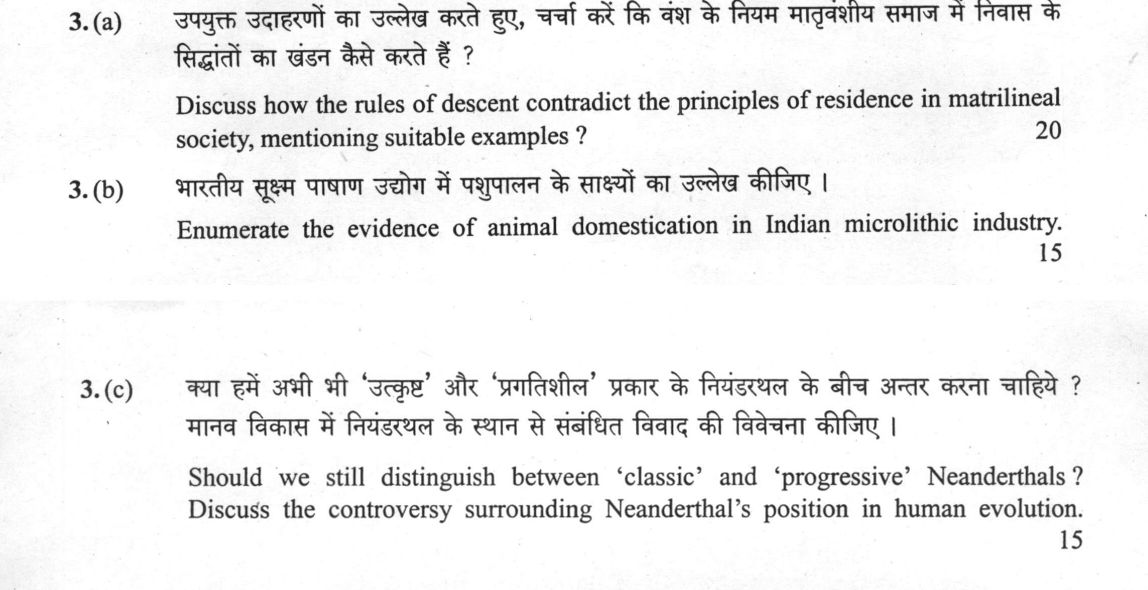
(a) Discuss how the rules of descent contradict the principles of residence in matrilineal society, mentioning suitable examples…
Discuss how the rules of descent contradict the principles of residence in matrilineal society, mentioning suitable examples ? 20 marks
Enumerate the evidence of animal domestication in Indian microlithic industry. 15 marks
Should we still distinguish between 'classic' and 'progressive' Neanderthals ? Discuss the controversy surrounding Neanderthal's position in human evolution. 15 marks
हिंदी में प्रश्न पढ़ें
उपयुक्त उदाहरणों का उल्लेख करते हुए, चर्चा करें कि वंश के नियम मातृवंशीय समाज में निवास के सिद्धांतों का खंडन कैसे करते हैं ? 20 marks
भारतीय सूक्ष्म पाषाण उद्योग में पशुपालन के साक्ष्यों का उल्लेख कीजिए । 15 marks
क्या हमें अभी भी 'उत्कृष्ट' और 'प्रगतिशील' प्रकार के नियंडरथल के बीच अंतर करना चाहिए ? मानव विकास में नियंडरथल के स्थान से संबंधित विवाद की विवेचना कीजिए । 15 marks
Model answer
Written by UPSC Answer Check against this question's marking rubric, to the expected length. UPSC does not publish answers for Mains — this is one way to score well, not an official key.
Matrilineal Descent and Residence Contradictions
The structural tension in matrilineal systems—termed the 'matrilineal puzzle' by Audrey Richards—arises because descent and property transmission operate through the female line, while political authority typically remains with males (the mother's brother or avunculus). When descent rules intersect with post-marital residence principles, contradictions emerge. If residence is virilocal (patrilocal), women are dispersed away from their natal descent group, fragmenting the matrilineal core. Conversely, if residence is uxorilocal (matrilocal), in-marrying husbands reside as domestic outsiders, facing conflicting loyalties between their wives' households and their sisters' descent groups.
Ethnographic evidence highlights varied structural solutions to this tension:
- Nayars of Kerala: The traditional taravad resolved the puzzle through the sambandham (visiting husband) system. Men lived in their natal homes and only visited their wives at night, entirely separating conjugal residence from property management and lineage authority.
- Garos of Meghalaya: Matrilineal descent is maintained alongside a system where only the designated heiress (nokna) brings in an in-marrying nephew-husband (nokkrom), while non-inheriting daughters practice neolocal or virilocal residence, causing spatial dispersion of the broader clan.
- Khasis of Meghalaya: Matrilocal residence is strictly observed for the youngest daughter (khadduh), who inherits the ancestral hearth, maintaining congruence between descent and residence, though modern socioeconomic changes frequently cause friction between the resident father and the maternal uncle.
Evidence of Animal Domestication in Indian Microlithic Industry
The Indian Mesolithic-Microlithic transition witnessed a strategic shift from broad-spectrum hunting-gathering to incipient pastoralism, evidenced across several stratified archaeological contexts:
- Faunal Remains: Excavations at Bagor (Rajasthan) by V.N. Misra provided stratified faunal evidence of domesticated sheep, goat (Capra/Ovis), and humped cattle (Bos indicus) dated to c. 5000 BCE. Adamgarh Hills (Madhya Pradesh) yielded significant assemblages of domesticated cattle, sheep, goat, and pig alongside wild game. Langhnaj (Gujarat) and Birbhanpur (West Bengal) similarly document transitional faunal profiles.
- Vindhyan and Ganga Valley Sites: In sites such as Mahadaha, Damdama, and Sarai Nahar Rai, osteological analyses—including age-at-death profiles and slaughter patterns—indicate selective culling, herding, and incipient management of ungulates alongside intensive foraging.
- Material and Spatial Evidence: Geometric microliths (lunates, trapezes, triangles) functioned not only as projectile points but as hafted composite tools for harvesting fodder. Structural remains of animal pens, living floors, and seasonal settlement patterns reflect transhumant pastoral cycles.
Classic vs. Progressive Neanderthals and Evolutionary Controversy
Palaeoanthropologists historically bifurcated Neanderthals into two morphological groups:
- Classic Neanderthals: Located primarily in Western Europe (e.g., La Chapelle-aux-Saints, Neander Valley), dating to the Würm glaciation. They exhibited hyper-robust, cold-adapted features: large cranial vaults (1500–1600 cc), pronounced occipital buns, heavy supraorbital tori, taurodontism, and stocky limb proportions.
- Progressive Neanderthals: Found mainly in Southwest Asia and the Levant (e.g., Shanidar, Amud, Tabun). They displayed more generalized, gracile features, higher cranial vaults, and less pronounced facial prognathism, superficially resembling anatomically modern humans (AMH).
Today, maintaining this rigid typological distinction is largely discouraged. Contemporary anthropologists view these differences as clinal variations and ecogeographical adaptations (Bergmann’s and Allen’s rules) across space and time, rather than discrete taxonomic grades.
The controversy over the Neanderthal’s evolutionary position has shifted significantly:
- Phylogenetic Status: Previously polarized between the 'Linear Ancestor' model (Multiregionalism) and the 'Dead-End Sister Taxon' model (Recent African Origin), current consensus recognizes Neanderthals as a distinct lineage (Homo neanderthalensis or Homo sapiens neanderthalensis) that shared a common ancestor (Homo heidelbergensis) with AMH.
- Genetic Admixture: Ancient DNA studies (Pääbo et al.) revealed 1–2% Neanderthal genomic introgression in contemporary non-African populations, demonstrating fertile interbreeding during chronological overlaps in the Levant and Europe, thereby confirming an Assimilation or 'Leaky Replacement' model.
Moving forward, understanding human cultural and biological evolution requires viewing social institutions, subsistence strategies, and hominin phylogenies not as rigid, static categories, but as dynamic, interconnected systems shaped by continuous adaptation, gene flow, and structural negotiations over space and time.
What "Discuss" is asking you to do
Lay the issue out from more than one side — how it arose, what is claimed for it, what is held against it, and where it now stands. UPSC attaches discuss to broad topics with several live dimensions, so coverage of the dimensions earns more than the strength of your opinion.
Structure that answers it
Set the issue up → the case as it is made → the case against → the dimension both sides leave out → where the balance now lies
Where marks are lost
Listing facts with no thread between them, or arguing one side throughout and calling it a discussion.
How this answer will be evaluated
Approach
Framework: UPSC Anthropology Paper 1 (Social Anthropology & Physical Anthropology). (a) discuss: intro > 3-4 dimensions > example > balanced close | (b) enumerate: list the items in order > one line each > no commentary | (c) discuss: intro > 3-4 dimensions > example > balanced close Full marks: Comprehensive, well-structured, with specific examples and theoretical depth.
Key points expected
- Define matrilineal descent and matrilocal residence
- Explain the 'contradiction' (e.g., husband's presence in wife's lineage)
- Mention specific examples (e.g., Khasi, Garo, or Minangkabau)
- Discuss the role of the maternal uncle (avunculate)
- Mention specific sites (e.g., Bagor, Mahadaha, Sarai Nahar Rai)
- Identify specific animals (e.g., dog, cattle, sheep, goat)
- Describe the type of evidence (e.g., faunal remains, burials)
- Link evidence to the Mesolithic/Microlithic timeframe
Evaluation rubric
Each sub-part is marked on its own, against the marks and word limit printed on the paper.
- (a) Explain the logical conflict between matrilineal descent and residence rules with examples. 20 marks
discuss— intro → 3-4 dimensions → example → balanced close
Must cover
- Define matrilineal descent and matrilocal residence
- Explain the 'contradiction' (e.g., husband's presence in wife's lineage)
- Mention specific examples (e.g., Khasi, Garo, or Minangkabau)
- Discuss the role of the maternal uncle (avunculate)
Loses marks
- Confusing matrilineal with matrilocal
- Failing to explain the 'contradiction' explicitly
- Sociological generalities without anthropological examples
Earns more
- Reference to Radcliffe-Brown or Malinowski
- Distinction between matrilineal and matrilocal
- Mention of 'virilocal' as a contrast
- Reference to Indian tribal context (e.g., Khasi)
Extra mark
- Kinship chart showing the relationship
- Reference to specific ethnographic study
- (b) List the specific archaeological evidence for animal domestication in the Indian microlithic period. 15 marks
enumerate— list the items in order → one line each → no commentary
Must cover
- Mention specific sites (e.g., Bagor, Mahadaha, Sarai Nahar Rai)
- Identify specific animals (e.g., dog, cattle, sheep, goat)
- Describe the type of evidence (e.g., faunal remains, burials)
- Link evidence to the Mesolithic/Microlithic timeframe
Loses marks
- Listing animals without site evidence
- Confusing microlithic with neolithic evidence
- Vague statements like 'animals were kept'
Earns more
- Mention of 'proto-domestication' vs 'full domestication'
- Reference to specific faunal analysis (e.g., by Clutton-Brock)
- Mention of dog as the earliest domesticated animal
- Reference to the 'Neolithic Revolution' context
Extra mark
- Table listing sites and associated animals
- Reference to specific excavation reports
- (c) Analyze the debate on Neanderthal classification and their place in human evolution. 15 marks
discuss— intro → 3-4 dimensions → example → balanced close
Must cover
- Define 'classic' vs 'progressive' Neanderthal
- Discuss the 'multiregional' vs 'out of Africa' debate
- Mention the 'hybridization' or 'assimilation' model
- Reference to specific fossil evidence (e.g., Shanidar, Kebara)
Loses marks
- Failing to define the terms 'classic' and 'progressive'
- Ignoring the evolutionary debate
- Vague statements without fossil evidence
Earns more
- Mention of 'Homo neanderthalensis' vs 'Homo sapiens neanderthalensis'
- Reference to specific researchers (e.g., Stringer, Rightmire)
- Mention of DNA evidence (e.g., 1-4% Neanderthal DNA in modern humans)
- Discussion of 'archaic' vs 'modern' features
Extra mark
- Skull comparison diagram
- Reference to specific genetic study
Practice this exact question
Write your answer and it is marked point by point against the model answer above — what you covered, what you missed, what you got wrong.
Evaluate my answer →More from Anthropology 2022 Paper I
- Q1 Write notes on the following in about 150 words each: (a) Debate between formalist and su…
- Q2 (a) "Anthropology is the systematic, objective and holistic study of human kind in all ti…
- Q3 (a) Discuss how the rules of descent contradict the principles of residence in matrilinea…
- Q4 (a) Why Heath and Carter used anthropometric measurements instead of photographs of an in…
- Q5 Write notes on the following in about 150 words each: (a) Balanced and transient genetic…
- Q6 (a) Discuss the mechanism of social control in different kinds of political systems. (20…