Paper I — Q2
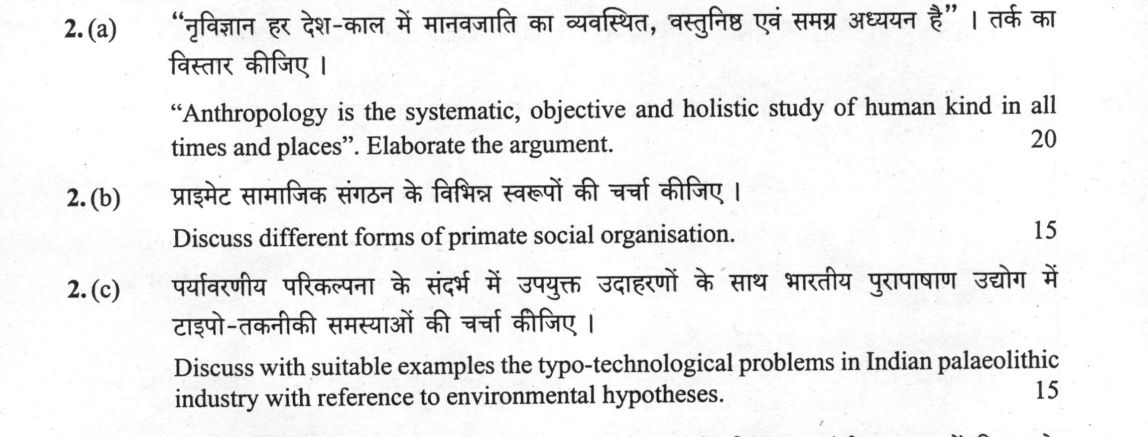
(a) "Anthropology is the systematic, objective and holistic study of human kind in all times and places". Elaborate the argument…
"Anthropology is the systematic, objective and holistic study of human kind in all times and places". Elaborate the argument. 20 marks
Discuss different forms of primate social organisation. 15 marks
Discuss with suitable examples the typo-technological problems in Indian palaeolithic industry with reference to environmental hypotheses. 15 marks
हिंदी में प्रश्न पढ़ें
"नृविज्ञान हर देश-काल में मानवजाति का व्यवस्थित, वस्तुनिष्ठ एवं समग्र अध्ययन है" । तर्क का विस्तार कीजिए । 20 marks
प्राइमेट सामाजिक संगठन के विभिन्न स्वरूपों की चर्चा कीजिए । 15 marks
पर्यावरणीय परिकल्पना के संदर्भ में उपयुक्त उदाहरणों के साथ भारतीय पुरापाषाण उद्योग में टाइपो-तकनीकी समस्याओं की चर्चा कीजिए । 15 marks
Model answer
Written by UPSC Answer Check against this question's marking rubric, to the expected length. UPSC does not publish answers for Mains — this is one way to score well, not an official key.
Anthropology: Scope, Primates, and Palaeolithic Technology
The definition of anthropology as the "systematic, objective and holistic study of human kind in all times and places" encapsulates the discipline’s unique epistemological stance. To elaborate on this, one must unpack its three core pillars. First, the systematic nature refers to the rigorous application of the scientific method, distinguishing anthropology from casual observation. It relies on structured fieldwork and comparative analysis, offering a broader temporal and spatial canvas than history (which is often text-bound) or sociology (which often focuses on contemporary, literate societies). Second, objectivity is an aspirational standard, historically linked to Malinowski’s insistence on empirical data. However, this is debated through the lens of etic (outsider) versus emic (insider) perspectives and modern reflexivity, acknowledging that the researcher’s bias is inevitable. Third, holism is the defining feature, integrating the four-field approach: biological, archaeological, linguistic, and cultural anthropology. This ensures that human behavior is understood as a product of biology, culture, and environment interacting across all times and places, encompassing both diachronic (evolutionary) and synchronic (contemporary) dimensions, from salvage ethnography to modern urban studies.
Primate Social Organisation
Primate social structures are adaptive responses to ecological pressures, primarily resource distribution, predation, and sexual selection.
- Solitary: Orangutans exhibit low social cohesion, driven by dispersed fruit resources and high male-male aggression.
- Monogamous: Gibbons form stable pairs, often with territorial defense, reflecting a strategy where both parents are needed for offspring survival.
- Polyandrous: Tamarins and marmosets feature one female with multiple males, where males assist in infant care, reducing the female’s reproductive cost.
- Polygynous (One-male groups): Hanuman langurs and howler monkeys consist of one dominant male and several females. This structure is linked to clumped food resources and high predation risk, where group living offers safety.
- Multi-male, Multi-female: Bonnet macaques and rhesus macaques form large, stable troops. This is common in environments with unpredictable resources, allowing for social learning and defense.
- Fission-Fusion: Chimpanzees and baboons display fluid group sizes. Individuals split and merge based on food availability and social dynamics, offering flexibility in resource exploitation.
Typo-technological Problems in Indian Palaeolithic
The Indian Palaeolithic record presents significant typo-technological challenges, particularly regarding the classification of tools and their environmental context. A primary issue is the overlap between tool types, such as distinguishing handaxes from cleavers or choppers. In the Siwalik region, tools are often made of quartzite, which fractures differently than the chert or flint found in the Deccan. This raw material constraint leads to morphological variations that are often misinterpreted as distinct cultural industries rather than technological adaptations to local geology. Consequently, debates arise over functional vs. morphological classification: is a tool defined by its shape or its use-wear?
These problems are inextricably linked to environmental hypotheses. The climatic framework for Indian prehistory, originally proposed by de Terra and Paterson (and later refined by Zeuner), posits that tool industries correspond to pluvial (wet) and interpluvial (dry) phases. For instance, the Soanian industry in the Siwaliks is often associated with interpluvial periods, while the Acheulian in the Deccan is linked to pluvial phases. However, this environmental determinism is criticized for oversimplifying human agency. In the Hunsgi and Baichbal valleys, the sequence of industries does not strictly follow a simple climatic toggle; instead, it reflects complex interactions between population movement and resource availability. Similarly, the Didwana and Belan valley sequences show continuity and change that cannot be explained solely by climate. The critique highlights that while environment sets the stage, typo-technological evolution is driven by human innovation and social transmission, not just ecological pressure.
Conclusion
In synthesis, the holistic definition of anthropology is exemplified by the interplay between biological anthropology (primate social strategies) and archaeology (palaeolithic technology). While the definition provides a robust framework, it faces postmodern critiques regarding the illusion of objectivity and the need for decolonized perspectives. Nevertheless, it remains the most comprehensive lens for understanding human diversity, bridging the gap between our biological past and our cultural present.
What "Elaborate" is asking you to do
Give the full detailed account the question has compressed into a line — every dimension of it, with specifics. Elaborate rewards completeness and detail rather than clarification or argument: the examiner is checking whether you can fill out a topic without being told what its parts are.
Structure that answers it
State the proposition → first dimension in detail → second dimension in detail → the part the statement leaves implicit → the consolidated picture
Where marks are lost
Repeating the statement at greater length instead of adding substance. Elaborate also punishes narrowness: omitting a whole dimension costs more here than anywhere else in this family.
How this answer will be evaluated
Approach
(a) explain: definition/context > points in order > small example > short close | (b) discuss: intro > 3-4 dimensions > example > balanced close | (c) discuss: intro > 3-4 dimensions > example > balanced close Full marks: Precise definitions, clear linkage of theory to evidence, and specific Indian examples.
Key points expected
- Define 'systematic' as scientific method vs. armchair speculation
- Define 'objective' as value-free stance and cross-cultural comparison
- Define 'holistic' as integration of biological and cultural anthropology
- Define 'all times and places' as diachronic and synchronic scope
- Describe 'One-male, multi-female' (harem) groups (e.g., Baboons)
- Describe 'Multi-male, multi-female' (troop) groups (e.g., Macaques)
- Describe 'One-male, one-female' (pair-bonding) (e.g., Gibbons)
- Describe 'Solitary' or 'Fission-fusion' (e.g., Orangutans/Baboons)
Evaluation rubric
Each sub-part is marked on its own, against the marks and word limit printed on the paper.
- (a) Deconstruct the definition of anthropology into its four key methodological and scope-based components. 20 marks
explain— definition/context → points in order → small example → short close
Must cover
- Define 'systematic' as scientific method vs. armchair speculation
- Define 'objective' as value-free stance and cross-cultural comparison
- Define 'holistic' as integration of biological and cultural anthropology
- Define 'all times and places' as diachronic and synchronic scope
Loses marks
- Treating 'holistic' as merely 'comprehensive' without biological link
- Ignoring the 'objective' component or treating it as impossible
- Confusing 'systematic' with 'systemic'
Earns more
- Reference to Boas or Radcliffe-Brown on scientific method
- Distinction between anthropology and sociology
- Mention of 'cultural relativism' as a tool for objectivity
- Reference to 'biocultural' approach for the holistic aspect
Extra mark
- Reference to a specific Indian anthropologist (e.g., S.C. Dube)
- Mention of the 'four-field' approach (US model)
- (b) Outline the major structural types of primate social groups and their characteristics. 15 marks
discuss— intro → 3-4 dimensions → example → balanced close
Must cover
- Describe 'One-male, multi-female' (harem) groups (e.g., Baboons)
- Describe 'Multi-male, multi-female' (troop) groups (e.g., Macaques)
- Describe 'One-male, one-female' (pair-bonding) (e.g., Gibbons)
- Describe 'Solitary' or 'Fission-fusion' (e.g., Orangutans/Baboons)
Loses marks
- Confusing 'troop' with 'herd' (herd implies grazing)
- Failing to distinguish between 'solitary' and 'fission-fusion'
- Ignoring the reproductive strategy implications of group size
Earns more
- Linkage of group size to diet (frugivore vs. folivore)
- Mention of 'alliance' formation in multi-male groups
- Reference to 'infanticide' as a driver of social structure
- Mention of 'fission-fusion' dynamics in detail
Extra mark
- Reference to specific fieldwork (e.g., Goodall on chimps)
- Mention of 'matrilineal' vs 'patrilineal' dominance
- (c) Analyze the relationship between Indian Palaeolithic tool types and environmental conditions. 15 marks
discuss— intro → 3-4 dimensions → example → balanced close
Must cover
- Define 'typo-technological' (tool type + technology)
- Link Lower Palaeolithic (Acheulean) to open savanna/riverine environments
- Link Middle Palaeolithic (Mustrian) to cooler/interglacial phases
- Link Upper Palaeolithic (Microliths) to post-glacial/monsoon intensification
Loses marks
- Ignoring the 'environmental' aspect and focusing only on tools
- Confusing 'Palaeolithic' with 'Neolithic' (agriculture)
- Failing to link specific tool types to specific environments
Earns more
- Mention of specific sites (e.g., Belan valley, Bhimbetka)
- Reference to 'environmental hypothesis' (e.g., climate change driving tech)
- Mention of 'raw material' availability (chert vs. quartzite)
- Reference to 'subsistence' changes (hunting vs. gathering)
Extra mark
- Reference to specific Indian scholars (e.g., V.S. Wadnoti)
- Mention of 'microlithic' specific tools (geometric vs. non-geometric)
Practice this exact question
Write your answer and it is marked point by point against the model answer above — what you covered, what you missed, what you got wrong.
Evaluate my answer →More from Anthropology 2022 Paper I
- Q1 Write notes on the following in about 150 words each: (a) Debate between formalist and su…
- Q2 (a) "Anthropology is the systematic, objective and holistic study of human kind in all ti…
- Q3 (a) Discuss how the rules of descent contradict the principles of residence in matrilinea…
- Q4 (a) Why Heath and Carter used anthropometric measurements instead of photographs of an in…
- Q5 Write notes on the following in about 150 words each: (a) Balanced and transient genetic…