Paper I — Q6
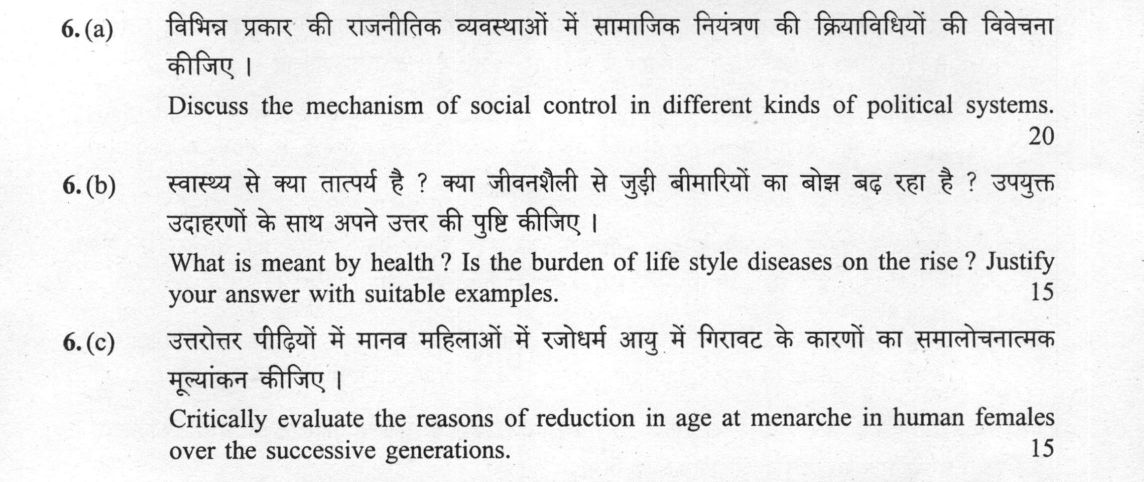
(a) Discuss the mechanism of social control in different kinds of political systems. (20 marks) (b) What is meant by health ? Is…
Discuss the mechanism of social control in different kinds of political systems. 20 marks
What is meant by health ? Is the burden of life style diseases on the rise ? Justify your answer with suitable examples. 15 marks
Critically evaluate the reasons of reduction in age at menarche in human females over the successive generations. 15 marks
हिंदी में प्रश्न पढ़ें
विभिन्न प्रकार की राजनीतिक व्यवस्थाओं में सामाजिक नियंत्रण की क्रियाविधियों की विवेचना कीजिए । 20 marks
स्वास्थ्य से क्या तात्पर्य है ? क्या जीवनशैली से जुड़ी बीमारियों का बोझ बढ़ रहा है ? उपयुक्त उदाहरणों के साथ अपने उत्तर की पुष्टि कीजिए । 15 marks
उत्तरोत्तर पीढ़ियों में मानव महिलाओं में रजोधर्म आयु में गिरावट के कारणों का समालोचनात्मक मूल्यांकन कीजिए । 15 marks
Model answer
Written by UPSC Answer Check against this question's marking rubric, to the expected length. UPSC does not publish answers for Mains — this is one way to score well, not an official key.
Mechanisms of Social Control
Social control in anthropology refers to the methods by which societies regulate individual behavior to maintain order. The mechanisms vary significantly across political systems, reflecting the complexity of social organization.
In band societies, which are small, egalitarian, and mobile, social control is informal and decentralized. There is no formal authority; instead, mechanisms rely on internalized norms and peer pressure. Sanctions include gossip, ridicule, and ostracism. As Radcliffe-Brown noted, these "sanctions" are often negative but effective in maintaining cohesion without coercion. Control is largely internalized through shame, as the small group size ensures constant surveillance.
Tribal societies introduce more structured mechanisms. In many tribal groups, age-grade systems or age-sets provide a framework for socialization and responsibility, where elders exert moral authority. In societies with "Big Man" systems (e.g., Melanesia), control is exercised through prestige, generosity, and ritual authority rather than coercive power. The Big Man influences through redistribution and social obligation, relying on the community’s respect for his status. Rituals and taboos also serve as powerful control mechanisms, reinforcing social boundaries and moral codes.
Chiefdoms represent a transition to hereditary authority. Here, social control is more formalized. Chiefs possess the right to redistribute resources, which creates dependency and loyalty. Ritual sanctions become more codified, often linked to lineage and ancestry. While still relying on prestige, chiefdoms begin to use institutionalized mechanisms to resolve disputes, moving away from purely informal peer pressure.
State systems rely on codified laws, specialized institutions like the police and judiciary, and an ideological apparatus. Control is externalized and coercive. E.A. Hoebel’s concept of "law-ways" distinguishes state law from tribal law by its use of institutionalized, impersonal sanctions. The state monopolizes the use of force, and control is maintained through surveillance, punishment, and legal frameworks. Unlike earlier systems, state control is often explicit and written, reducing reliance on internalized shame in favor of legal guilt.
Across all systems, there is a spectrum from internalized control (shame, guilt) to externalized control (punishment, surveillance). As political complexity increases, the mechanisms shift from informal, personal sanctions to formal, institutionalized ones.
Health and Lifestyle Diseases
The World Health Organization (WHO) defines health as a state of complete physical, mental, and social well-being, not merely the absence of disease. This holistic view contrasts with the biomedical perspective, which often focuses on pathology. Anthropology emphasizes the social determinants of health, including culture, environment, and socioeconomic status.
The burden of lifestyle diseases, or Non-Communicable Diseases (NCDs), is rising sharply in India. This shift is part of the epidemiological transition, where mortality from infectious diseases declines, and chronic diseases become dominant. According to NFHS-5 data, approximately 24% of women and 22.9% of men aged 15–49 are overweight or obese (BMI ≥25), a significant risk factor for NCDs. ICMR-NCDIR studies indicate that Type 2 diabetes and cardiovascular diseases (CVD) are prevalent in urban centers like Delhi and Mumbai, driven by sedentary lifestyles, dietary changes (high sugar, processed foods), and stress.
Even in rural areas, the transition is evident. Improved nutrition and reduced physical labor have led to increased obesity rates. Socio-cultural factors, such as the adoption of "Western" diets and urbanization, contribute to this rise. The demographic transition, with an aging population, further exacerbates the burden on healthcare systems. Addressing this requires a holistic approach that includes public health interventions, dietary education, and policy changes to promote active lifestyles.
Reduction in Age at Menarche
The age at menarche has declined significantly over successive generations, from approximately 16–17 years in the 19th century to 12–13 years today. This secular trend is influenced by biological, environmental, and psychosocial factors.
Biologically, improved nutrition and reduced disease load are primary drivers. The Frisch-Revelle hypothesis posits that a critical body fat percentage is necessary for the onset of puberty. As malnutrition decreases and caloric intake increases, girls reach this threshold earlier. Leptin, a hormone produced by fat cells, acts as a permissive signal for puberty, linking energy status to reproductive maturity.
Environmental factors also play a role. Exposure to endocrine-disrupting chemicals (EDCs) such as bisphenol A (BPA) and phthalates may alter hormonal pathways. While BPA is an estrogen mimic, phthalates are primarily anti-androgenic, yet both can disrupt normal pubertal timing. Psychosocial stress and family structure also influence menarche. The Belsky-Steinberg-Draper model suggests that high psychosocial stress and father absence can accelerate puberty as an adaptive strategy.
Critically, while genetic factors set the baseline, environmental determinants are increasingly significant. Indian studies, such as those by ICMR, show that urban girls reach menarche earlier than rural counterparts, correlating with higher socioeconomic status and better nutrition. This reduction raises concerns about long-term health risks, including increased susceptibility to breast cancer and metabolic disorders. Understanding these factors is crucial for public health policies aimed at adolescent well-being.
Conclusion
These three dimensions—social control, health transitions, and biological changes—are interconnected. Social structures shape health outcomes and biological development. As societies modernize, the mechanisms of control become more formalized, health burdens shift to NCDs, and biological markers like menarche change due to environmental and nutritional factors. Anthropology provides a holistic framework to understand these complex, interrelated processes.
What "Discuss" is asking you to do
Lay the issue out from more than one side — how it arose, what is claimed for it, what is held against it, and where it now stands. UPSC attaches discuss to broad topics with several live dimensions, so coverage of the dimensions earns more than the strength of your opinion.
Structure that answers it
Set the issue up → the case as it is made → the case against → the dimension both sides leave out → where the balance now lies
Where marks are lost
Listing facts with no thread between them, or arguing one side throughout and calling it a discussion.
How this answer will be evaluated
Approach
Framework: UPSC Anthropology Paper 1 (Social Anthropology & Biological Anthropology). (a) discuss: intro > 3-4 dimensions > example > balanced close | (b) justify: claim > 3-4 reasons > evidence > conclusion | (c) critically evaluate: positives > negatives/limits > conditions/safeguards > conclusion Full marks: Comprehensive, well-structured, uses specific anthropological examples and data, critical analysis where required.
Key points expected
- Define social control (formal/informal)
- Analyze mechanism in one tribal/kinship-based system
- Analyze mechanism in a modern state system
- Compare the role of law vs. custom
- Define health (WHO or biological definition)
- Identify specific lifestyle diseases (e.g., diabetes, CVD)
- Provide evidence/statistics for the rise
- Link causes to lifestyle factors (diet, sedentary)
Evaluation rubric
Each sub-part is marked on its own, against the marks and word limit printed on the paper.
- (a) Compare social control mechanisms across distinct political systems (e.g., tribal, democratic, authoritarian). 20 marks
discuss— intro → 3-4 dimensions → example → balanced close
Must cover
- Define social control (formal/informal)
- Analyze mechanism in one tribal/kinship-based system
- Analyze mechanism in a modern state system
- Compare the role of law vs. custom
Loses marks
- Sociological answer without anthropological context
- Ignoring the 'different kinds' requirement (only one system)
- Vague generalities without specific mechanisms
Earns more
- Reference to specific anthropological theories (e.g., Durkheim)
- Use of specific tribal examples (e.g., Naga, Gond)
- Distinction between internal and external control
Extra mark
- Reference to specific legal codes or tribal councils
- Mention of contemporary changes in tribal governance
- (b) Define health and provide evidence for the rising burden of lifestyle diseases. 15 marks
justify— claim → 3-4 reasons → evidence → conclusion
Must cover
- Define health (WHO or biological definition)
- Identify specific lifestyle diseases (e.g., diabetes, CVD)
- Provide evidence/statistics for the rise
- Link causes to lifestyle factors (diet, sedentary)
Loses marks
- Defining health only as 'absence of disease'
- Failing to justify the 'rise' with examples
- Confusing lifestyle diseases with infectious diseases
Earns more
- Mention of 'disease transition' or epidemiological shift
- Specific Indian context examples (e.g., urbanization)
- Distinction between acute and chronic diseases
Extra mark
- Citing specific health surveys (e.g., NFHS, ICMR)
- Mention of specific tribal health issues
- (c) Assess the biological and social reasons for the reduction in menarcheal age. 15 marks
critically evaluate— positives → negatives/limits → conditions/safeguards → conclusion
Must cover
- State the phenomenon (secular trend in menarche)
- Identify biological factors (nutrition, body fat)
- Identify social factors (stress, environment)
- Critically assess the impact of these factors
Loses marks
- Ignoring the 'critical' aspect (just listing reasons)
- Failing to link nutrition to menarche
- Confusing menarche with general puberty
Earns more
- Reference to 'secular trend' in biological anthropology
- Mention of specific studies or data on menarche
- Discussion of 'maturation' vs. 'growth'
Extra mark
- Reference to specific researchers (e.g., Tanner)
- Mention of specific Indian data on menarcheal age
Practice this exact question
Write your answer and it is marked point by point against the model answer above — what you covered, what you missed, what you got wrong.
Evaluate my answer →More from Anthropology 2022 Paper I
- Q3 (a) Discuss how the rules of descent contradict the principles of residence in matrilinea…
- Q4 (a) Why Heath and Carter used anthropometric measurements instead of photographs of an in…
- Q5 Write notes on the following in about 150 words each: (a) Balanced and transient genetic…
- Q6 (a) Discuss the mechanism of social control in different kinds of political systems. (20…
- Q7 (a) Discuss the role of evolutionary forces in creating human diversity. (20 marks) (b) W…
- Q8 (a) Discuss the contemporary population problems in the light of various socio-cultural d…