Paper I — Q5
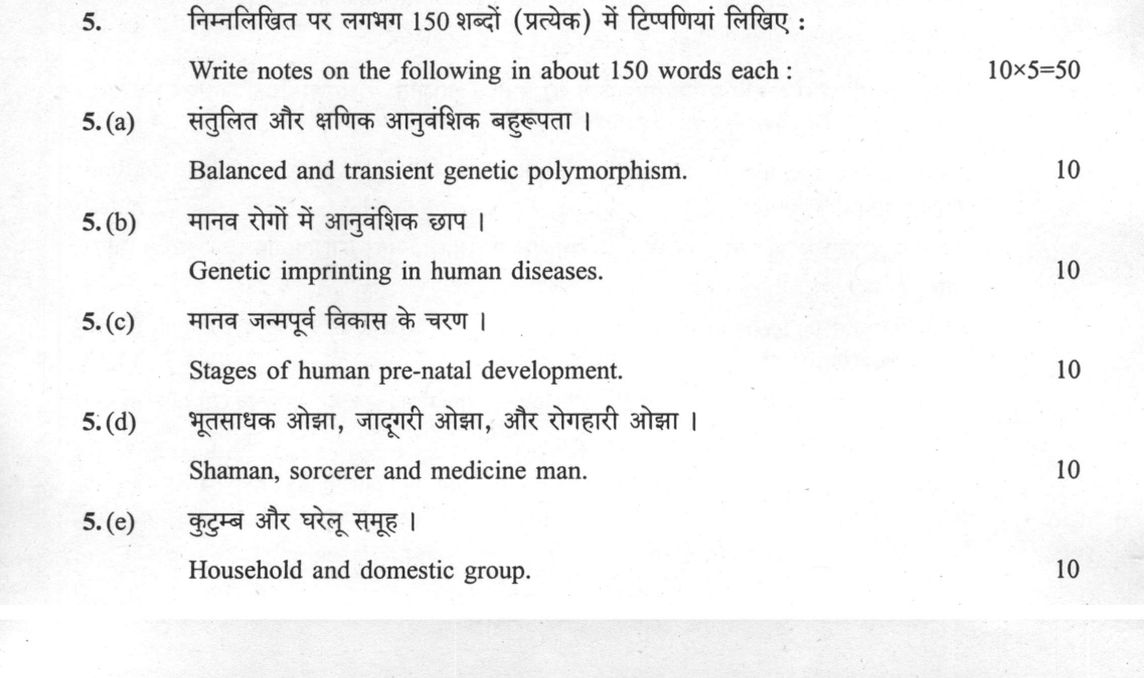
Write notes on the following in about 150 words each: (a) Balanced and transient genetic polymorphism. (10 marks) (b) Genetic…
Write notes on the following in about 150 words each: Balanced and transient genetic polymorphism. 10 marks
Genetic imprinting in human diseases. 10 marks
Stages of human pre-natal development. 10 marks
Shaman, sorcerer and medicine man. 10 marks
Household and domestic group. 10 marks
हिंदी में प्रश्न पढ़ें
निम्नलिखित पर लगभग 150 शब्दों (प्रत्येक) में टिप्पणियाँ लिखिए : संतुलित और क्षणिक आनुवंशिक बहुरूपता । 10 marks
मानव रोगों में आनुवंशिक छाप । 10 marks
मानव जन्मपूर्व विकास के चरण । 10 marks
भूतसाधक ओझा, जादूगरी ओझा, और रोगहारी ओझा । 10 marks
कुटुंब और घरेलू समूह । 10 marks
Model answer
Written by UPSC Answer Check against this question's marking rubric, to the 150-word length. UPSC does not publish answers for Mains — this is one way to score well, not an official key.
(a) Balanced and Transient Genetic Polymorphism
Genetic polymorphism refers to the simultaneous occurrence of two or more discontinuous genetic variants (alleles) in a population, where the rarest morph frequency exceeds 1%, ruling out mutation pressure alone (E.B. Ford).
Balanced Polymorphism: A stable equilibrium where natural selection actively maintains multiple alleles over generations at frequencies higher than expected by mutation. It typically operates via heterozygote advantage (overdominance), frequency-dependent selection, or environmental heterogeneity. The classic human example is the sickle-cell trait (HbA/HbS). In malaria-endemic zones like tropical Africa and tribal pockets of Central India (e.g., Gond, Bhil), heterozygous individuals possess selective resistance against Plasmodium falciparum, balancing the lethal effects of homozygous sickle-cell anemia (HbS/HbS) and normal susceptibility (HbA/HbA).
Transient Polymorphism: A temporary, dynamic phase during which one allele progressively replaces another under directional selection until the favored allele reaches fixation. It reflects an evolving population adapting to a directional ecological shift. The standard paradigm is industrial melanism in the peppered moth (Biston betularia), where the melanic morph temporarily outcompeted the light morph due to soot-covered trees, only to reverse when pollution abated. In humans, transient polymorphisms occur during the rapid geographic spread of novel adaptive alleles, such as lactase persistence or specific drug-resistant pathogen strains.
(b) Genetic Imprinting in Human Diseases
Genetic imprinting is a non-Mendelian epigenetic phenomenon wherein gene expression is regulated in a parent-of-origin specific manner. Through DNA methylation and histone modifications during gametogenesis, one parental allele is selectively silenced (imprinted), while only the allele inherited from the other parent remains transcriptionally active.
Disruption of this monoallelic expression—through microdeletions, loss of imprinting, epimutations, or Uniparental Disomy (UPD, where an individual inherits both chromosome copies from a single parent)—causes severe developmental and metabolic syndromes:
Prader-Willi Syndrome (PWS): Results from the loss of expression of paternally active genes in the 15q11-q13 chromosomal region, caused by paternal microdeletion (~70%), maternal uniparental disomy (UPD15, ~25%), or imprinting center defects. Phenotypically manifests as neonatal hypotonia, infantile failure to thrive, followed by hyperphagia, morbid obesity, and hypogonadism.
Angelman Syndrome (AS): Arises from the loss of maternal expression of the UBE3A gene within the same 15q11-q13 region, via maternal deletion (~70%), paternal UPD15 (~7%), or UBE3A mutations. It is characterized by severe intellectual disability, ataxic gait, absent speech, and unprovoked paroxysms of laughter.
Beckwith-Wiedemann Syndrome (BWS): Involves dysregulation of imprinted growth-regulatory genes on chromosome 11p15.5 (such as IGF2 and CDKN1C), causing somatic overgrowth, macroglossia, and pediatric embryonal tumors.
Imprinting highlights how epigenetic errors can drive pathogenesis without structural alterations in the primary DNA sequence.
(c) Stages of Human Pre-natal Development
Human prenatal development spans approximately 38 to 40 weeks (gestational age) from fertilization to parturition, divided auxologically into three distinct sequential phases:
1. Germinal Stage (0 to 2 weeks): Initiated at fertilization in the fallopian tube, forming a single-celled diploid zygote. It undergoes rapid mitotic cleavage to form a morula, which subsequently develops into a fluid-filled blastocyst comprising an inner cell mass (embryoblast) and an outer layer (trophoblast). The phase concludes with the complete implantation of the blastocyst into the maternal endometrium by day 10–14.
2. Embryonic Stage (3 to 8 weeks): Characterized by rapid cellular differentiation, gastrulation into three primary germ layers (ectoderm, mesoderm, endoderm), and organogenesis. Key milestones include neural tube formation and closure, primitive heart pulsation (by week 4), and limb bud emergence. This stage represents the critical window of development; tissues are exceptionally vulnerable to environmental teratogens (e.g., thalidomide, rubella, alcohol), which cause major structural congenital malformations.
3. Fetal Stage (9 weeks to Birth): Dominated by somatic growth, histogenesis, and functional maturation of organ systems. Bone ossification accelerates, sexual differentiation is morphologically distinct by week 12, and neuromuscular activity increases (quickening). The threshold of fetal viability is achieved around 24 weeks with pulmonary surfactant synthesis, leading up to term birth where adipose accumulation and neuro-development prepare the neonate for extrauterine survival.
(d) Shaman, Sorcerer and Medicine Man
Anthropological study of magico-religious specialists classifies practitioners based on their recruitment, social legitimacy, techniques, and structural functions within traditional societies.
Shaman: An ecstatic, part-time religious specialist who derives power through direct, personal spiritual selection (often preceded by an initiatory illness or crisis). The shaman operates on behalf of the community via Altered States of Consciousness (ASC), trance, and "soul flight" to negotiate with the spirit world, divine events, and heal illnesses (e.g., Siberian Tungus, or the *Ojha*/*Sokha* among the Santhal and Munda). Shamanic practice holds high institutional legitimacy and serves public, integrative functions.
Sorcerer: A practitioner of malevolent magic who uses learned, mechanical rites, spells, and physical paraphernalia (e.g., poisons, nail pairings, sympathetic effigies) to inflict harm, disease, or misfortune. Sorcery relies on acquired techniques rather than innate spiritual possession. Unlike the shaman, the sorcerer operates covertly and anti-socially; sorcery accusations (e.g., Azande ngua, or Dakin accusations in tribal India) function as mechanisms of social tension management and moral control.
Medicine Man: An empirical-rational healer whose role is rooted in ethnomedical knowledge, herbal pharmacology, bone-setting, and diagnostic techniques (e.g., traditional Vaidya, Kaviraj, or indigenous root doctors). While their practice may incorporate ritual purification and incantations, their primary efficacy is naturalistic rather than purely spiritual. They occupy a recognized, legitimate, and secular therapeutic office focused on somatic restoration.
(e) Household and Domestic Group
While often used interchangeably in popular discourse, anthropology distinguishes between the household and the domestic group based on spatial, structural, and developmental criteria.
Household: A residential and commensal unit whose members share a common physical dwelling, pool economic resources, and consume food prepared from a common hearth ("chulah"). The United Nations defines a household primarily on co-residence and shared socio-economic arrangements. It is a spatial and demographic construct, which can be nuclear, sub-nuclear, or extended, and may include unrelated individuals (e.g., domestic servants or lodgers).
Domestic Group: A broader, task-oriented kinship unit organized around biological reproduction, primary socialization, economic cooperation, and intergenerational transmission of property and status. Members of a domestic group may not always co-reside within the same physical household. For example, in migrant labor contexts in rural India, family members residing in urban centers remain functionally, economically, and ritually integrated into the village domestic group through regular remittances and ritual participation.
Analytical Significance: Meyer Fortes and Jack Goody formulated the concept of the Developmental Cycle in Domestic Groups, showing that domestic units expand, disperse, and replace themselves over time. In Indian anthropology, A.M. Shah demonstrated that while the co-residential joint household may experience residential fission into nuclear households due to modern socioeconomic pressures, the broader joint domestic group persists through enduring mutual kinship obligations, property co-ownership, and ancestral rituals.
What "Write short notes" is asking you to do
Five or six self-contained answers, marked separately, typically 10 marks and about 150 words each. Each note must carry its own definition, its two or three defining features and a line on why it matters; a common introduction or conclusion across the notes earns nothing.
Structure that answers it
Per note: one-line definition or identification → two or three features, mechanisms or named examples → one line of significance or Indian application
Where marks are lost
Writing the first two notes at essay length and rationing the rest. Each note is marked on its own, so marks surrendered on a compressed or unattempted note cannot be won back by the long ones.
How this answer will be evaluated
Approach
Framework: UPSC Anthropology Paper I (Physical & Social Anthropology). (a) write short notes: define > 3-4 key features > one example > one-line significance | (b) write short notes: define > 3-4 key features > one example > one-line significance | (c) write short notes: define > 3-4 key features > one example > one-line significance | (d) write short notes: define > 3-4 key features > one example > one-line significance | (e) write short notes: define > 3-4 key features > one example > one-line significance Full marks: Precise definitions, clear distinctions, specific examples (diseases/tribes), and correct terminology.
Key points expected
- Define balanced polymorphism (heterozygote advantage)
- Define transient polymorphism (migration/selection)
- Example: Sickle cell anemia (balanced)
- Example: ABO blood groups (transient)
- Define genomic imprinting (parental origin)
- Mention Prader-Willi syndrome
- Mention Angelman syndrome
- Mention Beckwith-Wiedemann syndrome
Evaluation rubric
Each sub-part is marked on its own, against the marks and word limit printed on the paper.
- (a) Define and distinguish balanced vs transient polymorphism with examples. 10 marks · 150 words
write short notes— define → 3-4 key features → one example → one-line significance
Must cover
- Define balanced polymorphism (heterozygote advantage)
- Define transient polymorphism (migration/selection)
- Example: Sickle cell anemia (balanced)
- Example: ABO blood groups (transient)
Loses marks
- Confusing balanced with transient
- No specific biological examples
- Ignoring the mechanism of maintenance
Earns more
- Mention Hardy-Weinberg equilibrium
- Reference to Haldane or Fisher
- Mention gene flow as a factor
Extra mark
- Specific population data (e.g., Malaria belt)
- Mention of specific allele frequencies
- (b) Explain genetic imprinting and its role in specific human diseases. 10 marks · 150 words
write short notes— define → 3-4 key features → one example → one-line significance
Must cover
- Define genomic imprinting (parental origin)
- Mention Prader-Willi syndrome
- Mention Angelman syndrome
- Mention Beckwith-Wiedemann syndrome
Loses marks
- Confusing imprinting with mutation
- Listing diseases without mechanism
- No mention of parent-of-origin effect
Earns more
- Mention methylation mechanism
- Reference to 15q11-q13 region
- Mention Igf2 gene
Extra mark
- Mention specific gene (e.g., Ube3a)
- Reference to a specific researcher (e.g., Surani)
- (c) Outline the chronological stages of human prenatal development. 10 marks · 150 words
write short notes— define → 3-4 key features → one example → one-line significance
Must cover
- Define zygote/embryonic stage
- Define fetal stage
- Mention organogenesis
- Mention trimesters
Loses marks
- Skipping the embryonic-fetal distinction
- No chronological order
- Confusing prenatal with postnatal
Earns more
- Mention gastrulation
- Mention neural tube formation
- Mention implantation
Extra mark
- Specific week markers (e.g., week 8)
- Mention of teratogens
- (d) Differentiate between shaman, sorcerer, and medicine man roles. 10 marks · 150 words
write short notes— define → 3-4 key features → one example → one-line significance
Must cover
- Define shaman (trance/ecstasy)
- Define sorcerer (malevolent magic)
- Define medicine man (healing/ritual)
Loses marks
- Treating all three as identical
- No distinction between benevolent/malevolent
- Ignoring the trance state for shamans
Earns more
- Mention Malinowski or Evans-Pritchard
- Mention specific tribe (e.g., Inuit, San)
- Mention 'witch doctor' distinction
Extra mark
- Reference to specific ethnography (e.g., Kachin)
- Mention of 'shamanic flight'
- (e) Define and distinguish household from domestic group. 10 marks · 150 words
write short notes— define → 3-4 key features → one example → one-line significance
Must cover
- Define household (residential unit)
- Define domestic group (functional unit)
- Mention distinction (e.g., Murdock)
- Mention nuclear vs extended
Loses marks
- Using terms interchangeably
- No functional distinction
- Ignoring the residential aspect
Earns more
- Mention 'household' vs 'family'
- Mention 'domestic group' in tribal context
- Mention 'commensality'
Extra mark
- Reference to specific tribal structure (e.g., Nayar)
- Mention of 'matrilocal' vs 'patrilocal'
Practice this exact question
Write your answer and it is marked point by point against the model answer above — what you covered, what you missed, what you got wrong.
Evaluate my answer →More from Anthropology 2022 Paper I
- Q2 (a) "Anthropology is the systematic, objective and holistic study of human kind in all ti…
- Q3 (a) Discuss how the rules of descent contradict the principles of residence in matrilinea…
- Q4 (a) Why Heath and Carter used anthropometric measurements instead of photographs of an in…
- Q5 Write notes on the following in about 150 words each: (a) Balanced and transient genetic…
- Q6 (a) Discuss the mechanism of social control in different kinds of political systems. (20…
- Q7 (a) Discuss the role of evolutionary forces in creating human diversity. (20 marks) (b) W…
- Q8 (a) Discuss the contemporary population problems in the light of various socio-cultural d…