Paper I — Q4
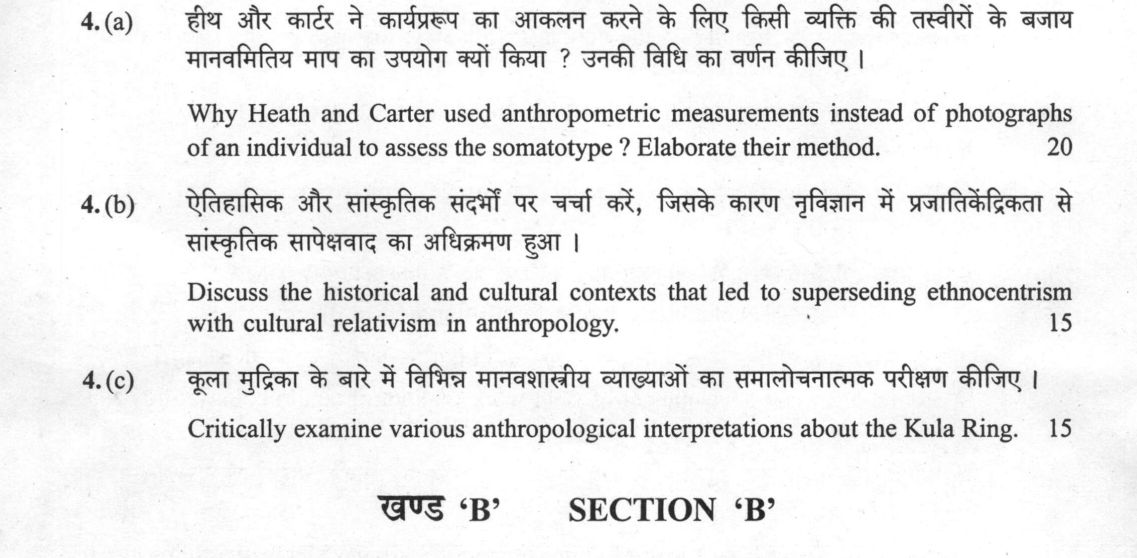
(a) Why Heath and Carter used anthropometric measurements instead of photographs of an individual to assess the somatotype ?…
Why Heath and Carter used anthropometric measurements instead of photographs of an individual to assess the somatotype ? Elaborate their method. 20 marks
Discuss the historical and cultural contexts that led to superseding ethnocentrism with cultural relativism in anthropology. 15 marks
Critically examine various anthropological interpretations about the Kula Ring. 15 marks
हिंदी में प्रश्न पढ़ें
हीथ और कार्टर ने कार्यप्ररूप का आकलन करने के लिए किसी व्यक्ति की तस्वीरों के बजाय मानवमितीय माप का उपयोग क्यों किया ? उनकी विधि का वर्णन कीजिए । 20 marks
ऐतिहासिक और सांस्कृतिक संदर्भों पर चर्चा करें, जिसके कारण नृविज्ञान में प्रजातिकेंद्रिता से सांस्कृतिक सापेक्षवाद का अधिक्रमण हुआ । 15 marks
कुला मुद्रिका के बारे में विभिन्न मानवशास्त्रीय व्याख्याओं का समालोचनात्मक परीक्षण कीजिए । 15 marks
Model answer
Written by UPSC Answer Check against this question's marking rubric, to the expected length. UPSC does not publish answers for Mains — this is one way to score well, not an official key.
Anthropological Methodology and Theory: From Somatotyping to Exchange
Anthropology relies on rigorous methodological frameworks and evolving theoretical paradigms to decode human variation and social structures. This response examines the technical precision of the Heath-Carter somatotype, the historical shift from ethnocentrism to cultural relativism, and the interpretive debates surrounding the Kula Ring.
Part (a): The Heath-Carter Somatotype Method
Heath and Carter preferred anthropometric measurements over photographs because photographs lack the objectivity, reproducibility, and quantification required for scientific assessment. Visual assessment is subjective and prone to observer bias, whereas anthropometry provides standardized, numerical data. Their method assesses the body as a composite of three components: endomorphy (fatness), mesomorphy (muscularity), and ectomorphy (linearity), each rated on a 1–7 scale.
The method utilizes ten specific measurements: height, weight, four skinfold thicknesses (triceps, subscapular, suprailiac, and medial calf), two bone breadths (biceps and calf), and two limb girths (arm and calf). To calculate endomorphy, a formula uses height, weight, and the sum of the four skinfolds. For mesomorphy, the arm and calf girths are used, but a critical technical step is required: the triceps and medial calf skinfold values, measured in millimeters, must be divided by 10 to convert them to centimeters before being subtracted from the respective girths. This corrected value is then used in the mesomorphy formula. Ectomorphy is derived from height and weight. These calculations yield a three-digit somatotype (e.g., 4.5-5.0-1.5), allowing for precise, reproducible classification that photographs cannot achieve.
Part (b): From Ethnocentrism to Cultural Relativism
The shift from ethnocentrism to cultural relativism was driven by the critique of 19th-century unilineal evolutionism. Thinkers like Tylor and Morgan posited that all societies evolve through identical stages, implicitly ranking Western industrial society as the pinnacle and labeling non-Western cultures as "primitive." This ethnocentric view was challenged by Franz Boas, who rejected environmental determinism and unilineal evolution. In his 1887 work Mind of Primitive Man, Boas argued for the distinctiveness of each culture, laying the groundwork for historical particularism.
This intellectual current was further developed by the German historicists, particularly Herder, who emphasized the unique spirit (Volksgeist) of each people. In the 20th century, Melville Herskovits formalized cultural relativism as a methodological and ethical doctrine. While his posthumous 1972 book Cultural Relativism compiled his views, he had already established the doctrine in Man and His Works (1948), arguing that cultures must be understood in their own context, not judged by external standards. This shift was reinforced by functionalists like Malinowski and later by post-colonial consciousness and UNESCO’s statements on race, which condemned scientific racism and affirmed the equal value of all cultural expressions.
Part (c): Critical Examination of Kula Ring Interpretations
Malinowski’s functionalist interpretation of the Kula Ring in the Trobriand Islands viewed it as a system of reciprocal exchange that establishes social solidarity and prestige. He distinguished Kula objects (soulava necklaces and mwali armbands) from ordinary commodities, emphasizing their ceremonial nature and the "Kula magic" associated with them. However, this interpretation has been critiqued for underestimating the economic and political dimensions of the exchange.
Marcel Mauss’s structuralist analysis in The Gift (1925) introduced the concept of the "total prestation," arguing that exchange is a social bond involving legal, religious, and economic aspects. Mauss’s concept of the hau (the spirit of the gift) was derived from his analysis of Maori gift exchange, not the Kula Ring. Applying this to Kula, critics argue that Mauss over-generalized a specific Maori belief to a different cultural context, potentially imposing a universalist framework that does not fully fit the Trobriand reality.
Subsequent interpretations have added nuance. Annette Weiner focused on gendered exchange and inalienable possessions, arguing that Kula objects are not truly "given away" but are used to display status and lineage. Marilyn Strathern and others have highlighted the spatiotemporal transformations of objects, viewing Kula as a process of creating social personhood rather than just circulating goods. Damon’s work further examines how Kula reproduces personhood through the circulation of objects.
Critically, while Malinowski provided the foundational ethnographic data, his functionalism risks reducing complex social dynamics to simple social glue. Mauss’s structuralism offers a powerful theoretical tool but risks cultural conflation. Later interpretations by Weiner and Strathern provide a more dynamic view, emphasizing agency and the construction of identity. Thus, the Kula Ring is best understood not as a single phenomenon but as a multi-layered system where economic, social, and symbolic values intersect, requiring a synthesis of functional, structural, and interpretive approaches for a complete understanding.
What "Elaborate" is asking you to do
Give the full detailed account the question has compressed into a line — every dimension of it, with specifics. Elaborate rewards completeness and detail rather than clarification or argument: the examiner is checking whether you can fill out a topic without being told what its parts are.
Structure that answers it
State the proposition → first dimension in detail → second dimension in detail → the part the statement leaves implicit → the consolidated picture
Where marks are lost
Repeating the statement at greater length instead of adding substance. Elaborate also punishes narrowness: omitting a whole dimension costs more here than anywhere else in this family.
How this answer will be evaluated
Approach
(a) explain: definition/context > points in order > small example > short close | (b) discuss: intro > 3-4 dimensions > example > balanced close | (c) critique: the claim > its strengths > its weaknesses > your judgment Full marks: Precise definitions, named theorists, and specific ethnographic details.
Key points expected
- Limitations of 2D photos for 3D body composition
- Definition of Ectomorph, Mesomorph, Endomorph
- Specific measurements: skinfolds, bone breadths, muscle girths
- Calculation of 7-component somatotype score
- Definition of ethnocentrism vs cultural relativism
- Role of Boas and the Four Field Cultures
- Impact of colonialism and 'civilizing mission' critique
- Contribution of Malinowski or Radcliffe-Brown
Evaluation rubric
Each sub-part is marked on its own, against the marks and word limit printed on the paper.
- (a) Justify the use of anthropometry over photography and detail the Heath-Carter method. 20 marks
explain— definition/context → points in order → small example → short close
Must cover
- Limitations of 2D photos for 3D body composition
- Definition of Ectomorph, Mesomorph, Endomorph
- Specific measurements: skinfolds, bone breadths, muscle girths
- Calculation of 7-component somatotype score
Loses marks
- Confusing somatotype with general body mass index
- Failing to explain why photos are insufficient
- Listing measurements without explaining their purpose
Earns more
- Mention of specific sites (e.g., triceps, calf)
- Reference to the 1972 Heath-Carter paper
- Comparison with Sheldon's visual method
- Mention of the 'endomorphic' vs 'ectomorphic' ratio
Extra mark
- Sketch of a somatotype chart
- Mention of specific skinfold calipers used
- (b) Trace the shift from ethnocentrism to cultural relativism in anthropology. 15 marks
discuss— intro → 3-4 dimensions → example → balanced close
Must cover
- Definition of ethnocentrism vs cultural relativism
- Role of Boas and the Four Field Cultures
- Impact of colonialism and 'civilizing mission' critique
- Contribution of Malinowski or Radcliffe-Brown
Loses marks
- Treating relativism as moral relativism
- Ignoring the historical context of colonialism
- Failing to name key anthropologists
Earns more
- Mention of the 'Culture and Society' debate
- Reference to specific 'primitive' societies studied
- Discussion of the 'universal' vs 'particular' in culture
- Mention of the 1928 Boas lecture
Extra mark
- Reference to the 1948 UN Declaration on Human Rights
- Mention of the 'cultural determinism' school
- (c) Critically evaluate anthropological interpretations of the Kula Ring. 15 marks
critique— the claim → its strengths → its weaknesses → your judgment
Must cover
- Description of the Kula exchange (soulava/mwali)
- Malinowski's functionalist interpretation
- Mauss's gift theory application
- Sahlins' or Strathern's critique of the 'gift'
Loses marks
- Confusing Kula with general barter
- Failing to name Malinowski or Mauss
- Treating the Kula as a simple economic system
Earns more
- Mention of the Trobriand Islands
- Discussion of 'prestige' vs 'utility' in exchange
- Reference to the 'Kula' as a 'total social fact'
- Mention of the 'reciprocity' debate
Extra mark
- Reference to the 'Kula' in modern anthropology
- Mention of the 'Kula' in economic anthropology
Practice this exact question
Write your answer and it is marked point by point against the model answer above — what you covered, what you missed, what you got wrong.
Evaluate my answer →More from Anthropology 2022 Paper I
- Q1 Write notes on the following in about 150 words each: (a) Debate between formalist and su…
- Q2 (a) "Anthropology is the systematic, objective and holistic study of human kind in all ti…
- Q3 (a) Discuss how the rules of descent contradict the principles of residence in matrilinea…
- Q4 (a) Why Heath and Carter used anthropometric measurements instead of photographs of an in…
- Q5 Write notes on the following in about 150 words each: (a) Balanced and transient genetic…
- Q6 (a) Discuss the mechanism of social control in different kinds of political systems. (20…
- Q7 (a) Discuss the role of evolutionary forces in creating human diversity. (20 marks) (b) W…