Paper I — Q7
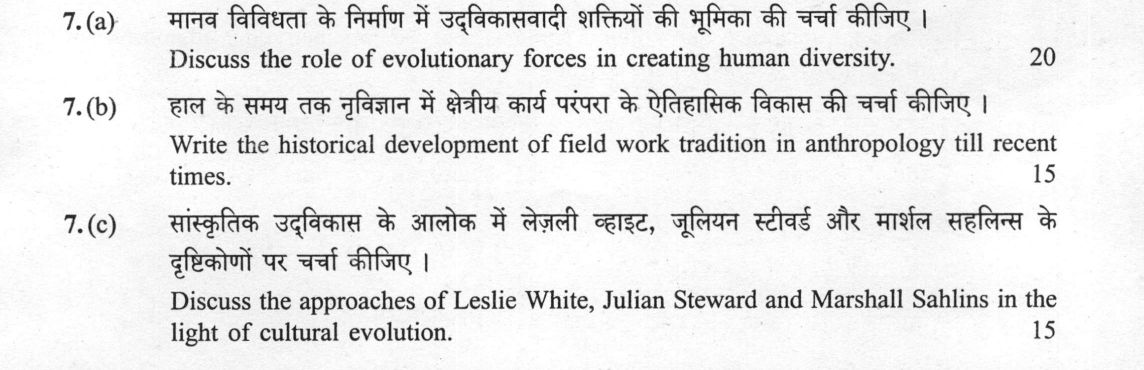
(a) Discuss the role of evolutionary forces in creating human diversity. (20 marks) (b) Write the historical development of field…
Discuss the role of evolutionary forces in creating human diversity. 20 marks
Write the historical development of field work tradition in anthropology till recent times. 15 marks
Discuss the approaches of Leslie White, Julian Steward and Marshall Sahlins in the light of cultural evolution. 15 marks
हिंदी में प्रश्न पढ़ें
मानव विविधता के निर्माण में उद्विकासवादी शक्तियों की भूमिका की चर्चा कीजिए । 20 marks
हाल के समय तक नृविज्ञान में क्षेत्रीय कार्य परंपरा के ऐतिहासिक विकास की चर्चा कीजिए । 15 marks
सांस्कृतिक उद्विकास के आलोक में लेजली व्हाइट, जूलियन स्टीवर्ड और मार्शल सहलिंस के दृष्टिकोणों पर चर्चा कीजिए । 15 marks
Model answer
Written by UPSC Answer Check against this question's marking rubric, to the expected length. UPSC does not publish answers for Mains — this is one way to score well, not an official key.
Human diversity is not a static inventory of fixed types but a dynamic outcome of evolutionary processes interacting with environmental and social variables. To understand this, one must examine the biological mechanisms driving variation, the methodological shifts that allowed us to study it, and the theoretical frameworks that interpret it.
Evolutionary Forces and Biological Diversity The primary engines of human variation are mutation, natural selection, genetic drift, and gene flow. Mutation introduces new genetic variants, while gene flow homogenizes populations through migration. However, natural selection and genetic drift are the key drivers of divergence. Natural selection operates in two main modes: directional selection, which shifts a population mean toward one extreme (e.g., increased height in high-altitude populations), and balancing selection, which maintains multiple alleles in a population. A classic example of balancing selection is the sickle-cell trait, where heterozygotes have a survival advantage in malaria-endemic regions, preserving the deleterious allele. Similarly, skin pigmentation gradients represent clinal variation, a smooth geographic transition rather than discrete racial categories, driven by selection for UV protection versus vitamin D synthesis. Lactase persistence in pastoralist societies, including parts of India and Europe, illustrates recent adaptive evolution. Conversely, genetic drift, particularly the founder effect, explains the high frequency of certain alleles in isolated populations, such as the high prevalence of specific genetic disorders in small, endogamous communities. This highlights the tension between the neutral theory, which posits that most molecular changes are selectively neutral, and adaptationist perspectives that emphasize functional utility.
Historical Development of Fieldwork Anthropology’s methodology has evolved from "armchair" speculation to immersive engagement. Early figures like Tylor and Morgan relied on secondary data, a phase often termed "verandah anthropology." The 1898 Cambridge Anthropological Expedition to Torres Straits marked a pivotal transition, moving away from armchair analysis toward direct, systematic observation. This shift was cemented by Franz Boas in the US and Bronislaw Malinowski in the UK, who established intensive, long-term participant observation as the gold standard. In the post-World War II era, distinct national traditions emerged: British social anthropology focused on functionalist structures in small-scale societies, while American cultural anthropology, influenced by Boasians like Margaret Mead and Ruth Benedict, emphasized culture and personality, though their foundational work was largely pre-war. By the 1970s and 1980s, decolonial critiques, notably by Talal Asad (1973) and Edward Said (1978), challenged the colonial gaze of traditional fieldwork. Contemporary anthropology has moved beyond single-site immersion to multi-sited ethnography, digital methods, and collaborative approaches that address global flows and power dynamics.
Theoretical Approaches to Cultural Evolution Theoretical interpretations of cultural change have shifted from universalism to contextualism. Leslie White’s neo-evolutionism proposed a universal, general evolution based on energy capture per capita, arguing that technological progress drives cultural complexity. This technological determinism rejected nineteenth-century unilinear schemes but maintained a universal trajectory of increasing efficiency. Julian Steward countered this with cultural ecology and multilineal evolution. He argued that cultures evolve differently based on specific environmental adaptations, introducing the "culture core" concept to identify central adaptive strategies. Steward’s approach was particularistic, emphasizing that similar technologies could lead to different cultural outcomes depending on ecological context. Marshall Sahlins, in Island of History and Evolution and Culture, did not simply synthesize White and Steward but reframed the debate by distinguishing between "general evolution" (universal trends like increasing complexity) and "specific evolution" (particular historical trajectories). Sahlins argued that while general evolutionary trends exist, they are not deterministic; specific historical and cultural contexts shape unique outcomes, allowing for both progress and stasis.
In conclusion, human diversity is a product of biological mechanisms like selection and drift, studied through a fieldwork tradition that has matured from colonial observation to collaborative, multi-sited inquiry. Theoretically, the field has moved from White’s universal energy-based progress to Steward’s ecological particularism and Sahlins’ nuanced distinction between general trends and specific historical paths. This evolution reflects a broader anthropological shift toward recognizing the complex interplay of biology, environment, and history in shaping human variation.
What "Discuss" is asking you to do
Lay the issue out from more than one side — how it arose, what is claimed for it, what is held against it, and where it now stands. UPSC attaches discuss to broad topics with several live dimensions, so coverage of the dimensions earns more than the strength of your opinion.
Structure that answers it
Set the issue up → the case as it is made → the case against → the dimension both sides leave out → where the balance now lies
Where marks are lost
Listing facts with no thread between them, or arguing one side throughout and calling it a discussion.
How this answer will be evaluated
Approach
Framework: UPSC Anthropology Paper 1. (a) discuss: intro > 3-4 dimensions > example > balanced close | (b) explain: definition/context > points in order > small example > short close | (c) discuss: intro > 3-4 dimensions > example > balanced close Full marks: Comprehensive, specific, and well-structured with named examples and clear distinctions.
Key points expected
- Define mutation, selection, drift, migration
- Link natural selection to specific traits (e.g., skin color)
- Explain genetic drift in isolated populations
- Mention gene flow and its homogenizing effect
- Mention Malinowski and participant observation
- Reference to Boas and cultural relativism
- Discuss the shift from 'armchair' to fieldwork
- Mention modern trends (e.g., digital ethnography)
Evaluation rubric
Each sub-part is marked on its own, against the marks and word limit printed on the paper.
- (a) Explain how evolutionary forces (mutation, selection, drift, migration) generate human biological diversity. 20 marks
discuss— intro → 3-4 dimensions → example → balanced close
Must cover
- Define mutation, selection, drift, migration
- Link natural selection to specific traits (e.g., skin color)
- Explain genetic drift in isolated populations
- Mention gene flow and its homogenizing effect
Loses marks
- Confusing cultural with biological evolution
- Ignoring the role of migration
- Vague generalities without specific examples
Earns more
- Reference to specific populations (e.g., Inuit, San)
- Mention of lactose tolerance or high-altitude adaptation
- Distinction between micro and macro evolution
- Reference to Hardy-Weinberg equilibrium
Extra mark
- Labelled diagram of selection types
- Reference to specific genetic markers (e.g., HbS)
- (b) Trace the evolution of fieldwork methods from early armchair anthropology to modern participatory approaches. 15 marks
explain— definition/context → points in order → small example → short close
Must cover
- Mention Malinowski and participant observation
- Reference to Boas and cultural relativism
- Discuss the shift from 'armchair' to fieldwork
- Mention modern trends (e.g., digital ethnography)
Loses marks
- Listing names without explaining their contribution
- Ignoring the methodological shift
- Confusing fieldwork with laboratory work
Earns more
- Reference to Radcliffe-Brown and functionalism
- Mention of specific field sites (e.g., Trobriand Islands)
- Discussion of ethical considerations in fieldwork
- Reference to Indian anthropologists (e.g., S.C. Dube)
Extra mark
- Mention of specific recent fieldwork projects
- Reference to specific methodological innovations
- (c) Compare the cultural evolution theories of White, Steward, and Sahlins. 15 marks
discuss— intro → 3-4 dimensions → example → balanced close
Must cover
- Explain White's unilineal evolution (energy capture)
- Explain Steward's multilinear evolution (culture core)
- Explain Sahlins' dialectical materialism
- Contrast their views on cultural change
Loses marks
- Confusing the three approaches
- Ignoring the 'cultural evolution' context
- Vague descriptions without specific concepts
Earns more
- Reference to specific examples used by each
- Mention of 'culture core' concept
- Discussion of 'mode of production'
- Reference to specific works (e.g., 'The Evolution of Culture')
Extra mark
- Comparison table of the three approaches
- Reference to specific critiques of each theory
Practice this exact question
Write your answer and it is marked point by point against the model answer above — what you covered, what you missed, what you got wrong.
Evaluate my answer →More from Anthropology 2022 Paper I
- Q4 (a) Why Heath and Carter used anthropometric measurements instead of photographs of an in…
- Q5 Write notes on the following in about 150 words each: (a) Balanced and transient genetic…
- Q6 (a) Discuss the mechanism of social control in different kinds of political systems. (20…
- Q7 (a) Discuss the role of evolutionary forces in creating human diversity. (20 marks) (b) W…
- Q8 (a) Discuss the contemporary population problems in the light of various socio-cultural d…