Paper I — Q8
(a) Discuss the contemporary population problems in the light of various socio-cultural demographic theories. (20 marks) (b) What…
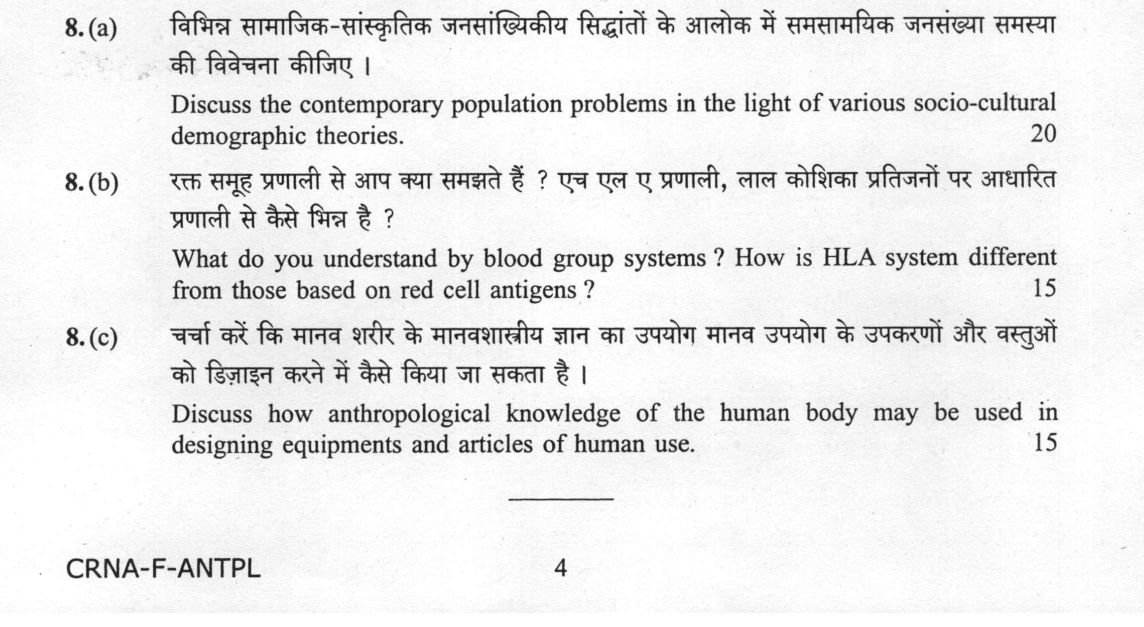
Discuss the contemporary population problems in the light of various socio-cultural demographic theories. 20 marks
What do you understand by blood group systems ? How is HLA system different from those based on red cell antigens ? 15 marks
Discuss how anthropological knowledge of the human body may be used in designing equipments and articles of human use. 15 marks
हिंदी में प्रश्न पढ़ें
विभिन्न सामाजिक-सांस्कृतिक जनसांख्यिकीय सिद्धांतों के आलोक में समसामयिक जनसंख्या समस्या की विवेचना कीजिए । 20 marks
रक्त समूह प्रणाली से आप क्या समझते हैं ? एच एल ए प्रणाली, लाल कोशिका प्रतिजनों पर आधारित प्रणाली से कैसे भिन्न है ? 15 marks
चर्चा करें कि मानव शरीर के मानवशास्त्रीय ज्ञान का उपयोग मानव उपयोग के उपकरणों और वस्तुओं को डिजाइन करने में कैसे किया जा सकता है । 15 marks
Model answer
Written by UPSC Answer Check against this question's marking rubric, to the expected length. UPSC does not publish answers for Mains — this is one way to score well, not an official key.
Anthropology investigates human populations at the intersection of biology, culture, and material life, providing an integrated lens for demographic dynamics, immunogenetics, and ergonomic design.
Socio-Cultural Theories and Population Problems
Contemporary demographic challenges—below-replacement fertility (TFR 2.0 in NFHS-5), rapid population ageing, and distress rural-urban migration—find clear explanation across classical and socio-cultural demographic theories. Demographic Transition Theory explains India’s sharp regional divergence: southern states face an impending greying population and shrinking workforce, while northern states experience an expanding youth bulge. Malthusian pressures persist in ecological strain and metropolitan infrastructure deficits.
Cultural theories enrich this biological framing. John Caldwell’s Wealth Flows Theory demonstrates that fertility declines when intergenerational wealth flows reverse from children-to-parents to parents-to-children, driven by escalating education and healthcare costs. Richard Easterlin’s relative cohort size hypothesis explains rising economic anxieties, delayed marriages, and voluntary childlessness among urban youth.
Crucially, demographic outcomes are embedded in cultural institutions. Entrenched son preference—driven by patrilineal inheritance, lineage continuity, and funeral rituals—alongside the escalating economic burden of dowry, sustains skewed child sex ratios despite falling overall fertility. Conversely, rising female literacy and autonomy delay childbearing and drive contraceptive adoption, while socio-religious norms continue to modulate regional fertility behavior.
Blood Group Systems and the HLA System
Blood group systems are inherited antigenic determinants on the erythrocyte membrane. The classical ABO system (Karl Landsteiner) and Rh system (Landsteiner and Wiener) are characterized by carbohydrate and protein antigens on red blood cells, functioning primarily in blood transfusion compatibility and maternal-fetal incompatibility (erythroblastosis fetalis).
In contrast, the Human Leukocyte Antigen (HLA) system comprises the Major Histocompatibility Complex (MHC) located on the short arm of Chromosome 6 (6p21.3). While red cell antigens are expressed largely on anucleated erythrocytes (controlled by genes on Chromosome 9 for ABO and Chromosome 1 for Rh), HLA molecules are cell-surface glycoproteins expressed across all nucleated cells and lymphocytes.
The systems differ fundamentally across several dimensions:
- Polymorphism: HLA is the most hyper-polymorphic genetic cluster known in humans, possessing thousands of alleles across HLA-A, -B, -C, -DR, and -DQ loci, compared to the limited discrete allelic series of red cell groups.
- Function and Inheritance: Blood groups are inherited via simple Mendelian codominance. HLA alleles are inherited en bloc as tightly linked haplotypes, functioning in presenting foreign peptide antigens to T-cells for self/non-self immune recognition.
- Clinical Scope: Beyond transfusion matching, HLA determines tissue/organ transplant compatibility, modulates disease susceptibility (e.g., HLA-B27 with ankylosing spondylitis), and serves as an indispensable tool in anthropological studies of human microevolution and historical migrations.
Anthropometry in Ergonomic Design
Applied physical anthropology utilizes anthropometry—the systematic measurement of physical dimensions (stature, limb reach, functional sitting height) following protocols like the International Society for the Advancement of Kinanthropometry (ISAK)—to tailor human-machine interfaces. By replacing the standard "average man" assumption with dynamic 5th to 95th percentile distributions, anthropometry mitigates musculoskeletal disorders and maximizes human efficiency.
In India, anthropometric application is critical across diverse domains:
- Defence and Aviation: The cockpit layout of the indigenous Light Combat Aircraft (LCA) Tejas was designed using anthropometric databases of Indian Air Force pilots rather than unsuitable Western military standards.
- Public Transport: Indian Railways standardized passenger berth lengths, seat inclinations, and doorway clearances based on national somatic variations.
- Agriculture and Labor: The Central Institute of Agricultural Engineering (CIAE) utilizes body dimensions to design women-friendly sickles, weeders, and harvesters, reducing physical drudgery.
- Public Health: The COVID-19 pandemic highlighted that standardized Personal Protective Equipment (PPE) kits were ill-fitted to Indian bodily proportions, particularly for female healthcare workers, underscoring the urgent necessity of comprehensive, gender-disaggregated anthropometric databases.
Demographic transition policies, immunogenetic mapping like HLA, and somatic ergonomic design demonstrate the essential convergence of biological and cultural anthropology in translating human variability into evidence-based public policy and inclusive technology.
What "Discuss" is asking you to do
Lay the issue out from more than one side — how it arose, what is claimed for it, what is held against it, and where it now stands. UPSC attaches discuss to broad topics with several live dimensions, so coverage of the dimensions earns more than the strength of your opinion.
Structure that answers it
Set the issue up → the case as it is made → the case against → the dimension both sides leave out → where the balance now lies
Where marks are lost
Listing facts with no thread between them, or arguing one side throughout and calling it a discussion.
How this answer will be evaluated
Approach
Framework: UPSC Anthropology Paper 1 (Physical Anthropology & Demography). (a) discuss: intro > 3-4 dimensions > example > balanced close | (b) explain: definition/context > points in order > small example > short close | (c) discuss: intro > 3-4 dimensions > example > balanced close Full marks: Comprehensive application of theories, precise biological distinctions, and specific anthropometric examples.
Key points expected
- Define contemporary population problems (e.g., aging, migration, fertility decline)
- Apply Malthusian theory to current resource/population dynamics
- Apply Demographic Transition Theory (DTT) to stage-specific issues
- Integrate socio-cultural factors (education, urbanization) into the analysis
- Define blood group systems as genetic markers on cell surfaces
- Explain the basis of red cell antigen systems (e.g., ABO, Rh)
- Define HLA (Human Leukocyte Antigen) system and its location (leukocytes)
- Highlight the key difference: HLA is highly polymorphic and linked to immunity
Evaluation rubric
Each sub-part is marked on its own, against the marks and word limit printed on the paper.
- (a) Analyze contemporary population issues through the lens of socio-cultural demographic theories. 20 marks
discuss— intro → 3-4 dimensions → example → balanced close
Must cover
- Define contemporary population problems (e.g., aging, migration, fertility decline)
- Apply Malthusian theory to current resource/population dynamics
- Apply Demographic Transition Theory (DTT) to stage-specific issues
- Integrate socio-cultural factors (education, urbanization) into the analysis
Loses marks
- Listing problems without connecting them to specific theories
- Treating the answer as pure sociology without demographic theory
- Ignoring the 'socio-cultural' aspect of the prompt
Earns more
- Reference to Boserup's theory of population and agricultural change
- Mention of 'demographic dividend' in the context of developing nations
- Linkage of cultural values to fertility rates (e.g., son preference)
Extra mark
- Citing specific data from the Census of India or UN reports
- Reference to specific Indian policy (e.g., National Population Policy 2000)
- (b) Define blood group systems and distinguish the HLA system from red cell antigen systems. 15 marks
explain— definition/context → points in order → small example → short close
Must cover
- Define blood group systems as genetic markers on cell surfaces
- Explain the basis of red cell antigen systems (e.g., ABO, Rh)
- Define HLA (Human Leukocyte Antigen) system and its location (leukocytes)
- Highlight the key difference: HLA is highly polymorphic and linked to immunity
Loses marks
- Confusing HLA with general blood groups (ABO/Rh)
- Failing to mention the immunological significance of HLA
- Vague description of 'antigens' without specifying cell type
Earns more
- Mentioning the role of HLA in tissue typing and transplant rejection
- Noting that HLA is the most polymorphic system in humans
- Briefly mentioning the MHC (Major Histocompatibility Complex) complex
Extra mark
- A simple diagram comparing RBC surface vs Leukocyte surface antigens
- Mentioning specific HLA loci (e.g., HLA-A, HLA-B, HLA-DR)
- (c) Explain the application of anthropological knowledge of the human body in designing equipment. 15 marks
discuss— intro → 3-4 dimensions → example → balanced close
Must cover
- Define anthropometry (measurement of the human body)
- Explain the concept of 'ergonomics' or 'human factors' in design
- Provide examples of equipment design based on body dimensions (e.g., chairs, tools)
- Discuss the importance of population variation (size, shape) in universal design
Loses marks
- Discussing general ergonomics without linking it to anthropological data
- Ignoring the 'human body' aspect and focusing only on technology
- Failing to provide concrete examples of equipment
Earns more
- Mentioning 'percentile' data (e.g., 5th to 95th percentile) in design
- Reference to specific tools (e.g., pliers, handles) designed for grip
- Linking skeletal structure to posture and equipment use
Extra mark
- Reference to specific anthropometric studies (e.g., Indian anthropometric data)
- Mentioning 'universal design' principles for accessibility
Practice this exact question
Write your answer and it is marked point by point against the model answer above — what you covered, what you missed, what you got wrong.
Evaluate my answer →More from Anthropology 2022 Paper I
- Q5 Write notes on the following in about 150 words each: (a) Balanced and transient genetic…
- Q6 (a) Discuss the mechanism of social control in different kinds of political systems. (20…
- Q7 (a) Discuss the role of evolutionary forces in creating human diversity. (20 marks) (b) W…
- Q8 (a) Discuss the contemporary population problems in the light of various socio-cultural d…