Paper II — Q1
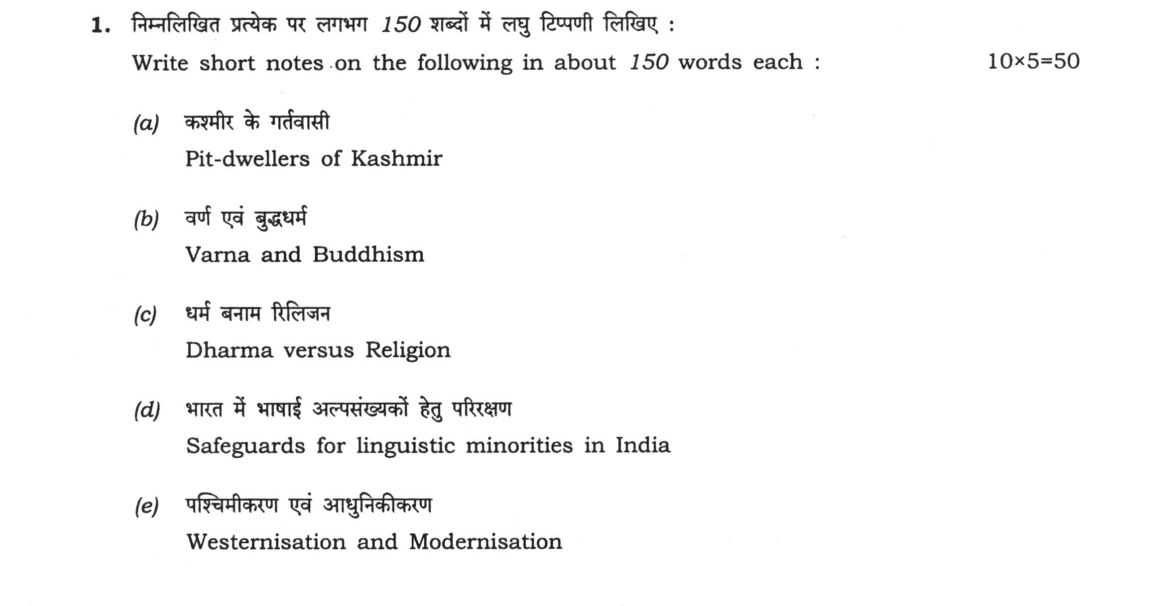
Write short notes on the following in about 150 words each: 10×5=50 (a) Pit-dwellers of Kashmir (b) Varna and Buddhism (c)…
Write short notes on the following in about 150 words each: 10×5=50
Pit-dwellers of Kashmir
Varna and Buddhism
Dharma versus Religion
Safeguards for linguistic minorities in India
Westernisation and Modernisation
हिंदी में प्रश्न पढ़ें
निम्नलिखित प्रत्येक पर लगभग 150 शब्दों में लघु टिप्पणी लिखिए : 10×5=50
कश्मीर के गर्तवासी
वर्ण एवं बौद्धधर्म
धर्म बनाम रिलिजन
भारत में भाषाई अल्पसंख्यकों हेतु परिरक्षण
पश्चिमीकरण एवं आधुनिकीकरण
Model answer
Written by UPSC Answer Check against this question's marking rubric, to the 150-word length. UPSC does not publish answers for Mains — this is one way to score well, not an official key.
(a) Pit-dwellers of Kashmir
The pit-dwellers of the Kashmir Valley represent a distinctive Northern Neolithic cultural tradition, predominantly excavated at Burzahom and Gufkral. Flourishing from circa 3000 BCE, these communities adapted to the cold sub-Himalayan climate by constructing subterranean pit-dwellings. Excavations reveal circular, oval, and rectangular pits dug into the natural loessic soil, featuring rammed earth floors plastered with red ochre, post-holes for supporting conical timber roofs, and stone-lined hearths. The sequence began with an aceramic Neolithic phase (notably Gufkral Period IA), relying on ground stone celts, polished bone tools, and birch bark artifacts, with no pottery initially. Subsistence was based on nascent cultivation and the domestication of sheep and goats alongside hunting. In subsequent phases, this subterranean dwelling tradition transitioned into above-ground mud-brick structures, accompanied by burnished grey pottery. Kashmir pit-dwellings highlight unique ecological adaptation and an autochthonous technological trajectory in Indian protohistory.
(b) Varna and Buddhism
Early Buddhism mounted a profound ideological critique against the hereditary, ritualistic Brahmanical varna system. The Buddha rejected birth-based spiritual hierarchy in texts like the Vasettha Sutta and Assalayana Sutta, arguing that social stratifications are conventional rather than divinely ordained. In place of birth, Buddhism instituted the doctrine of karma and moral conduct (sila) as the true determinant of an individual's spiritual status. The Buddhist Sangha served as an egalitarian institutional alternative where recruits surrendered their previous social identities, like rivers losing their distinct names upon entering the sea. This casteless ethos is exemplified by the elevation of Upali, a former barber who became the foremost authority on monastic discipline (Vinaya), and Sunita, a sweeper who attained Arhathood. However, Buddhism made practical compromises with the prevailing social order, accepting secular divisions outside the monastery and maintaining patron relationships with Kshatriya rulers and wealthy Gahapatis.
(c) Dharma versus Religion
The conceptual conflation of ‘Dharma’ and ‘Religion’ obscures fundamental civilisational differences. Derived from the Sanskrit root dhri (‘to uphold’), Dharma signifies cosmic order (rta), righteousness, ethical conduct, socio-legal duty, and contextual obligation (varnashramadharma). It operates as an all-encompassing way of life without being tethered to a single prophet, dogma, or institutionalised church, meaning there is no direct equivalent term in the Indian tradition. In contrast, 'Religion' is historically a Western-Semitic construct predicated on a bounded, faith-based belief system, creedal exclusivity, and institutional allegiance. Jurist Rajeev Dhavan highlights this constitutional distinction in Indian jurisprudence: while Dharma embodies a comprehensive moral-philosophical framework and duties-oriented living, the Indian Constitution legally conceptualises 'religion' under Articles 25–28 as specific faith-based beliefs and practices subject to public order, morality, and state reform.
(d) Safeguards for linguistic minorities in India
Safeguards for linguistic minorities in India are enshrined through constitutional provisions, administrative mechanisms, and federal restructuring. Fundamental rights under Article 29 protect the right of any section of citizens to conserve their distinct language, script, or culture, while Article 30 guarantees linguistic minorities the right to establish and administer educational institutions. Directive principles and special provisions include Article 350A, directing states to provide primary instruction in the mother tongue, and Article 350B, which establishes the Special Officer for Linguistic Minorities to investigate constitutional protections. Additionally, the Eighth Schedule recognizes major languages, and the Official Languages Act, 1963 governs non-discriminatory administrative usage. Beyond statutory safeguards, India accommodated linguistic diversity through the Fazal Ali Commission-led State Reorganisation of 1956 on a linguistic basis, as well as asymmetric sub-state administrative solutions like the Gorkhaland Territorial Administration and the Mizo Accord for regional linguistic minorities.
(e) Westernisation and Modernisation
Sociologist M.N. Srinivas distinguished between Westernisation and Modernisation to analyse socio-cultural change in India. Srinivas defined Westernisation as the cultural borrowing of styles, technology, institutions, and values (such as humanitarianism and rationalism) resulting from more than 150 years of British colonial rule. In contrast, Modernisation represents a broader, universal, and structural transformation encompassing scientific temper, industrialisation, democratic institution-building, and social mobility, which is not confined to Western hegemony. Yogendra Singh in Modernization of Indian Tradition observed that Indian modernisation is not a mere replication of Western models, but a process of selective adaptation. Exogenous Westernising forces interact continuously with endogenous traditional frameworks without completely displacing them. Consequently, institutions like caste and kinship modernise their functions—mobilising politically and adapting to market economies—while demonstrating institutional continuity and resilience alongside structural modern change.
What "Write short notes" is asking you to do
Five or six self-contained answers, marked separately, typically 10 marks and about 150 words each. Each note must carry its own definition, its two or three defining features and a line on why it matters; a common introduction or conclusion across the notes earns nothing.
Structure that answers it
Per note: one-line definition or identification → two or three features, mechanisms or named examples → one line of significance or Indian application
Where marks are lost
Writing the first two notes at essay length and rationing the rest. Each note is marked on its own, so marks surrendered on a compressed or unattempted note cannot be won back by the long ones.
How this answer will be evaluated
Approach
Framework: Anthropology Paper II (Socio-Cultural). (a) write short notes: define > 3-4 key features > one example > one-line significance | (b) write short notes: define > 3-4 key features > one example > one-line significance | (c) write short notes: define > 3-4 key features > one example > one-line significance | (d) write short notes: define > 3-4 key features > one example > one-line significance | (e) write short notes: define > 3-4 key features > one example > one-line significance Full marks: Precise definitions, specific examples, clear distinction between concepts, and strong Indian context.
Key points expected
- Define 'pit-dwellers' (semi-subterranean structures)
- Identify key sites (e.g., Burzahom, Gufkral)
- Mention material culture (bone tools, fish bones)
- Note chronological context (Neolithic/Chalcolithic)
- Define Varna (social stratification)
- Identify Buddhism's critique of Varna (e.g., rejection of Brahmanical authority)
- Mention Buddha's stance on caste (e.g., Sangha as egalitarian)
- Note the social context (rise of Shudras/Kshatriyas)
Evaluation rubric
Each sub-part is marked on its own, against the marks and word limit printed on the paper.
- (a) Define pit-dwellers and outline their archaeological significance in Kashmir. · 150 words
write short notes— define → 3-4 key features → one example → one-line significance
Must cover
- Define 'pit-dwellers' (semi-subterranean structures)
- Identify key sites (e.g., Burzahom, Gufkral)
- Mention material culture (bone tools, fish bones)
- Note chronological context (Neolithic/Chalcolithic)
Loses marks
- Confusing with Indus Valley Civilization
- Ignoring the specific Kashmiri context
- Vague description without site names
Earns more
- Reference to specific excavator (e.g., H.N. Chakravarti)
- Mention of 'Kashmir Neolithic' culture
- Comparison with other Indian Neolithic sites
Extra mark
- Sketch of a pit-dwelling structure
- Mention of specific artifact types (e.g., 'Kashmiri' bone points)
- (b) Explain the relationship between the Varna system and the rise of Buddhism. · 150 words
write short notes— define → 3-4 key features → one example → one-line significance
Must cover
- Define Varna (social stratification)
- Identify Buddhism's critique of Varna (e.g., rejection of Brahmanical authority)
- Mention Buddha's stance on caste (e.g., Sangha as egalitarian)
- Note the social context (rise of Shudras/Kshatriyas)
Loses marks
- Treating Varna as purely religious (ignoring social aspect)
- Ignoring the political context of the time
- Vague generalities without specific Buddhist concepts
Earns more
- Reference to specific Buddhist texts (e.g., Suttas)
- Mention of 'Sangha' structure
- Comparison with Jainism's stance
Extra mark
- Mention of specific Buddha's parable (e.g., 'River Ganga')
- Reference to specific historical figure (e.g., Ajatashatru)
- (c) Distinguish between the concepts of Dharma and Religion in the Indian context. · 150 words
write short notes— define → 3-4 key features → one example → one-line significance
Must cover
- Define 'Dharma' (cosmic order, duty, law)
- Define 'Religion' (organized belief system, rituals)
- Highlight the difference (Dharma is broader, includes secular duty)
- Mention the Indian context (e.g., 'Dharmakshetra' vs. 'Temple')
Loses marks
- Treating Dharma and Religion as identical
- Ignoring the secular aspect of Dharma
- Vague definitions without specific examples
Earns more
- Reference to specific texts (e.g., Mahabharata, Manusmriti)
- Mention of 'Dharma' in modern Indian law
- Comparison with Western concept of 'Religion'
Extra mark
- Mention of specific philosopher (e.g., Gandhi's 'Dharma')
- Reference to specific legal case (e.g., 'Dharma' in constitutional interpretation)
- (d) Outline the constitutional and legal safeguards for linguistic minorities in India. · 150 words
write short notes— define → 3-4 key features → one example → one-line significance
Must cover
- Mention Article 350A (Facilities for instruction in mother-tongue)
- Mention Article 344 (Commission for Minorities)
- Mention the 8th Schedule (recognition of languages)
- Note the role of the State (e.g., bilingual policy)
Loses marks
- Confusing linguistic minorities with religious minorities
- Ignoring the constitutional provisions
- Vague description without specific Articles
Earns more
- Reference to specific laws (e.g., Official Languages Act)
- Mention of specific minority languages (e.g., Hindi, Urdu)
- Comparison with other countries' policies
Extra mark
- Mention of specific commission report (e.g., Second B.C. Roy Commission)
- Reference to specific court judgment (e.g., 'Tamil Nadu' case)
- (e) Distinguish between Westernisation and Modernisation in the Indian context. · 150 words
write short notes— define → 3-4 key features → one example → one-line significance
Must cover
- Define 'Westernisation' (adoption of Western culture/lifestyle)
- Define 'Modernisation' (adoption of modern technology/institutions)
- Highlight the difference (Westernisation is cultural, Modernisation is structural)
- Mention the Indian context (e.g., 'Gandhian' vs. 'Nehruvian' views)
Loses marks
- Treating Westernisation and Modernisation as identical
- Ignoring the Indian context
- Vague definitions without specific examples
Earns more
- Reference to specific thinkers (e.g., S.N. Mukherjee, M.N. Srinivas)
- Mention of specific examples (e.g., 'Western' clothing vs. 'Modern' industry)
- Comparison with other post-colonial societies
Extra mark
- Mention of specific sociologist (e.g., M.N. Srinivas's 'Sanskritisation')
- Reference to specific historical event (e.g., 'Non-Aligned Movement')
Practice this exact question
Write your answer and it is marked point by point against the model answer above — what you covered, what you missed, what you got wrong.
Evaluate my answer →More from Anthropology 2022 Paper II
- Q1 Write short notes on the following in about 150 words each: 10×5=50 (a) Pit-dwellers of K…
- Q2 (a) Illustrate the contribution of Irawati Karve to Indian Anthropology. Make a special m…
- Q3 (a) Make a critical appraisal of Megalithic tradition in India with special reference to…
- Q4 (a) "Globalisation, on one hand has provided opportunities and on the other hand thrown c…