Paper II — Q5
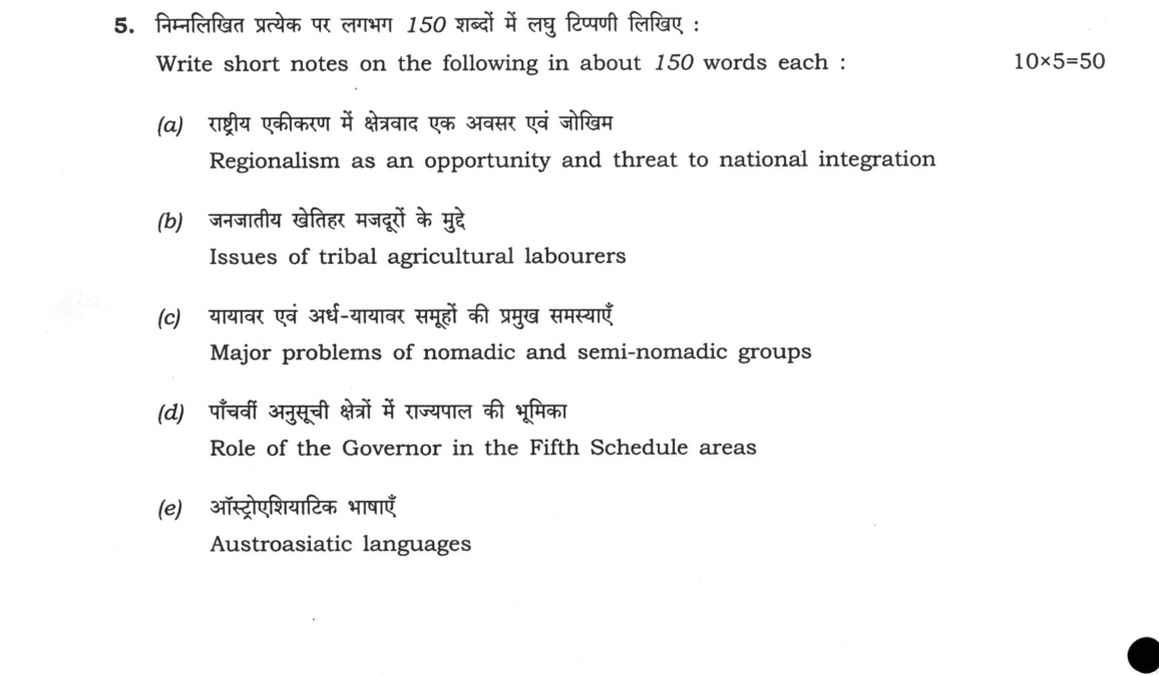
Write short notes on the following in about 150 words each: 10×5=50 (a) Regionalism as an opportunity and threat to national…
Write short notes on the following in about 150 words each: 10×5=50
Regionalism as an opportunity and threat to national integration
Issues of tribal agricultural labourers
Major problems of nomadic and semi-nomadic groups
Role of the Governor in the Fifth Schedule areas
Austroasiatic languages
हिंदी में प्रश्न पढ़ें
निम्नलिखित प्रत्येक पर लगभग 150 शब्दों में लघु टिप्पणी लिखिए : 10×5=50
राष्ट्रीय एकीकरण में क्षेत्रवाद एक अवसर एवं जोखिम
जनजातीय खेतिहर मज़दूरों के मुद्दे
यायावर एवं अर्ध-यायावर समूहों की प्रमुख समस्याएँ
पाँचवीं अनुसूची क्षेत्रों में राज्यपाल की भूमिका
ऑस्ट्रोएशियाटिक भाषाएँ
Model answer
Written by UPSC Answer Check against this question's marking rubric, to the 150-word length. UPSC does not publish answers for Mains — this is one way to score well, not an official key.
(a) Regionalism as an Opportunity and Threat to National Integration
Regionalism refers to an ideology and political consciousness centered on loyalty to a distinct geographic region, rooted in shared language, culture, ethnicity, or historical identity.
As an opportunity, regionalism fosters cultural preservation by safeguarding sub-national identities within India’s plural fabric. It promotes democratic decentralization, administrative efficiency, and competitive development by articulating grassroots needs, as seen in the Dravidian movement, which catalyzed substantial social welfare reforms, literacy, and affirmative action in Tamil Nadu. It also enables balanced regional resource distribution through federal bargaining.
As a threat, aggressive regionalism manifests as chauvinism, breeding inter-state boundary disputes, water-sharing conflicts, and nativist 'sons-of-the-soil' agitations that target migrant communities. In its extreme form, regional disaffection degenerates into secessionism and violent ethnic militancy, evidenced historically in parts of the North-East insurgency. Harmonizing regional aspirations with national priorities through cooperative federalism is vital to maintaining integration.
(b) Issues of Tribal Agricultural Labourers
The transformation of self-reliant tribal cultivators into landless agricultural labourers represents a classic outcome of historical land alienation and socio-ecological displacement.
Tribal agricultural labourers face pervasive structural vulnerabilities, primarily characterized by low, exploitative wages far below statutory minimums and severe seasonal unemployment during non-agricultural months. Having lost customary land control to non-tribals and commercial projects, they suffer from an absolute lack of tenancy rights, functioning as insecure, casual workers. Deep-seated poverty forces dependence on local moneylenders (mahajans), leading to usurious debt cycles and unfree or bonded labour relations across several central and eastern states.
Furthermore, mechanization and the erosion of forest-based subsidiary livelihoods have intensified distress migration under precarious conditions. Although the Scheduled Tribes and Other Traditional Forest Dwellers (Recognition of Forest Rights) Act, 2006 (FRA) provides a statutory framework to restore tenurial security and forest access, slow implementation leaves large swathes of tribal labourers landless and socio-economically marginalized.
(c) Major Problems of Nomadic and Semi-Nomadic Groups
Nomadic and semi-nomadic communities (NT-SNTs) represent mobile populations whose customary pastoral, foraging, or artisanal livelihoods conflict with sedentary state structures.
A primary crisis is state-driven sedentarization pressure and the rapid loss of traditional grazing lands and migratory corridors due to urbanization, industrial expansion, and strict conservation policies, severely impacting groups like the pastoral Dhangars of Maharashtra and Gollas of the Deccan. Culturally and socially, many of these groups continue to bear the historical stigma of the colonial Criminal Tribes Act, 1871, which institutionalized societal prejudice and leaves them vulnerable to routine police harassment.
Their spatial mobility poses acute administrative challenges: lacking permanent residential proofs, they are frequently excluded from basic citizenship documents such as ration cards, voter identity cards, and caste certificates. This documentation deficit severely impedes their access to public healthcare, social protection schemes, and formal education for migratory children, perpetuating intergenerational poverty.
(d) Role of the Governor in the Fifth Schedule Areas
Under Article 244(1) and the Fifth Schedule of the Constitution, the Governor is vested with overarching supervisory and legislative powers to protect the interests of Scheduled Tribes in Scheduled Areas.
The Governor acts as a constitutional safeguard with the discretion to direct that any specific Act of Parliament or State Legislature shall not apply, or shall apply only with specified modifications, to a Scheduled Area. The Governor is empowered to make regulations prohibiting or restricting the transfer of land by or among Scheduled Tribe members to non-tribals, and to regulate the business of agricultural money-lending to tribals.
Institutionally, the Governor oversees the establishment and functioning of the Tribes Advisory Council (TAC) and is constitutionally mandated to submit an annual report to the President regarding the administration of these areas. However, in practice, these powers remain constrained by aid-and-advice conventions, and systemic gaps persist in effectively aligning gubernatorial regulations with the participatory mandate of the Panchayats (Extension to Scheduled Areas) Act (PESA), 1996.
(e) Austroasiatic Languages
The Austroasiatic language family constitutes one of the oldest linguistic and anthropological substrata of the Indian subcontinent, systematically classified in early Indian philology by G.A. Grierson in his Linguistic Survey of India.
In India, the family is broadly split into two distinct branches:
- Munda Branch: Spoken primarily across the Central and Eastern Indian tribal belts, particularly in the Chota Nagpur plateau and adjoining regions. Key languages include Santhali (the only Austroasiatic language recognized in the Eighth Schedule), Mundari, Ho, Korku, and Savara.
- Mon-Khmer Branch: Spoken peripherally in the North-East and island territories. It is represented by the Khasi and Pnar (Jaintia) languages in Meghalaya, as well as the Nicobarese language spoken across the Nicobar archipelago.
Typologically marked by prefixing morphology and rich phonetic inventories, Austroasiatic languages provide critical insights into prehistoric tribal migrations. However, several non-scheduled dialects face severe endangerment today due to assimilation into dominant regional languages and a lack of standardized tribal scripts.
What "Write short notes" is asking you to do
Five or six self-contained answers, marked separately, typically 10 marks and about 150 words each. Each note must carry its own definition, its two or three defining features and a line on why it matters; a common introduction or conclusion across the notes earns nothing.
Structure that answers it
Per note: one-line definition or identification → two or three features, mechanisms or named examples → one line of significance or Indian application
Where marks are lost
Writing the first two notes at essay length and rationing the rest. Each note is marked on its own, so marks surrendered on a compressed or unattempted note cannot be won back by the long ones.
How this answer will be evaluated
Approach
Framework: UPSC Anthropology Paper II (Social Anthropology). (a) write short notes: define > 3-4 key features > one example > one-line significance | (b) write short notes: define > 3-4 key features > one example > one-line significance | (c) write short notes: define > 3-4 key features > one example > one-line significance | (d) write short notes: define > 3-4 key features > one example > one-line significance | (e) write short notes: define > 3-4 key features > one example > one-line significance Full marks: Precise definitions, specific Indian examples, clear distinction between concepts, and accurate statutory references.
Key points expected
- Define regionalism as a political/social phenomenon
- Identify it as an opportunity (e.g., resource mobilization)
- Identify it as a threat (e.g., separatism, identity politics)
- Provide one Indian example (e.g., Naxal, Northeast, or linguistic states)
- Define the specific group (Adivasis in wage labour)
- Address landlessness or lack of land rights
- Discuss exploitation (e.g., bonded labour, low wages)
- Mention vulnerability to climate or market changes
Evaluation rubric
Each sub-part is marked on its own, against the marks and word limit printed on the paper.
- (a) Define regionalism and evaluate its dual role in national integration. · 150 words
write short notes— define → 3-4 key features → one example → one-line significance
Must cover
- Define regionalism as a political/social phenomenon
- Identify it as an opportunity (e.g., resource mobilization)
- Identify it as a threat (e.g., separatism, identity politics)
- Provide one Indian example (e.g., Naxal, Northeast, or linguistic states)
Loses marks
- Treating regionalism only as a threat
- Ignoring the 'opportunity' aspect of the prompt
- General political science answer without anthropological context
Earns more
- Mention specific state or region
- Reference to 'unity in diversity' concept
- Link to federalism or center-state relations
Extra mark
- Cite a specific Supreme Court judgment on regionalism
- Reference to a specific tribal or linguistic movement
- (b) Outline the socio-economic issues facing tribal agricultural labourers. · 150 words
write short notes— define → 3-4 key features → one example → one-line significance
Must cover
- Define the specific group (Adivasis in wage labour)
- Address landlessness or lack of land rights
- Discuss exploitation (e.g., bonded labour, low wages)
- Mention vulnerability to climate or market changes
Loses marks
- Discussing general agricultural issues without tribal focus
- Ignoring the 'labourer' aspect (focusing only on farmers)
- Vague generalities without specific issues
Earns more
- Reference to specific tribal group (e.g., Gond, Munda)
- Mention of PESA Act or land rights
- Link to migration or urbanization
Extra mark
- Cite a specific study or fieldwork on tribal labour
- Reference to specific government scheme for labourers
- (c) List and explain the major problems of nomadic and semi-nomadic groups. · 150 words
write short notes— define → 3-4 key features → one example → one-line significance
Must cover
- Define nomadic/semi-nomadic groups
- Address loss of grazing lands (encroachment)
- Discuss lack of legal status or identity
- Mention health/education access issues due to mobility
Loses marks
- Confusing nomads with settled tribes
- Ignoring the 'mobility' aspect of their problems
- Listing problems without explaining them
Earns more
- Reference to specific group (e.g., Rabaris, Bhils)
- Mention of 'Nomadic and Boad People' policies
- Link to environmental degradation
Extra mark
- Cite a specific policy or committee report on nomads
- Reference to specific state's nomadic policy
- (d) Explain the specific role of the Governor in Fifth Schedule areas. · 150 words
write short notes— define → 3-4 key features → one example → one-line significance
Must cover
- Define Fifth Schedule areas (Tribal Areas)
- Explain the Governor's power to make regulations
- Mention the power to restrict land transfer
- Discuss the role in setting up Tribal Development Councils
Loses marks
- Confusing Fifth Schedule with Sixth Schedule
- Ignoring the 'regulatory' power of the Governor
- General answer on Governor's role without tribal focus
Earns more
- Reference to Article 244(1) of the Constitution
- Mention of specific state (e.g., MP, Jharkhand)
- Link to protection of tribal interests
Extra mark
- Cite a specific regulation made by a Governor
- Reference to a specific Tribal Development Council
- (e) Describe the Austroasiatic language family and its distribution. · 150 words
write short notes— define → 3-4 key features → one example → one-line significance
Must cover
- Define Austroasiatic language family
- Identify major branches (e.g., Munda, Khmer)
- Mention distribution in India (e.g., Jharkhand, Odisha)
- List specific languages (e.g., Santali, Mundari)
Loses marks
- Confusing Austroasiatic with Dravidian or Indo-Aryan
- Listing languages without identifying the family
- Ignoring the 'distribution' aspect
Earns more
- Reference to specific tribal group speaking the language
- Mention of linguistic features (e.g., tonal)
- Link to cultural identity
Extra mark
- Cite a specific linguistic study or classification
- Reference to a specific language's status (e.g., endangered)
Practice this exact question
Write your answer and it is marked point by point against the model answer above — what you covered, what you missed, what you got wrong.
Evaluate my answer →More from Anthropology 2022 Paper II
- Q2 (a) Illustrate the contribution of Irawati Karve to Indian Anthropology. Make a special m…
- Q3 (a) Make a critical appraisal of Megalithic tradition in India with special reference to…
- Q4 (a) "Globalisation, on one hand has provided opportunities and on the other hand thrown c…
- Q5 Write short notes on the following in about 150 words each: 10×5=50 (a) Regionalism as an…
- Q6 (a) Discuss the objectives of Integrated Tribal Development Projects (ITDPs). How far hav…
- Q7 (a) Discuss the views of G. S. Ghurye and Verrier Elwin on the approach towards tribal po…
- Q8 (a) Compare the nature of tribal movements between North-East and Central India. Briefly…