Paper II — Q6
(a) Discuss the objectives of Integrated Tribal Development Projects (ITDPs). How far have these objectives been achieved?…
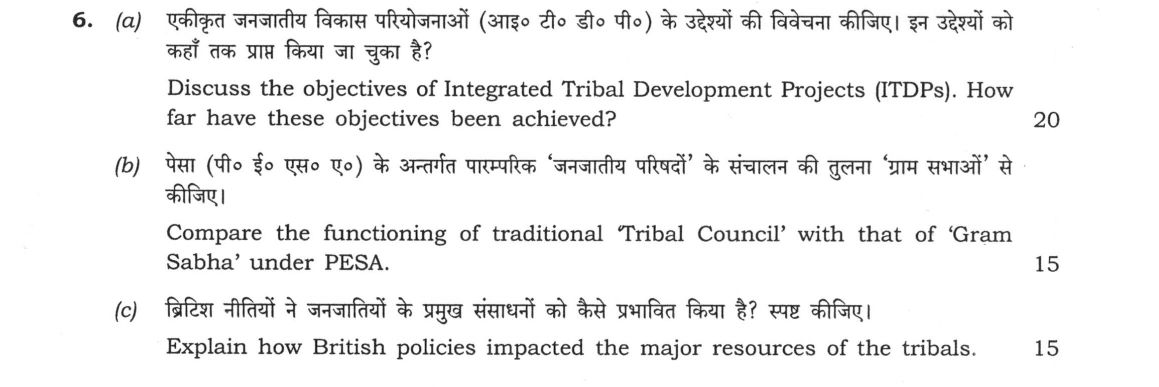
Discuss the objectives of Integrated Tribal Development Projects (ITDPs). How far have these objectives been achieved? 20 marks
Compare the functioning of traditional 'Tribal Council' with that of 'Gram Sabha' under PESA. 15 marks
Explain how British policies impacted the major resources of the tribals. 15 marks
हिंदी में प्रश्न पढ़ें
एकीकृत जनजातीय विकास परियोजनाओं (आइ० टी० डी० पी०) के उद्देश्यों की विवेचना कीजिए। इन उद्देश्यों को कहाँ तक प्राप्त किया जा चुका है? 20 marks
पेसा (पी० ई० एस० ए०) के अन्तर्गत पारम्परिक 'जनजातीय परिषदों' के संचालन की तुलना 'ग्राम सभाओं' से कीजिए। 15
ब्रिटिश नीतियों ने जनजातियों के प्रमुख संसाधनों को कैसे प्रभावित किया है? स्पष्ट कीजिए। 15
Model answer
Written by UPSC Answer Check against this question's marking rubric, to the expected length. UPSC does not publish answers for Mains — this is one way to score well, not an official key.
Introduced during the Fifth Five-Year Plan under the Tribal Sub-Plan strategy, Integrated Tribal Development Projects (ITDPs) were instituted for contiguous administrative units having 50 percent or more Scheduled Tribe population.
Objectives and Achievements of ITDPs
ITDPs were conceptualised around four core objectives: initiating area-based integrated socio-economic development, eliminating structural exploitation by moneylenders and middlemen, expanding basic physical infrastructure such as connectivity, schools, and healthcare, and securing tribal livelihoods through improved agriculture, minor irrigation, and allied activities.
Regarding their achievements, ITDPs succeeded in creating administrative footholds and basic infrastructure in remote tracts, contributing to increased tribal literacy and access to institutional credit. However, comprehensive reviews by the Dandekar Committee and subsequent NITI Aayog evaluations highlight critical deficits. The top-down bureaucratic approach marginalised indigenous participation, while line departments (forest, revenue, and agriculture) consistently failed to achieve administrative convergence. In regions like Bastar in Chhattisgarh and Koraput in Odisha, ITDP areas remain plagued by acute land alienation, corporate and state-led displacement, food insecurity, and poor human development indices. Consequently, while ITDPs achieved quantitative physical targets, they largely failed to secure socio-economic autonomy or halt structural exploitation.
Traditional Tribal Councils versus Gram Sabha under PESA
Traditional Tribal Councils, such as the Parha among the Munda or clan councils among the Gond, derive their authority from customary law and lineage. Membership is largely hereditary or kinship-based, decision-making relies on community consensus, and their jurisdiction covers social disputes, rituals, and customary management of communal resources. However, traditional councils often reflect patriarchal structures with limited institutional representation for women.
In contrast, the Gram Sabha under the Provisions of the Panchayats (Extension to the Scheduled Areas) Act, 1996 (PESA) enjoys constitutional sanction under Article 243M. Unlike kinship-limited traditional bodies, the PESA Gram Sabha embodies universal adult suffrage, ensuring democratic representation and mandatory participation of women. PESA legally endows the Gram Sabha with statutory authority to manage natural resources: mandatory consultation prior to land acquisition, ownership of Minor Forest Produce (MFP), control over minor water bodies, regulation of land alienation, and management of local plans. While traditional councils rely on unwritten customary legitimacy, PESA synthesises customary traditions with statutory democratic decentralisation, though structural friction between traditional village elders and elected panchayat representatives persists.
Colonial Impact on Tribal Resources
British administrative and legal policies fundamentally disrupted the tribal resource triad of land, forest, and water (Jal, Jangal, Jameen). The introduction of the Permanent Settlement of 1793 and uniform land revenue systems extended zamindari property regimes into indigenous territories, converting communal ancestral lands (khuntkatti) into alienable private property. This facilitated heavy indebtedness, mortgaging, and large-scale land transfer to non-tribal dikus.
Through the Indian Forest Acts of 1878 and 1927, the colonial state established absolute state monopoly over forests to extract commercial timber like sal and teak for imperial railway expansion. These acts criminalised shifting cultivation (jhum or podu), barred grazing, and severely curtailed tribal access to Minor Forest Produce such as mahua, tendu leaves, and fuel wood. Additionally, the commercialisation of natural resources disrupted customary irrigation systems, such as traditional dongas and ahar-pyne channels, while the state commodified water bodies for revenue. This colonial resource extraction dismantled self-sufficient tribal economies, reducing autonomous forest dwellers into bonded or landless agricultural labourers.
To redress this historical dispossession, a robust convergence between ITDP developmental funding and the statutory rights guaranteed under PESA and the Forest Rights Act (2006) is imperative to realise genuine tribal self-governance and sustainable development.
What "Discuss" is asking you to do
Lay the issue out from more than one side — how it arose, what is claimed for it, what is held against it, and where it now stands. UPSC attaches discuss to broad topics with several live dimensions, so coverage of the dimensions earns more than the strength of your opinion.
Structure that answers it
Set the issue up → the case as it is made → the case against → the dimension both sides leave out → where the balance now lies
Where marks are lost
Listing facts with no thread between them, or arguing one side throughout and calling it a discussion.
How this answer will be evaluated
Approach
Framework: UPSC Anthropology Paper II (Social Anthropology). (a) discuss: intro > 3-4 dimensions > example > balanced close | (b) compare: paired headings or table > key differences > significance > conclusion | (c) explain: definition/context > points in order > small example > short close Full marks: Comprehensive, specific, and critical analysis with named schemes, statutes, and tribal examples.
Key points expected
- Define ITDP and its core objectives (economic/social upliftment)
- Identify specific ITDP schemes (e.g., DTRP, TRIFED, STRI)
- Critically assess achievement vs. objective (successes/failures)
- Provide specific tribal examples (e.g., Gond, Santhal, Bhil)
- Define traditional Tribal Council (structure, authority, functions)
- Define PESA Gram Sabha (legal basis, powers, functions)
- Compare decision-making processes and authority
- Highlight key differences in social vs. legal governance
Evaluation rubric
Each sub-part is marked on its own, against the marks and word limit printed on the paper.
- (a) Analyze ITDP objectives and evaluate their success/failure in tribal development. 20 marks
discuss— intro → 3-4 dimensions → example → balanced close
Must cover
- Define ITDP and its core objectives (economic/social upliftment)
- Identify specific ITDP schemes (e.g., DTRP, TRIFED, STRI)
- Critically assess achievement vs. objective (successes/failures)
- Provide specific tribal examples (e.g., Gond, Santhal, Bhil)
Loses marks
- Generic discussion of tribal development without specific ITDP focus
- Lack of critical evaluation of ITDP effectiveness
- No specific tribal examples or case studies
Earns more
- Mention specific ITDP phases or implementation bodies
- Reference specific tribal development statistics or reports
- Discuss challenges in ITDP implementation (bureaucracy, lack of funds)
- Compare ITDP with other tribal welfare schemes
Extra mark
- Cite specific ITDP project names and locations
- Reference specific government reports or studies on ITDP
- (b) Contrast traditional Tribal Councils with PESA Gram Sabhas in structure and function. 15 marks
compare— paired headings or table → key differences → significance → conclusion
Must cover
- Define traditional Tribal Council (structure, authority, functions)
- Define PESA Gram Sabha (legal basis, powers, functions)
- Compare decision-making processes and authority
- Highlight key differences in social vs. legal governance
Loses marks
- Vague comparison without specific structural or functional details
- Lack of specific tribal examples for traditional councils
- No reference to PESA legal framework or specific provisions
Earns more
- Mention specific tribal councils (e.g., Gond, Munda, Santhal)
- Reference specific PESA provisions (e.g., Article 243ZG)
- Discuss challenges in PESA implementation in tribal areas
- Compare conflict resolution mechanisms
Extra mark
- Cite specific tribal council names and their functions
- Reference specific PESA implementation challenges in tribal areas
- (c) Detail how British colonial policies affected tribal resources (land, forest, labor). 15 marks
explain— definition/context → points in order → small example → short close
Must cover
- Identify major tribal resources (land, forest, labor, minerals)
- Explain specific British policies (e.g., Forest Act, land revenue)
- Describe impact on tribal livelihoods and social structure
- Provide specific tribal examples (e.g., Santhal, Munda, Gond)
Loses marks
- Generic discussion of colonial impact without specific tribal focus
- Lack of specific British policies or their mechanisms
- No specific tribal examples or case studies
Earns more
- Mention specific British policies (e.g., Indian Forest Act 1865, 1927)
- Reference specific tribal uprisings (e.g., Santhal Rebellion, Munda Rebellion)
- Discuss economic exploitation and resource extraction
- Compare pre-British and post-British tribal resource access
Extra mark
- Cite specific British policy names and dates
- Reference specific tribal uprisings and their causes
Practice this exact question
Write your answer and it is marked point by point against the model answer above — what you covered, what you missed, what you got wrong.
Evaluate my answer →More from Anthropology 2022 Paper II
- Q3 (a) Make a critical appraisal of Megalithic tradition in India with special reference to…
- Q4 (a) "Globalisation, on one hand has provided opportunities and on the other hand thrown c…
- Q5 Write short notes on the following in about 150 words each: 10×5=50 (a) Regionalism as an…
- Q6 (a) Discuss the objectives of Integrated Tribal Development Projects (ITDPs). How far hav…
- Q7 (a) Discuss the views of G. S. Ghurye and Verrier Elwin on the approach towards tribal po…
- Q8 (a) Compare the nature of tribal movements between North-East and Central India. Briefly…