Paper II — Q4
(a) "Globalisation, on one hand has provided opportunities and on the other hand thrown challenges to Indian villages."…
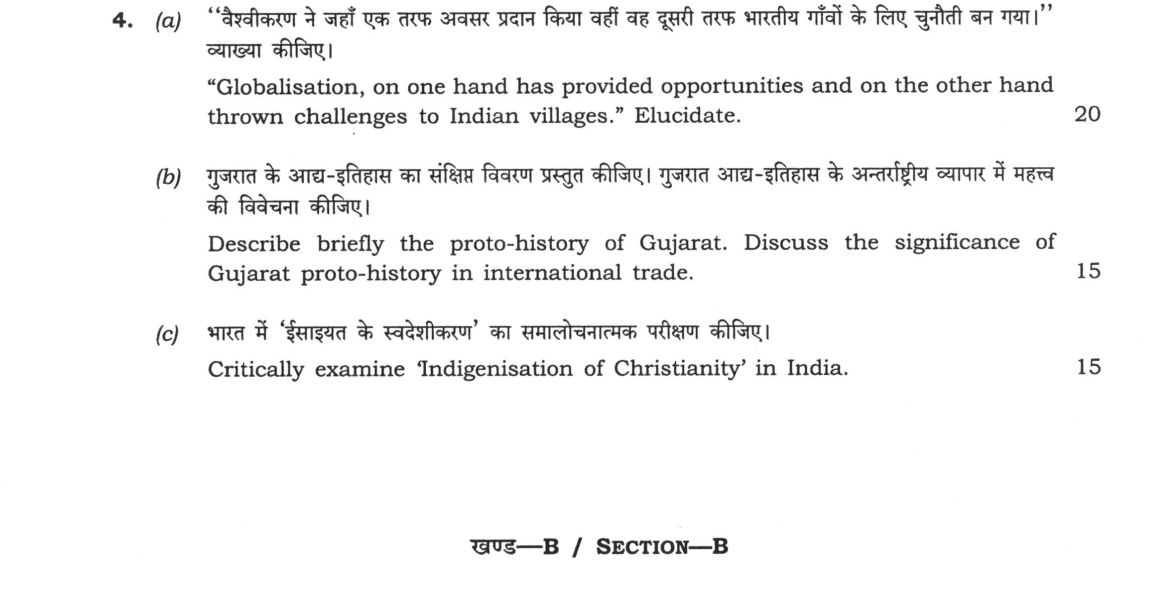
"Globalisation, on one hand has provided opportunities and on the other hand thrown challenges to Indian villages." Elucidate. 20 marks
Describe briefly the proto-history of Gujarat. Discuss the significance of Gujarat proto-history in international trade. 15 marks
Critically examine 'Indigenisation of Christianity' in India. 15 marks
हिंदी में प्रश्न पढ़ें
"वैश्वीकरण ने जहाँ एक तरफ अवसर प्रदान किया वहीं वह दूसरी तरफ भारतीय गाँवों के लिए चुनौती बन गया।" व्याख्या कीजिए। 20
गुजरात के आद्य-इतिहास का संक्षिप्त विवरण प्रस्तुत कीजिए। गुजरात आद्य-इतिहास के अंतर्राष्ट्रीय व्यापार में महत्व की विवेचना कीजिए। 15
भारत में 'ईसाइयत के स्वदेशीकरण' का समालोचनात्मक परीक्षण कीजिए। 15
Model answer
Written by UPSC Answer Check against this question's marking rubric, to the expected length. UPSC does not publish answers for Mains — this is one way to score well, not an official key.
Globalisation, Proto-History, and Religious Indigenisation
Globalisation in India is not a monolithic force but a dialectical process that simultaneously empowers and dispossesses rural communities. To elucidate its dual impact, one must look beyond economic metrics to the socio-cultural fabric of the village.
Part (a): The Dual Impact of Globalisation on Indian Villages
The opportunities presented by globalisation are tangible. The most significant is the inflow of NRI remittances, which have fundamentally restructured village economies, particularly in the "Kerala model" where remittances drive housing, education, and local consumption. Furthermore, ICT-enabled agricultural markets and rural BPOs have created new avenues for non-farm employment, allowing villages to bypass traditional middlemen. However, these opportunities are shadowed by severe challenges. The integration into global supply chains has led to agrarian distress, characterized by land alienation to industrial interests and the rise of farmer suicides due to debt traps. Sociologically, this manifests as de-peasantisation and the erosion of jajmani relations, where traditional reciprocal obligations are replaced by market logic. Theoretically, this can be understood through the lens of articulation of modes of production. While M.N. Srinivas’ concepts of Westernisation and Sanskritisation explain earlier cultural shifts, contemporary globalisation is better analyzed through the framework of "globalisation from below" (associated with scholars like Appadurai), which highlights how local actors selectively appropriate global flows. Jan Breman’s work on labour casualisation further underscores how global capital demands flexible, insecure rural labour, stripping away the social security once provided by the village community.
Part (b): Proto-History of Gujarat and International Trade
The proto-history of Gujarat is anchored in the Indus Valley Civilization (IVC), with key sites including Lothal, Dholavira, and Rangpur. Lothal is renowned for its dockyard, suggesting early maritime infrastructure, and its bead factory. Dholavira stands out for its sophisticated water management systems and the discovery of a signboard, indicating complex social organization. Rangpur provides evidence of early rice cultivation, adding to the agricultural diversity of the region. These sites are not merely local; they are nodes in a vast international trade network. Mesopotamian texts frequently reference "Meluhha," widely identified with the Indus region, highlighting the depth of this interaction. Gujarat’s significance lies in its role as an export hub for carnelian beads and cotton textiles, commodities highly valued in Mesopotamia and the Persian Gulf. The development of maritime technology in the Gulf of Khambhat enabled this Indian Ocean trade network. It is crucial to note that while Gujarat was a processing and export center, raw materials like lapis lazuli were primarily imported from Badakhshan (Afghanistan) into the Indus zone, rather than being sourced locally. This trade facilitated not just economic exchange but also the diffusion of technological and cultural ideas across the ancient world.
Part (c): Critical Examination of Indigenisation of Christianity
The indigenisation of Christianity in India refers to the adaptation of Christian practices to local cultural contexts. This is visible in the Hindu-style architecture of churches, such as the Basilica of Our Lady of Ransom in Velankanni, and the Sanskritisation of liturgy. In regions like Kerala, Syrian Christianity has retained caste structures, integrating with local social hierarchies. Conversely, Dalit Christianity has emerged as a form of social assertion, where conversion is a political act against caste oppression. A critical examination reveals tensions in this process. Lancy Lobo critiques the notion of "Hindu-Christian syncretism," arguing that it often masks underlying power structures and caste prejudices within the church. Rowena Robinson highlights the gendered dimensions of conversion, noting how indigenisation can reinforce patriarchal norms. The central debate is between inculturation (respectful adaptation) and the dilution of core theological tenets. Critics argue that excessive indigenisation can dilute the universal message of Christianity, while proponents argue that it is essential for the faith to be relevant in the Indian context.
Conclusion
Collectively, these three dimensions illustrate the anthropological concept of glocalisation. Whether in the economic restructuring of villages, the ancient trade networks of Gujarat, or the religious adaptation of Christianity, Indian society demonstrates a capacity for selective appropriation rather than passive homogenisation. The verdict is that while global forces exert structural domination, local agency persists in reshaping these forces to fit indigenous realities, ensuring that cultural identity remains dynamic rather than static.
What "Elucidate" is asking you to do
Make a stated proposition plain and then prove it with instances. Elucidate stems almost always carry a claim or a named concept, and very often the words “with examples” or “with suitable diagrams” — the illustration is part of the directive, not decoration.
Structure that answers it
Plain-language statement of what the proposition means → the part that is obscure, resolved → first illustration → second illustration → why the proposition holds
Where marks are lost
Adding terminology; elucidate rewards removing it. The commoner loss is a clean explanation with no example, when the stem asked for examples.
How this answer will be evaluated
Approach
(a) explain: definition/context > points in order > small example > short close | (b) describe: define > structure or process in order > labelled diagram > significance | (c) examine: intro > how/why with reasoning > evidence > conclusion Full marks: Comprehensive, specific, and critically analytical with named examples and sites.
Key points expected
- Define globalisation in the context of rural India
- Detail opportunities: market access, remittances, technology
- Detail challenges: cultural erosion, economic disparity, migration
- Provide specific Indian village examples or case studies
- Define proto-history period for Gujarat (e.g., Harappan)
- Identify key sites: Lothal, Dholavira, Rangpur
- Explain trade significance: maritime routes, artifacts
- Connect to international trade networks (Mesopotamia, etc.)
Evaluation rubric
Each sub-part is marked on its own, against the marks and word limit printed on the paper.
- (a) Explain the dual impact of globalisation on Indian villages (opportunities vs challenges). 20 marks
explain— definition/context → points in order → small example → short close
Must cover
- Define globalisation in the context of rural India
- Detail opportunities: market access, remittances, technology
- Detail challenges: cultural erosion, economic disparity, migration
- Provide specific Indian village examples or case studies
Loses marks
- Generic globalisation definition without rural focus
- Ignoring the 'challenges' aspect of the prompt
- Sociological answers without anthropological context
Earns more
- Reference to specific rural development policies
- Mention of specific tribal or regional contexts
- Discussion of digital divide in rural areas
- Reference to specific anthropological studies on rural change
Extra mark
- Citation of specific government reports (e.g., NITI Aayog)
- Reference to specific tribal policy impacts
- (b) Outline Gujarat's proto-history and its role in international trade. 15 marks
describe— define → structure or process in order → labelled diagram → significance
Must cover
- Define proto-history period for Gujarat (e.g., Harappan)
- Identify key sites: Lothal, Dholavira, Rangpur
- Explain trade significance: maritime routes, artifacts
- Connect to international trade networks (Mesopotamia, etc.)
Loses marks
- Confusing proto-history with ancient history
- Ignoring the 'international trade' aspect
- Vague descriptions without specific site names
Earns more
- Mention of specific artifacts (e.g., dockyard at Lothal)
- Reference to specific trade goods (carnelian, cotton)
- Discussion of urban planning in proto-historic sites
- Mention of specific scholars (e.g., S.R. Rao)
Extra mark
- Reference to specific archaeological excavations
- Mention of specific trade route maps
- (c) Critically analyze the process of 'Indigenisation of Christianity' in India. 15 marks
examine— intro → how/why with reasoning → evidence → conclusion
Must cover
- Define 'Indigenisation of Christianity' in Indian context
- Examine the process: adaptation to local cultures
- Critically evaluate: successes and limitations
- Provide specific examples of indigenised practices
Loses marks
- Descriptive account without critical analysis
- Ignoring the 'indigenisation' aspect
- Generalizing without specific Indian examples
Earns more
- Reference to specific missionaries (e.g., Robert Noble)
- Mention of specific tribal conversions
- Discussion of syncretism in Christian practices
- Reference to specific anthropological studies on conversion
Extra mark
- Citation of specific tribal policy impacts on conversion
- Reference to specific academic works on Indian Christianity
Practice this exact question
Write your answer and it is marked point by point against the model answer above — what you covered, what you missed, what you got wrong.
Evaluate my answer →More from Anthropology 2022 Paper II
- Q1 Write short notes on the following in about 150 words each: 10×5=50 (a) Pit-dwellers of K…
- Q2 (a) Illustrate the contribution of Irawati Karve to Indian Anthropology. Make a special m…
- Q3 (a) Make a critical appraisal of Megalithic tradition in India with special reference to…
- Q4 (a) "Globalisation, on one hand has provided opportunities and on the other hand thrown c…
- Q5 Write short notes on the following in about 150 words each: 10×5=50 (a) Regionalism as an…
- Q6 (a) Discuss the objectives of Integrated Tribal Development Projects (ITDPs). How far hav…
- Q7 (a) Discuss the views of G. S. Ghurye and Verrier Elwin on the approach towards tribal po…