Paper II — Q3
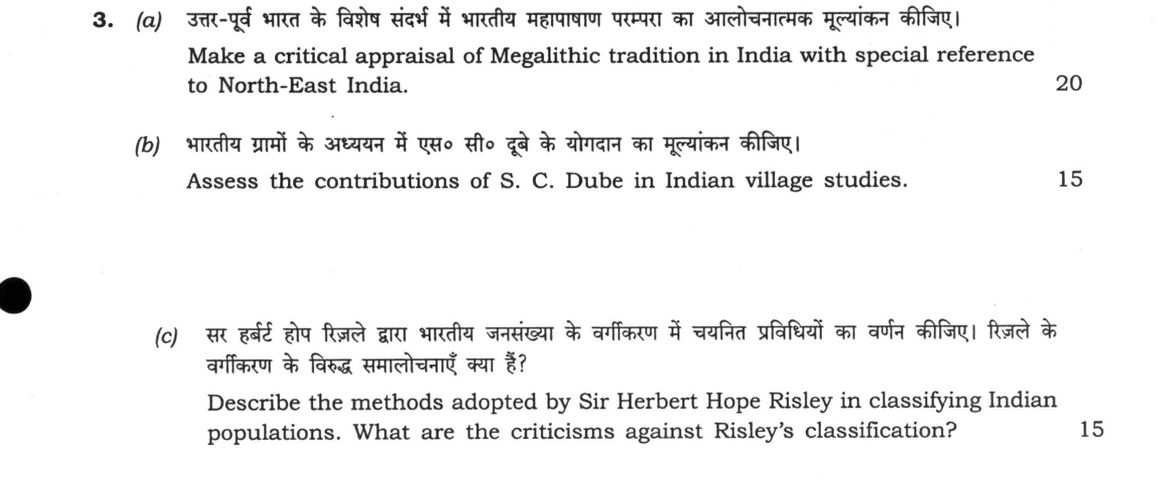
(a) Make a critical appraisal of Megalithic tradition in India with special reference to North-East India. 20 (b) Assess the…
Make a critical appraisal of Megalithic tradition in India with special reference to North-East India. 20 marks
Assess the contributions of S. C. Dube in Indian village studies. 15 marks
Describe the methods adopted by Sir Herbert Hope Risley in classifying Indian populations. What are the criticisms against Risley's classification? 15 marks
हिंदी में प्रश्न पढ़ें
उत्तर-पूर्व भारत के विशेष संदर्भ में भारतीय महापाषाण परंपरा का आलोचनात्मक मूल्यांकन कीजिए। 20
भारतीय ग्रामों के अध्ययन में एस० सी० दुबे के योगदान का मूल्यांकन कीजिए। 15
सर हर्बर्ट होप रिजले द्वारा भारतीय जनसंख्या के वर्गीकरण में चयनित प्रविधियों का वर्णन कीजिए। रिजले के वर्गीकरण के विरुद्ध समालोचनाएँ क्या हैं? 15 marks
Model answer
Written by UPSC Answer Check against this question's marking rubric, to the expected length. UPSC does not publish answers for Mains — this is one way to score well, not an official key.
Indian anthropology encompasses a dynamic trajectory transitioning from colonial racial classifications to functional village monographs and ethno-archaeological inquiries into prehistoric material culture.
Megalithic Tradition in India with Special Reference to North-East India
The Megalithic tradition in India encompasses monuments constructed of large stones, functionally classified into sepulchral (cist burials, dolmenoid cists, urn burials, cairn circles) and non-sepulchral or commemorative types (menhirs, alignment stones, stone seats). While peninsular Indian megaliths (e.g., Brahmagiri, Adichanallur) are extinct, Iron Age archaeological horizons associated with Black-and-Red Ware, North-East India presents a globally significant "living megalithic culture."
Among the Khasi, Jaintia, and Naga (particularly Angami and Maram) communities, megaliths remain actively integrated into socio-religious life. As documented by colonial ethnographers like P.R.T. Gurdon (among the Khasi) and J.H. Hutton (among the Nagas), menhirs (Mawbynna or Mawlong) and dolmens (Mawkjat) serve as bone-deposition repositories (Mawbah), clan alliances, and markers of status earned through Feasts of Merit.
A critical appraisal reveals severe empirical and theoretical challenges in North-Eastern megalithic studies. First, unlike peninsular megaliths, several North-Eastern sites lack an explicit association with iron or diagnostic pottery, creating stratigraphic ambiguities. Second, absolute chronology remains problematic; recent Accelerator Mass Spectrometry (AMS) dating challenges uniform antiquity, showing chronologies ranging from the late prehistoric to the modern ethnographic present. Third, an unresolved debate persists between diffusionist models—which link North-East megaliths to Southeast Asian Austronesian/Mon-Khmer migrations—and indigenous evolution models emphasizing local ecological adaptations. Thus, while peninsular studies rely purely on archaeological inference, North-East India provides an indispensable ethno-archaeological bridge, demonstrating that megalithism is a cultural process rather than a static chronological marker.
S. C. Dube's Contributions to Indian Village Studies
S.C. Dube fundamentally reshaped Indian rural sociology by moving beyond colonial notions of the village as an isolated, self-sufficient "little republic." Through his seminal monographs Indian Village (1955), based on field studies in Shamirpet (Telangana), and India's Changing Villages (1958), Dube pioneered a comprehensive structural-functional approach.
Methodologically, Dube broke new ground by utilizing interdisciplinary teams and demonstrating how Shamirpet was tied to wider regional social fields through economic ties, kinship networks, religious pilgrimages, and political structures. In India's Changing Villages, he engineered a vital shift from pure functionalism to applied anthropology, critically evaluating planned change under the Community Development Programme (CDP).
However, Dube’s contribution warrants critical scrutiny. His analysis of social change overemphasized a top-down developmental perspective, assuming bureaucratic state interventions would smoothly modernize rural stratification. Furthermore, Dube contested M.N. Srinivas’s overarching concept of Sanskritization, arguing that it failed to capture the multifaceted nature of status mobility, which also drew upon Western, localized, and non-Brahmanical reference models. Ultimately, Dube’s lasting legacy lies in grounding village studies in empirical, policy-oriented applied anthropology.
Herbert Risley's Racial Classification and its Critiques
Sir Herbert Hope Risley pioneered colonial racial classification using systematic anthropometry, detailed in The Tribes and Castes of Bengal (1891) and The People of India (1908). Risley’s primary methodology relied on physical measurements, notably the nasal index (breadth divided by height) and cephalic index, supplemented by standardized ethnographic photography. Based on these metrics, he classified the Indian population into seven morphological types: Turko-Iranian, Indo-Aryan, Scytho-Dravidian, Aryo-Dravidian, Mongolo-Dravidian, Mongoloid, and Dravidian. Risley formulated a rigid caste-race equation, postulating that a group's social position varied inversely with its nasal index.
Risley’s framework faced severe scientific invalidation. His methodology was driven by scientific racism designed to legitimize colonial governance through divide-and-rule. His core premise committed circular reasoning by taking socially constructed caste hierarchies to validate biological racial divisions. Furthermore, Risley treated cranial and nasal traits as fixed genetic markers, completely ignoring Franz Boas’s demonstrations of environmental plasticity. Later anthropologists such as B.S. Guha and D.N. Majumdar thoroughly rejected Risley’s seven-fold taxonomy, demonstrating significant sampling biases and measuring errors. Modern population genetics (e.g., Reich et al.) has conclusively refuted his racial typology, demonstrating that Indian genetic structure is characterized by Ancestral North Indian (ANI) and Ancestral South Indian (ASI) ancestral clines shaped by endogamy rather than discrete, unmixed racial types.
Conclusion
Indian anthropology’s progress is marked by its decisive departure from Risley’s flawed biological determinism toward Dube's rigorous functional and applied analyses, while the living megalithic traditions of North-East India continue to dismantle rigid colonial distinctions between prehistoric archaeology and contemporary ethnography.
What "Critically evaluate" is asking you to do
Judge how well something has performed against the standard it set for itself — its stated aim, mandate or promise — and commit to a verdict. Name the yardstick before you judge; an unanchored judgement reads as opinion. “Critically” is not a section added at the end: name the yardstick you are judging by — the evidence, the stated objective, a constitutional principle, a rival explanation — and let a verdict close each part of the body. Where the question quotes a claim, that verdict must land on the claim itself, accepted, qualified or rejected, and not on the theme in general.
Structure that answers it
Name the yardstick — stated aim, mandate or benchmark → performance against it → shortfall against it → why the gap exists → verdict
Where marks are lost
Merits in one paragraph, demerits in the next, and a conclusion calling for a balanced and holistic approach. That is a survey with the judgement left out and it holds the answer in the middle band. The opposite error is reading “critically” as permission to attack — and with the odd pairings, critically describe or critically explain, the exposition still carries most of the marks, the judgement being a layer on it rather than a substitute for it.
How this answer will be evaluated
Approach
(a) critique: the claim > its strengths > its weaknesses > your judgment | (b) evaluate: criteria > evidence > balanced judgment | (c) describe: define > structure or process in order > labelled diagram > significance Full marks: Comprehensive, critical, and well-supported with specific examples and scholars.
Key points expected
- Define Megalithic tradition and its chronological scope
- Describe specific North-East sites (e.g., Khasi, Jaintia)
- Critique the 'Megalithic culture' concept (e.g., diffusionism)
- Link to specific tribal groups (e.g., Khasi, Garo)
- Identify Dube's key works (e.g., 'Indian Village')
- Explain his methodological approach (participant observation)
- Discuss his view on caste and village structure
- Evaluate his impact on subsequent village studies
Evaluation rubric
Each sub-part is marked on its own, against the marks and word limit printed on the paper.
- (a) Critical appraisal of Megalithic tradition in India, focusing on North-East India. 20 marks
critique— the claim → its strengths → its weaknesses → your judgment
Must cover
- Define Megalithic tradition and its chronological scope
- Describe specific North-East sites (e.g., Khasi, Jaintia)
- Critique the 'Megalithic culture' concept (e.g., diffusionism)
- Link to specific tribal groups (e.g., Khasi, Garo)
Loses marks
- Treating megaliths as a single uniform culture
- Ignoring the specific North-East context
- Lack of critical analysis of the term 'tradition'
Earns more
- Mention specific scholars (e.g., H.N. Chaudhary)
- Discuss function of megaliths (ritual vs. status)
- Reference specific excavation reports or sites
- Compare North-East with South Indian traditions
Extra mark
- Labelled diagram of a dolmen or menhir
- Reference to recent tribal policy on heritage
- (b) Assessment of S. C. Dube's contributions to Indian village studies. 15 marks
evaluate— criteria → evidence → balanced judgment
Must cover
- Identify Dube's key works (e.g., 'Indian Village')
- Explain his methodological approach (participant observation)
- Discuss his view on caste and village structure
- Evaluate his impact on subsequent village studies
Loses marks
- Confusing Dube with other village study scholars
- Failing to assess the impact of his work
- Lack of specific examples from his fieldwork
Earns more
- Mention specific villages studied (e.g., Bishpurzi)
- Compare with M.N. Srinivas's approach
- Discuss his concept of 'village as a social system'
- Reference his work on caste mobility
Extra mark
- Reference to specific ethnographic details from his work
- Mention of his influence on policy or academia
- (c) Description of Risley's methods and criticisms of his classification. 15 marks
describe— define → structure or process in order → labelled diagram → significance
Must cover
- Describe Risley's method (nasal index)
- Explain his classification (Aryans, Dravidians, etc.)
- Discuss the criticisms of his method (e.g., biological)
- Mention the social/political context of his work
Loses marks
- Presenting Risley's view as scientifically valid
- Ignoring the social context of his classification
- Lack of specific details on his method
Earns more
- Mention specific indices used (nasal, cephalic)
- Discuss the 'Aryan-Dravidian' debate
- Reference specific critics (e.g., Srinivas, Chaudhary)
- Link to colonial administrative needs
Extra mark
- Sketch of the nasal index measurement
- Reference to modern genetic studies contradicting him
Practice this exact question
Write your answer and it is marked point by point against the model answer above — what you covered, what you missed, what you got wrong.
Evaluate my answer →More from Anthropology 2022 Paper II
- Q1 Write short notes on the following in about 150 words each: 10×5=50 (a) Pit-dwellers of K…
- Q2 (a) Illustrate the contribution of Irawati Karve to Indian Anthropology. Make a special m…
- Q3 (a) Make a critical appraisal of Megalithic tradition in India with special reference to…
- Q4 (a) "Globalisation, on one hand has provided opportunities and on the other hand thrown c…
- Q5 Write short notes on the following in about 150 words each: 10×5=50 (a) Regionalism as an…
- Q6 (a) Discuss the objectives of Integrated Tribal Development Projects (ITDPs). How far hav…