Paper II — Q7
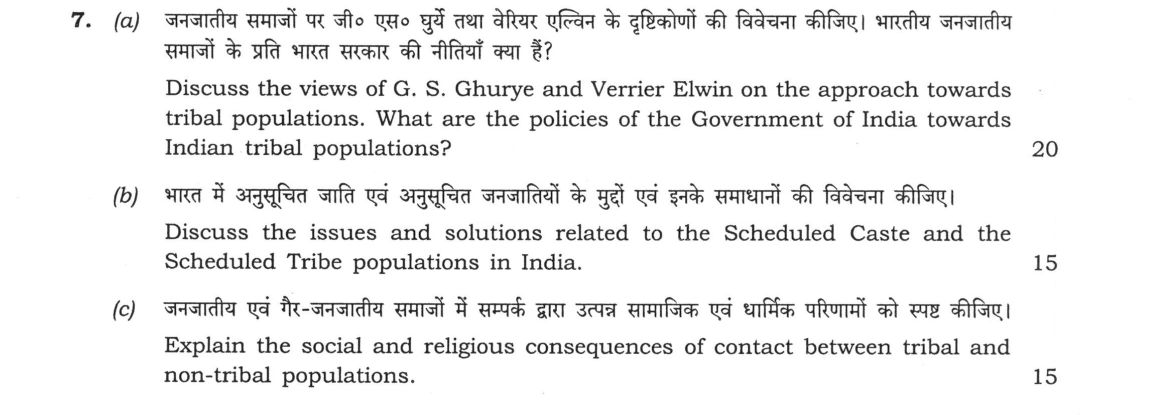
(a) Discuss the views of G. S. Ghurye and Verrier Elwin on the approach towards tribal populations. What are the policies of the…
Discuss the views of G. S. Ghurye and Verrier Elwin on the approach towards tribal populations. What are the policies of the Government of India towards Indian tribal populations? 20 marks
Discuss the issues and solutions related to the Scheduled Caste and the Scheduled Tribe populations in India. 15 marks
Explain the social and religious consequences of contact between tribal and non-tribal populations. 15 marks
हिंदी में प्रश्न पढ़ें
जनजातीय समाजों पर जी० एस० घुर्ये तथा वेरियर एल्विन के दृष्टिकोणों की विवेचना कीजिए। भारतीय जनजातीय समाजों के प्रति भारत सरकार की नीतियाँ क्या हैं? 20 marks
भारत में अनुसूचित जाति एवं अनुसूचित जनजातियों के मुद्दे एवं इनके समाधानों की विवेचना कीजिए। 15
जनजातीय एवं गैर-जनजातीय समाजों में सम्पर्क द्वारा उत्पन्न सामाजिक एवं धार्मिक परिणामों को स्पष्ट कीजिए। 15
Model answer
Written by UPSC Answer Check against this question's marking rubric, to the expected length. UPSC does not publish answers for Mains — this is one way to score well, not an official key.
The Ghurye-Elwin Debate and Tribal Policy
The debate between G.S. Ghurye and Verrier Elwin remains the foundational axis for understanding India’s approach to tribal populations. Ghurye viewed tribes as "backward Hindus," arguing that their isolation was a temporary phase of development. He advocated for rapid integration into the mainstream, believing that contact with the dominant caste society would modernize tribal life and eliminate "primitive" traits. In contrast, Elwin championed "protective isolationism," arguing that tribal cultures were distinct, self-sufficient, and superior in their social cohesion. He warned that contact would lead to exploitation and cultural destruction. Later, Elwin shifted to a "middle way," advocating for development that respected tribal identity without forcing assimilation. This philosophical tension—integration versus preservation—has shaped Indian policy from colonial isolation to post-Independence constitutional protections.
Government Policies: From Isolation to Empowerment
Post-Independence policy evolved to balance these views. The Constitution provides the framework: Article 244(1) and the Fifth Schedule allow the President to make special provisions for tribal areas in eight states, while Article 244(2) and the Sixth Schedule grant autonomous administrative councils in six northeastern states. The "Panchsheel" principles (1956) guided development, emphasizing no land acquisition, no conversion, and no change in customs without tribal consent. The Panchayats (Extension to Scheduled Areas) Act, 1996 (PESA), devolved power to Gram Sabhas, recognizing their traditional authority. The Forest Rights Act, 2006 (FRA), further empowered tribes by recognizing their rights over forest lands, addressing historical alienation.
Issues and Solutions for SCs and STs
Scheduled Castes (SCs) and Scheduled Tribes (STs) face distinct yet intersecting challenges. SCs primarily grapple with untouchability, manual scavenging, and caste-based atrocities. STs face land alienation, displacement due to industrialization, and cultural erosion. Both groups suffer from economic marginalization and social exclusion.
Constitutional and legislative solutions include the Protection of Civil Rights Act, 1955, and the Scheduled Castes and Scheduled Tribes (Prevention of Atrocities) Act, 1989, which was strengthened by the 2015 Amendment to include specific offenses and mandatory timelines. Reservation policies in education and employment aim to ensure representation. For STs, the Vanbandhu Kalyan Yojana focuses on holistic development, while the Tribal Sub-Plan (TSP) under the National Rural Livelihood Mission ensures targeted funding. Judicial interventions, such as the Supreme Court’s rulings on FRA implementation, have reinforced the right to land and forest, though enforcement remains a challenge.
Social and Religious Consequences of Contact
Contact between tribal and non-tribal populations has profound social and religious impacts. Socially, it leads to acculturation and detribalization. Traditional authority structures, such as village councils, often weaken as modern legal and political systems encroach. The shift from jhum (shifting cultivation) to settled agriculture, driven by market integration, alters livelihoods and social hierarchies. The emergence of a tribal middle class, often educated and urbanized, creates internal stratification and tension with traditional norms. Gender roles also shift, with women increasingly participating in wage labor, challenging patriarchal structures.
Religiously, contact has triggered conversion movements and revitalization. Christian missions and Hinduization efforts (Sanskritization) have led to significant conversions, often motivated by social mobility or resistance to caste oppression. Conversely, revitalization movements like the Tana Bhagat movement (under Jatu Ram Murmu) and the Birsa Munda uprising sought to restore tribal autonomy and reject external religious and political control. Syncretism is also common, where tribal deities are merged with Hindu pantheon figures, creating hybrid religious practices that reflect both resistance and adaptation.
Conclusion
The Ghurye-Elwin debate is not merely historical; it defines the contemporary tension between development and displacement. Current policies, such as PESA and FRA, attempt to honor Elwin’s call for autonomy while facilitating Ghurye’s vision of integration. However, the effectiveness of these policies depends on their implementation. The way forward lies in a "middle way" that ensures tribal participation in decision-making, protects their land and culture, and provides economic opportunities without erasing their identity. Addressing the root causes of marginalization—land rights, education, and social justice—is essential for a just and inclusive India.
What "Discuss" is asking you to do
Lay the issue out from more than one side — how it arose, what is claimed for it, what is held against it, and where it now stands. UPSC attaches discuss to broad topics with several live dimensions, so coverage of the dimensions earns more than the strength of your opinion.
Structure that answers it
Set the issue up → the case as it is made → the case against → the dimension both sides leave out → where the balance now lies
Where marks are lost
Listing facts with no thread between them, or arguing one side throughout and calling it a discussion.
How this answer will be evaluated
Approach
Framework: UPSC Anthropology Paper II Rubric. (a) discuss: intro > 3-4 dimensions > example > balanced close | (b) discuss: intro > 3-4 dimensions > example > balanced close | (c) explain: definition/context > points in order > small example > short close Full marks: Precise anthropological terminology, specific examples, balanced analysis, clear structure
Key points expected
- Ghurye's 'Primitive' vs 'Tribal' distinction
- Elwin's 'Tribal' vs 'Adivasi' distinction
- Ghurye's integrationist approach to tribes
- Elwin's protectionist approach to tribes
- Specific issues faced by SC populations
- Specific issues faced by ST populations
- Government solutions for SC populations
- Government solutions for ST populations
Evaluation rubric
Each sub-part is marked on its own, against the marks and word limit printed on the paper.
- (a) Compare Ghurye and Elwin's tribal approaches and detail Indian government policies. 20 marks
discuss— intro → 3-4 dimensions → example → balanced close
Must cover
- Ghurye's 'Primitive' vs 'Tribal' distinction
- Elwin's 'Tribal' vs 'Adivasi' distinction
- Ghurye's integrationist approach to tribes
- Elwin's protectionist approach to tribes
Loses marks
- Confusing Ghurye and Elwin's views
- Ignoring the policy component of the question
- Vague generalities without specific anthropological terms
Earns more
- Mention of Fifth/Fifth Schedule provisions
- Reference to PESA Act 1996
- Discussion of tribal welfare schemes
- Comparison of their anthropological schools
Extra mark
- Citing specific tribal policy documents
- Mentioning specific tribal welfare committees
- (b) Analyze issues and solutions for SC and ST populations in India. 15 marks
discuss— intro → 3-4 dimensions → example → balanced close
Must cover
- Specific issues faced by SC populations
- Specific issues faced by ST populations
- Government solutions for SC populations
- Government solutions for ST populations
Loses marks
- Treating SC and ST as identical
- Listing issues without corresponding solutions
- Ignoring the 'solutions' part of the question
Earns more
- Reference to specific SC/ST schemes
- Mention of constitutional provisions
- Discussion of social discrimination
- Economic empowerment strategies
Extra mark
- Citing specific SC/ST welfare statistics
- Mentioning specific SC/ST rights cases
- (c) Explain social and religious consequences of tribal-non-tribal contact. 15 marks
explain— definition/context → points in order → small example → short close
Must cover
- Social consequences of tribal-non-tribal contact
- Religious consequences of tribal-non-tribal contact
- Examples of social changes in tribes
- Examples of religious changes in tribes
Loses marks
- Confusing social and religious consequences
- Ignoring the 'contact' aspect of the question
- Vague generalities without specific examples
Earns more
- Discussion of syncretism in tribal religion
- Mention of caste system influence
- Reference to specific tribal examples
- Analysis of cultural assimilation
Extra mark
- Citing specific tribal conversion cases
- Mentioning specific tribal social changes
Practice this exact question
Write your answer and it is marked point by point against the model answer above — what you covered, what you missed, what you got wrong.
Evaluate my answer →More from Anthropology 2022 Paper II
- Q4 (a) "Globalisation, on one hand has provided opportunities and on the other hand thrown c…
- Q5 Write short notes on the following in about 150 words each: 10×5=50 (a) Regionalism as an…
- Q6 (a) Discuss the objectives of Integrated Tribal Development Projects (ITDPs). How far hav…
- Q7 (a) Discuss the views of G. S. Ghurye and Verrier Elwin on the approach towards tribal po…
- Q8 (a) Compare the nature of tribal movements between North-East and Central India. Briefly…