Paper II — Q8
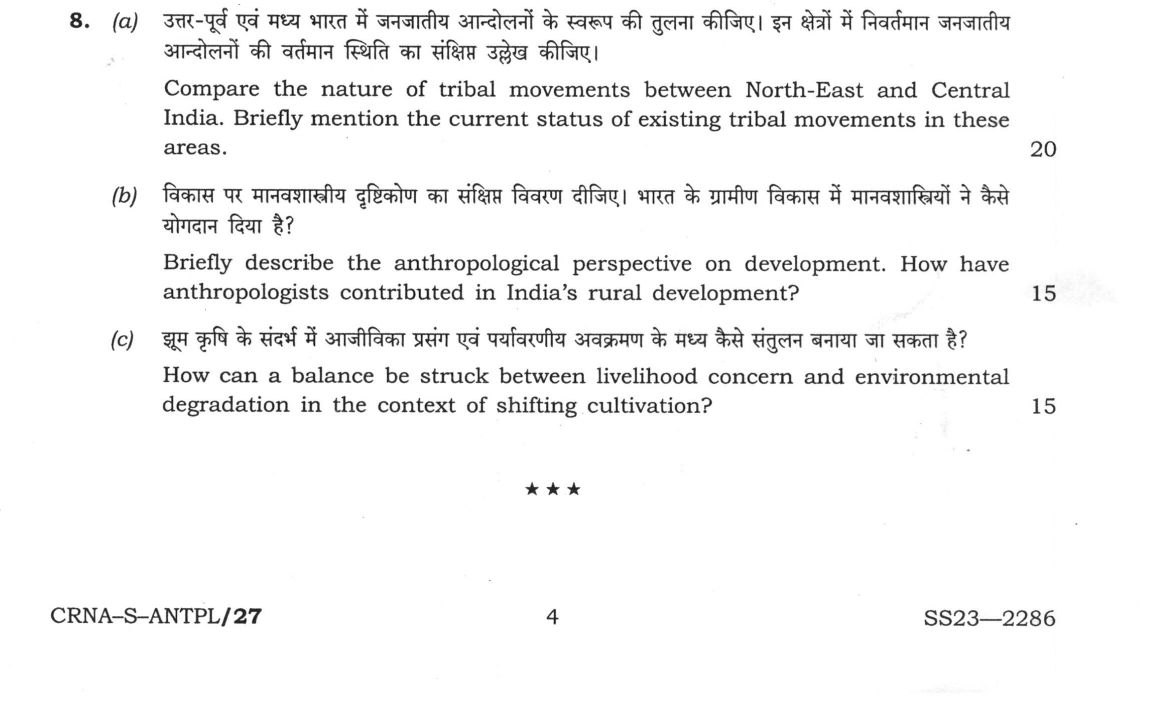
(a) Compare the nature of tribal movements between North-East and Central India. Briefly mention the current status of existing…
Compare the nature of tribal movements between North-East and Central India. Briefly mention the current status of existing tribal movements in these areas. 20 marks
Briefly describe the anthropological perspective on development. How have anthropologists contributed in India's rural development? 15 marks
How can a balance be struck between livelihood concern and environmental degradation in the context of shifting cultivation? 15 marks
हिंदी में प्रश्न पढ़ें
उत्तर-पूर्व एवं मध्य भारत में जनजातीय आंदोलनों के स्वरूप की तुलना कीजिए। इन क्षेत्रों में निवर्तमान जनजातीय आंदोलनों की वर्तमान स्थिति का संक्षिप्त उल्लेख कीजिए। 20
विकास पर मानवशास्त्रीय दृष्टिकोण का संक्षिप्त विवरण दीजिए। भारत के ग्रामीण विकास में मानवशास्त्रियों ने कैसे योगदान दिया है? 15 marks
झूम कृषि के संदर्भ में आजीविका प्रसंग एवं पर्यावरणीय अवक्षयण के मध्य कैसे संतुलन बनाया जा सकता है? 15 marks
Model answer
Written by UPSC Answer Check against this question's marking rubric, to the expected length. UPSC does not publish answers for Mains — this is one way to score well, not an official key.
Comparative Nature and Current Status of Tribal Movements
Tribal movements in India reflect distinct socio-ecological conditions and historical trajectories across North-East and Central India.
In their ideological orientation and causation, movements in North-East India have primarily been ethno-nationalist and identity-driven, seeking political self-determination, autonomy, or complete secession, as witnessed in the Naga movement led by the NNC, the Mizo National Front, and the Bodo agitation. Conversely, Central Indian movements have historically been agrarian and resource-based, rising against land alienation, forced displacement, forest enclosure, and exploitation by non-tribals (dikus), exemplified by Birsa Munda’s Ulgulan, the Santhal Hul, and Bhil and Gond uprisings.
Regarding their relationship with the Indian State, North-Eastern movements emerged from distinct geopolitical peripheries, challenging constitutional assimilation and often adopting armed insurgency. Central Indian movements, in contrast, have largely sought restorative justice, economic protection, and inclusion within the constitutional framework through defensive struggles against colonial and neo-colonial resource extraction. Both regions, however, share the fundamental characteristic of tribal agency resisting the disruption of traditional socio-political structures.
Currently, the North-East is witnessing a phase of post-insurgency institutionalization. The region has transitioned towards democratic integration through peace accords (such as the 2020 Bodo Accord and Karbi Anglong settlement) and strengthening of Sixth Schedule autonomous councils, though residual militancy and inter-ethnic tensions persist. In Central India, current mobilization is focused on anti-mining displacement protests, assertion of community rights under the Forest Rights Act (FRA) 2006, and democratic self-governance, while remaining entangled in security challenges arising from Left-Wing Extremism (Maoist influence).
Anthropological Perspective on Development and Rural Contributions
The anthropological perspective critiques top-down, technocentric models of modernization, advocating instead for cultural relativism, bottom-up participatory approaches, and the integration of indigenous knowledge systems. S.C. Dube pioneered Indian development anthropology, demonstrating that planned change cannot succeed as a purely economic exercise; it must be culturally compatible with local social structures.
Anthropologists have shaped Indian rural development across multiple domains. M.N. Srinivas used intensive village studies to provide empirical insights into caste dynamics, social change, and the role of dominant castes, which grounded rural planning in social reality. Robert Chambers’ development of Participatory Rural Appraisal (PRA) techniques transformed development planning into a collaborative process with rural communities. Furthermore, anthropological insights were foundational in formulating the Tribal Sub-Plan (TSP) approach, enacting the Panchayats (Extension to Scheduled Areas) Act (PESA), 1996, and designing community-led action research in watershed management.
Balancing Livelihood Concerns and Environmental Degradation in Shifting Cultivation
Shifting cultivation (jhum), widely practiced in North-East India, forms an integrated socio-cultural and food-security system for indigenous communities. However, population pressures and land-tenure changes have drastically reduced the fallow cycle from 15–20 years to 2–5 years, leading to soil erosion, biodiversity loss, and ecological degradation.
A balance between tribal livelihoods and ecological conservation requires shifting from coercive eradication to sustainable modification:
First, agroforestry must be integrated into fallow management. The indigenous Alder (Alnus nepalensis) agroforestry model of Khonoma in Nagaland illustrates how nitrogen-fixing trees can maintain soil fertility even under short fallow cycles.
Second, zonal alternation and scientific contour cropping can stabilize fragile upland slopes while preserving staple crop diversity.
Third, state support through the North Eastern Council (NEC) and the Ministry of Tribal Affairs should facilitate value-addition and organic certification under schemes like the Mission Organic Value Chain Development for North Eastern Region (MOVCD-NER), ensuring higher economic returns from smaller landholdings.
Finally, conferring Community Forest Resource rights under the FRA, 2006 provides the tenurial security necessary for communities to invest in long-term soil conservation and sustainable fallow management.
Balancing tribal rights with national development requires institutional mechanisms that respect indigenous autonomy, secure tenurial rights, and utilize traditional ecological knowledge for sustainable resource governance.
What "Compare" is asking you to do
Set the items against each other on named dimensions. In UPSC practice compare already carries both halves — likeness and difference — and where the stem names the dimensions, as in region, nature and climatic impact, those are the headings the examiner expects to see.
Structure that answers it
Dimensions named → both items on dimension 1 → dimension 2 → dimension 3 → where they converge and where they part
Where marks are lost
Two self-contained descriptive blocks with the comparison left for the reader to make. Marks here sit on the dimensions, so an answer that names none of them gives the examiner nothing to award.
How this answer will be evaluated
Approach
(a) compare: paired headings or table > key differences > significance > conclusion | (b) describe: define > structure or process in order > labelled diagram > significance | (c) suggest: the problem in one line > implementable measures > who acts > conclusion Full marks: Comprehensive, specific, and well-structured answers with clear examples and theoretical grounding.
Key points expected
- Contrast NE (identity/autonomy) vs Central (land/resource) nature
- Identify specific NE movements (e.g., Naga, Mizo, Bodo)
- Identify specific Central movements (e.g., Naxal, Gond, Santhal)
- Briefly mention current status of movements in both regions
- Define anthropological perspective on development (holistic, cultural)
- Explain how anthropologists contribute to rural development
- Provide specific examples of anthropological contributions
- Link anthropological insights to practical rural development outcomes
Evaluation rubric
Each sub-part is marked on its own, against the marks and word limit printed on the paper.
- (a) Contrast tribal movement nature in NE vs Central India and state current status. 20 marks
compare— paired headings or table → key differences → significance → conclusion
Must cover
- Contrast NE (identity/autonomy) vs Central (land/resource) nature
- Identify specific NE movements (e.g., Naga, Mizo, Bodo)
- Identify specific Central movements (e.g., Naxal, Gond, Santhal)
- Briefly mention current status of movements in both regions
Loses marks
- Treating NE and Central India as identical
- Ignoring the 'current status' part of the question
- Vague generalizations without specific tribal examples
Earns more
- Reference to specific tribal leaders or organizations
- Mention of specific demands (e.g., Sixth Schedule, PESA)
- Distinction between political vs socio-economic demands
- Reference to specific geographical features influencing nature
Extra mark
- Reference to specific recent policy or agreement
- Mention of specific dates of movement formation
- (b) Explain anthropological perspective on development and anthropologists' contribution to rural development. 15 marks
describe— define → structure or process in order → labelled diagram → significance
Must cover
- Define anthropological perspective on development (holistic, cultural)
- Explain how anthropologists contribute to rural development
- Provide specific examples of anthropological contributions
- Link anthropological insights to practical rural development outcomes
Loses marks
- Confusing anthropological with sociological perspectives
- Ignoring the 'contribution' part of the question
- Vague statements without specific examples
Earns more
- Mention of specific anthropologists (e.g., M.N. Srinivas, G.S. Ghurye)
- Reference to specific rural development programs
- Discussion of cultural sensitivity in development
- Mention of specific tribal or rural communities studied
Extra mark
- Reference to specific anthropological theories of development
- Mention of specific fieldwork locations
- (c) Suggest how to balance livelihood and environmental concerns in shifting cultivation. 15 marks
suggest— the problem in one line → implementable measures → who acts → conclusion
Must cover
- Identify the tension between livelihood and environment
- Suggest specific measures to balance both concerns
- Explain how these measures work in practice
- Consider the needs of tribal communities
Loses marks
- Ignoring the livelihood aspect
- Ignoring the environmental aspect
- Vague suggestions without practical implementation
Earns more
- Mention of specific sustainable practices
- Reference to government policies or programs
- Discussion of community-based management
- Mention of specific crops or techniques
Extra mark
- Reference to specific case studies
- Mention of specific environmental data
Practice this exact question
Write your answer and it is marked point by point against the model answer above — what you covered, what you missed, what you got wrong.
Evaluate my answer →More from Anthropology 2022 Paper II
- Q5 Write short notes on the following in about 150 words each: 10×5=50 (a) Regionalism as an…
- Q6 (a) Discuss the objectives of Integrated Tribal Development Projects (ITDPs). How far hav…
- Q7 (a) Discuss the views of G. S. Ghurye and Verrier Elwin on the approach towards tribal po…
- Q8 (a) Compare the nature of tribal movements between North-East and Central India. Briefly…