Paper II — Q2
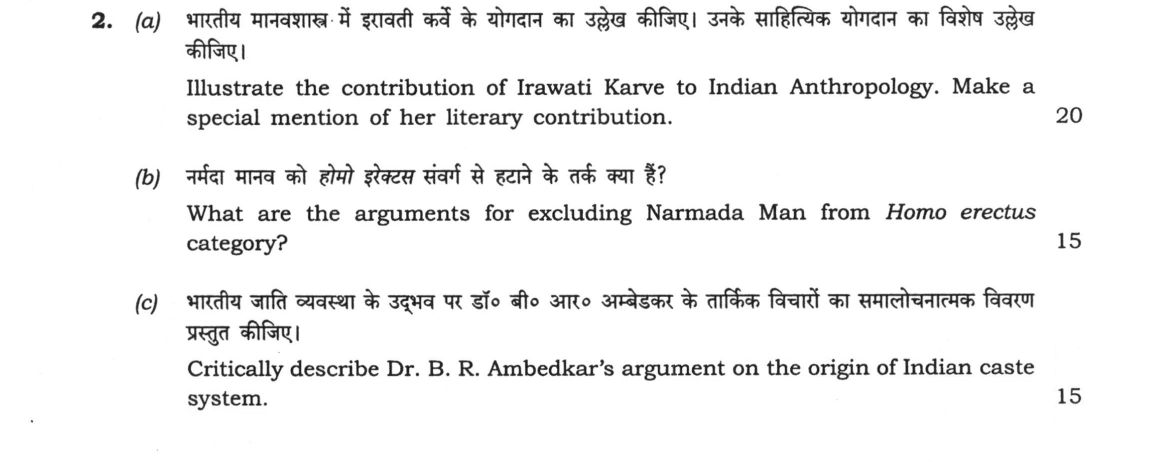
(a) Illustrate the contribution of Irawati Karve to Indian Anthropology. Make a special mention of her literary contribution…
Illustrate the contribution of Irawati Karve to Indian Anthropology. Make a special mention of her literary contribution. 20 marks
What are the arguments for excluding Narmada Man from Homo erectus category? 15 marks
Critically describe Dr. B. R. Ambedkar's argument on the origin of Indian caste system. 15 marks
हिंदी में प्रश्न पढ़ें
भारतीय मानवशास्त्र में इरावती कर्वे के योगदान का उल्लेख कीजिए। उनके साहित्यिक योगदान का विशेष उल्लेख कीजिए। 20
नर्मदा मानव को होमो इरेक्टस संवर्ग से हटाने के तर्क क्या हैं? 15 marks
भारतीय जाति व्यवस्था के उद्भव पर डॉ० बी० आर० अम्बेडकर के तार्किक विचारों का समालोचनात्मक विवरण प्रस्तुत कीजिए। 15
Model answer
Written by UPSC Answer Check against this question's marking rubric, to the expected length. UPSC does not publish answers for Mains — this is one way to score well, not an official key.
Indian anthropology integrates palaeoanthropological discoveries, indigenous socio-cultural formulations, and critical social theories to map the biocultural evolution and structural realities of the subcontinent.
Irawati Karve: Indological Fieldwork and Literary Anthropology Irawati Karve pioneered an indigenous synthesis of classical Indology, physical anthropometry, and empirical fieldwork, establishing the Department of Anthropology at Deccan College and Pune University. Her landmark work Kinship Organization in India (1953) mapped four distinct regional kinship zones (Northern, Central, Southern, Eastern) across linguistic and geographical boundaries, illustrating how cross-cousin marriages in the South contrast with strict village exogamy in the North. In Hindu Society: An Interpretation (1961), she challenged Furnivall's plural society model, defining caste as an agglomerative, federated structure where jatis of distinct ethnic origins merged into an overarching varna framework.
Karve's literary contributions uniquely humanized anthropological inquiry. In Yuganta: The End of an Epoch (1967 Sahitya Akademi Award), she applied socio-anthropological realism to the Mahabharata, deconstructing characters like Draupadi, Kunti, and Bhishma not as divine archetypes, but as individuals constrained by patriarchal kin obligations, polyandry, and feudal power dynamics. Her Marathi essays in Bhovara and Paripurti further wove autobiographical ethnography with everyday village and regional life in Maharashtra, making anthropology accessible beyond academia.
**Taxonomic Exclusion of Narmada Man from *Homo erectus*** The fossil calvaria discovered in 1982 by Arun Sonakia at Hathnora in the Middle Pleistocene Narmada valley alluvium was initially classified as an advanced Homo erectus narmadensis. However, subsequent anatomical reappraisals, notably by Kenneth A. R. Kennedy, provided compelling morphometric grounds to exclude it from the sensu stricto Homo erectus taxon.
First, the cranial capacity of Narmada Man is estimated between 1155 cc and 1421 cc, significantly exceeding the typical Homo erectus range (750–1050 cc) and overlapping with modern Homo sapiens. Second, morphological analysis reveals derived neurocranial traits: pronounced parietal bossing, an expanded cranial vault, a higher vertical forehead, and the absence of a distinct angular torus or classic sagittal keeling characteristic of Asian Homo erectus (such as Java and Peking Man). Consequently, palaeoanthropologists classify the Hathnora hominin as an "archaic *Homo sapiens*" or Homo heidelbergensis, representing a transitional evolutionary grade bridging late erectines and early anatomically modern humans in South Asia.
Ambedkar's Critique of the Genesis of Caste In Castes in India: Their Mechanism, Genesis and Development (1916) and Annihilation of Caste (1936), Dr. B. R. Ambedkar formulated a structural-mechanistic theory of caste origin, rejecting the biological-racial theories of Herbert Risley and the purely economic-occupational determinism of J. C. Nesfield. Ambedkar demonstrated that caste is not merely a "division of labour," but a hierarchical "division of labourers" enforced without individual agency.
Ambedkar defined caste essentially as an "enclosed class." He argued that the original Hindu society was divided into open classes based on occupational aptitude. The priestly class (Brahmins) first enclosed itself into a closed group by instituting strict endogamy. To maintain the numerical balance between marriageable males and females within the enclosed unit, institutions like sati (burning of the widow), enforced widowhood, and pre-puberty girl marriage were mechanically introduced. Other non-Brahmin classes, through what Ambedkar termed the "infection of imitation," emulated these endogamous closures to claim social status. Supported by canonical religious sanctions in texts like Manusmriti, this artificial parcelization crystallized into the rigid, graded inequality of the caste system.
Together, Karve's cultural-textual mappings, the paleoanthropological re-evaluations of hominin fossils, and Ambedkar's foundational institutional critiques demonstrate the multi-disciplinary breadth required to holistically analyze India's bio-social landscape.
What "Illustrate" is asking you to do
Carry the point with concrete cases rather than assert it, so the examples do the work of proving it. In the technical papers illustrate is often literal — a labelled diagram, a map, a graph — and an answer without the figure has not complied with the instruction.
Structure that answers it
The point stated → example 1 with the feature it demonstrates → example 2 → example 3 or the required diagram → what the set of examples establishes
Where marks are lost
Examples named and then abandoned. A case listed without the sentence showing what it demonstrates is marked as recall of information, not as illustration.
How this answer will be evaluated
Approach
Framework: UPSC Anthropology Paper II (Sociology & Social Anthropology). (a) explain: definition/context > points in order > small example > short close | (b) examine: intro > how/why with reasoning > evidence > conclusion | (c) critique: the claim > its strengths > its weaknesses > your judgment Full marks: Comprehensive, well-structured, with specific examples and critical analysis.
Key points expected
- Classification of Indian tribes into four groups
- Study of family and kinship in India
- Mention of 'Sahitya aur Samaj' (Literature and Society)
- Reference to 'Jati-pravritti' (Caste Practices)
- Mention of cranial capacity differences
- Discussion of morphological features
- Reference to dating controversies
- Comparison with other Homo erectus specimens
Evaluation rubric
Each sub-part is marked on its own, against the marks and word limit printed on the paper.
- (a) Detailed account of Irawati Karve's anthropological and literary contributions. 20 marks
explain— definition/context → points in order → small example → short close
Must cover
- Classification of Indian tribes into four groups
- Study of family and kinship in India
- Mention of 'Sahitya aur Samaj' (Literature and Society)
- Reference to 'Jati-pravritti' (Caste Practices)
Loses marks
- Focusing only on literary works without anthropological context
- Confusing her work with other anthropologists
- Lack of specific examples from her studies
Earns more
- Mention of 'Sahitya aur Samaj' (Literature and Society)
- Reference to 'Jati-pravritti' (Caste Practices)
- Discussion of her work on 'Sahitya aur Samaj'
- Mention of her role in Indian anthropology
Extra mark
- Mention of her work on 'Sahitya aur Samaj'
- Reference to 'Jati-pravritti' (Caste Practices)
- (b) Arguments for excluding Narmada Man from Homo erectus category. 15 marks
examine— intro → how/why with reasoning → evidence → conclusion
Must cover
- Mention of cranial capacity differences
- Discussion of morphological features
- Reference to dating controversies
- Comparison with other Homo erectus specimens
Loses marks
- Presenting only one side of the argument
- Lack of specific morphological details
- Ignoring dating controversies
Earns more
- Mention of cranial capacity differences
- Discussion of morphological features
- Reference to dating controversies
- Comparison with other Homo erectus specimens
Extra mark
- Reference to specific dating methods used
- Mention of specific morphological features
- (c) Critical description of Dr. B. R. Ambedkar's argument on the origin of Indian caste system. 15 marks
critique— the claim → its strengths → its weaknesses → your judgment
Must cover
- Mention of Ambedkar's 'Annihilation of Caste'
- Discussion of his argument on caste origin
- Critical evaluation of his arguments
- Reference to his views on social stratification
Loses marks
- Presenting only Ambedkar's views without critical evaluation
- Lack of specific references to his works
- Ignoring the critical aspect of the question
Earns more
- Mention of Ambedkar's 'Annihilation of Caste'
- Discussion of his argument on caste origin
- Critical evaluation of his arguments
- Reference to his views on social stratification
Extra mark
- Reference to specific passages from 'Annihilation of Caste'
- Mention of his views on social stratification
Practice this exact question
Write your answer and it is marked point by point against the model answer above — what you covered, what you missed, what you got wrong.
Evaluate my answer →More from Anthropology 2022 Paper II
- Q1 Write short notes on the following in about 150 words each: 10×5=50 (a) Pit-dwellers of K…
- Q2 (a) Illustrate the contribution of Irawati Karve to Indian Anthropology. Make a special m…
- Q3 (a) Make a critical appraisal of Megalithic tradition in India with special reference to…
- Q4 (a) "Globalisation, on one hand has provided opportunities and on the other hand thrown c…
- Q5 Write short notes on the following in about 150 words each: 10×5=50 (a) Regionalism as an…