Paper I — Q1
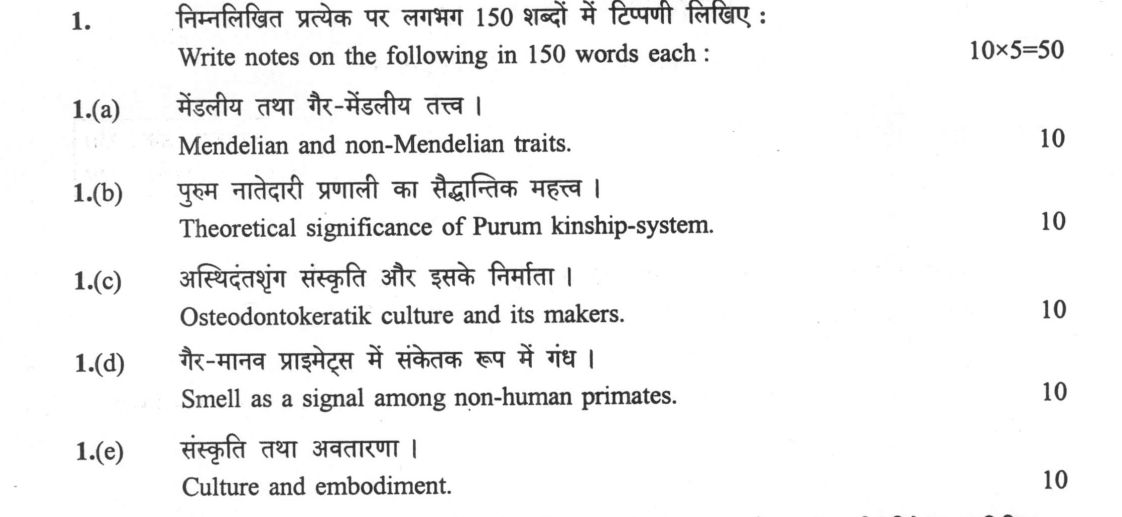
Write notes on the following in 150 words each: (a) Mendelian and non-Mendelian traits. (10 marks) (b) Theoretical significance…
Write notes on the following in 150 words each: Mendelian and non-Mendelian traits. 10 marks
Theoretical significance of Purum kinship-system. 10 marks
Osteodontokeratik culture and its makers. 10 marks
Smell as a signal among non-human primates. 10 marks
Culture and embodiment. 10 marks
हिंदी में प्रश्न पढ़ें
निम्नलिखित प्रत्येक पर लगभग 150 शब्दों में टिप्पणी लिखिए : मेंडलीय तथा गैर-मेंडलीय तत्त्व । (10 अंक)
पुरुम नातेदारी प्रणाली का सैद्धांतिक महत्व । (10 अंक)
अस्थिदंतशृंग संस्कृति और इसके निर्माता । (10 अंक)
गैर-मानव प्राइमेट्स में संकेतक रूप में गंध । (10 अंक)
संस्कृति तथा अवतारणा । (10 अंक)
Model answer
Written by UPSC Answer Check against this question's marking rubric, to the 150-word length. UPSC does not publish answers for Mains — this is one way to score well, not an official key.
a) Mendelian and Non-Mendelian Traits Mendelian traits follow Gregor Mendel’s laws of segregation and independent assortment, where single genes with distinct dominant and recessive alleles determine phenotypes. Examples include human blood groups (ABO system) and attached earlobes. In contrast, non-Mendelian inheritance involves complex mechanisms that deviate from simple dominance. Polygenic inheritance, such as skin color or height, results from the cumulative effect of multiple genes. Mitochondrial DNA is inherited strictly maternally, bypassing paternal contribution. Genomic imprinting renders a gene active or silent depending on whether it is inherited from the mother or father, as seen in Prader-Willi syndrome. Epistasis occurs when one gene masks the expression of another, such as in coat color in mice. Understanding these distinctions is crucial for genetic counseling, as non-Mendelian traits often present with variable expressivity and incomplete penetrance, complicating pedigree analysis and risk assessment in clinical genetics.
b) Theoretical Significance of Purum Kinship The Purum of Manipur, studied by Veena Das, provide a critical case for kinship theory. Their society is divided into two exogamous moieties: Maka (wife-givers) and Chaka (wife-takers). This structure challenges the binary of descent versus alliance. While descent theorists like Fortes and Evans-Pritchard emphasized unilineal groups, and alliance theorists like Levi-Strauss focused on marriage exchanges, the Purum system complicates both. The Maka hold higher status as wife-givers, yet the Chaka are the ones who take wives, creating a paradoxical hierarchy. This arrangement illustrates that kinship is not merely a biological or structural fact but a site of political negotiation and moral order. The Purum case demonstrates how gendered roles and ritual practices reinforce social stratification, offering a nuanced critique of Levi-Strauss’s elementary structures by showing how local agency and historical context shape kinship rules beyond universalist models.
c) Osteodontokeratic Culture and Its Makers Raymond Dart coined the term "osteodontokeratic" to describe the tool use of Australopithecus africanus, referring to implements made of bone (osteo), tooth (odonto), and horn (kerato). This hypothesis suggested that early hominins used natural materials as tools before mastering stone technology. Evidence from Makapansgat and Taung caves, including modified bones and animal remains, supported this view. However, the theory was contested by Louis Leakey, who argued that true tool-making (Oldowan) was the defining feature of the genus Homo, not Australopithecus. The debate highlighted the criteria for hominin identification: whether tool use or brain size was the primary differentiator. While modern archaeology has found some Australopithecus sites with stone tools, the osteodontokeratic culture remains significant in illustrating the gradual transition from natural object use to manufactured technology, bridging the gap between animal behavior and human culture.
d) Smell as a Signal Among Non-Human Primates Olfaction is a primary communicative channel in strepsirrhine primates, such as lemurs and lorises, which possess a well-developed vomeronasal organ. They use scent glands, like the brachial gland in slow lorises, for territorial marking and reproductive signaling. Males often rub their arms on trees to deposit chemical cues indicating presence, dominance, and mating status. In contrast, haplorhine primates (tarsiers, monkeys, apes, and humans) have reduced olfactory capabilities, relying more on vision. However, smell still plays a role in predator avoidance and social recognition. For instance, some monkeys detect scent markers of predators or rival groups. The evolutionary shift from olfactory to visual dominance in haplorhines correlates with diurnal activity and complex social structures. Studying primate olfaction provides insights into the sensory trade-offs in primate evolution and the origins of human social communication, highlighting how sensory modalities shape behavioral ecology.
e) Culture and Embodiment Embodiment theory posits that culture is not just mental but physically inscribed in the body. Marcel Mauss’s "techniques of the body" demonstrated how social norms shape bodily practices, such as posture and movement. Pierre Bourdieu’s concept of habitus describes how social structures are internalized as "bodily hexis," influencing unconscious dispositions and tastes. Thomas Csordas’s phenomenological approach emphasizes that the body is the primary medium of cultural experience. In India, classical dance forms like Bharatanatyam and yoga exemplify embodied culture, where rigorous training transforms the body into a site of spiritual and aesthetic expression. These practices illustrate how cultural values are stored and transmitted through physical discipline. Understanding embodiment challenges the mind-body dualism, showing that social identity is performed and maintained through the body, offering a holistic view of cultural transmission and socialization.
What "Write short notes" is asking you to do
Five or six self-contained answers, marked separately, typically 10 marks and about 150 words each. Each note must carry its own definition, its two or three defining features and a line on why it matters; a common introduction or conclusion across the notes earns nothing.
Structure that answers it
Per note: one-line definition or identification → two or three features, mechanisms or named examples → one line of significance or Indian application
Where marks are lost
Writing the first two notes at essay length and rationing the rest. Each note is marked on its own, so marks surrendered on a compressed or unattempted note cannot be won back by the long ones.
How this answer will be evaluated
Approach
Framework: UPSC Anthropology Paper I (Physical & Social Anthropology). (a) write short notes: define > 3-4 key features > one example > one-line significance | (b) write short notes: define > 3-4 key features > one example > one-line significance | (c) write short notes: define > 3-4 key features > one example > one-line significance | (d) write short notes: define > 3-4 key features > one example > one-line significance | (e) write short notes: define > 3-4 key features > one example > one-line significance Full marks: Precise definitions, named examples/sites, theoretical links, clear distinction between concepts.
Key points expected
- Define Mendelian traits (single gene, dominant/recessive)
- Define non-Mendelian traits (polygenic, epistasis, linkage)
- Provide one example for each type
- Briefly mention significance in human variation
- Identify Purum as a bilateral kinship system
- Mention the 'Purum paradox' (bilateral descent, unilineal residence)
- Link to theoretical debates on descent vs residence
- Reference to specific anthropologist (e.g., Gellner)
Evaluation rubric
Each sub-part is marked on its own, against the marks and word limit printed on the paper.
- (a) Define and distinguish Mendelian vs non-Mendelian traits with examples. 10 marks · 150 words
write short notes— define → 3-4 key features → one example → one-line significance
Must cover
- Define Mendelian traits (single gene, dominant/recessive)
- Define non-Mendelian traits (polygenic, epistasis, linkage)
- Provide one example for each type
- Briefly mention significance in human variation
Loses marks
- Confusing genotype with phenotype
- Ignoring the 'non-Mendelian' aspect
Earns more
- Mention specific human traits (e.g., blood groups vs height)
- Reference to specific genetic mechanisms
Extra mark
- Simple Punnett square or diagram
- (b) Explain the theoretical importance of the Purum kinship system. 10 marks · 150 words
write short notes— define → 3-4 key features → one example → one-line significance
Must cover
- Identify Purum as a bilateral kinship system
- Mention the 'Purum paradox' (bilateral descent, unilineal residence)
- Link to theoretical debates on descent vs residence
- Reference to specific anthropologist (e.g., Gellner)
Loses marks
- Describing it as unilineal (patrilineal/matrilineal)
- Failing to mention the theoretical paradox
Earns more
- Discussion of 'cognatic' vs 'bilateral' terminology
- Comparison with other Indian tribal systems
Extra mark
- Kinship chart of Purum structure
- (c) Describe Osteodontokeratic culture and identify its makers. 10 marks · 150 words
write short notes— define → 3-4 key features → one example → one-line significance
Must cover
- Define Osteodontokeratic (bone, tooth, horn) culture
- Identify makers (e.g., Neanderthals, early Homo sapiens)
- Mention specific sites (e.g., Shanidar, Le Moustier)
- Explain function (ornamentation, ritual, tools)
Loses marks
- Confusing with lithic (stone) culture
- Failing to name specific makers or sites
Earns more
- Mention specific artifacts (e.g., bone needles, flutes)
- Link to cognitive development/symbolic thought
Extra mark
- Sketch of a specific osteodontokeratic tool
- (d) Explain the role of smell as a signal in non-human primates. 10 marks · 150 words
write short notes— define → 3-4 key features → one example → one-line significance
Must cover
- Define olfactory communication in primates
- Mention specific signals (e.g., urine marking, scent glands)
- Give examples (e.g., gorillas, chimpanzees, lemurs)
- Explain function (territory, mating, social status)
Loses marks
- Focusing only on humans
- Ignoring the 'signal' aspect (just describing smell)
Earns more
- Mention specific chemical compounds (e.g., androstenone)
- Comparison with human olfactory reduction
Extra mark
- Diagram of scent gland location
- (e) Discuss the relationship between culture and embodiment. 10 marks · 150 words
write short notes— define → 3-4 key features → one example → one-line significance
Must cover
- Define embodiment in anthropology
- Explain how culture shapes the body (e.g., foot binding, scarification)
- Mention specific theories (e.g., Bourdieu's habitus)
- Provide an example of cultural embodiment
Loses marks
- Treating body as separate from culture
- Ignoring the theoretical framework
Earns more
- Discussion of 'lived body' vs 'social body'
- Reference to specific Indian practices (e.g., tattooing)
Extra mark
- Reference to specific ethnographic study
Practice this exact question
Write your answer and it is marked point by point against the model answer above — what you covered, what you missed, what you got wrong.
Evaluate my answer →More from Anthropology 2025 Paper I
- Q1 Write notes on the following in 150 words each: (a) Mendelian and non-Mendelian traits. (…
- Q2 (a) Discuss the Miocene hominoid remains and their significance in evolution. (20 marks)…
- Q3 (a) How anthropologists assess the nutritional status of a community? Discuss the signifi…
- Q4 (a) Anthropology provides a multidimensional understanding of human beings by bridging th…