Paper I — Q6
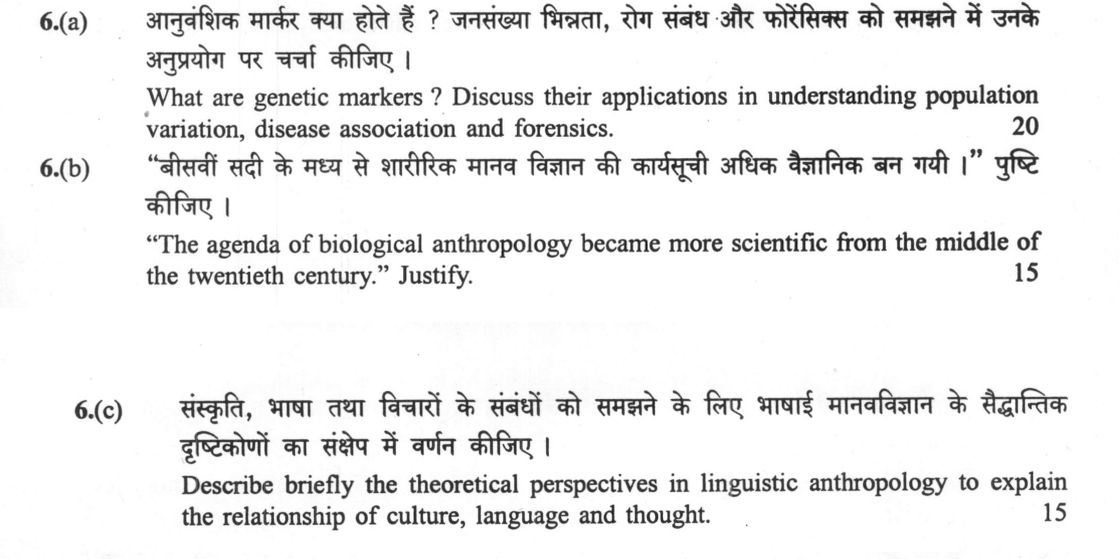
(a) What are genetic markers? Discuss their applications in understanding population variation, disease association and…
What are genetic markers? Discuss their applications in understanding population variation, disease association and forensics. 20 marks
"The agenda of biological anthropology became more scientific from the middle of the twentieth century." Justify. 15 marks
Describe briefly the theoretical perspectives in linguistic anthropology to explain the relationship of culture, language and thought. 15 marks
हिंदी में प्रश्न पढ़ें
आनुवंशिक मार्कर क्या होते हैं ? जनसंख्या भिन्नता, रोग संबंध और फोरेंसिक्स को समझने में उनके अनुप्रयोग पर चर्चा कीजिए। (20 अंक)
"बीसवीं सदी के मध्य से शारीरिक मानव विज्ञान की कार्यसूची अधिक वैज्ञानिक बन गयी।" पुष्टि कीजिए। (15 अंक)
संस्कृति, भाषा तथा विचारों के संबंधों को समझने के लिए भाषाई मानवविज्ञान के सैद्धांतिक दृष्टिकोणों का संक्षेप में वर्णन कीजिए। (15 अंक)
Model answer
Written by UPSC Answer Check against this question's marking rubric, to the expected length. UPSC does not publish answers for Mains — this is one way to score well, not an official key.
Genetic Markers and Anthropological Perspectives
Genetic markers are specific DNA sequences that serve as landmarks for mapping and identifying genetic variation. They include Single Nucleotide Polymorphisms (SNPs), Short Tandem Repeats (STRs), Restriction Fragment Length Polymorphisms (RFLPs), and uniparentally inherited markers like mitochondrial DNA (mtDNA) and Y-chromosome haplogroups. Unlike autosomal markers that follow Mendelian inheritance, mtDNA and Y-chromosome markers trace maternal and paternal lineages respectively, offering distinct tools for reconstructing human history.
Applications in Population Variation, Disease, and Forensics In population genetics, these markers elucidate human migration and phylogenetic reconstruction. SNPs reveal fine-scale population structure, while mtDNA and Y-chromosome markers track ancient dispersals. In India, the Indian Genome Variation Consortium (IGVC) provided a comprehensive reference panel of 2,504 individuals, highlighting the complex admixture of Ancestral North Indian (ANI) and Ancestral South Indian (ASI) components. It is crucial to note that the ANI/ASI model was proposed by Reich et al. (2009); the IGVC’s contribution lies in providing the high-resolution genomic data that validates and refines these ancestral components within the Indian context.
For disease association, Genome-Wide Association Studies (GWAS) utilize SNPs to identify genetic variants linked to complex traits and pharmacogenomics. For instance, the HLA-B*1502 allele is strongly associated with carbamazepine-induced severe cutaneous adverse reactions, particularly in Han Chinese and other Asian populations, necessitating pre-emptive testing. Mendelian disorders like beta-thalassemia and sickle cell anaemia are typically identified through direct mutation analysis rather than linkage mapping, which is more useful for locating unknown disease genes in families. In forensics, STR profiling is the gold standard for individual identification, supported by databases like CODIS in the US and similar systems in India for disaster victim identification and paternity testing.
The Scientific Turn in Biological Anthropology The mid-twentieth century marked a paradigm shift from static, typological racial classification to a dynamic, evolutionary science. This transition was driven by the integration of population genetics into anthropology, catalyzed by Theodosius Dobzhansky’s Genetics and the Origin of Species (1937) and Sherwood Washburn’s 1951 paper, "The New Physical Anthropology." Washburn argued for the abandonment of race as a biological concept in favor of population genetics, emphasizing variation within groups over differences between them.
This "New Physical Anthropology" was further revolutionized by molecular technologies, specifically Polymerase Chain Reaction (PCR) and DNA sequencing, which allowed for direct analysis of genetic variation. The field moved from descriptive morphology to quantitative methods and statistical rigor, aligning biological anthropology with the Modern Synthesis of evolutionary biology. In India, this shift was reflected in the institutionalization of anthropological research post-1950s, moving away from colonial-era racial typologies toward studying genetic diversity and adaptation in Indian populations.
Linguistic Anthropology: Culture, Language, and Thought Linguistic anthropology explores the interplay between language, culture, and cognition through several theoretical lenses. Franz Boas emphasized linguistic relativism, arguing that each language is a unique system that shapes the worldview of its speakers. This evolved into the Sapir-Whorf hypothesis, which posits that language structure influences thought. The "strong" version (linguistic determinism) suggests language determines thought, while the "weak" version (linguistic relativism) suggests it influences perception.
Malinowski’s context theory highlighted the role of language in social action and "speech acts," moving beyond structural analysis to pragmatic function. Dell Hymes expanded this with the "ethnography of communication," introducing the concept of "communicative competence" and situating language use within broader cultural and social contexts. Contemporary cognitive linguistics further bridges these perspectives by examining how embodied experience and cultural context shape linguistic categorization. In the Indian context, the distinct linguistic structures of Dravidian and Indo-Aryan families offer rich case studies for how different grammatical frameworks may influence cognitive processing and cultural expression.
Conclusion The integration of genetic markers and linguistic perspectives reveals anthropology as a holistic discipline. While genetic data provides the biological substrate of human variation, linguistic anthropology elucidates the cultural and cognitive dimensions of that variation. A critical evaluation acknowledges the limitations of reductionist molecular approaches and the ethical complexities of genetic studies, yet the synergy between these fields offers a robust framework for understanding the full spectrum of human diversity.
What "Discuss" is asking you to do
Lay the issue out from more than one side — how it arose, what is claimed for it, what is held against it, and where it now stands. UPSC attaches discuss to broad topics with several live dimensions, so coverage of the dimensions earns more than the strength of your opinion.
Structure that answers it
Set the issue up → the case as it is made → the case against → the dimension both sides leave out → where the balance now lies
Where marks are lost
Listing facts with no thread between them, or arguing one side throughout and calling it a discussion.
How this answer will be evaluated
Approach
Framework: UPSC Anthropology Paper 1. (a) discuss: intro > 3-4 dimensions > example > balanced close | (b) justify: claim > 3-4 reasons > evidence > conclusion | (c) describe: define > structure or process in order > labelled diagram > significance Full marks: Comprehensive, specific, and well-structured with named examples and clear theoretical grounding.
Key points expected
- Define genetic markers (SNPs, STRs, mtDNA)
- Application in population variation (migration/admixture)
- Application in disease association (GWAS)
- Application in forensics (DNA profiling)
- Shift from typology to population genetics
- Integration of molecular biology (DNA)
- Use of statistical methods (multivariate analysis)
- Focus on microevolution and adaptation
Evaluation rubric
Each sub-part is marked on its own, against the marks and word limit printed on the paper.
- (a) Define genetic markers and analyze their utility in population, disease, and forensic contexts. 20 marks
discuss— intro → 3-4 dimensions → example → balanced close
Must cover
- Define genetic markers (SNPs, STRs, mtDNA)
- Application in population variation (migration/admixture)
- Application in disease association (GWAS)
- Application in forensics (DNA profiling)
Loses marks
- Confusing genetic markers with genes
- Ignoring the forensic application
- Vague description of population variation
Earns more
- Mention specific markers (e.g., HLA, Rh)
- Reference to Indian population studies
- Distinction between coding/non-coding regions
Extra mark
- Labelled diagram of DNA profiling
- Reference to specific Indian forensic case
- (b) Justify the shift of biological anthropology to a scientific agenda post-1950s. 15 marks
justify— claim → 3-4 reasons → evidence → conclusion
Must cover
- Shift from typology to population genetics
- Integration of molecular biology (DNA)
- Use of statistical methods (multivariate analysis)
- Focus on microevolution and adaptation
Loses marks
- Focusing only on physical traits
- Ignoring the molecular revolution
- Treating it as a history of the discipline
Earns more
- Mention of key figures (Dobzhansky, Lewontin)
- Reference to the 'New Physical Anthropology'
- Discussion of the 'evolutionary synthesis'
Extra mark
- Reference to specific Indian biological studies
- Mention of specific statistical tools (PCA)
- (c) Describe theoretical perspectives on the culture-language-thought relationship. 15 marks
describe— define → structure or process in order → labelled diagram → significance
Must cover
- Linguistic Determinism (Sapir-Whorf hypothesis)
- Linguistic Relativity (weak version)
- Language as a social practice (ethnography of communication)
- Link between language and cultural cognition
Loses marks
- Confusing linguistics with linguistic anthropology
- Ignoring the 'thought' component
- Vague description of the relationship
Earns more
- Mention of specific ethnographic examples
- Reference to Dell Hymes or Gumperz
- Discussion of 'linguistic relativity' in Indian context
Extra mark
- Reference to specific Indian linguistic study
- Mention of 'cultural models' in language
Practice this exact question
Write your answer and it is marked point by point against the model answer above — what you covered, what you missed, what you got wrong.
Evaluate my answer →More from Anthropology 2025 Paper I
- Q3 (a) How anthropologists assess the nutritional status of a community? Discuss the signifi…
- Q4 (a) Anthropology provides a multidimensional understanding of human beings by bridging th…
- Q5 Write notes on the following in about 150 words each: (a) Multispecies, Multi-sited and C…
- Q6 (a) What are genetic markers? Discuss their applications in understanding population vari…
- Q7 (a) How the study of variation in forms of marriage led to rethinking on the concepts of…
- Q8 (a) How the theories of postmodernism are relevant in promoting social justice and empowe…