Paper I — Q8
(a) How the theories of postmodernism are relevant in promoting social justice and empowerment of marginalised communities? (20…
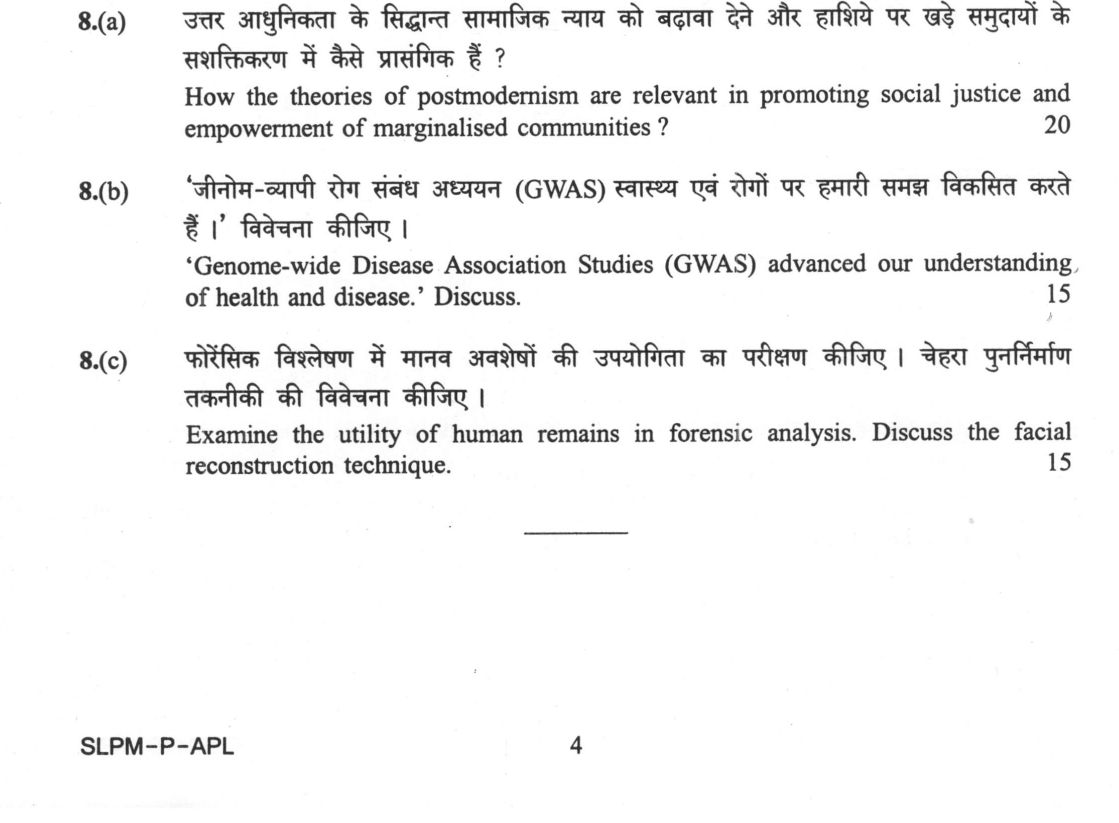
How the theories of postmodernism are relevant in promoting social justice and empowerment of marginalised communities? 20 marks
'Genome-wide Disease Association Studies (GWAS) advanced our understanding of health and disease.' Discuss. 15 marks
Examine the utility of human remains in forensic analysis. Discuss the facial reconstruction technique. 15 marks
हिंदी में प्रश्न पढ़ें
उत्तर आधुनिकता के सिद्धांत सामाजिक न्याय को बढ़ावा देने और हाशिये पर खड़े समुदायों के सशक्तिकरण में कैसे प्रासंगिक हैं ? (20 अंक)
'जीनोम-व्यापी रोग संबंध अध्ययन (GWAS) स्वास्थ्य एवं रोगों पर हमारी समझ विकसित करते हैं।' विवेचना कीजिए। (15 अंक)
फोरेंसिक विश्लेषण में मानव अवशेषों की उपयोगिता का परीक्षण कीजिए। चेहरा पुनर्निर्माण तकनीकी की विवेचना कीजिए। (15 अंक)
Model answer
Written by UPSC Answer Check against this question's marking rubric, to the expected length. UPSC does not publish answers for Mains — this is one way to score well, not an official key.
Postmodernism, Social Justice, and Marginalised Empowerment
Postmodernism revolutionized anthropological inquiry by challenging universalist grand narratives that legitimized dominant power structures. Jean-François Lyotard’s critique of metanarratives and Michel Foucault’s formulation of power/knowledge (pouvoir-savoir) exposed how institutional discourses systematically marginalize subaltern worldviews. Concurrently, Jacques Derrida’s deconstruction provided the conceptual apparatus to dismantle Eurocentric, paternalistic development models that imposed top-down modernizing frameworks onto local cultures.
Methodologically, postmodernism introduced reflexivity, positionality, and collaborative ethnography, transforming marginalized subjects from passive informants into active co-producers of anthropological knowledge. Through Participatory Action Research (PAR), marginalized communities assert agency over their own socio-cultural representation. In the Indian context, these theoretical shifts facilitate the empowerment of Dalits and Adivasis by de-centring Brahmanical and colonial epistemologies. By validating oral histories, ethno-epistemic traditions, and subaltern lived experiences, postmodern anthropology supports indigenous rights, grassroots advocacy under the Forest Rights Act (FRA, 2006), and the broader decolonization of academic and policy discourse.
Genome-Wide Association Studies (GWAS) in Health and Disease
Genome-wide Disease Association Studies have significantly advanced biomedical anthropology by scanning the entire genome to pinpoint Single Nucleotide Polymorphisms (SNPs) statistically linked to disease vulnerability. Utilizing high-density SNP arrays, well-characterized case-control cohorts, and rigorous statistical corrections for population stratification, GWAS has transformed the understanding of complex, non-communicable diseases. It has elucidated the polygenic architecture of conditions such as Type-2 Diabetes, cardiovascular illnesses, and autoimmune disorders.
Beyond etiology, GWAS underpins precision medicine through the construction of Polygenic Risk Scores (PRS), which quantify individual disease susceptibility, and through pharmacogenomics, which predicts adverse drug reactions and optimizes therapeutic interventions.
However, critical limitations persist. GWAS encounters the problem of "missing heritability," where identified common variants account for only a fraction of phenotypic variance, often overlooking structural variants, rare mutations, and gene-environment interactions. Furthermore, GWAS exhibits a pronounced Eurocentric bias, as non-European populations remain significantly underrepresented in major genomic databases. Addressing this disparity requires inclusive initiatives like the GenomeIndia Project to map population-specific disease loci accurately.
Forensic Utility of Human Remains and Facial Reconstruction
The forensic analysis of human skeletal remains provides vital medico-legal intelligence by establishing the biological profile of deceased individuals. Forensic anthropologists analyze osteological and dental markers to determine biological sex (via pelvic and cranial dimorphism), chronological age at death (epiphyseal fusion, pubic symphyseal metamorphosis), ancestral affiliation through morphoscopic traits, and living stature using long-bone regression equations. Furthermore, distinguishing between ante-mortem, peri-mortem trauma, and post-mortem taphonomic alterations assists in reconstructing the cause and manner of death, as well as estimating the Post-Mortem Interval (PMI). These techniques are indispensable in criminal investigations and Disaster Victim Identification (DVI), as demonstrated during the 2004 Indian Ocean Tsunami.
When decomposed or skeletal remains preclude visual, dental, or DNA identification, facial reconstruction is deployed to trigger public recognition. Anthropometric reconstruction includes the Russian anatomical method developed by Mikhail Gerasimov, which builds musculature directly upon the cranium, and the American method, which utilizes standardized average soft-tissue depth pegs across anatomical landmarks. Modern forensic anthropology increasingly utilizes computerized 3D modeling, laser surface scanning, and forensic DNA phenotyping to objectively predict soft-tissue features and pigmentation. In India, such cranial reconstructions have provided critical investigative breakthroughs in unidentified skeleton cases, including the Purulia skeleton investigations.
Ultimately, the theoretical reflexivity of postmodernism and the empirical rigor of genomic and forensic methods demonstrate anthropology's broad relevance. Bridging these distinct paradigms ensures that technological precision and ethical, decolonized methodologies combine to advance evidence-based policy, human rights, and social justice.
What "Discuss" is asking you to do
Lay the issue out from more than one side — how it arose, what is claimed for it, what is held against it, and where it now stands. UPSC attaches discuss to broad topics with several live dimensions, so coverage of the dimensions earns more than the strength of your opinion.
Structure that answers it
Set the issue up → the case as it is made → the case against → the dimension both sides leave out → where the balance now lies
Where marks are lost
Listing facts with no thread between them, or arguing one side throughout and calling it a discussion.
How this answer will be evaluated
Approach
(a) explain: definition/context > points in order > small example > short close | (b) discuss: intro > 3-4 dimensions > example > balanced close | (c) examine: intro > how/why with reasoning > evidence > conclusion Full marks: Comprehensive, well-structured, with specific examples and critical analysis.
Key points expected
- Define postmodernism's critique of grand narratives
- Explain relevance to social justice (e.g., intersectionality)
- Explain relevance to empowerment of marginalized communities
- Provide specific examples of marginalized groups
- Define Genome-wide Disease Association Studies (GWAS)
- Explain how GWAS identifies genetic variants
- Discuss specific examples of diseases studied
- Mention implications for personalized medicine
Evaluation rubric
Each sub-part is marked on its own, against the marks and word limit printed on the paper.
- (a) Link postmodernist theory to social justice and empowerment of marginalized groups. 20 marks
explain— definition/context → points in order → small example → short close
Must cover
- Define postmodernism's critique of grand narratives
- Explain relevance to social justice (e.g., intersectionality)
- Explain relevance to empowerment of marginalized communities
- Provide specific examples of marginalized groups
Loses marks
- Vague definitions of postmodernism
- Lack of connection to social justice
- Ignoring marginalized communities
Earns more
- Mention specific theorists (e.g., Foucault, Derrida)
- Discuss power dynamics and discourse
- Reference Indian context (e.g., caste, tribal issues)
- Critique of modernist approaches
Extra mark
- Reference specific postmodernist works
- Mention specific empowerment strategies
- (b) Discuss how GWAS advanced understanding of health and disease. 15 marks
discuss— intro → 3-4 dimensions → example → balanced close
Must cover
- Define Genome-wide Disease Association Studies (GWAS)
- Explain how GWAS identifies genetic variants
- Discuss specific examples of diseases studied
- Mention implications for personalized medicine
Loses marks
- Incorrect definition of GWAS
- Lack of specific examples
- Ignoring the 'advanced understanding' aspect
Earns more
- Explain the methodology of GWAS
- Discuss limitations of GWAS
- Mention specific genes or variants identified
- Reference specific studies or discoveries
Extra mark
- Mention specific statistical methods used
- Reference specific databases or resources
- (c) Examine utility of human remains in forensics and discuss facial reconstruction. 15 marks
examine— intro → how/why with reasoning → evidence → conclusion
Must cover
- Examine utility of human remains in forensic analysis
- Discuss facial reconstruction technique
- Explain the process of facial reconstruction
- Mention applications in identifying remains
Loses marks
- Vague description of facial reconstruction
- Ignoring the 'utility' aspect
- Lack of specific examples
Earns more
- Describe different types of facial reconstruction (e.g., 2D, 3D)
- Mention specific software or tools used
- Discuss accuracy and limitations of the technique
- Reference specific forensic cases
Extra mark
- Mention specific anthropologists or forensic experts
- Reference specific software versions
Practice this exact question
Write your answer and it is marked point by point against the model answer above — what you covered, what you missed, what you got wrong.
Evaluate my answer →More from Anthropology 2025 Paper I
- Q5 Write notes on the following in about 150 words each: (a) Multispecies, Multi-sited and C…
- Q6 (a) What are genetic markers? Discuss their applications in understanding population vari…
- Q7 (a) How the study of variation in forms of marriage led to rethinking on the concepts of…
- Q8 (a) How the theories of postmodernism are relevant in promoting social justice and empowe…