Paper I — Q2
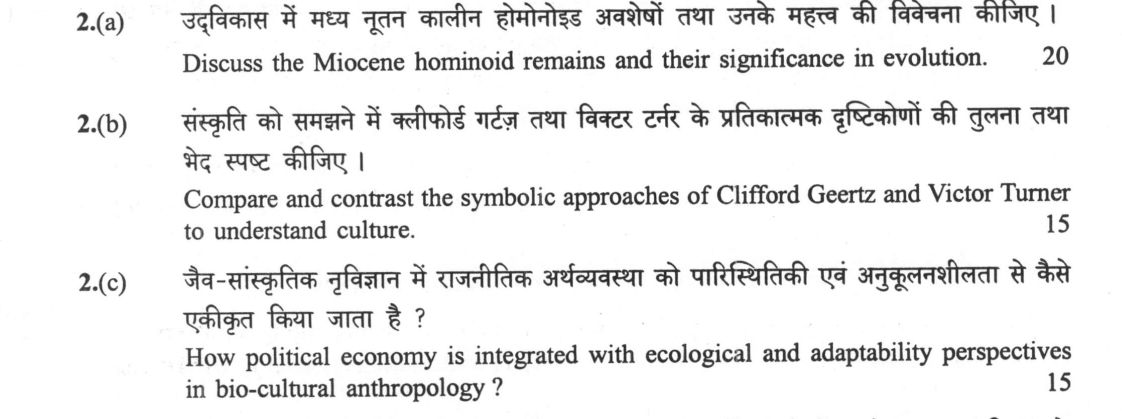
(a) Discuss the Miocene hominoid remains and their significance in evolution. (20 marks) (b) Compare and contrast the symbolic…
Discuss the Miocene hominoid remains and their significance in evolution. 20 marks
Compare and contrast the symbolic approaches of Clifford Geertz and Victor Turner to understand culture. 15 marks
How political economy is integrated with ecological and adaptability perspectives in bio-cultural anthropology? 15 marks
हिंदी में प्रश्न पढ़ें
उद्विकास में मध्य नूतन कालीन होमिनोइड अवशेषों तथा उनके महत्व की विवेचना कीजिए । (20 अंक)
संस्कृति को समझने में क्लीफोर्ड गीर्ट्ज तथा विक्टर टर्नर के प्रतीकात्मक दृष्टिकोणों की तुलना तथा भेद स्पष्ट कीजिए । (15 अंक)
जैव-सांस्कृतिक नृविज्ञान में राजनीतिक अर्थव्यवस्था को पारिस्थितिकी एवं अनुकूलनशीलता से कैसे एकीकृत किया जाता है ? (15 अंक)
Model answer
Written by UPSC Answer Check against this question's marking rubric, to the expected length. UPSC does not publish answers for Mains — this is one way to score well, not an official key.
Miocene Hominoids and Symbolic Anthropology
The study of human origins and cultural meaning requires integrating paleoanthropological evidence with theoretical frameworks that interpret human behavior. This response examines the evolutionary significance of Miocene hominoids, contrasts the symbolic approaches of Geertz and Turner, and explores the bio-cultural integration of political economy with ecological perspectives.
Miocene Hominoids and Evolutionary Significance The Miocene epoch (23–5.3 Ma) is pivotal for understanding the divergence of hominoids. Key remains include Proconsul from East Africa (approx. 18–15 Ma), which exhibits a mix of primitive and derived traits, suggesting a position near the base of the hominoid radiation. In Europe, Dryopithecus (approx. 12–9 Ma) shows adaptations for vertical climbing and suspensory locomotion, indicating a distinct evolutionary lineage. The most significant finds for human evolution come from the Siwalik Hills in India and Pakistan, where Ramapithecus (approx. 14–12 Ma) was initially identified. Morphological studies, particularly the analysis of the GSP 15000 face and comparative dental metrics, established that Ramapithecus is a female morph of Sivapithecus. This synonymy was confirmed primarily through morphological evidence rather than biomolecular phylogenetics, which has instead been used to refine divergence dates and confirm pongine affinities. Consequently, Ramapithecus is now reassessed as an ancestral orangutan rather than a direct hominid ancestor. This reclassification shifts the focus of hominid origins to later African genera like Orrorin and Sahelanthropus. The dental evidence from these Miocene forms, showing reduced canine size and altered jaw morphology in certain lineages, remains crucial for understanding the early steps toward the hominid condition, even as the specific lineage of Ramapithecus is excluded from the direct human lineage.
Geertz vs. Turner: Symbolic Approaches Clifford Geertz and Victor Turner both rejected structural-functionalism, offering interpretive frameworks for culture, yet their methodologies diverge significantly. Geertz’s "interpretive anthropology" posits culture as a text to be read. His concept of "thick description" argues that social acts are embedded in layers of meaning, requiring the anthropologist to decode the "webs of significance" that humans spin. Geertz’s approach is largely static and semiotic, focusing on how symbols maintain social order and how meaning is constructed through literary and analytical interpretation.
In contrast, Victor Turner’s approach is processual and performative. He focuses on "social drama," analyzing how conflicts disrupt social structure and are resolved through ritual. Turner’s concepts of "liminality" and "communitas" describe the transitional phase where social hierarchies are suspended, allowing for social regeneration. For Turner, symbols are not just signs to be interpreted but active agents that generate social action and emotional transformation. While Geertz emphasizes the cognitive and semiotic aspects of culture, Turner emphasizes the dynamic, conflict-resolution function of ritual. Both scholars highlight agency, but Geertz sees it in the construction of meaning, while Turner sees it in the performance of ritual that reshapes social bonds.
Political Economy in Bio-Cultural Anthropology Bio-cultural anthropology integrates political economy with ecological and adaptability perspectives to explain how power structures shape human biology. Scholars like Eric Wolf and Sidney Mintz argue that colonialism and capitalism are not just economic systems but forces that restructure human ecology. This perspective moves beyond simple environmental adaptation to examine how economic constraints and class relations influence biological outcomes.
Critical medical anthropology, as advanced by Irving Singer, illustrates this integration by showing how political-economic forces create "social etiologies" of disease. For instance, the Green Revolution in India, while increasing agricultural productivity, introduced monocultures and chemical inputs that altered rural health profiles. The shift in diet and labor patterns led to new patterns of malnutrition and non-communicable diseases, demonstrating how economic policies become embodied through stress, growth patterns, and epidemiological changes. This bio-cultural synthesis reveals that biological adaptation is not a neutral response to nature but is mediated by political and economic structures. Understanding human health and evolution thus requires analyzing the interplay between ecological constraints and the power dynamics of global capitalism.
Conclusion In conclusion, the study of anthropology requires a multi-layered approach. The re-evaluation of Miocene hominoids like Ramapithecus clarifies the evolutionary path, while the symbolic theories of Geertz and Turner provide tools to interpret cultural meaning. Furthermore, integrating political economy into bio-cultural analysis reveals how historical and economic forces are inscribed on the human body. Together, these perspectives underscore the interdisciplinary nature of anthropology, linking deep time evolution with contemporary social and biological realities.
What "Discuss" is asking you to do
Lay the issue out from more than one side — how it arose, what is claimed for it, what is held against it, and where it now stands. UPSC attaches discuss to broad topics with several live dimensions, so coverage of the dimensions earns more than the strength of your opinion.
Structure that answers it
Set the issue up → the case as it is made → the case against → the dimension both sides leave out → where the balance now lies
Where marks are lost
Listing facts with no thread between them, or arguing one side throughout and calling it a discussion.
How this answer will be evaluated
Approach
(a) discuss: intro > 3-4 dimensions > example > balanced close | (b) compare: paired headings or table > key differences > significance > conclusion | (c) explain: definition/context > points in order > small example > short close Full marks: Comprehensive, specific, and well-structured answers with named examples and clear distinctions.
Key points expected
- Name specific Miocene hominoid taxa (e.g., Proconsul, Dryopithecus)
- Detail morphological features (skull, dentition, limb proportions)
- Explain phylogenetic significance (common ancestor vs. side branch)
- Mention key fossil sites (e.g., East Africa, Europe)
- Define Geertz's 'Thick Description' and 'Interpretive Anthropology'
- Define Turner's 'Liminality' and 'Communitas'
- Contrast their views on symbols (Geertz: meaning; Turner: process)
- Contrast their views on ritual (Geertz: text; Turner: performance)
Evaluation rubric
Each sub-part is marked on its own, against the marks and word limit printed on the paper.
- (a) Intro > 3-4 dimensions > example > balanced close 20 marks
discuss— intro → 3-4 dimensions → example → balanced close
Must cover
- Name specific Miocene hominoid taxa (e.g., Proconsul, Dryopithecus)
- Detail morphological features (skull, dentition, limb proportions)
- Explain phylogenetic significance (common ancestor vs. side branch)
- Mention key fossil sites (e.g., East Africa, Europe)
Loses marks
- Confusing Miocene hominoids with Pliocene hominins
- Vague generalities without naming specific species
- Ignoring the 'significance' aspect of the question
Earns more
- Discuss the 'African Origin' hypothesis
- Compare Miocene hominoids with modern apes
- Mention specific geological time scales (e.g., 15-20 mya)
Extra mark
- Labelled diagram of a Miocene hominoid skull
- Reference to specific fieldwork (e.g., Leakey's discoveries)
- (b) Paired headings or table > key differences > significance > conclusion 15 marks
compare— paired headings or table → key differences → significance → conclusion
Must cover
- Define Geertz's 'Thick Description' and 'Interpretive Anthropology'
- Define Turner's 'Liminality' and 'Communitas'
- Contrast their views on symbols (Geertz: meaning; Turner: process)
- Contrast their views on ritual (Geertz: text; Turner: performance)
Loses marks
- Treating them as identical symbolic anthropologists
- Failing to distinguish 'meaning' vs 'process'
- Ignoring the 'contrast' aspect of the question
Earns more
- Mention Geertz's 'Religion as a Cultural System'
- Mention Turner's 'The Forest of Symbols'
- Discuss the 'Dramaturgical' approach of Turner
Extra mark
- Reference to specific ethnographic examples (e.g., Balinese cockfight)
- Mention the influence of structuralism on both
- (c) Definition/context > points in order > small example > short close 15 marks
explain— definition/context → points in order → small example → short close
Must cover
- Define 'Political Economy' in anthropological context
- Explain 'Ecological' perspective (e.g., Steward's Cultural Ecology)
- Explain 'Adaptability' (e.g., Optimal Foraging Theory)
- Show how political economy integrates these (e.g., resource control)
Loses marks
- Treating political economy as purely economic
- Ignoring the 'ecological' or 'adaptability' components
- Failing to show the 'integration' of these perspectives
Earns more
- Mention 'Marxist Anthropology' (e.g., Sahlins, Godelier)
- Discuss 'Mode of Production' and 'Surplus'
- Mention 'World Systems Theory' (e.g., Wallerstein)
Extra mark
- Reference to specific tribal policy or land rights
- Mention 'Political Ecology' (e.g., Peet, Watts)
Practice this exact question
Write your answer and it is marked point by point against the model answer above — what you covered, what you missed, what you got wrong.
Evaluate my answer →More from Anthropology 2025 Paper I
- Q1 Write notes on the following in 150 words each: (a) Mendelian and non-Mendelian traits. (…
- Q2 (a) Discuss the Miocene hominoid remains and their significance in evolution. (20 marks)…
- Q3 (a) How anthropologists assess the nutritional status of a community? Discuss the signifi…
- Q4 (a) Anthropology provides a multidimensional understanding of human beings by bridging th…
- Q5 Write notes on the following in about 150 words each: (a) Multispecies, Multi-sited and C…