Paper I — Q5
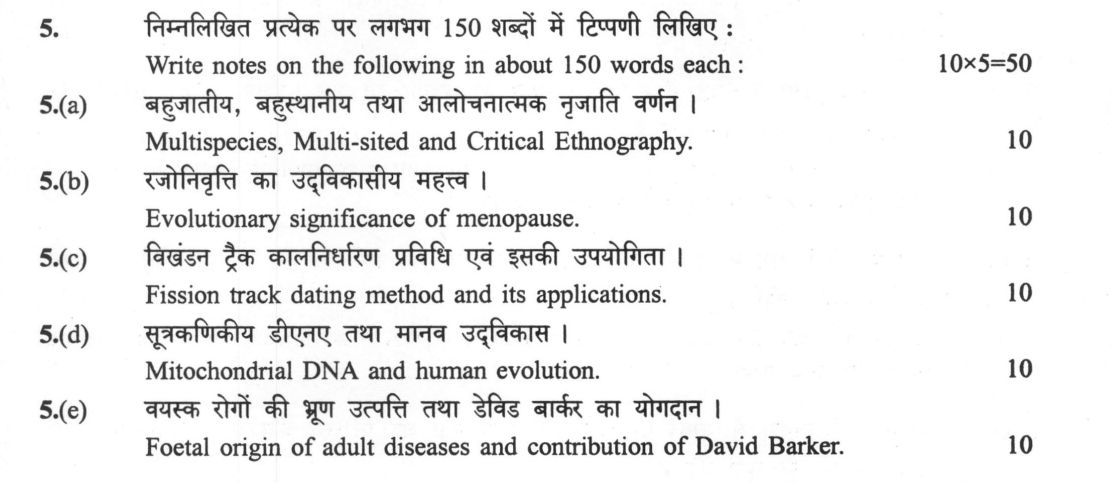
Write notes on the following in about 150 words each: (a) Multispecies, Multi-sited and Critical Ethnography. (10 marks) (b)…
Write notes on the following in about 150 words each: Multispecies, Multi-sited and Critical Ethnography. 10 marks
Evolutionary significance of menopause. 10 marks
Fission track dating method and its applications. 10 marks
Mitochondrial DNA and human evolution. 10 marks
Foetal origin of adult diseases and contribution of David Barker. 10 marks
हिंदी में प्रश्न पढ़ें
निम्नलिखित प्रत्येक पर लगभग 150 शब्दों में टिप्पणी लिखिए : बहुजातीय, बहुस्थानीय तथा आलोचनात्मक नृजाति वर्णन। (10 अंक)
रजोनिवृत्ति का उद्विविकासीय महत्व। (10 अंक)
विखंडन ट्रैक कालनिर्धारण प्रविधि एवं इसकी उपयोगिता। (10 अंक)
सूत्रकणिकीय डीएनए तथा मानव उद्विविकास। (10 अंक)
वयस्क रोगों की भ्रूण उत्पत्ति तथा डेविड बार्कर का योगदान। (10 अंक)
Model answer
Written by UPSC Answer Check against this question's marking rubric, to the 150-word length. UPSC does not publish answers for Mains — this is one way to score well, not an official key.
(a) Multispecies, Multi-sited and Critical Ethnography
These three frameworks represent a paradigm shift in contemporary anthropological fieldwork, moving beyond static, human-centric, and single-site observations. Multispecies ethnography, pioneered by Donna Haraway and Anna Tsing, rejects the human/animal binary. It posits that humans are entangled with other species in co-constitutive relationships. Fieldwork thus involves observing non-human actors—animals, plants, microbes—as active agents in social life. For instance, Tsing’s work in the Pacific Northwest examines how humans and mushrooms co-evolve, challenging anthropocentric narratives of nature.
Multi-sited ethnography, articulated by George Marcus, addresses the fragmentation of social life in a globalized world. It argues that culture cannot be understood in a single locale but must be traced across multiple sites where social processes are distributed. This approach follows the "threads" of social phenomena, such as migration, trade, or media, across borders. For example, studying the global supply chain of coffee requires fieldwork in plantations, processing plants, and consumer markets simultaneously, revealing the translocal nature of economic and cultural practices.
Critical ethnography, associated with scholars like Norman K. Denzin and Paul Thomas, integrates ethnographic description with explicit political and moral commitments. It is reflexive, acknowledging the researcher’s positionality and the power dynamics inherent in the research process. Unlike "armchair" anthropology, it aims for social justice, often advocating for marginalized communities. It critiques the objectivity of traditional methods and emphasizes the role of ethnography in exposing structural inequalities. For instance, critical ethnographies of labor often highlight the exploitation of workers and advocate for policy changes, blending academic rigor with activist engagement. Together, these approaches expand the scope of anthropology to be more inclusive, spatially dynamic, and ethically engaged.
(b) Evolutionary Significance of Menopause
Menopause, the permanent cessation of menstruation, is a rare phenomenon in the animal kingdom, occurring primarily in humans, some cetaceans (orcas, pilot whales), and a few other species. Its evolutionary significance is primarily explained by the Grandmother Hypothesis and the Mother Hypothesis, both rooted in kin selection and inclusive fitness theory.
The Grandmother Hypothesis, proposed by Kristen Hawkes and colleagues, suggests that post-reproductive longevity in females enhances the survival and reproductive success of their grandchildren. By ceasing reproduction, older women can redirect their energy and resources from their own offspring to their grandchildren, who share 25% of their genes. This "grandmothering" behavior increases the inclusive fitness of the grandmother, as her genes are passed on through her children’s children. In foraging societies, the presence of post-reproductive women significantly boosts the caloric intake and survival rates of young children, providing a selective advantage for genes associated with menopause.
The Mother Hypothesis offers a complementary explanation, focusing on the trade-offs of maternal investment. It posits that continuing to reproduce at an advanced age carries high risks to both the mother and the fetus, potentially reducing the overall reproductive success of the mother. By stopping reproduction, the mother avoids the physiological costs and risks of late-life pregnancy, thereby maximizing the survival of her existing offspring. This hypothesis suggests that menopause is an adaptive strategy to balance the costs of reproduction with the benefits of ensuring the survival of already-born children.
Both hypotheses highlight that menopause is not merely a biological decline but an adaptive trait that has been shaped by natural selection to maximize genetic transmission. The rarity of menopause in other primates underscores the unique social and ecological pressures in human evolution, particularly the extended dependency of human infants and the complex social structures that allow for intergenerational care. This phenomenon illustrates how life history strategies can evolve to optimize fitness in specific ecological and social contexts.
(c) Fission Track Dating Method and Applications
Fission track dating is a geochronological method used to determine the age of minerals and glasses by counting the damage trails left by the spontaneous fission of uranium-238 (²³⁸U) atoms. When ²³⁸U undergoes fission, it produces two daughter nuclei that recoil and create a linear damage track in the crystal lattice of the host mineral. These tracks are stable over geological time and can be revealed by chemical etching, which widens the tracks to make them visible under a microscope.
The method relies on measuring the density of these spontaneous tracks and comparing them to the density of induced tracks created by irradiating the sample with a neutron beam. By knowing the uranium concentration in the sample and the neutron flux, the age can be calculated using the decay constant of ²³⁸U. The formula involves the ratio of spontaneous to induced tracks, the uranium content, and the irradiation parameters. This method is particularly useful for dating volcanic glass (tephra) and certain minerals like zircon, apatite, and biotite, which are common in archaeological and geological contexts.
Applications of fission track dating are extensive. In archaeology, it is used to date obsidian artifacts and volcanic ash layers, providing precise timelines for human occupation and environmental changes. For example, fission track dating has been applied to tephra layers at early hominin sites in East Africa, such as Hadar, Ethiopia, helping to correlate sedimentary sequences and refine the age of fossil finds. It is also used in tephrochronology to match volcanic ash layers across different sites, establishing synchronous time markers. Additionally, the method is valuable in studying the thermal history of rocks, as fission tracks can be annealed (erased) at high temperatures, providing information about past heating events. This makes it a powerful tool for understanding geological processes and archaeological chronologies.
(d) Mitochondrial DNA and Human Evolution
Mitochondrial DNA (mtDNA) is a small, circular genome located in the mitochondria, the energy-producing organelles of cells. It is maternally inherited, meaning it is passed from mother to offspring without recombination, and it has a high mutation rate compared to nuclear DNA. These characteristics make mtDNA a valuable tool for studying human evolution and population genetics. The lack of recombination allows for the construction of clear phylogenetic trees, while the high mutation rate provides sufficient variation to trace recent evolutionary events.
One of the most significant applications of mtDNA in human evolution is the identification of Mitochondrial Eve. This term refers to the most recent common ancestor of all living humans through the maternal line. Studies of mtDNA sequences from diverse global populations have shown that all modern humans share a common mtDNA lineage that originated in Africa approximately 150,000 to 200,000 years ago. This supports the "Out of Africa" hypothesis, which posits that modern humans evolved in Africa and then migrated to other parts of the world, replacing or mixing with other hominin species.
mtDNA is also used to define haplogroups, which are groups of people who share a common ancestor and specific mutations. Major haplogroups such as L0-L6 are found in Africa, while others like M and N are associated with the migration out of Africa. By analyzing the distribution of these haplogroups, researchers can trace the routes and timing of human migrations. For example, the presence of specific haplogroups in Asia and Europe helps reconstruct the peopling of these continents. However, mtDNA has limitations, as it only represents the maternal line and can be subject to selection pressures, which may distort the true population history. Therefore, it is often used in conjunction with nuclear DNA and Y-chromosome data to provide a more comprehensive picture of human evolution.
(e) Foetal Origin of Adult Diseases and David Barker
The Developmental Origins of Health and Disease (DOHaD) hypothesis, originally proposed by David Barker in the 1990s, suggests that diseases in adulthood, such as cardiovascular disease, diabetes, and obesity, have their roots in the prenatal and early postnatal environment. Barker’s work challenged the prevailing view that these diseases were solely caused by adult lifestyle factors, highlighting the critical role of foetal programming.
Barker’s hypothesis is based on the Thrifty Phenotype theory. He proposed that if the foetus experiences a nutrient-poor environment in utero, it adapts by slowing growth and prioritizing the development of vital organs like the brain over less critical systems. This adaptation, known as the thrifty phenotype, is beneficial if the postnatal environment remains poor, as it conserves energy. However, if the postnatal environment is nutrient-rich, this mismatch can lead to metabolic disorders. The foetus is "programmed" for scarcity, but when faced with abundance, it develops insulin resistance, high blood pressure, and other risk factors for adult diseases.
Barker’s research, particularly the Pune Maternal Nutrition Study led by C.S. Yajnik, provided strong evidence for this hypothesis. The study followed cohorts of mothers and their children in India, showing that low birth weight, a marker of poor foetal growth, was associated with a higher risk of type 2 diabetes and cardiovascular disease in adulthood. This finding was significant because it linked early life nutrition to long-term health outcomes, especially in populations undergoing rapid nutritional transitions.
The implications of the DOHaD hypothesis are profound for public health policy. It emphasizes the importance of maternal nutrition, prenatal care, and early childhood interventions in preventing chronic diseases. By focusing on the foetal period, health systems can address the root causes of adult diseases, rather than just treating symptoms later in life. This approach has led to increased attention on maternal health, nutrition programs, and the prevention of low birth weight, particularly in developing countries where malnutrition is prevalent. The work of Barker and subsequent researchers has fundamentally changed our understanding of the link between early life experiences and adult health.
What "Write short notes" is asking you to do
Five or six self-contained answers, marked separately, typically 10 marks and about 150 words each. Each note must carry its own definition, its two or three defining features and a line on why it matters; a common introduction or conclusion across the notes earns nothing.
Structure that answers it
Per note: one-line definition or identification → two or three features, mechanisms or named examples → one line of significance or Indian application
Where marks are lost
Writing the first two notes at essay length and rationing the rest. Each note is marked on its own, so marks surrendered on a compressed or unattempted note cannot be won back by the long ones.
How this answer will be evaluated
Approach
Framework: Anthropology Paper 1: Biological & Social Anthropology. (a) write short notes: define > 3-4 key features > one example > one-line significance | (b) write short notes: define > 3-4 key features > one example > one-line significance | (c) write short notes: define > 3-4 key features > one example > one-line significance | (d) write short notes: define > 3-4 key features > one example > one-line significance | (e) write short notes: define > 3-4 key features > one example > one-line significance Full marks: Precise definitions, named theories (e.g., Grandmother Hypothesis), and specific examples for all 5 parts.
Key points expected
- Define multispecies ethnography (e.g., Haraway)
- Define multi-sited ethnography (e.g., Marcus)
- Define critical ethnography (e.g., Foucault/Power)
- Briefly distinguish the scope of each
- Define menopause as a biological phenomenon
- Explain the Grandmother Hypothesis
- Mention the Kin Selection mechanism
- Link to increased grand-offspring survival
Evaluation rubric
Each sub-part is marked on its own, against the marks and word limit printed on the paper.
- (a) Define and distinguish three specific ethnographic methodologies. 10 marks · 150 words
write short notes— define → 3-4 key features → one example → one-line significance
Must cover
- Define multispecies ethnography (e.g., Haraway)
- Define multi-sited ethnography (e.g., Marcus)
- Define critical ethnography (e.g., Foucault/Power)
- Briefly distinguish the scope of each
Loses marks
- Confusing multi-sited with multi-ethnic
- Treating them as general research methods
Earns more
- Mentioning specific fieldwork examples
- Linking to postmodern theory
Extra mark
- Citing specific authors like Viveiros de Castro
- (b) Explain the evolutionary theories behind menopause. 10 marks · 150 words
write short notes— define → 3-4 key features → one example → one-line significance
Must cover
- Define menopause as a biological phenomenon
- Explain the Grandmother Hypothesis
- Mention the Kin Selection mechanism
- Link to increased grand-offspring survival
Loses marks
- Describing it only as a medical condition
- Ignoring the evolutionary 'why'
Earns more
- Mentioning the 'reproductive conflict' theory
- Comparing with other primates
Extra mark
- Citing specific studies on hunter-gatherer grandmothers
- (c) Describe the fission track dating method and its uses. 10 marks · 150 words
write short notes— define → 3-4 key features → one example → one-line significance
Must cover
- Define fission tracks (U-238 decay)
- Explain the dating mechanism (annealing)
- Mention application in archaeology (e.g., Olduvai)
- Mention application in geology
Loses marks
- Confusing with radiocarbon dating
- Vague description of the process
Earns more
- Comparing with K-Ar dating
- Mentioning specific sites like Koobi Fora
Extra mark
- Sketch of a fission track
- (d) Explain the role of mtDNA in tracing human evolution. 10 marks · 150 words
write short notes— define → 3-4 key features → one example → one-line significance
Must cover
- Define mtDNA (maternal, non-recombining)
- Explain the 'Mitochondrial Eve' concept
- Mention the Out of Africa theory support
- Note its limitations (maternal line only)
Loses marks
- Claiming it proves total ancestry
- Ignoring the maternal-only limitation
Earns more
- Mentioning Y-chromosome for comparison
- Citing specific haplogroups
Extra mark
- Diagram of mtDNA inheritance
- (e) Explain the Fetal Origins hypothesis and David Barker's work. 10 marks · 150 words
write short notes— define → 3-4 key features → one example → one-line significance
Must cover
- Define the Fetal Origins Hypothesis (DOHaD)
- Explain David Barker's contribution (1990s)
- Link fetal malnutrition to adult disease (e.g., diabetes)
- Mention the 'thrifty phenotype' concept
Loses marks
- Focusing only on adult lifestyle factors
- Ignoring the developmental link
Earns more
- Mentioning the 'Barker Hypothesis' explicitly
- Citing specific diseases like hypertension
Extra mark
- Mentioning epigenetic mechanisms
Practice this exact question
Write your answer and it is marked point by point against the model answer above — what you covered, what you missed, what you got wrong.
Evaluate my answer →More from Anthropology 2025 Paper I
- Q2 (a) Discuss the Miocene hominoid remains and their significance in evolution. (20 marks)…
- Q3 (a) How anthropologists assess the nutritional status of a community? Discuss the signifi…
- Q4 (a) Anthropology provides a multidimensional understanding of human beings by bridging th…
- Q5 Write notes on the following in about 150 words each: (a) Multispecies, Multi-sited and C…
- Q6 (a) What are genetic markers? Discuss their applications in understanding population vari…
- Q7 (a) How the study of variation in forms of marriage led to rethinking on the concepts of…
- Q8 (a) How the theories of postmodernism are relevant in promoting social justice and empowe…