Paper I — Q7
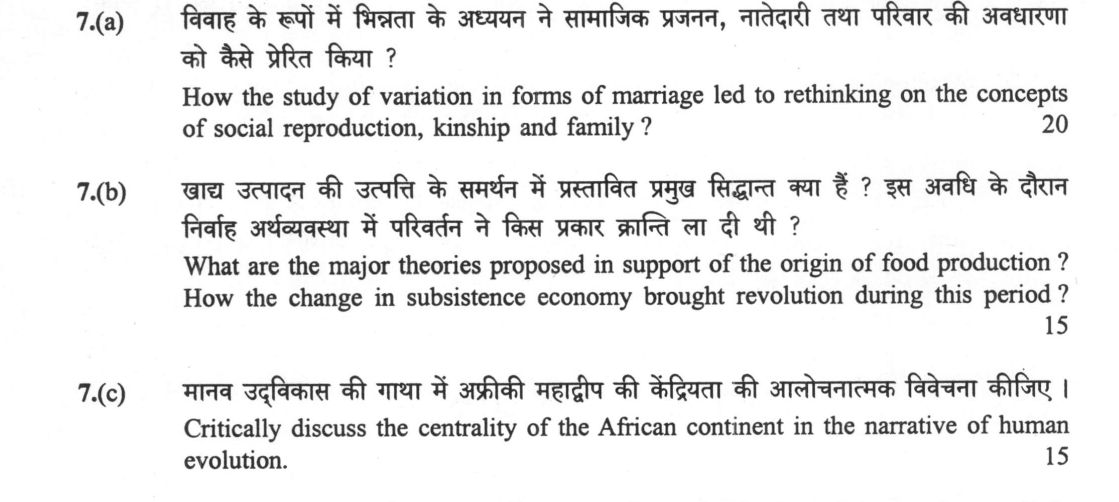
(a) How the study of variation in forms of marriage led to rethinking on the concepts of social reproduction, kinship and family?…
How the study of variation in forms of marriage led to rethinking on the concepts of social reproduction, kinship and family? 20 marks
What are the major theories proposed in support of the origin of food production? How the change in subsistence economy brought revolution during this period? 15 marks
Critically discuss the centrality of the African continent in the narrative of human evolution. 15 marks
हिंदी में प्रश्न पढ़ें
विवाह के रूपों में भिन्नता के अध्ययन ने सामाजिक प्रजनन, नातेदारी तथा परिवार की अवधारणा को कैसे प्रेरित किया ? (20 अंक)
खाद्य उत्पादन की उत्पत्ति के समर्थन में प्रस्तावित प्रमुख सिद्धांत क्या हैं ? इस अवधि के दौरान निर्वाह अर्थव्यवस्था में परिवर्तन ने किस प्रकार क्रांति ला दी थी ? (15 अंक)
मानव उद्विकास की गाथा में अफ्रीकी महाद्वीप की केंद्रीयता की आलोचनात्मक विवेचना कीजिए। (15 अंक)
Model answer
Written by UPSC Answer Check against this question's marking rubric, to the expected length. UPSC does not publish answers for Mains — this is one way to score well, not an official key.
Cross-cultural studies of marriage have systematically dismantled the universal validity of Euro-American, bio-genetic paradigms of family and kinship. Classical structural-functionalists like Radcliffe-Brown and Fortes anchored kinship to descent systems grounded in biological reproduction within monogamous units. However, ethnographies of fraternal polyandry among the Toda and Jaunsari, alongside matrilineal arrangements among the Nayar (sambandham) and Khasi, demonstrated that sexual access, legal paternity, and domestic property management can function independently. Moreover, institutionalized female-female marriages among the Nuer demonstrated that marriage is fundamentally a legal-economic mechanism for social reproduction rather than a fixed biological union.
Marriage Variation and Kinship Rethinking These variations catalyzed David Schneider’s cultural critique, exposing Western kinship as an ethnocentric symbolic construct of biological "blood ties" rather than a cross-cultural fact. Expanding this, Marilyn Strathern (After Nature) showed how relational social praxis, rather than a rigid nature-culture binary, creates human connection. Janet Carsten advanced this through her theory of "relatedness," showing that bodily "substance" is fluid, acquired through shared commensality, co-residence, and care rather than fixed procreation. Thus, social reproduction has been re-conceptualized not as the mere biological replenishment of the nuclear household, but as a diverse, performative, and processual social creation.
Theories and Impacts of the Neolithic Transition The transition to food production has been explained via demographic, ecological, and socio-cultural frameworks. Ester Boserup argued that population pressure necessitated agricultural intensification, driving communities from broad-spectrum foraging into labor-intensive farming. Carl Sauer proposed an alternative ecological model, asserting that plant domestication originated not from scarcity, but in sedentary environments of ecological abundance where foragers had leisure to manipulate flora. Brian Hayden introduced an agency-driven perspective through the competitive feasting model, suggesting that aspiring elites (aggrandizers) intensified food production to generate surplus for ceremonial display and political alliances.
This subsistence shift triggered Gordon Childe’s "Neolithic Revolution." Permanent sedentism reorganized social life into institutionalized hierarchies and surplus-driven political complexity, as evidenced at South Asian sites like Mehrgarh. However, this transition had severe trade-offs. Bioarchaeological research by Cohen and Armelagos demonstrated that the shift to agriculture induced a marked health decline, characterized by nutritional deficiencies, dental hypoplasia, infectious pathologies, and decreased stature resulting from dietary monotony and dense, unhygienic settlements.
Centrality of Africa in Human Phylogenesis Africa’s centrality in hominin evolution is fundamentally supported by both paleontological and genetic records. The East African Rift Valley served as a dynamic evolutionary theater, where tectonic and climatic shifts favored hominin bipedalism. The "Out of Africa" model gains strong empirical support from early fossil discoveries such as Omo-Kibish and Herto, coupled with mitochondrial DNA and Y-chromosome coalescent data demonstrating maximum genetic diversity within African populations. Furthermore, the Saharan Pump hypothesis provides an ecological mechanism for pulses of early human dispersal into Eurasia.
Nonetheless, evaluating this centrality requires interrogating early paleoanthropology’s Eurocentric biases, which long resisted recognizing African antiquity (e.g., initial skepticism toward Raymond Dart’s Taung Child). Furthermore, Multiregional Continuity models and recent genomic evidence of archaic introgression (Neanderthal and Denisovan) highlight significant Eurasian gene flow. Crucially, discoveries at Jebel Irhoud (Morocco) dating early Homo sapiens morphology to ~300,000 BP have challenged a strictly East Africa-centric narrative, replacing it with a pan-African, polycentric model of evolutionary emergence.
Conclusion Anthropological theory advances by continually dismantling monocentric and biologically reductionist assumptions. Whether by redefining kinship through diverse marriage practices, revealing the demographic and paleopathological complexities of the Neolithic transition, or establishing a nuanced, pan-African evolutionary network, the evidence affirms that human biocultural trajectories are fundamentally plural, non-linear, and relationally constructed.
What "Critically discuss" is asking you to do
Lay the issue out from more than one side — how it arose, what is claimed for it, what is held against it, and where it now stands. UPSC attaches discuss to broad topics with several live dimensions, so coverage of the dimensions earns more than the strength of your opinion. “Critically” is not a section added at the end: name the yardstick you are judging by — the evidence, the stated objective, a constitutional principle, a rival explanation — and let a verdict close each part of the body. Where the question quotes a claim, that verdict must land on the claim itself, accepted, qualified or rejected, and not on the theme in general.
Structure that answers it
Set the issue up → the case as it is made → the case against → the dimension both sides leave out → where the balance now lies
Where marks are lost
Merits in one paragraph, demerits in the next, and a conclusion calling for a balanced and holistic approach. That is a survey with the judgement left out and it holds the answer in the middle band. The opposite error is reading “critically” as permission to attack — and with the odd pairings, critically describe or critically explain, the exposition still carries most of the marks, the judgement being a layer on it rather than a substitute for it.
How this answer will be evaluated
Approach
Framework: UPSC Anthropology Paper I (Physical & Social Anthropology). (a) discuss: intro > 3-4 dimensions > example > balanced close | (b) explain: definition/context > points in order > small example > short close | (c) discuss: intro > 3-4 dimensions > example > balanced close Full marks: Precise definitions, named theories/fieldworkers, specific ethnographic cases, and clear critical analysis.
Key points expected
- Define social reproduction and its link to marriage
- Cite specific non-standard marriage forms (e.g., polyandry, levirate)
- Name a specific ethnographic case (e.g., Nayar, Khasa)
- Explain the rethinking of 'family' as a social unit
- Name at least two major theories (e.g., Oases, Feeding the Population)
- Define the 'Neolithic Revolution' or 'Agricultural Revolution'
- Explain the shift from foraging to food production
- Mention the impact on social structure (e.g., sedentism)
Evaluation rubric
Each sub-part is marked on its own, against the marks and word limit printed on the paper.
- (a) Explain how marriage variation challenges standard kinship/family definitions. 20 marks
discuss— intro → 3-4 dimensions → example → balanced close
Must cover
- Define social reproduction and its link to marriage
- Cite specific non-standard marriage forms (e.g., polyandry, levirate)
- Name a specific ethnographic case (e.g., Nayar, Khasa)
- Explain the rethinking of 'family' as a social unit
Loses marks
- Defining marriage only by legal/religious standards
- Ignoring the 'social reproduction' aspect of the question
- Sociological definitions without anthropological context
Earns more
- Reference to Malinowski or Radcliffe-Brown
- Mention of 'matrilocal' or 'patrilocal' residence patterns
- Discussion of 'fictive kinship' or 'alliance theory'
Extra mark
- Sketch of a kinship chart showing the specific marriage form
- Reference to a specific Indian tribal group (e.g., Khasa polyandry)
- (b) List origin theories and explain the subsistence revolution. 15 marks
explain— definition/context → points in order → small example → short close
Must cover
- Name at least two major theories (e.g., Oases, Feeding the Population)
- Define the 'Neolithic Revolution' or 'Agricultural Revolution'
- Explain the shift from foraging to food production
- Mention the impact on social structure (e.g., sedentism)
Loses marks
- Confusing 'food production' with 'food gathering'
- Ignoring the 'subsistence economy' change aspect
- Listing theories without explaining their logic
Earns more
- Reference to Childe or Binford
- Mention of specific crops (wheat, rice) or animals
- Discussion of 'surplus' and 'storage'
Extra mark
- Mention of a specific site (e.g., Mehrgarh, Jhusi)
- Reference to 'domestication' vs 'cultivation' distinction
- (c) Evaluate Africa's role in human evolution with critical analysis. 15 marks
discuss— intro → 3-4 dimensions → example → balanced close
Must cover
- State the 'Out of Africa' hypothesis
- Mention key fossil evidence (e.g., Lucy, Omo remains)
- Discuss the 'multiregional' or 'multiregionalism' counter-argument
- Critically evaluate the evidence for African centrality
Loses marks
- Presenting 'Out of Africa' as absolute fact without critique
- Ignoring the 'multiregional' perspective
- Confusing 'human evolution' with 'human migration'
Earns more
- Reference to Leakey or Johanson
- Mention of 'Homo sapiens' vs 'Homo erectus'
- Discussion of 'mitochondrial Eve' or 'Y-chromosomal Adam'
Extra mark
- Mention of a specific site (e.g., Olduvai Gorge, Omo Kibish)
- Reference to 'archaic' vs 'modern' human features
Practice this exact question
Write your answer and it is marked point by point against the model answer above — what you covered, what you missed, what you got wrong.
Evaluate my answer →More from Anthropology 2025 Paper I
- Q4 (a) Anthropology provides a multidimensional understanding of human beings by bridging th…
- Q5 Write notes on the following in about 150 words each: (a) Multispecies, Multi-sited and C…
- Q6 (a) What are genetic markers? Discuss their applications in understanding population vari…
- Q7 (a) How the study of variation in forms of marriage led to rethinking on the concepts of…
- Q8 (a) How the theories of postmodernism are relevant in promoting social justice and empowe…