Paper I — Q3
(a) How anthropologists assess the nutritional status of a community? Discuss the significance of intersectionality of ecology…
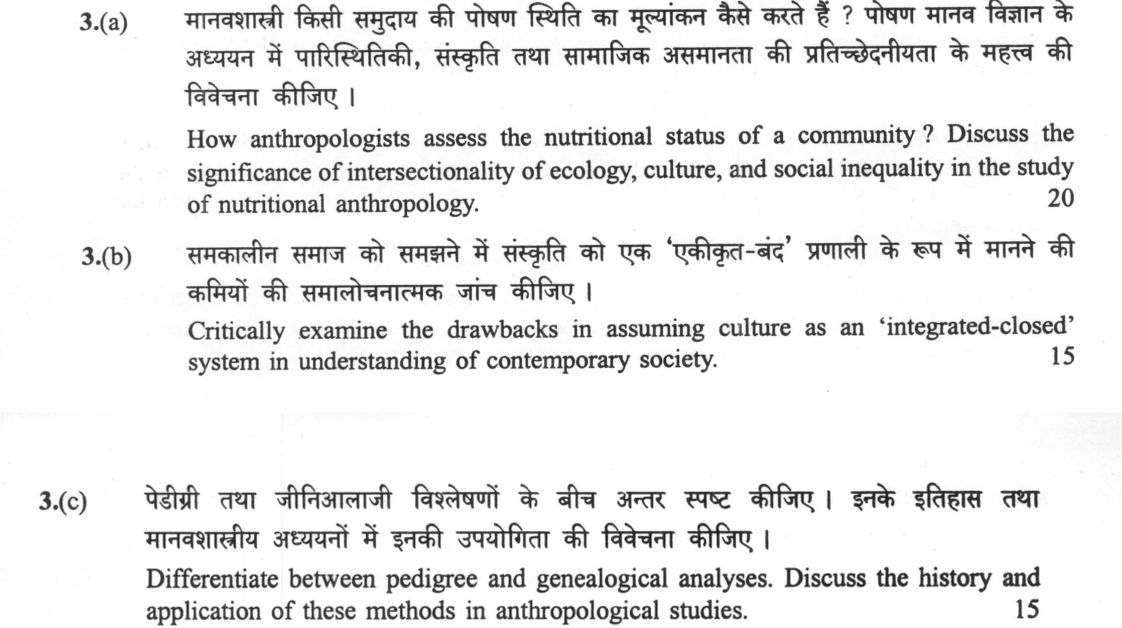
How anthropologists assess the nutritional status of a community? Discuss the significance of intersectionality of ecology, culture, and social inequality in the study of nutritional anthropology. 20 marks
Critically examine the drawbacks in assuming culture as an 'integrated-closed' system in understanding of contemporary society. 15 marks
Differentiate between pedigree and genealogical analyses. Discuss the history and application of these methods in anthropological studies. 15 marks
हिंदी में प्रश्न पढ़ें
मानवशास्त्री किसी समुदाय की पोषण स्थिति का मूल्यांकन कैसे करते हैं ? पोषण मानव विज्ञान के अध्ययन में पारिस्थितिकी, संस्कृति तथा सामाजिक असमानता की प्रतिछेदनीयता के महत्व की विवेचना कीजिए । (20 अंक)
समकालीन समाज को समझने में संस्कृति को एक 'एकीकृत-बंद' प्रणाली के रूप में मानने की कमियों की समालोचनात्मक जांच कीजिए । (15 अंक)
पेडिग्री तथा जीनियालाजी विश्लेषणों के बीच अंतर स्पष्ट कीजिए। इनके इतिहास तथा मानवशास्त्रीय अध्ययनों में इनकी उपयोगिता की विवेचना कीजिए। (15 अंक)
Model answer
Written by UPSC Answer Check against this question's marking rubric, to the expected length. UPSC does not publish answers for Mains — this is one way to score well, not an official key.
Nutritional Anthropology, Cultural Systems, and Kinship Methods
Nutritional anthropology moves beyond mere calorie counting to interpret how biological needs are mediated by social structures. To assess the nutritional status of a community, anthropologists employ a multi-dimensional framework. Anthropometric measurements track physical growth and body composition, such as height-for-age and BMI, to identify stunting or wasting. Biochemical assessments involve analyzing blood or urine samples for markers like hemoglobin, serum albumin, or micronutrient levels, providing objective data on internal physiological status. Clinical examinations detect physical signs of deficiency, such as goiter or xerophthalmia. Finally, dietary assessment methods, including 24-hour recalls and food frequency questionnaires, document actual intake. However, these metrics are interpreted through the lens of intersectionality, where ecology, culture, and social inequality converge. Ecologically, seasonal food availability and agro-ecosystems dictate baseline nutrition. Culturally, food taboos, commensality rules, and gendered food distribution (where women often eat last or least) shape who receives nutrients. Socially, caste and class hierarchies create structural deprivation. In India, studies on tribal groups like the Dangs or Birhors reveal that protein-calorie malnutrition is not just an ecological scarcity but a result of social exclusion from market economies and cultural practices that prioritize male labor. Data from the Integrated Child Development Services (ICDS) further highlights how caste-based discrimination in food distribution exacerbates nutritional gaps, demonstrating that biological outcomes are socially produced.
The traditional view of culture as an 'integrated-closed' system, rooted in the functionalism of Malinowski and Radcliffe-Brown, posits that cultural elements are interdependent parts of a self-sustaining whole. While this model offered coherence, it has significant drawbacks in understanding contemporary society. First, it fails to explain culture change and hybridity, assuming stability where there is constant flux. Second, it ignores globalization flows and external influences that disrupt local equilibria. Third, it masks internal contradictions and power dynamics, treating culture as a harmonious consensus rather than a site of conflict. Alternative frameworks offer more nuance: Fredrik Barth’s transactionalism focuses on boundaries and interaction rather than internal cohesion; Pierre Bourdieu’s practice theory emphasizes habitus and agency; and Arjun Appadurai’s concept of '-scapes' (ethnoscapes, mediascapes) captures the fluid, transnational nature of modern culture. In the Indian context, this is evident in urban slum hybrid identities where traditional caste norms intersect with digital media and global pop culture, creating new, non-closed cultural formations that defy functionalist predictions. Similarly, diasporic Indian communities maintain distinct cultural practices that are neither fully "closed" in their origin nor fully assimilated in their host countries, illustrating the limitations of static system models.
Pedigree analysis and genealogical analysis are distinct yet complementary methods in anthropology. Pedigree analysis is primarily a medical-genetic tool focused on an individual proband to track the inheritance patterns of specific traits or diseases, such as sickle cell anemia or thalassemia, across generations. It relies on Mendelian genetics to identify dominant or recessive patterns. In contrast, genealogical analysis is an anthropological method focused on relational networks, marriage alliances, and descent systems. It maps social relationships rather than just biological ones, using kinship terminologies to understand social structure. Historically, Lewis Henry Morgan used genealogical data to classify kinship systems, while W.H.R. Rivers formalized the method during the Cambridge Anthropological Expedition to Torres Straits in 1898, using it to reconstruct social organization. In contemporary applications, the genealogical method is central to village studies, such as M.N. Srinivas’s work in Rampura, where kinship ties defined political and economic access. Pedigree analysis is now widely used in anthropological genetics to study population history and disease prevalence in Indian populations. The convergence of these methods allows anthropologists to link biological heritage with social structure, providing a holistic view of human societies.
In conclusion, nutritional anthropology reveals that health is a product of ecological, cultural, and social intersections. The critique of culture as a closed system highlights the dynamic, hybrid nature of modern societies, while the distinction between pedigree and genealogical methods underscores the need to integrate biological and social perspectives. Together, these approaches provide a robust framework for understanding the complex interplay of biology, culture, and society in contemporary anthropology.
What "Discuss" is asking you to do
Lay the issue out from more than one side — how it arose, what is claimed for it, what is held against it, and where it now stands. UPSC attaches discuss to broad topics with several live dimensions, so coverage of the dimensions earns more than the strength of your opinion.
Structure that answers it
Set the issue up → the case as it is made → the case against → the dimension both sides leave out → where the balance now lies
Where marks are lost
Listing facts with no thread between them, or arguing one side throughout and calling it a discussion.
How this answer will be evaluated
Approach
Framework: UPSC Anthropology Paper 1 (Physical Anthropology & Social Anthropology). (a) discuss: intro > 3-4 dimensions > example > balanced close | (b) critique: the claim > its strengths > its weaknesses > your judgment | (c) compare: paired headings or table > key differences > significance > conclusion Full marks: Precise definitions, clear differentiation, strong application to Indian context, and critical analysis.
Key points expected
- Define nutritional status and anthropometric indicators (BMI, stunting).
- Explain ecological determinants (food availability, environment).
- Analyze cultural factors (taboos, food rituals, beliefs).
- Discuss social inequality (class, caste, gender) in nutrition.
- Define 'integrated-closed' system (Malinowski/Radcliffe-Brown).
- Identify drawback: ignores external influences (globalization).
- Identify drawback: assumes internal consistency (ignores conflict).
- Apply to contemporary society (urbanization, migration).
Evaluation rubric
Each sub-part is marked on its own, against the marks and word limit printed on the paper.
- (a) Assessment methods for nutritional status and the intersection of ecology, culture, and inequality. 20 marks
discuss— intro → 3-4 dimensions → example → balanced close
Must cover
- Define nutritional status and anthropometric indicators (BMI, stunting).
- Explain ecological determinants (food availability, environment).
- Analyze cultural factors (taboos, food rituals, beliefs).
- Discuss social inequality (class, caste, gender) in nutrition.
Loses marks
- Ignoring the intersectionality aspect.
- Treating nutrition purely as a medical issue.
Earns more
- Mention specific anthropometric tools (e.g., triceps skinfold).
- Reference specific tribal food habits (e.g., Gond, Santhal).
- Link to Indian tribal policy (e.g., PDS, ICDS).
Extra mark
- Labelled diagram of anthropometric measurement.
- Specific statistic on tribal malnutrition.
- (b) Drawbacks of the 'integrated-closed' system model for contemporary society. 15 marks
critique— the claim → its strengths → its weaknesses → your judgment
Must cover
- Define 'integrated-closed' system (Malinowski/Radcliffe-Brown).
- Identify drawback: ignores external influences (globalization).
- Identify drawback: assumes internal consistency (ignores conflict).
- Apply to contemporary society (urbanization, migration).
Loses marks
- Defending the model without critique.
- Vague generalities about 'modern society'.
Earns more
- Mention specific functionalist critics (e.g., Evans-Pritchard).
- Reference specific contemporary social changes.
Extra mark
- Comparison with structural-functionalism.
- Reference to specific modern Indian social change.
- (c) Differentiate pedigree and genealogical analyses; history and application. 15 marks
compare— paired headings or table → key differences → significance → conclusion
Must cover
- Define pedigree analysis (biological/genetic focus).
- Define genealogical analysis (social/kinship focus).
- Differentiate: biological vs. social descent.
- Discuss history (Morgan, Boas) and application.
Loses marks
- Confusing biological pedigree with social genealogy.
- Ignoring the historical context of the methods.
Earns more
- Mention specific kinship terms (e.g., cognatic, unilineal).
- Reference specific tribal kinship systems.
Extra mark
- Sketch of a kinship chart.
- Reference to specific genetic study.
Practice this exact question
Write your answer and it is marked point by point against the model answer above — what you covered, what you missed, what you got wrong.
Evaluate my answer →More from Anthropology 2025 Paper I
- Q1 Write notes on the following in 150 words each: (a) Mendelian and non-Mendelian traits. (…
- Q2 (a) Discuss the Miocene hominoid remains and their significance in evolution. (20 marks)…
- Q3 (a) How anthropologists assess the nutritional status of a community? Discuss the signifi…
- Q4 (a) Anthropology provides a multidimensional understanding of human beings by bridging th…
- Q5 Write notes on the following in about 150 words each: (a) Multispecies, Multi-sited and C…
- Q6 (a) What are genetic markers? Discuss their applications in understanding population vari…