Paper I — Q4
(a) Anthropology provides a multidimensional understanding of human beings by bridging the gap between science and humanities…
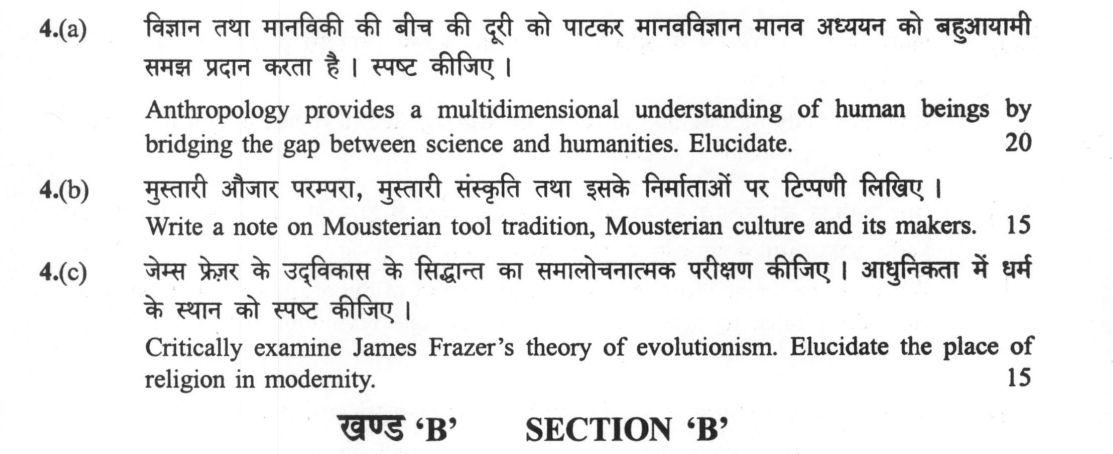
Anthropology provides a multidimensional understanding of human beings by bridging the gap between science and humanities. Elucidate. 20 marks
Write a note on Mousterian tool tradition, Mousterian culture and its makers. 15 marks
Critically examine James Frazer's theory of evolutionism. Elucidate the place of religion in modernity. 15 marks
हिंदी में प्रश्न पढ़ें
विज्ञान तथा मानविकी की बीच की दूरी को पाटकर मानवविज्ञान मानव अध्ययन को बहुआयामी समझ प्रदान करता है। स्पष्ट कीजिए। (20 अंक)
मुस्तारी औजार परंपरा, मुस्तारी संस्कृति तथा इसके निर्माताओं पर टिप्पणी लिखिए। (15 अंक)
जेम्स फ्रेजर के उद्विविकास के सिद्धांत का समालोचनात्मक परीक्षण कीजिए। आधुनिकता में धर्म के स्थान को स्पष्ट कीजिए। (15 अंक)
Model answer
Written by UPSC Answer Check against this question's marking rubric, to the expected length. UPSC does not publish answers for Mains — this is one way to score well, not an official key.
Anthropology: Bridging Science and Humanities
Anthropology’s unique position in the academic landscape lies in its holistic mandate to study humanity in all its dimensions, thereby bridging the chasm between empirical science and humanistic inquiry. While natural sciences seek universal laws through quantification, humanities focus on meaning, interpretation, and subjective experience. Anthropology synthesizes these by treating humans as both biological organisms and cultural agents. This integration is operationalized through the four-field approach: biological anthropology uses forensic and genetic methods to understand human evolution; archaeology employs stratigraphy and radiocarbon dating to reconstruct past lifeways; linguistic anthropology analyzes structure and change in communication; and cultural anthropology utilizes participant observation to interpret social norms. In India, this bridge is exemplified by N.K. Bose, who integrated biological data with cultural context to study tribal populations, and M.N. Srinivas, whose concept of "sanskritization" used scientific rigor to explain dynamic cultural change. Thus, anthropology elucidates human complexity by refusing to separate the body from the mind or the past from the present.
Mousterian Tradition and Its Makers
The Mousterian industry, characteristic of the Middle Palaeolithic period, is primarily dated to c. 160,000–40,000 BP. It is defined by the Levallois prepared-core technique, where a core is carefully shaped to produce predetermined flakes. The resulting toolkit includes large cutting flakes, scrapers, points, and side scrapers. Crucially, while bifacial handaxes occur in some variants (Mousterian of Acheulean Tradition), they are core tools, distinct from the primary flake tools of the tradition. The industry is geographically widespread across Europe, West Asia, and North Africa. However, the makers were not uniform. In Europe, the primary makers were Homo neanderthalensis, who demonstrated cognitive sophistication through burial practices and symbolic behavior. In North Africa, such as at Jebel Irhoud, similar assemblages are associated with early Homo sapiens. In the Indian context, Middle Palaeolithic sites like Didwana, Nevasa, and Bhimbetka exhibit Mousterian-like technologies, indicating parallel technological developments among early modern humans and their contemporaries.
Frazer’s Evolutionism and Religion in Modernity
James Frazer’s The Golden Bough posits an intellectualist evolutionary sequence: magic, religion, and science. He argued that magic, based on sympathetic and contagious laws, preceded religion (propitiation of gods), which was later superseded by science (rational control). This unilinear scheme has been critically examined and largely rejected. Bronislaw Malinowski challenged Frazer’s intellectualism, arguing that magic serves functional psychological needs in moments of uncertainty, rather than being a primitive error. E.E. Evans-Pritchard further dismantled the notion of "irrationality" by demonstrating that Azande witchcraft beliefs were logically consistent within their own cosmological framework.
In modernity, the relationship between religion and society is complex, defying simple secularization theses. While secularization predicts the decline of religious authority, "desecularization" is evident in the rise of fundamentalism and the commodification of faith. In India, religion remains a potent public force. The Ayodhya dispute highlighted the intersection of religious identity and political power, while the rapid growth of Pentecostalism in urban areas reflects religion’s adaptability to modern anxieties. Syncretic traditions continue to blend Hindu, Islamic, and Christian elements, showing that religion is not a static relic but a dynamic social institution.
Conclusion
Anthropology elucidates the human condition by integrating scientific precision with humanistic depth. From the technological ingenuity of Mousterian makers to the complex role of religion in contemporary India, the discipline reveals that human behavior is neither purely biological nor purely cultural, but a holistic interplay of both. This multidimensional perspective is essential for understanding the full spectrum of human experience.
What "Elucidate" is asking you to do
Make a stated proposition plain and then prove it with instances. Elucidate stems almost always carry a claim or a named concept, and very often the words “with examples” or “with suitable diagrams” — the illustration is part of the directive, not decoration.
Structure that answers it
Plain-language statement of what the proposition means → the part that is obscure, resolved → first illustration → second illustration → why the proposition holds
Where marks are lost
Adding terminology; elucidate rewards removing it. The commoner loss is a clean explanation with no example, when the stem asked for examples.
How this answer will be evaluated
Approach
(a) explain: definition/context > points in order > small example > short close | (b) describe: define > structure or process in order > labelled diagram > significance | (c) critique: the claim > its strengths > its weaknesses > your judgment Full marks: Comprehensive, well-structured, with specific examples and critical analysis.
Key points expected
- Define anthropology's multidimensional scope
- Identify scientific strands (physical, biological)
- Identify humanities strands (cultural, social)
- Explain the synthesis of both
- Define Mousterian tool tradition
- Describe key tool types (Levallois)
- Identify the makers (Neanderthals)
- Mention the time period
Evaluation rubric
Each sub-part is marked on its own, against the marks and word limit printed on the paper.
- (a) Explain how anthropology bridges science and humanities to provide a multidimensional view of humans. 20 marks
explain— definition/context → points in order → small example → short close
Must cover
- Define anthropology's multidimensional scope
- Identify scientific strands (physical, biological)
- Identify humanities strands (cultural, social)
- Explain the synthesis of both
Loses marks
- Treating anthropology as only sociology
- Ignoring the biological aspect
- Vague generalities without examples
Earns more
- Mention specific sub-disciplines
- Cite a specific anthropologist
- Use an Indian tribal example
- Discuss the holistic approach
Extra mark
- Labelled diagram of sub-fields
- Reference to a specific Indian study
- (b) Describe Mousterian tool tradition, culture, and its makers. 15 marks
describe— define → structure or process in order → labelled diagram → significance
Must cover
- Define Mousterian tool tradition
- Describe key tool types (Levallois)
- Identify the makers (Neanderthals)
- Mention the time period
Loses marks
- Confusing with Acheulean tradition
- Ignoring the makers
- No mention of specific tools
Earns more
- Mention specific sites (e.g., Bhimbetka)
- Describe the Levallois technique
- Discuss the cultural context
- Mention the geographical spread
Extra mark
- Sketch of a Mousterian tool
- Reference to a specific excavation
- (c) Critically examine Frazer's evolutionism and the place of religion in modernity. 15 marks
critique— the claim → its strengths → its weaknesses → your judgment
Must cover
- Explain Frazer's stages (magic, religion, science)
- Critique the unilinear evolutionism
- Discuss the place of religion in modernity
- Provide a balanced judgment
Loses marks
- Describing only without critique
- Ignoring the modernity aspect
- Overstating the validity of evolutionism
Earns more
- Mention 'The Golden Bough'
- Cite specific criticisms (e.g., Malinowski)
- Discuss secularization vs. persistence
- Use a modern example
Extra mark
- Reference to a specific modern study
- Mention a specific critic
Practice this exact question
Write your answer and it is marked point by point against the model answer above — what you covered, what you missed, what you got wrong.
Evaluate my answer →More from Anthropology 2025 Paper I
- Q1 Write notes on the following in 150 words each: (a) Mendelian and non-Mendelian traits. (…
- Q2 (a) Discuss the Miocene hominoid remains and their significance in evolution. (20 marks)…
- Q3 (a) How anthropologists assess the nutritional status of a community? Discuss the signifi…
- Q4 (a) Anthropology provides a multidimensional understanding of human beings by bridging th…
- Q5 Write notes on the following in about 150 words each: (a) Multispecies, Multi-sited and C…
- Q6 (a) What are genetic markers? Discuss their applications in understanding population vari…
- Q7 (a) How the study of variation in forms of marriage led to rethinking on the concepts of…