Paper II — Q1
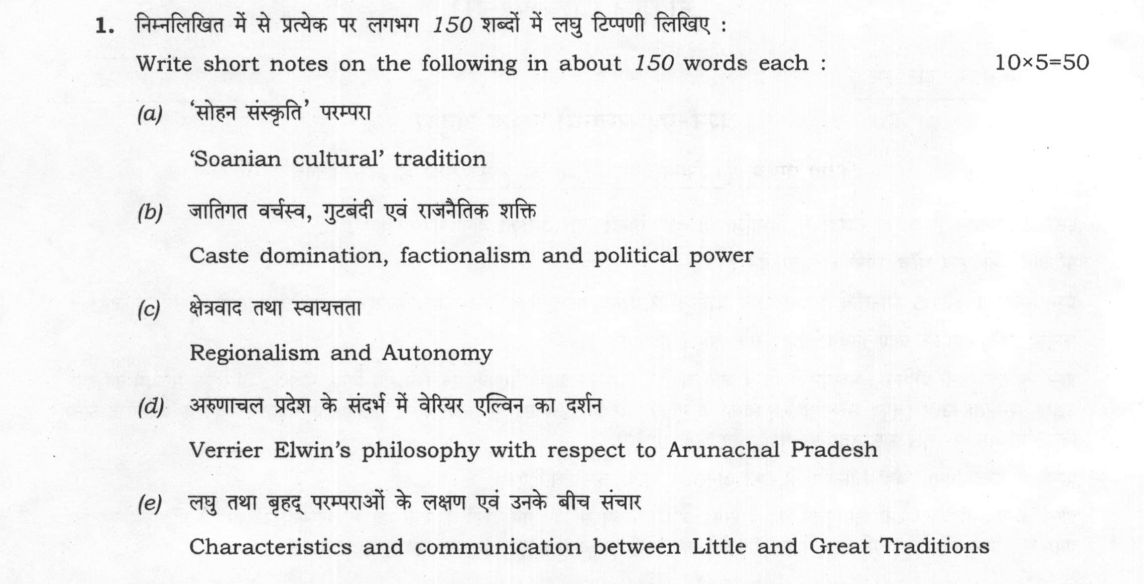
Write short notes on the following in about 150 words each : 10×5=50 (a) 'Soanian cultural' tradition (b) Caste domination…
Write short notes on the following in about 150 words each : 10×5=50
'Soanian cultural' tradition
Caste domination, factionalism and political power
Regionalism and Autonomy
Verrier Elwin's philosophy with respect to Arunachal Pradesh
Characteristics and communication between Little and Great Traditions
हिंदी में प्रश्न पढ़ें
निम्नलिखित में से प्रत्येक पर लगभग 150 शब्दों में लघु टिप्पणी लिखिए : 10×5=50
'सोहन संस्कृति' परम्परा
जातिगत वर्चस्व, गुटबंदी एवं राजनीतिक शक्ति
क्षेत्रवाद तथा स्वायत्तता
अरुणाचल प्रदेश के संदर्भ में वेरियर एल्विन का दर्शन
लघु तथा बृहद् परम्पराओं के लक्षण एवं उनके बीच संचार
Model answer
Written by UPSC Answer Check against this question's marking rubric, to the 150-word length. UPSC does not publish answers for Mains — this is one way to score well, not an official key.
Soanian Cultural Tradition The Soanian tradition is a Lower Paleolithic chopper-chopping tool culture found in the Soan Valley, Pakistan, and parts of India. Predating the Acheulian, it features heavy, uniface tools distinct from the bifacial Madrasian industry. Associated with Pleistocene deposits, it represents an early adaptive strategy. Its location west of the conventional Movius Line makes it a significant exception to the global distribution of handaxes, highlighting regional variability in early human technological evolution.
Caste Domination, Factionalism, and Political Power M.N. Srinivas’s concept of the "Dominant Caste" explains how specific castes monopolize political power in localities through economic and social superiority. This leads to factionalism, where intra-caste rivalries, such as the Reddy-Kamma conflicts in Andhra Pradesh, shape electoral outcomes. Caste associations act as interest groups, mobilizing vote banks for vertical integration. This nexus transforms social hierarchy into political leverage, ensuring that dominant castes control state resources and policy formulation at the district and state levels.
Regionalism and Autonomy Regionalism arises from linguistic and cultural distinctiveness, driving demands for autonomy to address development disparities. India’s response ranges from administrative adjustments to constitutional protections. While the linguistic states movement reorganized boundaries, sub-regional demands like Gorkhaland or Bodoland seek greater self-governance. Mechanisms vary: the Sixth Schedule provides autonomy to tribal areas in northeastern states, whereas Article 371A grants special protections to Nagaland. This spectrum reflects the tension between national integration and the preservation of regional identity and resource control.
Verrier Elwin’s Philosophy on Arunachal Pradesh Verrier Elwin initially advocated for a "leave them alone" policy, arguing that tribal societies should be isolated from mainstream Hindu culture to prevent cultural erosion. This influenced the North-East Frontier Tracts (NEFT) policy. Later, he shifted to "controlled integration," accepting modernization while protecting tribal rights. His philosophy rejected assimilationist models, emphasizing tribal agency. Although Arunachal Pradesh is not under the Sixth Schedule, Elwin’s legacy is evident in the protective spirit of Article 371H and the broader Fifth Schedule framework, which safeguards tribal lands and customs from external encroachment.
Little and Great Traditions Robert Redfield’s model distinguishes between the "Great Tradition" (elite, classical, Sanskritic) and the "Little Tradition" (folk, local, vernacular). Communication between them occurs through universalization, where Great Tradition elements are simplified for the masses, and parochialization, where local practices gain legitimacy. In India, Sanskritization illustrates this upward and downward flow, where lower castes adopt upper-caste rituals to improve status. Scholars like McKim Marriott refined this, noting that local festivals, such as Salono in Kishan Garhi, are not merely goddess worship but complex social rituals that integrate local and classical elements, creating a dynamic continuum rather than a rigid hierarchy.
Conclusion These notes collectively illustrate the complex interplay between prehistoric heritage, social stratification, political geography, and cultural dynamics in India. Understanding the Soanian tradition provides a deep-time context for human adaptation, while the analysis of caste and regionalism reveals the structural mechanisms of contemporary power. Elwin’s philosophy and the Little-Great Tradition model offer critical frameworks for interpreting the tension between integration and identity. Together, they underscore that Indian society is not static but a continuous negotiation between historical legacies and modern political realities, requiring nuanced anthropological insight to comprehend fully.
What "Write short notes" is asking you to do
Five or six self-contained answers, marked separately, typically 10 marks and about 150 words each. Each note must carry its own definition, its two or three defining features and a line on why it matters; a common introduction or conclusion across the notes earns nothing.
Structure that answers it
Per note: one-line definition or identification → two or three features, mechanisms or named examples → one line of significance or Indian application
Where marks are lost
Writing the first two notes at essay length and rationing the rest. Each note is marked on its own, so marks surrendered on a compressed or unattempted note cannot be won back by the long ones.
How this answer will be evaluated
Approach
Framework: UPSC Anthropology Paper II (Sociology & Social Anthropology). (a) write short notes: define > 3-4 key features > one example > one-line significance | (b) write short notes: define > 3-4 key features > one example > one-line significance | (c) write short notes: define > 3-4 key features > one example > one-line significance | (d) write short notes: define > 3-4 key features > one example > one-line significance | (e) write short notes: define > 3-4 key features > one example > one-line significance Full marks: Precise definitions, named sites/thinkers, clear Indian examples, no factual errors.
Key points expected
- Define Soanian as Lower Paleolithic industry
- Mention specific tools (e.g., hand axes, cleavers)
- Identify key sites (e.g., Soan Valley, Ropar)
- State chronological period (Pleistocene)
- Define caste domination in political context
- Explain factionalism as a mechanism of power
- Link caste identity to vote bank politics
- Provide an Indian tribal or state example
Evaluation rubric
Each sub-part is marked on its own, against the marks and word limit printed on the paper.
- (a) Define Soanian tradition and list key features with one example. · 150 words
write short notes— define → 3-4 key features → one example → one-line significance
Must cover
- Define Soanian as Lower Paleolithic industry
- Mention specific tools (e.g., hand axes, cleavers)
- Identify key sites (e.g., Soan Valley, Ropar)
- State chronological period (Pleistocene)
Loses marks
- Confusing Soanian with Middle Paleolithic
- Vague description without tool names
Earns more
- Mention raw material (chert, quartzite)
- Reference specific excavator (e.g., Deaton)
Extra mark
- Sketch of a Soanian hand axe
- Map showing Soan Valley location
- (b) Explain the link between caste, factions, and political power. · 150 words
write short notes— define → 3-4 key features → one example → one-line significance
Must cover
- Define caste domination in political context
- Explain factionalism as a mechanism of power
- Link caste identity to vote bank politics
- Provide an Indian tribal or state example
Loses marks
- Treating caste and faction as unrelated
- Ignoring the 'political power' aspect
Earns more
- Reference specific political scientist (e.g., M.N. Srinivas)
- Mention specific state (e.g., Bihar, UP)
Extra mark
- Diagram of caste-faction hierarchy
- Reference to specific election data
- (c) Define regionalism and autonomy and their relationship. · 150 words
write short notes— define → 3-4 key features → one example → one-line significance
Must cover
- Define regionalism (cultural/political)
- Define autonomy (constitutional/legal)
- Explain the demand for autonomy in India
- Mention specific constitutional provisions (e.g., 6th/7th Schedule)
Loses marks
- Confusing regionalism with separatism
- Ignoring the 'autonomy' aspect
Earns more
- Reference specific tribal movement (e.g., Naga, Mizo)
- Mention 'Aspirational States' concept
Extra mark
- Map of autonomous districts
- Reference to specific High Court judgment
- (d) Summarize Verrier Elwin's philosophy on Arunachal Pradesh. · 150 words
write short notes— define → 3-4 key features → one example → one-line significance
Must cover
- Identify Elwin as a key anthropologist
- Explain his 'non-interference' or 'protection' stance
- Mention his view on tribal identity in Arunachal
- Reference his work with specific tribes (e.g., Abor, Galo)
Loses marks
- Confusing Elwin with other anthropologists
- Ignoring the 'Arunachal Pradesh' context
Earns more
- Mention his role in tribal administration
- Reference his writings (e.g., 'The Tribal World')
Extra mark
- Quote from Elwin's work
- Mention his influence on policy
- (e) Define Little and Great Traditions and their communication. · 150 words
write short notes— define → 3-4 key features → one example → one-line significance
Must cover
- Define Little Tradition (folk, oral)
- Define Great Tradition (elite, written)
- Explain the concept of 'communication' or 'syncretism'
- Provide an Indian example (e.g., local deities in Hinduism)
Loses marks
- Confusing 'Little' with 'minor' or 'inferior'
- Ignoring the 'communication' aspect
Earns more
- Reference M.N. Srinivas (coined the terms)
- Mention 'Sanskritization' as a mechanism
Extra mark
- Diagram showing the two traditions
- Reference to specific ritual syncretism
Practice this exact question
Write your answer and it is marked point by point against the model answer above — what you covered, what you missed, what you got wrong.
Evaluate my answer →More from Anthropology 2025 Paper II
- Q1 Write short notes on the following in about 150 words each : 10×5=50 (a) 'Soanian cultura…
- Q2 (a) Discuss the palaeoanthropological significance of Siwaliks of India giving its subdiv…
- Q3 (a) Describe the distinctive features and distribution of Upper Palaeolithic of India. 20…
- Q4 (a) What are the different types of caste mobility in India? Highlight the various factor…