Paper II — Q3
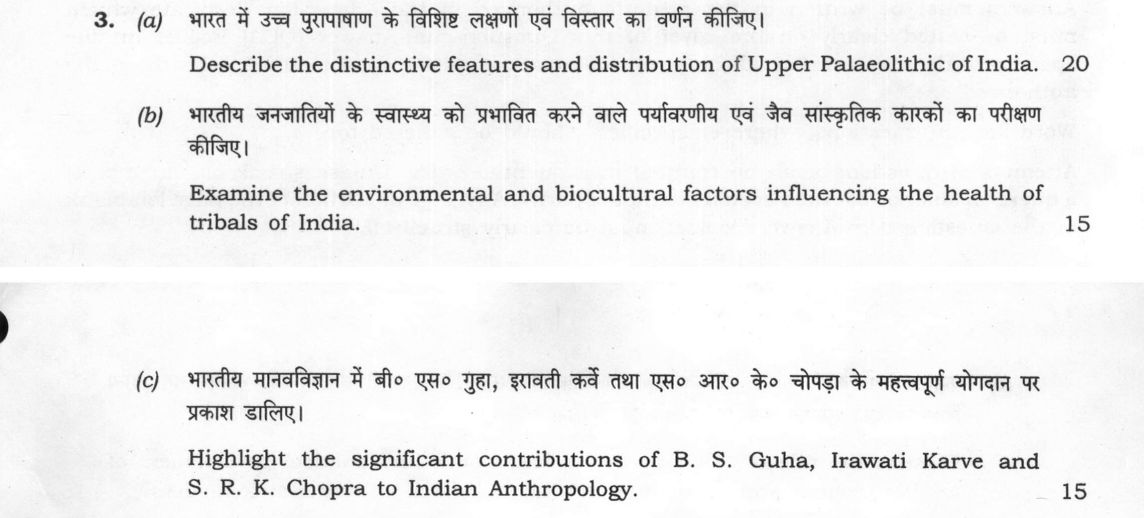
(a) Describe the distinctive features and distribution of Upper Palaeolithic of India. 20 (b) Examine the environmental and…
Describe the distinctive features and distribution of Upper Palaeolithic of India. 20 marks
Examine the environmental and biocultural factors influencing the health of tribals of India. 15 marks
Highlight the significant contributions of B. S. Guha, Irawati Karve and S. R. K. Chopra to Indian Anthropology. 15 marks
हिंदी में प्रश्न पढ़ें
भारत में उच्च पुरापाषाण के विशिष्ट लक्षणों एवं विस्तार का वर्णन कीजिए। 20
भारतीय जनजातियों के स्वास्थ्य को प्रभावित करने वाले पर्यावरणीय एवं जैव सांस्कृतिक कारकों का परीक्षण कीजिए। 15
भारतीय मानवविज्ञान में बी० एस० गुहा, इरावती कर्वे तथा एस० आर० के० चोपड़ा के महत्त्वपूर्ण योगदान पर प्रकाश डालिए। 15
Model answer
Written by UPSC Answer Check against this question's marking rubric, to the expected length. UPSC does not publish answers for Mains — this is one way to score well, not an official key.
Upper Palaeolithic India: Technology, Distribution, and Anthropological Foundations
The Upper Palaeolithic (UP) of India, spanning approximately 40,000 to 10,000 BP, marks a critical transition in human evolution characterized by technological refinement, symbolic behavior, and distinct environmental adaptations. This period is best understood through its material culture, the health challenges facing contemporary tribal populations, and the foundational scholarship that defined Indian anthropology.
Distinctive Features and Distribution of the Upper Palaeolithic
The UP phase is distinguished from the preceding Middle Palaeolithic by the shift from hand-axe technology to blade and burin industries. While the Middle Palaeolithic relied on Levallois technique, the UP introduced systematic blade production, often from prismatic cores, and the widespread use of burins for engraving. This technological sophistication is evident in sites across the Belan, Son, Narmada, and Mahanadi valleys. Key sites include Patne in Madhya Pradesh, which yielded bone and antler tools, and the Kurnool caves in Andhra Pradesh, where stratified deposits reveal a clear sequence from Middle to Upper Palaeolithic. In Gujarat, the site of Visadi provides crucial evidence of this transition.
A hallmark of this period is the emergence of symbolic behavior, most notably at Bhimbetka in Madhya Pradesh. The earliest Upper Palaeolithic paintings here are generally linear and executed in green pigment, depicting animals and hunting scenes. This contrasts with the later Mesolithic "dynamic" style, which is typically red and more expressive. The presence of organic tools, such as the carved bone figurine found at Lohanda Nala, further underscores the cognitive leap of UP humans. The distribution of UP sites is not uniform; it is concentrated in river valleys and cave shelters, reflecting a hunter-gatherer lifestyle that was gradually transitioning toward the microlithic culture. This transition is visible in the late UP layers, where small geometric microliths begin to appear, bridging the gap to the Neolithic.
Environmental and Biocultural Factors in Tribal Health
The health of India’s tribal populations is shaped by a complex interplay of environmental stressors and biocultural factors. Environmentally, forest degradation and water contamination are primary drivers of morbidity. In central India, malaria remains endemic among tribes like the Gonds, exacerbated by deforestation that alters mosquito breeding patterns. In the Himalayas, altitude sickness poses a significant threat to high-altitude communities.
Biocultural factors include dietary transitions and genetic predispositions. The shift from traditional foraging to market-based agriculture has led to nutritional deficiencies, as seen in studies of the Dongria Kondh. Genetic factors also play a role; for instance, the prevalence of sickle cell trait in some Gond populations offers a historical advantage against malaria but poses health risks in non-endemic areas. Furthermore, the erosion of traditional medicine knowledge due to modernization leaves communities vulnerable. The Jarawa tribe of the Andaman Islands exemplifies the acute health crisis resulting from development-induced displacement and contact with outsiders, leading to high mortality from diseases like influenza. These cases highlight how development policies often intersect with health outcomes, necessitating culturally sensitive interventions.
Contributions of Key Anthropologists
The development of Indian anthropology owes much to the foundational work of B. S. Guha, Irawati Karve, and S. R. K. Chopra. B. S. Guha, often called the father of Indian anthropology, established the Anthropological Survey of India (ASI) in 1952. His 1935 work, The Races of India, proposed a racial classification of the Indian population, identifying a Negrito element and conducting skeletal studies at Mohenjodaro. His work laid the physical anthropology framework for the subcontinent.
Irawati Karve, the first woman anthropologist to conduct extensive fieldwork in India, revolutionized the study of social structure. Her seminal work, Hindu Society, described Indian society as a mosaic of endogamous groups rather than a rigid caste hierarchy. Her kinship studies, such as Yuganta, emphasized regional variations and the importance of fieldwork, shifting the discipline from armchair theorizing to empirical investigation.
S. R. K. Chopra expanded the scope of anthropology into human cytogenetics and dermatoglyphics. His population genetics studies of Indian tribes provided insights into genetic diversity and migration patterns. Beyond research, Chopra was instrumental in establishing anthropology departments across India and training the next generation of scholars, ensuring the discipline’s institutional growth.
Conclusion
The Upper Palaeolithic reveals the cognitive and technological roots of Indian civilization, while contemporary tribal health issues highlight the ongoing challenges of environmental and cultural change. The scholarly legacy of Guha, Karve, and Chopra provides the methodological and theoretical tools necessary to understand both the past and present of Indian society. Their contributions remain vital for addressing contemporary issues in anthropology and public health.
What "Describe" is asking you to do
Give a full, ordered account of the thing named — its parts, stages or mechanism — in the sequence in which it actually exists or occurs. Most describe questions come from the science optionals, where the marks sit in correct technical detail and, where the stem says so, a labelled diagram.
Structure that answers it
One-line identification of the subject → the parts or stages in their real order, each with its defining detail → labelled diagram where the subject is structural → closing line on function or significance
Where marks are lost
Loose general prose where the examiner is ticking named parts, correct terminology and their sequence; and in the General Studies papers, turning to evaluation before the description is finished.
How this answer will be evaluated
Approach
Framework: UPSC Anthropology Paper II (Physical & Social Anthropology). (a) describe: define > structure or process in order > labelled diagram > significance | (b) examine: intro > how/why with reasoning > evidence > conclusion | (c) highlight: name the salient points > one line of substance each > close Full marks: Comprehensive, specific, and well-structured with named sites, tribes, and scholars.
Key points expected
- Define Upper Palaeolithic (approx. 40,000-10,000 BP)
- List distinctive features (blade technology, microliths, bone tools)
- Map distribution (Narmada, Soan, Mahi valleys)
- Mention specific sites (Bagor, Kurnool, Patne, Jwalapur)
- Define environmental factors (climate, terrain, pollution)
- Define biocultural factors (diet, hygiene, social norms)
- Link factors to specific health issues (anemia, malaria)
- Provide Indian tribal examples (e.g., Santhal, Gond, Bhil)
Evaluation rubric
Each sub-part is marked on its own, against the marks and word limit printed on the paper.
- (a) Define Upper Palaeolithic, list distinctive features, and map its distribution in India. 20 marks
describe— define → structure or process in order → labelled diagram → significance
Must cover
- Define Upper Palaeolithic (approx. 40,000-10,000 BP)
- List distinctive features (blade technology, microliths, bone tools)
- Map distribution (Narmada, Soan, Mahi valleys)
- Mention specific sites (Bagor, Kurnool, Patne, Jwalapur)
Loses marks
- Confusing Upper Palaeolithic with Middle Palaeolithic
- Listing sites without regional context
- Ignoring the technological shift to microliths
Earns more
- Mention of specific industries (e.g., Jwalapur, Patne)
- Reference to faunal remains (e.g., Megaloceros)
- Mention of cave paintings (e.g., Bhimbetka)
Extra mark
- Labelled map of Indian UP sites
- Sketch of a specific tool type (e.g., microlith)
- (b) Analyze how environmental and biocultural factors impact tribal health in India. 15 marks
examine— intro → how/why with reasoning → evidence → conclusion
Must cover
- Define environmental factors (climate, terrain, pollution)
- Define biocultural factors (diet, hygiene, social norms)
- Link factors to specific health issues (anemia, malaria)
- Provide Indian tribal examples (e.g., Santhal, Gond, Bhil)
Loses marks
- Generic health discussion without tribal context
- Ignoring the 'biocultural' aspect (social norms)
- Focusing only on environmental factors
Earns more
- Mention of specific diseases (e.g., Kala Azar, TB)
- Reference to government schemes (e.g., Ayushman Bharat)
- Discussion of malnutrition and stunting
Extra mark
- Statistical data on tribal health indicators
- Reference to a specific study or report
- (c) Summarize the key contributions of B.S. Guha, Irawati Karve, and S.R.K. Chopra. 15 marks
highlight— name the salient points → one line of substance each → close
Must cover
- B.S. Guha: Contributions to physical anthropology (craniometry)
- Irawati Karve: Contributions to social anthropology (regionalism)
- S.R.K. Chopra: Contributions to physical anthropology (genetics)
- Mention specific works or theories for each
Loses marks
- Confusing the contributions of the three scholars
- Vague descriptions without specific works
- Ignoring the specific field of each scholar
Earns more
- Mention of 'Cultural Patterns in India' (Karve)
- Mention of 'The Races of India' (Guha)
- Mention of 'Genetics of Indian Populations' (Chopra)
Extra mark
- Comparison of their methodological approaches
- Mention of their institutional affiliations
Practice this exact question
Write your answer and it is marked point by point against the model answer above — what you covered, what you missed, what you got wrong.
Evaluate my answer →More from Anthropology 2025 Paper II
- Q1 Write short notes on the following in about 150 words each : 10×5=50 (a) 'Soanian cultura…
- Q2 (a) Discuss the palaeoanthropological significance of Siwaliks of India giving its subdiv…
- Q3 (a) Describe the distinctive features and distribution of Upper Palaeolithic of India. 20…
- Q4 (a) What are the different types of caste mobility in India? Highlight the various factor…
- Q5 Write short notes on the following in about 150 words each : 10×5=50 (a) Impact of urbani…
- Q6 (a) "The village was not merely a place where people lived; it had a design in which were…