Paper II — Q4
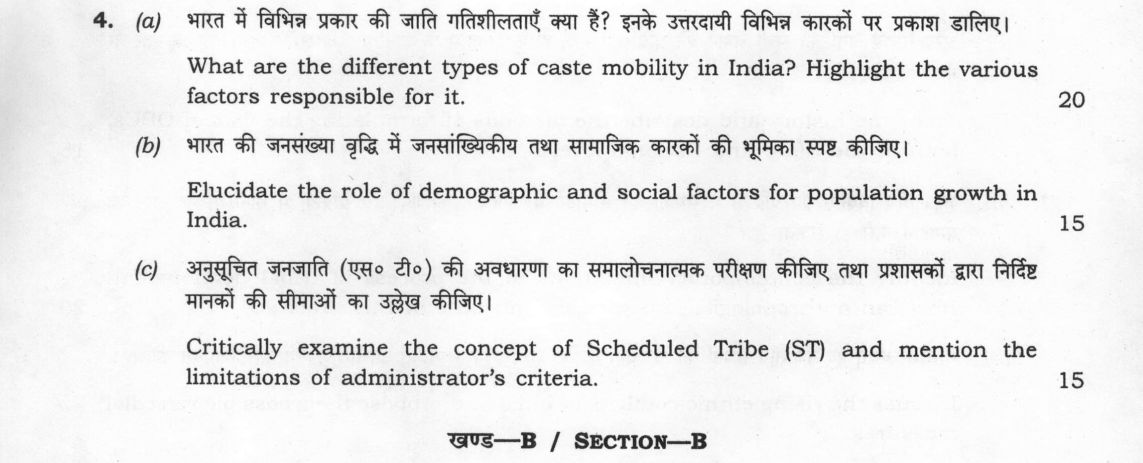
(a) What are the different types of caste mobility in India? Highlight the various factors responsible for it. 20 (b) Elucidate…
What are the different types of caste mobility in India? Highlight the various factors responsible for it. 20 marks
Elucidate the role of demographic and social factors for population growth in India. 15 marks
Critically examine the concept of Scheduled Tribe (ST) and mention the limitations of administrator's criteria. 15 marks
हिंदी में प्रश्न पढ़ें
भारत में विभिन्न प्रकार की जाति गतिशीलताएँ क्या हैं? इनके उत्तरदायी विभिन्न कारकों पर प्रकाश डालिए। 20
भारत की जनसंख्या वृद्धि में जनसांख्यिकीय तथा सामाजिक कारकों की भूमिका स्पष्ट कीजिए। 15
अनुसूचित जनजाति (एस० टी०) की अवधारणा का समालोचनात्मक परीक्षण कीजिए तथा प्रशासकों द्वारा निर्दिष्ट मानकों की सीमाओं का उल्लेख कीजिए। 15
Model answer
Written by UPSC Answer Check against this question's marking rubric, to the expected length. UPSC does not publish answers for Mains — this is one way to score well, not an official key.
Caste Mobility and Demographic Dynamics
Caste mobility in India is not merely a shift in status but a complex negotiation of social, economic, and political capital. M.N. Srinivas’s concept of Sanskritization remains central, describing how lower castes emulate the rituals and practices of upper castes to claim higher status. This vertical mobility is often accompanied by Westernization and modernization, where adoption of English education and urban lifestyles signals a break from traditional hierarchies. However, this is not a linear process. Marriott’s transactional analysis highlights that caste is a system of ritual purity and pollution (Dumont), meaning that economic success does not automatically translate into social acceptance. Beteille’s critique further notes the convergence of caste and class, where economic power can reinforce caste boundaries rather than dissolve them. Horizontal mobility, through occupational diversification and spatial migration, allows individuals to escape local caste surveillance. Collective mobility, driven by political assertion and reservation policies, has enabled groups like the Vanniyar in Tamil Nadu or the Marathas in Maharashtra to assert distinct identities. Key factors driving these shifts include access to education, land reforms, urbanization, and the political mobilization enabled by Articles 15 and 16 of the Constitution.
Demographic and Social Drivers of Population Growth
India’s population growth is shaped by the interplay of demographic and social factors. Demographically, the decline in mortality rates due to medical advances and public health interventions has outpaced the decline in fertility, creating a youthful age structure. This "demographic momentum" ensures population growth even as fertility rates fall. According to NFHS-5 (2019–21), the Total Fertility Rate (TFR) has reached 2.0, the replacement level, yet regional disparities persist, with states like Bihar and Uttar Pradesh still above this threshold. Migration patterns also play a role, as rural-to-urban migration concentrates populations in cities, influencing local growth rates. Social factors significantly influence fertility behavior. Patriarchal norms and the preference for sons, often driven by economic security and lineage continuity, lead to sex-selective practices and continued childbearing until a son is born. Early marriage and low female workforce participation further sustain higher fertility rates. The fertility transition theory suggests that as women gain education and economic agency, fertility declines; however, in many parts of India, social resistance to changing gender roles slows this transition.
Critical Examination of the Scheduled Tribe Concept
The concept of Scheduled Tribe (ST) is constitutionally specified under Article 342, but the criteria for inclusion are administrative rather than constitutional. The Dhebar Commission (1960–61) laid down the initial criteria for identifying STs, which were later reviewed and endorsed by the Lokur Committee (1965). These criteria include primitive traits, distinctive culture, geographical isolation, shyness of contact, and backwardness. A critical examination reveals significant limitations. First, the criteria are static and colonial in origin, reflecting a "primitive" view of tribal life that does not account for the dynamic and heterogeneous nature of tribal identities. Many tribes have interacted with mainstream society for centuries, making the "isolation" criterion outdated. Second, the administrative process has led to exclusion errors, where groups with similar characteristics are denied ST status, and inclusion errors, where assimilated groups retain benefits. The debate over "backwardness" as a criterion is problematic, as it conflates economic disadvantage with cultural identity. Furthermore, the fluidity of tribal boundaries means that identity is often negotiated rather than fixed, challenging the rigid administrative categories. The current framework fails to adequately address the diversity within STs and the varying degrees of development among different tribal groups.
Conclusion
In conclusion, caste mobility in India is a multidimensional process driven by economic, political, and social changes, yet it remains constrained by deep-seated hierarchies. Population growth is influenced by demographic momentum and persistent social norms, particularly son preference and gender inequality. The concept of Scheduled Tribe, while intended to protect marginalized communities, suffers from rigid administrative criteria that do not reflect the complex realities of tribal life. A more nuanced approach is needed, one that recognizes the fluidity of identity and addresses the specific developmental needs of different tribal groups, moving beyond the colonial legacy of "primitive" classification.
What "Critically examine" is asking you to do
Test the proposition the question puts to you and return a finding on how far it holds. Examine stems carry a claim, or ask whether something has happened, and expect evidence weighed both ways before the extent is stated — often with remedial measures attached. “Critically” is not a section added at the end: name the yardstick you are judging by — the evidence, the stated objective, a constitutional principle, a rival explanation — and let a verdict close each part of the body. Where the question quotes a claim, that verdict must land on the claim itself, accepted, qualified or rejected, and not on the theme in general.
Structure that answers it
Restate the claim as the question frames it → evidence that supports it → evidence that undercuts it → the conditions under which it holds → verdict on how far it stands
Where marks are lost
Merits in one paragraph, demerits in the next, and a conclusion calling for a balanced and holistic approach. That is a survey with the judgement left out and it holds the answer in the middle band. The opposite error is reading “critically” as permission to attack — and with the odd pairings, critically describe or critically explain, the exposition still carries most of the marks, the judgement being a layer on it rather than a substitute for it.
How this answer will be evaluated
Approach
Framework: UPSC Anthropology Paper II (Social Anthropology). (a) highlight: name the salient points > one line of substance each > close | (b) explain: definition/context > points in order > small example > short close | (c) critique: the claim > its strengths > its weaknesses > your judgment Full marks: Comprehensive, well-structured, uses specific anthropological terminology and Indian examples, directly addresses all parts of the question.
Key points expected
- Define vertical vs horizontal mobility
- Explain upward mobility (Sanskritization, economic success)
- Explain downward mobility (ritual pollution, loss of status)
- Link factors to specific social mechanisms
- Define demographic factors (birth/death rates, age structure)
- Define social factors (marriage, education, urbanization)
- Explain the demographic transition in India
- Link social changes to fertility rates
Evaluation rubric
Each sub-part is marked on its own, against the marks and word limit printed on the paper.
- (a) Categorize caste mobility types and identify the specific factors driving them. 20 marks
highlight— name the salient points → one line of substance each → close
Must cover
- Define vertical vs horizontal mobility
- Explain upward mobility (Sanskritization, economic success)
- Explain downward mobility (ritual pollution, loss of status)
- Link factors to specific social mechanisms
Loses marks
- Confusing caste with class mobility
- Ignoring the 'horizontal' dimension
- Generic sociological answer without anthropological terms
Earns more
- Mention M.N. Srinivas and Sanskritization
- Cite specific caste conversion examples
- Discuss political mobilization as a factor
- Reference legal changes (SC/ST status)
Extra mark
- Reference specific fieldwork (e.g., Srinivas in Mysore)
- Mention specific modern legal cases
- (b) Analyze how demographic and social factors specifically drive population growth in India. 15 marks
explain— definition/context → points in order → small example → short close
Must cover
- Define demographic factors (birth/death rates, age structure)
- Define social factors (marriage, education, urbanization)
- Explain the demographic transition in India
- Link social changes to fertility rates
Loses marks
- Treating demographic and social factors as identical
- Ignoring the 'growth' aspect (focusing only on size)
- Vague generalizations without specific Indian context
Earns more
- Mention the demographic dividend
- Discuss the impact of female literacy
- Reference specific government schemes (e.g., MTP Act)
- Discuss regional variations (e.g., Bihar vs Kerala)
Extra mark
- Cite specific Census of India data points
- Reference specific anthropological studies on fertility
- (c) Critically evaluate the concept of Scheduled Tribe and the limitations of administrative criteria. 15 marks
critique— the claim → its strengths → its weaknesses → your judgment
Must cover
- Define the concept of Scheduled Tribe (ST)
- Explain the administrative criteria for ST status
- Critique the limitations of these criteria
- Discuss the impact of ST status on tribal identity
Loses marks
- Confusing ST with SC (Scheduled Caste)
- Failing to critique the 'administrative' aspect
- Ignoring the social/cultural implications of the category
Earns more
- Mention the 5th and 6th Schedule
- Discuss the 'primitive' vs 'non-primitive' distinction
- Reference specific tribal groups (e.g., Gonds, Santhals)
- Discuss the issue of 'de-tribalization'
Extra mark
- Reference specific Supreme Court judgments on ST status
- Mention specific anthropological critiques of the ST category
Practice this exact question
Write your answer and it is marked point by point against the model answer above — what you covered, what you missed, what you got wrong.
Evaluate my answer →More from Anthropology 2025 Paper II
- Q1 Write short notes on the following in about 150 words each : 10×5=50 (a) 'Soanian cultura…
- Q2 (a) Discuss the palaeoanthropological significance of Siwaliks of India giving its subdiv…
- Q3 (a) Describe the distinctive features and distribution of Upper Palaeolithic of India. 20…
- Q4 (a) What are the different types of caste mobility in India? Highlight the various factor…
- Q5 Write short notes on the following in about 150 words each : 10×5=50 (a) Impact of urbani…
- Q6 (a) "The village was not merely a place where people lived; it had a design in which were…
- Q7 (a) Identify the contemporary limitations in the process of tribal development. How can a…