Paper II — Q6
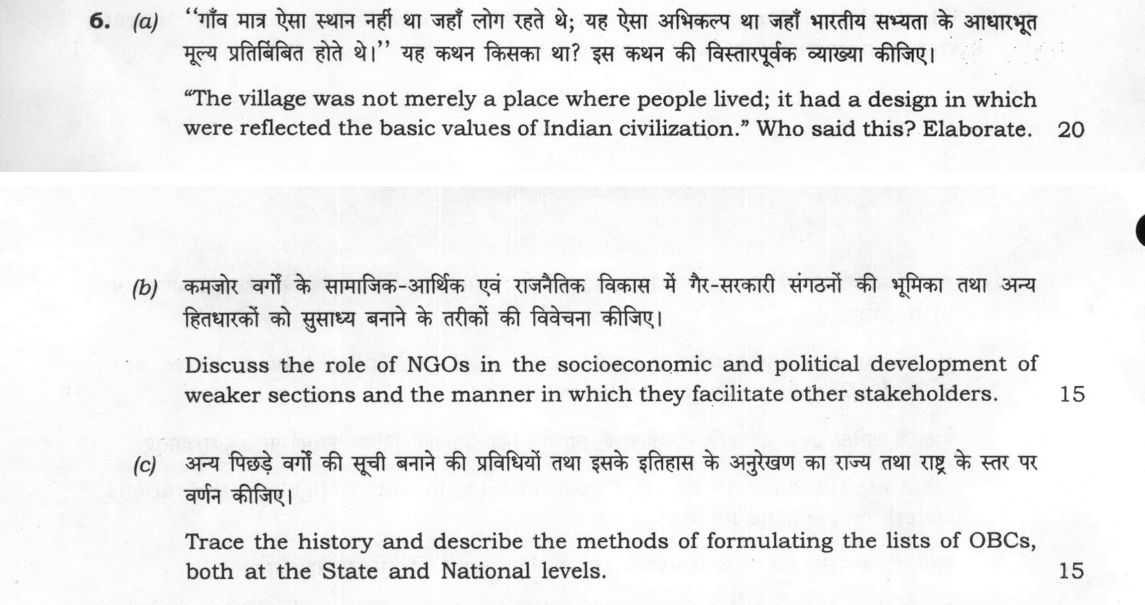
(a) "The village was not merely a place where people lived; it had a design in which were reflected the basic values of Indian…
"The village was not merely a place where people lived; it had a design in which were reflected the basic values of Indian civilization." Who said this? Elaborate. 20 marks
Discuss the role of NGOs in the socioeconomic and political development of weaker sections and the manner in which they facilitate other stakeholders. 15 marks
Trace the history and describe the methods of formulating the lists of OBCs, both at the State and National levels. 15 marks
हिंदी में प्रश्न पढ़ें
"गाँव मात्र ऐसा स्थान नहीं था जहाँ लोग रहते थे; यह ऐसा अभिकल्प था जहाँ भारतीय सभ्यता के आधारभूत मूल्य प्रतिबिंबित होते थे।" यह कथन किसका था? इस कथन की विस्तारपूर्वक व्याख्या कीजिए। 20
कमजोर वर्गों के सामाजिक-आर्थिक एवं राजनीतिक विकास में गैर-सरकारी संगठनों की भूमिका तथा अन्य हितधारकों को सुसाध्य बनाने के तरीकों की विवेचना कीजिए। 15
अन्य पिछड़े वर्गों की सूची बनाने की प्रविधियों तथा इसके इतिहास के अनुरेखण का राज्य तथा राष्ट्र के स्तर पर वर्णन कीजिए। 15
Model answer
Written by UPSC Answer Check against this question's marking rubric, to the expected length. UPSC does not publish answers for Mains — this is one way to score well, not an official key.
The Village as a Social System
The assertion that the Indian village possesses a design reflecting basic civilizational values is attributed to M.N. Srinivas, particularly in his seminal works The Remembered Village (1955) and Religion and Society among the Coorgs (1960). Srinivas argued that the village is not merely a geographic unit but a social system with a distinct internal architecture. This "design" is spatially and ritually organized to embody hierarchy, interdependence, and sacred geography.
Spatially, the layout mirrors caste stratification. The dominant caste typically occupies the central, ritually pure areas, while castes considered "polluting" reside on the periphery. This physical segregation reinforces social distance. Functionally, the village operates through the jajmani system, a network of hereditary service relationships that ensures economic interdependence among castes. Ritual integration further binds these groups; as Louis Dumont noted in Homo Hierarchicus, the caste system is a hierarchy of purity and pollution, while McKim Marriott’s transactional analysis highlights how ritual exchanges legitimize this hierarchy. Thus, the village’s physical and social design is a microcosm of Indian civilization’s core values of order and graded inequality.
NGOs in Socioeconomic and Political Development
Non-Governmental Organizations (NGOs) play a pivotal role in the development of weaker sections by bridging the gap between state policy and grassroots reality. Socioeconomically, they facilitate credit access through Self-Help Groups (SHGs) and microfinance, while also delivering education and health services in underserved areas. Politically, NGOs empower marginalized communities by conducting awareness drives, providing legal aid, and facilitating participation in Panchayati Raj institutions.
NGOs facilitate other stakeholders through specific mechanisms. They act as interface agencies, translating state schemes into local action and channeling community feedback to policymakers. They build networks with Community-Based Organizations (CBOs) to create advocacy coalitions and engage in conflict mediation. For instance, SEWA (Self-Employed Women’s Association) has mobilized informal workers for labor rights, while PRADAN has supported rural livelihoods. MKSS (Mazdoor Kisan Shakti Sangathan) was instrumental in the Right to Information (RTI) movement and social audits, which significantly influenced the transparency mechanisms in public works, though it did not single-handedly create the MGNREGA Act. These interventions demonstrate how civil society acts as a critical partner in democratic governance.
History and Methods of OBC List Formulation
The formulation of Other Backward Classes (OBC) lists is a complex historical and administrative process operating at both national and state levels.
Historical Trajectory: At the National level, the process began with the 1931 Census, which provided the first detailed caste tables. Post-independence, the Kaka Kalelkar Committee (1953) was the first to identify backward classes. The landmark Mandal Commission (1979-80) subsequently prepared a comprehensive list, leading to the 27% reservation implemented in 1990. At the State level, the history is equally significant. States like Uttar Pradesh established the Bhagat Ram Committee (1950) and later the Sachar Committee to identify backward castes. Many states formed their own commissions in the 1960s and 70s, resulting in diverse state-specific lists that often differ from the Central list.
Methods of Formulation: The Mandal Commission used 11 indicators to determine backwardness. Social indicators included inter-caste marriage, participation in festivals, and drinking habits. Economic indicators included average asset value, families in kutcha (temporary) houses, families with only two-room houses, and families without access to safe drinking water. At the State level, methods vary. Some states rely on field surveys and anthropological reports to assess social status, while others use administrative data. The National Commission for Backward Classes (NCBC) now oversees the inclusion of new castes, relying on evidence of social and educational backwardness. Crucially, the Supreme Court in Indra Sawhney v. Union of India (1992) upheld the 27% OBC reservation but introduced the "creamy layer" exclusion, barring affluent OBCs from benefits. The Court did not endorse the Mandal Commission’s specific point-based methodology as a legal standard, but rather affirmed the principle of reservation subject to the 50% ceiling and creamy layer exclusion.
Conclusion
Collectively, Srinivas’s village studies, NGO interventions, and OBC classifications represent successive waves of anthropological engagement with Indian social structure. They illustrate the ongoing negotiation between traditional social hierarchies, civil society activism, and state-led affirmative action in shaping modern Indian society.
What "Elaborate" is asking you to do
Give the full detailed account the question has compressed into a line — every dimension of it, with specifics. Elaborate rewards completeness and detail rather than clarification or argument: the examiner is checking whether you can fill out a topic without being told what its parts are.
Structure that answers it
State the proposition → first dimension in detail → second dimension in detail → the part the statement leaves implicit → the consolidated picture
Where marks are lost
Repeating the statement at greater length instead of adding substance. Elaborate also punishes narrowness: omitting a whole dimension costs more here than anywhere else in this family.
How this answer will be evaluated
Approach
Framework: UPSC Anthropology Paper II (Socio-Cultural Anthropology). (a) explain: definition/context > points in order > small example > short close | (b) discuss: intro > 3-4 dimensions > example > balanced close | (c) trace: start point > the stages in sequence > end point > what changed Full marks: Accurate attribution, critical analysis, specific examples, clear structure
Key points expected
- Correctly attribute quote to Charles Metcalfe (1830)
- Define 'little republics' and village self-sufficiency
- Explain the 'design' (social structure, caste, religion)
- Critically evaluate the quote (e.g., Srinivas's counter-argument)
- Define 'weaker sections' in Indian context
- Explain NGO role in socioeconomic development (education, health)
- Explain NGO role in political development (awareness, rights)
- Describe how NGOs facilitate other stakeholders (govt, community)
Evaluation rubric
Each sub-part is marked on its own, against the marks and word limit printed on the paper.
- (a) Identify the speaker of the quote and elaborate on the 'design' of the Indian village as a reflection of civilization. 20 marks
explain— definition/context → points in order → small example → short close
Must cover
- Correctly attribute quote to Charles Metcalfe (1830)
- Define 'little republics' and village self-sufficiency
- Explain the 'design' (social structure, caste, religion)
- Critically evaluate the quote (e.g., Srinivas's counter-argument)
Loses marks
- Attributing quote to M.N. Srinivas (factual error)
- Treating village as merely a geographical unit
- Ignoring the 'design' aspect of the quote
Earns more
- Mention M.N. Srinivas's critique (India's Villages)
- Reference 'Sanskritisation' or 'Dominant Caste' as the design
- Discuss the role of the village in social control
- Mention the 'village as a social unit' concept
Extra mark
- Cite specific ethnographic examples (e.g., Srinivas's Ghatshila)
- Reference specific Metcalfe minute details
- (b) Analyze the role of NGOs in the development of weaker sections and their facilitation of other stakeholders. 15 marks
discuss— intro → 3-4 dimensions → example → balanced close
Must cover
- Define 'weaker sections' in Indian context
- Explain NGO role in socioeconomic development (education, health)
- Explain NGO role in political development (awareness, rights)
- Describe how NGOs facilitate other stakeholders (govt, community)
Loses marks
- Focusing only on one type of development (e.g., only economic)
- Ignoring the 'facilitation' aspect of the question
- Treating NGOs as purely charitable (ignoring political role)
Earns more
- Mention specific NGO types (e.g., community-based, international)
- Reference specific programs (e.g., microfinance, legal aid)
- Discuss the 'third sector' role in governance
- Mention challenges faced by NGOs (funding, accountability)
Extra mark
- Cite specific NGO names (e.g., SEWA, PRADAN)
- Reference specific government-NGO partnerships
- (c) Trace the history and describe the methods of formulating OBC lists at State and National levels. 15 marks
trace— start point → the stages in sequence → end point → what changed
Must cover
- Trace history of OBC identification (pre-independence to present)
- Describe method of formulating State-level OBC lists
- Describe method of formulating National-level OBC lists
- Mention Mandal Commission (1979) and its recommendations
Loses marks
- Confusing OBC with SC/ST identification methods
- Ignoring the 'method' aspect of the question
- Failing to distinguish between State and National levels
Earns more
- Reference specific committees (e.g., Kalelkar, Mandal)
- Mention criteria for OBC identification (social, educational, economic)
- Discuss the 'creamy layer' concept
- Reference Indra Sawhney judgment (1992)
Extra mark
- Cite specific dates of committee formations
- Mention specific states with early OBC lists
Practice this exact question
Write your answer and it is marked point by point against the model answer above — what you covered, what you missed, what you got wrong.
Evaluate my answer →More from Anthropology 2025 Paper II
- Q3 (a) Describe the distinctive features and distribution of Upper Palaeolithic of India. 20…
- Q4 (a) What are the different types of caste mobility in India? Highlight the various factor…
- Q5 Write short notes on the following in about 150 words each : 10×5=50 (a) Impact of urbani…
- Q6 (a) "The village was not merely a place where people lived; it had a design in which were…
- Q7 (a) Identify the contemporary limitations in the process of tribal development. How can a…
- Q8 (a) Describe the nature of traditional socioeconomic interdependence among the Toda, Kota…