Paper II — Q5
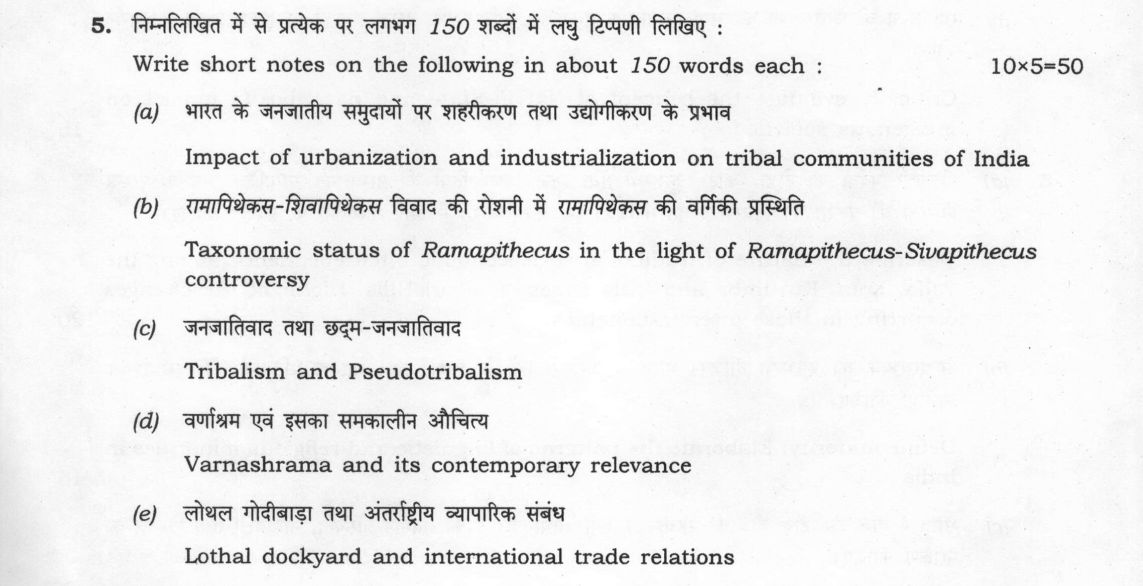
Write short notes on the following in about 150 words each : 10×5=50 (a) Impact of urbanization and industrialization on tribal…
Write short notes on the following in about 150 words each : 10×5=50
Impact of urbanization and industrialization on tribal communities of India
Taxonomic status of Ramapithecus in the light of Ramapithecus-Sivapithecus controversy
Tribalism and Pseudotribalism
Varnashrama and its contemporary relevance
Lothal dockyard and international trade relations
हिंदी में प्रश्न पढ़ें
निम्नलिखित में से प्रत्येक पर लगभग 150 शब्दों में लघु टिप्पणी लिखिए : 10×5=50
भारत के जनजातीय समुदायों पर शहरीकरण तथा उद्योगीकरण के प्रभाव
रामापिथेकस-शिवापिथेकस विवाद की रोशनी में रामापिथेकस की वर्गीकी प्रस्थिति
जनजातिवाद तथा छद्म-जनजातिवाद
वर्णाश्रम एवं इसका समकालीन औचित्य
लोथल गोदीबाड़ा तथा अंतर्राष्ट्रीय व्यापारिक संबंध
Model answer
Written by UPSC Answer Check against this question's marking rubric, to the 150-word length. UPSC does not publish answers for Mains — this is one way to score well, not an official key.
Impact of Urbanization and Industrialization on Tribal Communities
Urbanization and industrialization have fundamentally altered the socio-economic fabric of India’s tribal communities, primarily through displacement and cultural erosion. The expansion of mining and industrial projects, particularly in Jharkhand and Odisha, has led to massive land alienation. Tribals, who traditionally view land as a sacred entity, are forced into proletarianization, losing their agrarian autonomy to become wage laborers. This process disrupts traditional kinship networks and subsistence patterns. For instance, the displacement of Adivasis for steel plants or thermal power projects often results in the fragmentation of their social structures. Furthermore, urban migration, such as the movement of Bhil communities to cities like Mumbai or Delhi, exposes them to exploitative labor conditions and cultural disintegration. The loss of traditional livelihoods leads to economic dependency, while the influx of non-tribal cultures accelerates the erosion of indigenous languages, rituals, and identity. Consequently, these communities face a dual crisis: economic marginalization in the formal sector and cultural dilution in the urban periphery, threatening their distinct identity and social cohesion.
Taxonomic Status of Ramapithecus
The taxonomic status of Ramapithecus has been a subject of intense debate in physical anthropology, centered on the Ramapithecus-Sivapithecus controversy. Initially, David Pilbeam classified the fossil Ramapithecus (found in the Siwalik Hills) as a direct hominid ancestor, suggesting an Asian origin for human evolution. This view challenged the prevailing African hypothesis. However, subsequent analysis of the Greater Siwalik Group (GSP) fossils revealed significant morphological similarities between Ramapithecus and Sivapithecus, a known Miocene ape. Based on this evidence, the scientific community largely accepted the synonymization of Ramapithecus with Sivapithecus. This reclassification identified Ramapithecus not as a hominid, but as an extinct Miocene ape, likely an ancestor of the modern orangutan. This resolution was pivotal as it removed the primary evidence supporting the Asian origin theory of hominids. Consequently, the debate reinforced the consensus that human evolution originated in Africa, with Sivapithecus representing a parallel branch of primate evolution in Asia rather than a direct link to the human lineage.
Tribalism and Pseudotribalism
Tribalism and pseudotribalism represent distinct forms of group identity and solidarity. Tribalism refers to the structural solidarity based on kinship, territory, and shared cultural heritage, where identity is ascribed at birth and reinforced through traditional social mechanisms. It is characterized by a deep-seated sense of belonging and collective responsibility. In contrast, pseudotribalism is an instrumental mobilization of identity for political or economic gain, often lacking the deep historical roots of genuine tribalism. It is frequently constructed or exaggerated by political elites to consolidate power or secure resources. N.K. Bose’s work highlights how such identities can be manipulated in modern contexts. For example, certain regional movements in India may invoke tribal or caste-based identities not to preserve culture, but to leverage state policies or gain electoral advantage. While tribalism is organic and rooted in social structure, pseudotribalism is strategic and often transient. Understanding this distinction is crucial for analyzing contemporary political dynamics, where identity is often commodified. The rise of pseudotribalism can lead to social fragmentation, as it pits groups against each other for material benefits rather than fostering genuine communal harmony or cultural preservation.
Varnashrama and Contemporary Relevance
Varnashrama is a traditional Hindu social framework comprising four varnas (social classes) and four ashramas (life stages). The varna system categorizes society into Brahmins, Kshatriyas, Vaishyas, and Shudras, while the ashrama system outlines the stages of life: Brahmacharya, Grihastha, Vanaprastha, and Sannyasa. Historically, these systems regulated social duties and spiritual progression. In contemporary India, the relevance of Varnashrama is complex and largely contested. The Constitution of India, particularly Article 17, abolished untouchability, and Article 15 prohibits discrimination on grounds of caste, fundamentally challenging the hierarchical aspects of the varna system. However, residual ritual roles and social perceptions persist in many communities. The debate often centers on merit versus birth, with modern democratic values emphasizing equality and individual merit over hereditary status. While the ashrama concept retains some cultural significance in spiritual practices, the varna system is largely viewed as a relic of the past. Contemporary discourse focuses on social justice and affirmative action to address historical inequalities, rather than upholding the traditional varna structure. Thus, Varnashrama’s contemporary relevance is limited to cultural and religious contexts, while its social and political influence has been significantly diminished by constitutional reforms.
Lothal Dockyard and International Trade
Lothal, excavated by S.R. Rao, is a significant Harappan site that provides evidence of maritime trade and international commerce. The site features a trapeoidal structure, often interpreted as a dockyard, with a spill-channel connecting it to a nearby water body. This infrastructure suggests a sophisticated system for loading and unloading goods. Archaeological findings at Lothal include bead manufacturing workshops, indicating the production of carnelian and other beads for export. Crucially, the discovery of Mesopotamian seals and artifacts points to trade relations with the Persian Gulf region. The Indus Valley was known to Mesopotamians as Meluhha, and Lothal served as a key port for this exchange. This evidence highlights the Harappan civilization’s engagement in long-distance trade, exporting goods like cotton, beads, and timber, while importing lapis lazuli and other materials. The significance of Lothal lies in demonstrating the economic complexity and global connectivity of the Indus Valley Civilization. It challenges earlier notions of a purely agrarian society, revealing a vibrant maritime economy that facilitated cultural and commercial exchanges across ancient civilizations. This underscores the importance of maritime routes in shaping early urban economies and international relations.
What "Write short notes" is asking you to do
Five or six self-contained answers, marked separately, typically 10 marks and about 150 words each. Each note must carry its own definition, its two or three defining features and a line on why it matters; a common introduction or conclusion across the notes earns nothing.
Structure that answers it
Per note: one-line definition or identification → two or three features, mechanisms or named examples → one line of significance or Indian application
Where marks are lost
Writing the first two notes at essay length and rationing the rest. Each note is marked on its own, so marks surrendered on a compressed or unattempted note cannot be won back by the long ones.
How this answer will be evaluated
Approach
Framework: UPSC Anthropology Paper II (Sociology & Social Anthropology). (a) write short notes: define > 3-4 key features > one example > one-line significance | (b) write short notes: define > 3-4 key features > one example > one-line significance | (c) write short notes: define > 3-4 key features > one example > one-line significance | (d) write short notes: define > 3-4 key features > one example > one-line significance | (e) write short notes: define > 3-4 key features > one example > one-line significance Full marks: All 5 parts: precise definitions, named examples, clear distinctions, contemporary relevance, and specific evidence.
Key points expected
- Define urbanization and industrialization in tribal context
- Mention land alienation or displacement
- Mention cultural erosion or loss of identity
- Name one specific Indian tribe (e.g., Santhal, Gond)
- Define Ramapithecus (early hominid claim)
- Mention the Ramapithecus-Sivapithecus controversy
- State current status: junior synonym of Sivapithecus
- Clarify it is NOT a human ancestor
Evaluation rubric
Each sub-part is marked on its own, against the marks and word limit printed on the paper.
- (a) Define urbanization/industrialization and list 3-4 impacts on Indian tribal communities. · 150 words
write short notes— define → 3-4 key features → one example → one-line significance
Must cover
- Define urbanization and industrialization in tribal context
- Mention land alienation or displacement
- Mention cultural erosion or loss of identity
- Name one specific Indian tribe (e.g., Santhal, Gond)
Loses marks
- Generic sociology answer without tribal focus
- Ignoring the 'impact' aspect (only describing tribes)
Earns more
- Reference to specific policy (e.g., FRA 2006)
- Mention of specific industrial project (e.g., Narmada)
- Discussion of 'development-induced displacement'
Extra mark
- Reference to specific study (e.g., M.N. Srinivas)
- Mention of specific urban slum condition
- (b) Define Ramapithecus and explain the taxonomic shift due to the Sivapithecus controversy. · 150 words
write short notes— define → 3-4 key features → one example → one-line significance
Must cover
- Define Ramapithecus (early hominid claim)
- Mention the Ramapithecus-Sivapithecus controversy
- State current status: junior synonym of Sivapithecus
- Clarify it is NOT a human ancestor
Loses marks
- Claiming Ramapithecus is a direct human ancestor
- Confusing Ramapithecus with Australopithecus
Earns more
- Mention of key researchers (e.g., Leakey, Pilbeam)
- Reference to dental evidence (molar structure)
- Mention of 'Pithecanthropus' or 'Pithecanthropus' if relevant to context
Extra mark
- Mention of specific fossil site (e.g., Siwalik Hills)
- Reference to specific paper (e.g., 1970s debate)
- (c) Define Tribalism and Pseudotribalism and distinguish between them. · 150 words
write short notes— define → 3-4 key features → one example → one-line significance
Must cover
- Define Tribalism (ethnic identity/politics)
- Define Pseudotribalism (artificial/constructed identity)
- Distinguish between the two concepts
- Provide one example of each
Loses marks
- Confusing tribalism with tribalism (same word)
- Ignoring the 'pseudo' aspect (only defining tribalism)
Earns more
- Reference to M.N. Srinivas (concept originator)
- Mention of 'Great Tradition' vs 'Little Tradition'
- Example of a specific 'pseudo-tribe' (e.g., urban groups)
Extra mark
- Reference to specific book (e.g., 'Society and Culture in the Indian Tradition')
- Mention of specific case study (e.g., 'Tribal' identity in cities)
- (d) Define Varnashrama and explain its contemporary relevance in Indian society. · 150 words
write short notes— define → 3-4 key features → one example → one-line significance
Must cover
- Define Varna (4-fold division) and Shrama (duty)
- Explain the concept of 'Varnashrama Dharma'
- Discuss contemporary relevance (e.g., caste politics, social mobility)
- Mention one modern context (e.g., reservation, social reform)
Loses marks
- Only defining Varna without Shrama
- Ignoring the 'contemporary relevance' aspect
Earns more
- Reference to specific reformer (e.g., Ambedkar, Gandhi)
- Mention of 'Varna' vs 'Jati' distinction
- Discussion of 'Varna' in modern constitutional context
Extra mark
- Reference to specific text (e.g., Manusmriti)
- Mention of specific modern movement (e.g., Dalit movement)
- (e) Describe Lothal dockyard and its role in international trade relations. · 150 words
write short notes— define → 3-4 key features → one example → one-line significance
Must cover
- Describe Lothal dockyard (brick structure, tidal)
- Mention its location (Gujarat, India)
- Explain its role in international trade (e.g., Mesopotamia, Persian Gulf)
- Mention one piece of evidence (e.g., seals, beads, anchors)
Loses marks
- Confusing Lothal with other Harappan sites (e.g., Dholavira)
- Ignoring the 'international trade' aspect
Earns more
- Reference to S.R. Rao (excavator)
- Mention of 'Harappan' or 'Indus Valley' context
- Discussion of 'trade' vs 'exchange' (if relevant)
Extra mark
- Mention of specific artifact (e.g., 'circular seal')
- Reference to specific trade route (e.g., 'Maritime route')
Practice this exact question
Write your answer and it is marked point by point against the model answer above — what you covered, what you missed, what you got wrong.
Evaluate my answer →More from Anthropology 2025 Paper II
- Q2 (a) Discuss the palaeoanthropological significance of Siwaliks of India giving its subdiv…
- Q3 (a) Describe the distinctive features and distribution of Upper Palaeolithic of India. 20…
- Q4 (a) What are the different types of caste mobility in India? Highlight the various factor…
- Q5 Write short notes on the following in about 150 words each : 10×5=50 (a) Impact of urbani…
- Q6 (a) "The village was not merely a place where people lived; it had a design in which were…
- Q7 (a) Identify the contemporary limitations in the process of tribal development. How can a…
- Q8 (a) Describe the nature of traditional socioeconomic interdependence among the Toda, Kota…