Paper II — Q8
(a) Describe the nature of traditional socioeconomic interdependence among the Toda, Kota, Kurumba and Irula tribes of Nilgiri…
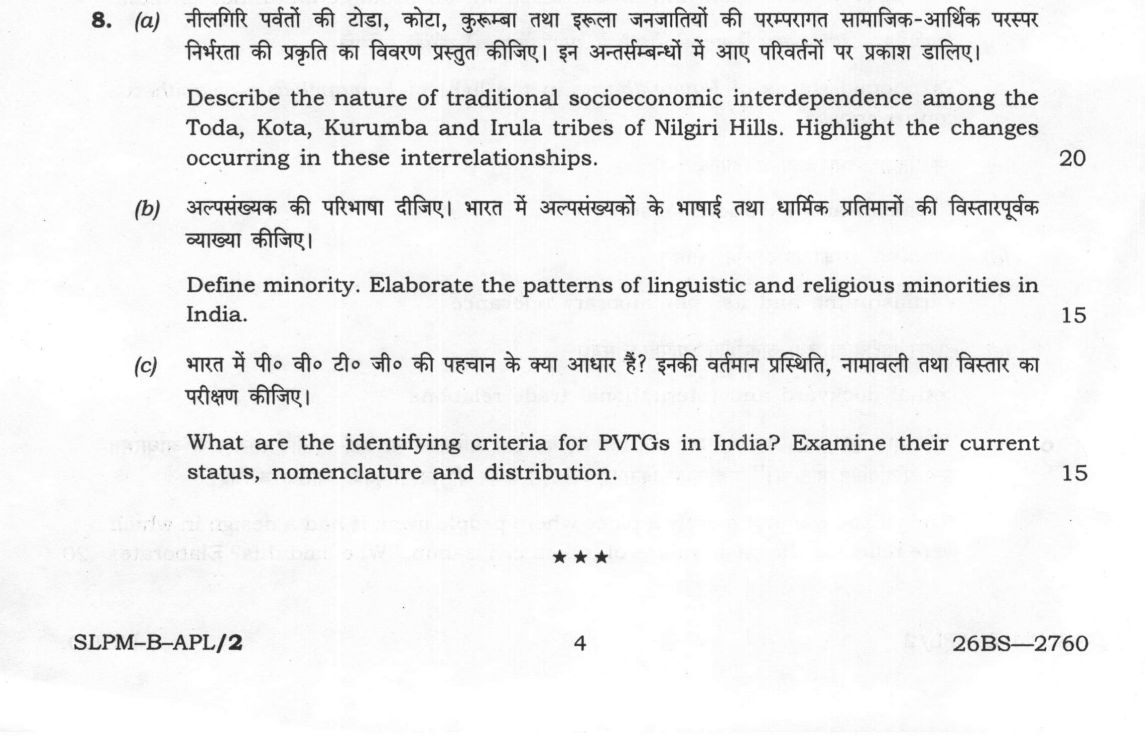
Describe the nature of traditional socioeconomic interdependence among the Toda, Kota, Kurumba and Irula tribes of Nilgiri Hills. Highlight the changes occurring in these interrelationships. 20 marks
Define minority. Elaborate the patterns of linguistic and religious minorities in India. 15 marks
What are the identifying criteria for PVTGs in India? Examine their current status, nomenclature and distribution. 15 marks
हिंदी में प्रश्न पढ़ें
नीलगिरि पर्वतों की टोडा, कोटा, कुरुम्बा तथा इरुला जनजातियों की परम्परागत सामाजिक-आर्थिक परस्पर निर्भरता की प्रकृति का विवरण प्रस्तुत कीजिए। इन अन्तर्सम्बन्धों में आए परिवर्तनों पर प्रकाश डालिए। 20
अल्पसंख्यक की परिभाषा दीजिए। भारत में अल्पसंख्यकों के भाषाई तथा धार्मिक प्रतिमानों की विस्तारपूर्वक व्याख्या कीजिए। 15
भारत में पी० वी० टी० जी० की पहचान के क्या आधार हैं? इनकी वर्तमान प्रस्थिति, नामावली तथा विस्तार का परीक्षण कीजिए। 15
Model answer
Written by UPSC Answer Check against this question's marking rubric, to the expected length. UPSC does not publish answers for Mains — this is one way to score well, not an official key.
Traditional Socioeconomic Interdependence in the Nilgiris and Recent Changes
The Nilgiri plateau presents a classic anthropological model of symbiotic, multi-ethnic economic and ritual interdependence among four distinct tribes: the pastoral Toda, artisan Kota, foraging and sorcerer Kurumba, and agricultural Irula. Functioning as an unstratified, non-caste *jajmani*-like network, their relationships were mediated through institutionalised reciprocal obligations and ceremonial exchanges such as kash-tokh (Toda-Kota exchange of dairy for grain and tools) and teymisi (ritual payments).
The Toda occupied the apex of pastoral sacredness, supplying clarified butter (ghee), dairy products, and embroidered shawls (poothkuli), while relying on other tribes for physical and ritual services. The Kota functioned as quintessential artisans—blacksmiths, potters, and musicians—providing iron implements, earthen pots, and essential funeral music to the Toda and Kurumba, receiving buffalo carcasses and grain in return. The Kurumba, living in the mid-slopes, supplied forest produce (honey, resin, wild tubers), watchmanship, and acted as medicinal healers and ritual shamans; crucially, their supposed mastery over sorcery induced fear, compelling the Toda and Kota to pay them protective ritual dues. The Irula, inhabiting the lower slopes, practised shifting cultivation and supplied wild millets, fruits, and agricultural labour.
Post-colonial expansion, commercial tea and eucalyptus plantations, and Shola forest degradation severely dismantled this ecological niche. State land alienation and monetization substituted traditional barter with cash transactions and wage labour. Kota pottery and smithy succumbed to industrial goods, Toda pastoralism shrank due to pasture loss, Kurumbas lost their forest rights, and tourism commodified sacred rituals into spectacles, altogether collapsing traditional ritual reciprocity.
Patterns of Linguistic and Religious Minorities in India
Sociologically, following Louis Wirth, a minority is not merely a numerical aggregate, but a group of people singled out from others in society for differential and unequal treatment due to physical, cultural, linguistic, or religious characteristics, holding a non-dominant, structurally disadvantaged status. The Indian Constitution provides institutional safeguards against assimilation and marginalisation under Articles 29 (protection of distinct language, script, culture) and 30 (right of minorities to establish educational institutions), complemented by Articles 350A and 350B for linguistic protection.
Linguistic minority patterns stem from post-Independence linguistic state reorganisations (States Reorganisation Act, 1956). Linguistic tensions manifest across the Indo-Aryan and Dravidian divide, resistance against perceived Hindi imposition in peninsular India, and demands for preservation of non-scheduled tribal dialects. Sixth Schedule mechanisms and linguistic minority commissions attempt to balance regional linguistic dominance against borderland enclaves.
Religious minority distribution reflects spatial concentration and distinct socio-economic profiles. Muslims, the largest minority, face structural deprivation in education, formal credit, and public employment, as documented by the Sachar Committee (2006). Christians show high concentration in the North-East and southern coastal belts; Sikhs remain clustered in Punjab; Buddhists include both traditional Himalayan communities and Ambedkarite neo-Buddhists in Maharashtra; while Jains and Parsis represent highly urbanised, economically prosperous minorities.
Particularly Vulnerable Tribal Groups (PVTGs): Criteria, Status, and Distribution
PVTGs represent the most marginalised segment among Scheduled Tribes. Following the recommendations of the Dhebar Commission (1960-61), which noted wide disparities in tribal development, the Government created the category of Primitive Tribal Groups (PTGs), further refined following the Lokur Committee (1965) criteria. In 2006, the category was rechristened Particularly Vulnerable Tribal Groups (PVTGs) to shed pejorative connotations.
The four identifying criteria for PVTGs are:
- Pre-agricultural level of technology (hunting-gathering or shifting cultivation).
- Stagnant or declining population growth.
- Extremely low level of literacy.
- Subsistence level of economy.
Currently, there are 75 recognized PVTGs distributed across 18 States and the Union Territory of Andaman and Nicobar Islands, with Odisha housing the highest number (13). Geographically and ecologically, they exhibit extreme habitat specificity—ranging from the island-dwelling Great Andamanese, Jarawa, and Sentinelese, to mainland forest groups like the Birhor of Jharkhand, Kamar of Chhattisgarh, and Chenchu of Andhra Pradesh. Despite dedicated micro-projects and the PM-PVTG Development Mission, acute implementation gaps persist in public healthcare, loss of forest biodiversity, and slow titling of community habitat rights under Section 3(1)(e) of the Forest Rights Act, 2006.
Addressing tribal interdependence breakdowns, minority marginalisation, and PVTG vulnerability requires moving beyond top-down welfare toward biocultural conservation, habitat tenure security, and pluralistic developmental policies that respect indigenous autonomy.
What "Describe" is asking you to do
Give a full, ordered account of the thing named — its parts, stages or mechanism — in the sequence in which it actually exists or occurs. Most describe questions come from the science optionals, where the marks sit in correct technical detail and, where the stem says so, a labelled diagram.
Structure that answers it
One-line identification of the subject → the parts or stages in their real order, each with its defining detail → labelled diagram where the subject is structural → closing line on function or significance
Where marks are lost
Loose general prose where the examiner is ticking named parts, correct terminology and their sequence; and in the General Studies papers, turning to evaluation before the description is finished.
How this answer will be evaluated
Approach
(a) describe: define > structure or process in order > labelled diagram > significance | (b) define: precise definition > the distinguishing feature > one example | (c) examine: intro > how/why with reasoning > evidence > conclusion Full marks: Comprehensive, specific, and well-structured answers with named examples and clear distinctions.
Key points expected
- Define the specific economic role of each tribe (Toda, Kota, Kurumba, Irula)
- Explain the traditional exchange mechanisms (e.g., Toda-Kota cattle exchange)
- Highlight changes in interrelationships due to modernization or policy
- Mention the specific ecological niche of each group
- Provide a precise definition of 'minority' (legal or sociological)
- Distinguish between linguistic and religious minorities
- Elaborate on the distribution patterns of religious minorities
- Elaborate on the distribution patterns of linguistic minorities
Evaluation rubric
Each sub-part is marked on its own, against the marks and word limit printed on the paper.
- (a) Explain the traditional division of labor and interdependence among the four Nilgiri tribes and the changes in these relationships. 20 marks
describe— define → structure or process in order → labelled diagram → significance
Must cover
- Define the specific economic role of each tribe (Toda, Kota, Kurumba, Irula)
- Explain the traditional exchange mechanisms (e.g., Toda-Kota cattle exchange)
- Highlight changes in interrelationships due to modernization or policy
- Mention the specific ecological niche of each group
Loses marks
- Treating the four tribes as a single undifferentiated group
- Ignoring the 'changes' aspect of the question
- Generalizing without specific Nilgiri examples
Earns more
- Reference to specific fieldworkers (e.g., Elwin, Huxley)
- Mention of the 'Tribal Council' or traditional governance
- Discussion of the impact of tourism or conservation laws
- Reference to the Nilgiri Biosphere Reserve context
Extra mark
- Labelled diagram of the traditional exchange cycle
- Citation of a specific recent policy affecting these tribes
- (b) Define minority and elaborate on the patterns of linguistic and religious minorities in India. 15 marks
define— precise definition → the distinguishing feature → one example
Must cover
- Provide a precise definition of 'minority' (legal or sociological)
- Distinguish between linguistic and religious minorities
- Elaborate on the distribution patterns of religious minorities
- Elaborate on the distribution patterns of linguistic minorities
Loses marks
- Confusing 'minority' with 'Scheduled Tribe' or 'Scheduled Caste'
- Failing to distinguish between linguistic and religious patterns
- Providing only a list without elaboration on patterns
Earns more
- Reference to the National Commission for Minorities
- Mention of the 8 scheduled religious minorities
- Discussion of the 'minority in majority' concept
- Reference to specific states with high minority populations
Extra mark
- Citation of a specific Supreme Court judgment on minority rights
- Reference to the 2011 Census data on minority distribution
- (c) Explain the identifying criteria for PVTGs and examine their current status, nomenclature, and distribution. 15 marks
examine— intro → how/why with reasoning → evidence → conclusion
Must cover
- List the identifying criteria for PVTGs (e.g., primitive technology, isolation)
- Explain the current status of PVTGs (e.g., protection, development)
- Discuss the nomenclature (e.g., 'Primitive', 'Vulnerable', 'Tribal', 'Group')
- Describe the distribution of PVTGs across India
Loses marks
- Confusing PVTGs with general Scheduled Tribes
- Failing to explain the 'identifying criteria' specifically
- Ignoring the 'nomenclature' aspect of the question
Earns more
- Reference to the 75 PVTGs identified by the government
- Mention of the 'PVTG Protection and Development' policy
- Discussion of the 'pre-agricultural' stage of development
- Reference to specific PVTG examples (e.g., Sentinelese, Jarawa)
Extra mark
- Map showing the distribution of PVTGs
- Citation of a specific recent development project for PVTGs
Practice this exact question
Write your answer and it is marked point by point against the model answer above — what you covered, what you missed, what you got wrong.
Evaluate my answer →More from Anthropology 2025 Paper II
- Q5 Write short notes on the following in about 150 words each : 10×5=50 (a) Impact of urbani…
- Q6 (a) "The village was not merely a place where people lived; it had a design in which were…
- Q7 (a) Identify the contemporary limitations in the process of tribal development. How can a…
- Q8 (a) Describe the nature of traditional socioeconomic interdependence among the Toda, Kota…