Paper II — Q7
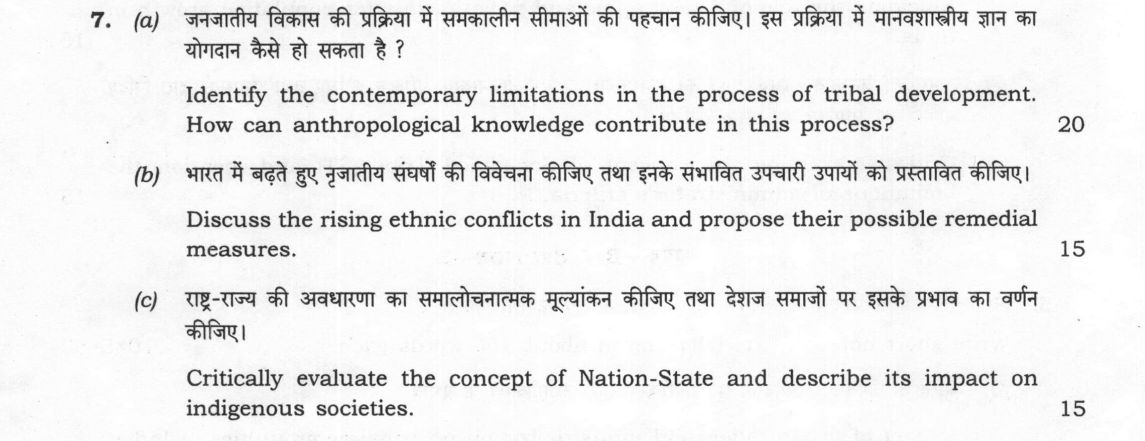
(a) Identify the contemporary limitations in the process of tribal development. How can anthropological knowledge contribute in…
Identify the contemporary limitations in the process of tribal development. How can anthropological knowledge contribute in this process? 20 marks
Discuss the rising ethnic conflicts in India and propose their possible remedial measures. 15 marks
Critically evaluate the concept of Nation-State and describe its impact on indigenous societies. 15 marks
हिंदी में प्रश्न पढ़ें
जनजातीय विकास की प्रक्रिया में समकालीन सीमाओं की पहचान कीजिए। इस प्रक्रिया में मानवशास्त्रीय ज्ञान का योगदान कैसे हो सकता है ? 20 marks
भारत में बढ़ते हुए नृजातीय संघर्षों की विवेचना कीजिए तथा इनके संभावित उपचारी उपायों को प्रस्तावित कीजिए। 15
राष्ट्र-राज्य की अवधारणा का समालोचनात्मक मूल्यांकन कीजिए तथा देशज समाजों पर इसके प्रभाव का वर्णन कीजिए। 15
Model answer
Written by UPSC Answer Check against this question's marking rubric, to the expected length. UPSC does not publish answers for Mains — this is one way to score well, not an official key.
Tribal development in India remains constrained by centralized, top-down bureaucratic planning that treats diverse communities as homogenous target groups. Development projects frequently cause large-scale land alienation and displacement without adequate rehabilitation, severing indigenous groups from their customary resource base. Furthermore, well-intentioned welfare policies often degenerate into forced assimilation or 'mainstreaming', triggering cultural erosion and linguistic decay. Anthropological knowledge provides the necessary corrective through applied and action-oriented approaches. By acting as cultural brokers and policy advocates, anthropologists bridge the perceptual gap between state apparatuses and tribal worldviews. Through Participatory Action Research (PAR), anthropologists place community voices at the center of planning. Methodologically, tools like Rapid Rural Appraisal (RRA) facilitate nuanced local data collection, Ethnographic Impact Assessments (EIA) predict socio-cultural fallout before project sanction, and systematic documentation of Indigenous Knowledge Systems (IKS) integrates traditional agro-forestry and ethnomedicine into sustainable development models.
Rising Ethnic Conflicts and Remedial Measures
Contemporary ethnic conflicts in India arise from acute competition over scarce land and resources, anxieties over demographic shifts caused by inward migration, and identity politics centered on territorial autonomy. In peripheral regions, these tensions manifest in protracted movements such as the Naga demand for sovereignty, Bodoland agitations in Assam, and the Gorkhaland struggle in West Bengal. These conflicts reflect structural anxieties where marginalized ethnic groups perceive the centralized state and dominant populations as threats to their political survival and economic security.
Resolving these conflicts requires multi-tiered institutional interventions. Constitutional mechanisms must be revitalized by extending and genuinely empowering Sixth Schedule Autonomous District Councils and strictly enforcing the Panchayats (Extension to Scheduled Areas) Act (PESA), 1996, to ensure local self-rule. Targeted, non-exploitative economic packages must address regional deprivation without triggering demographic disruption. Beyond statutory devolution, the state must institutionalize cultural autonomy and adopt truth-and-reconciliation approaches to address historical grievances, promote inter-community dialogue, and rebuild social cohesion.
Critical Evaluation of the Nation-State and Indigenous Societies
The classical Westphalian Nation-State, critically evaluated, is an inherently homogenizing construct. As Benedict Anderson posited, nation-states rely on "imagined communities" constructed through standardized languages, shared historical narratives, and centralized institutions. However, this totalizing framework inevitably clashes with deep multicultural realities. As James Scott demonstrates in his 'Zomia' thesis, state expansion historically seeks the territorial encapsulation, sedentarization, and fiscal-administrative enclosure of peripheral, non-state indigenous peoples who deliberately maintained egalitarian mobility outside state control.
Consequently, the impact on indigenous societies is profoundly disruptive. State-building imposes rigid borders that bifurcate traditional habitats, producing citizenship dilemmas where indigenous borderlanders are paradoxically framed as illegal immigrants or national security threats. Indigenous groups face intense cultural assimilation pressures to conform to dominant national identities, suffering the delegitimization of their customary legal and political institutions. In response, indigenous communities do not remain passive subjects; they deploy active resistance strategies, ranging from everyday forms of evasion to organized political mobilizations demanding ethnic federalism, constitutional asymmetry, and the right to internal self-determination.
Evaluating the nation-state against the standard of indigenous survival reveals that its assimilationist ethos is structurally ill-suited for pluralistic coexistence. To secure indigenous futures, the state must abandon its monocultural imperatives and transform into a plurinational federation that reconciles national sovereignty with indigenous territoriality, cultural autonomy, and decentralized self-governance.
What "Critically evaluate" is asking you to do
Judge how well something has performed against the standard it set for itself — its stated aim, mandate or promise — and commit to a verdict. Name the yardstick before you judge; an unanchored judgement reads as opinion. “Critically” is not a section added at the end: name the yardstick you are judging by — the evidence, the stated objective, a constitutional principle, a rival explanation — and let a verdict close each part of the body. Where the question quotes a claim, that verdict must land on the claim itself, accepted, qualified or rejected, and not on the theme in general.
Structure that answers it
Name the yardstick — stated aim, mandate or benchmark → performance against it → shortfall against it → why the gap exists → verdict
Where marks are lost
Merits in one paragraph, demerits in the next, and a conclusion calling for a balanced and holistic approach. That is a survey with the judgement left out and it holds the answer in the middle band. The opposite error is reading “critically” as permission to attack — and with the odd pairings, critically describe or critically explain, the exposition still carries most of the marks, the judgement being a layer on it rather than a substitute for it.
How this answer will be evaluated
Approach
(a) explain: definition/context > points in order > small example > short close | (b) discuss: intro > 3-4 dimensions > example > balanced close | (c) critically evaluate: positives > negatives/limits > conditions/safeguards > conclusion Full marks: Comprehensive, well-structured, with specific examples and anthropological depth.
Key points expected
- Identify 3-4 contemporary limitations (e.g., land alienation, cultural erosion, policy failure).
- Explain how anthropological knowledge contributes to the development process.
- Anchor claims to named schools or fieldworkers (e.g., Malinowski, Radcliffe-Brown).
- Pair every theory with one ethnographic case or Indian tribal context.
- Identify 3-4 dimensions of rising ethnic conflicts in India.
- Provide specific examples of ethnic conflicts (e.g., Naga, Mizo, Gorkhaland).
- Propose 3-4 possible remedial measures.
- Conclude with a balanced view on conflict resolution.
Evaluation rubric
Each sub-part is marked on its own, against the marks and word limit printed on the paper.
- (a) Identify contemporary limitations in tribal development and explain the role of anthropological knowledge. 20 marks
explain— definition/context → points in order → small example → short close
Must cover
- Identify 3-4 contemporary limitations (e.g., land alienation, cultural erosion, policy failure).
- Explain how anthropological knowledge contributes to the development process.
- Anchor claims to named schools or fieldworkers (e.g., Malinowski, Radcliffe-Brown).
- Pair every theory with one ethnographic case or Indian tribal context.
Loses marks
- Sociology answers wearing anthropology labels.
- Unlabelled diagrams or generic statements without tribal context.
- Failing to connect biological and social strands where relevant.
Earns more
- Mention specific contemporary issues like displacement or market integration.
- Discuss the role of ethnography in policy formulation.
- Reference specific anthropological concepts like acculturation or assimilation.
- Provide a balanced view of development vs. preservation.
Extra mark
- Reference a specific recent tribal policy or committee report.
- Include a labelled diagram showing the development process and limitations.
- (b) Discuss rising ethnic conflicts in India and propose remedial measures. 15 marks
discuss— intro → 3-4 dimensions → example → balanced close
Must cover
- Identify 3-4 dimensions of rising ethnic conflicts in India.
- Provide specific examples of ethnic conflicts (e.g., Naga, Mizo, Gorkhaland).
- Propose 3-4 possible remedial measures.
- Conclude with a balanced view on conflict resolution.
Loses marks
- Generic discussion without specific Indian examples.
- Failing to propose concrete remedial measures.
- Ignoring the anthropological perspective on ethnic identity.
Earns more
- Mention specific causes like resource control or identity politics.
- Reference specific remedial measures like autonomy or dialogue.
- Discuss the role of the state in conflict management.
- Provide a comparative analysis of different conflict scenarios.
Extra mark
- Reference a specific recent conflict resolution case study.
- Include a map showing the locations of major ethnic conflicts.
- (c) Critically evaluate the concept of Nation-State and its impact on indigenous societies. 15 marks
critically evaluate— positives → negatives/limits → conditions/safeguards → conclusion
Must cover
- Define the concept of Nation-State.
- Evaluate the positives of the Nation-State concept.
- Evaluate the negatives/limits of the Nation-State concept.
- Describe the impact on indigenous societies (e.g., marginalization, assimilation).
Loses marks
- One-sided evaluation without critical analysis.
- Failing to connect the Nation-State concept to specific indigenous impacts.
- Generic discussion without anthropological depth.
Earns more
- Discuss the tension between national identity and indigenous identity.
- Reference specific indigenous groups affected by the Nation-State.
- Mention specific policies or laws impacting indigenous rights.
- Provide a balanced judgment on the Nation-State concept.
Extra mark
- Reference a specific international convention on indigenous rights.
- Include a diagram showing the relationship between Nation-State and indigenous societies.
Practice this exact question
Write your answer and it is marked point by point against the model answer above — what you covered, what you missed, what you got wrong.
Evaluate my answer →More from Anthropology 2025 Paper II
- Q4 (a) What are the different types of caste mobility in India? Highlight the various factor…
- Q5 Write short notes on the following in about 150 words each : 10×5=50 (a) Impact of urbani…
- Q6 (a) "The village was not merely a place where people lived; it had a design in which were…
- Q7 (a) Identify the contemporary limitations in the process of tribal development. How can a…
- Q8 (a) Describe the nature of traditional socioeconomic interdependence among the Toda, Kota…