Paper II — Q2
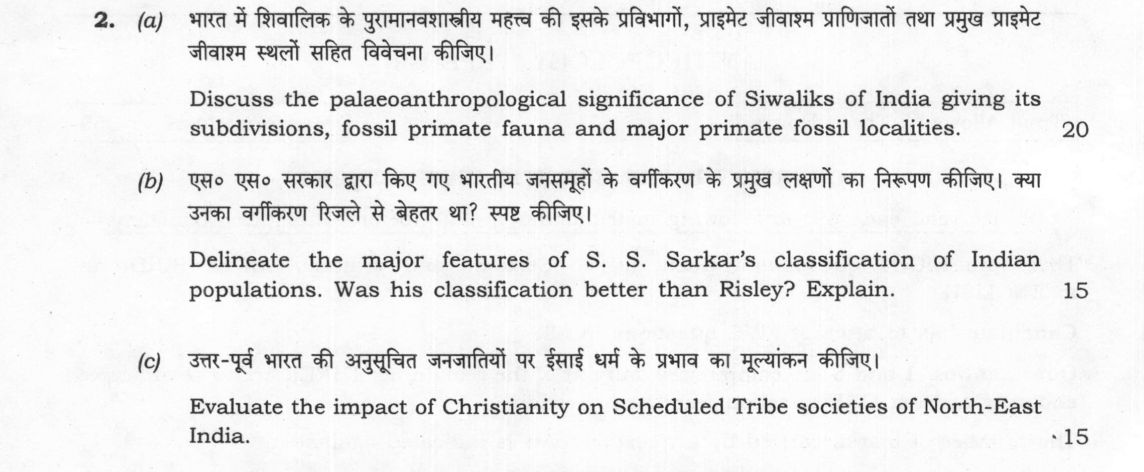
(a) Discuss the palaeoanthropological significance of Siwaliks of India giving its subdivisions, fossil primate fauna and major…
Discuss the palaeoanthropological significance of Siwaliks of India giving its subdivisions, fossil primate fauna and major primate fossil localities. 20 marks
Delineate the major features of S. S. Sarkar's classification of Indian populations. Was his classification better than Risley? Explain. 15 marks
Evaluate the impact of Christianity on Scheduled Tribe societies of North-East India. 15 marks
हिंदी में प्रश्न पढ़ें
भारत में शिवालिक के पुरामानवशास्त्रीय महत्व की इसके प्रविभागों, प्राइमेट जीवाश्म प्राणिजातों तथा प्रमुख प्राइमेट जीवाश्म स्थलों सहित विवेचना कीजिए। 20
एस. एस. सरकार द्वारा किए गए भारतीय जनसमूहों के वर्गीकरण के प्रमुख लक्षणों का निरूपण कीजिए। क्या उनका वर्गीकरण रिजले से बेहतर था? स्पष्ट कीजिए। 15
उत्तर-पूर्व भारत की अनुसूचित जनजातियों पर ईसाई धर्म के प्रभाव का मूल्यांकन कीजिए। 15
Model answer
Written by UPSC Answer Check against this question's marking rubric, to the expected length. UPSC does not publish answers for Mains — this is one way to score well, not an official key.
The Siwalik Hills, a vast geological formation stretching across the Himalayan foothills, serve as a critical archive for understanding hominoid evolution. Their palaeoanthropological significance lies in providing fossil evidence that challenges the exclusive "Out of Africa" hypothesis, suggesting significant Asian contributions to primate lineage.
Palaeoanthropological Significance of Siwaliks Geologically, the Siwaliks are divided into three subdivisions: the Lower Siwaliks (Pliocene, ~10-5 Ma), Middle Siwaliks (Late Miocene, ~15-10 Ma), and Upper Siwaliks (Early Miocene, ~20-15 Ma). These layers yield distinct primate faunas. The Lower Siwaliks contain Sivapithecus, a large dryopithecine ape, while the Middle Siwaliks are famous for Ramapithecus, once considered a direct hominid ancestor but now classified as a basal hominoid. The Upper Siwaliks preserve Gigantopithecus, the largest known primate, indicating a diverse ecosystem supporting multiple hominoid lineages. Major Indian localities include Ramnagar and Haritalyangar in Himachal Pradesh, and sites in Jammu and Kashmir. These fossils are pivotal in the "Out of Asia" debate, as they demonstrate that complex primate evolution occurred in South Asia contemporaneously with African developments, implying multiple centers of origin or significant inter-continental migration.
S. S. Sarkar’s Classification vs. Risley S. S. Sarkar’s classification of Indian populations, detailed in The Races of India, offers a more nuanced, anthropometric framework than H.H. Risley’s earlier work. Sarkar delineated four major racial elements: Australoid, Mongoloid, Indo-Aryan, and Irano-Scythian. Unlike Risley, who relied heavily on nasal index to categorize Indians into seven distinct races (e.g., Indo-Aryan, Dravidian, Mongoloid), Sarkar used a composite of cephalic index, nasal index, and stature to identify these four primary stocks and their sub-types. For instance, he identified Negrito and Proto-Australoid as sub-types within the broader Australoid element, rather than treating Negrito as a separate major race.
Sarkar’s approach was superior to Risley’s in methodological rigor. Risley’s typology was often criticized for being overly rigid and based on limited ethnographic observations that conflated culture with biology. Sarkar, utilizing data from the 1931 Census and anthropometric surveys, provided a statistical basis that acknowledged the continuous variation and admixture among Indian populations. While both classifications are now considered obsolete in light of population genetics, which reveals clinal variation rather than discrete races, Sarkar’s work remains a more accurate historical snapshot of phenotypic diversity. His classification better captured the complex admixture processes, such as the blending of Mongoloid and Australoid traits in tribal populations, offering a more scientific foundation for understanding India’s demographic mosaic.
Impact of Christianity on North-East Tribal Societies Christianity has profoundly transformed Scheduled Tribe societies in North-East India, particularly among the Naga, Mizo, and Khasi communities. The impact is multidimensional, affecting social, economic, and political structures. On the positive side, missionary activity was instrumental in introducing modern education and healthcare. This is evident in Nagaland and Mizoram, which consistently rank among the highest in literacy rates in India, a direct legacy of church-run schools. The shift from traditional shifting cultivation to settled agriculture and wage labor has also been accelerated by Christian economic ethics and the establishment of market-oriented livelihoods.
However, this transformation has led to significant cultural erosion. Traditional animistic beliefs, rituals, and social hierarchies were often suppressed or replaced by Christian norms, leading to a loss of indigenous cultural identity. Furthermore, the church has become a central institution in identity politics. In Nagaland, the Christian identity has intertwined with ethnic nationalism, influencing separatist movements and the demand for greater autonomy under Article 371A. The church often acts as a mediator in conflicts, such as the Naga peace process, but its influence also complicates state governance by creating parallel power structures. Thus, while Christianity empowered these communities socially and educationally, it also reconfigured their political consciousness, making the church a key stakeholder in the region’s ongoing struggle for self-determination and resource control.
Conclusion In conclusion, the Siwalik fossils provide a biological foundation for understanding human origins in Asia, while Sarkar’s anthropometric classification offers a more rigorous, albeit outdated, framework for analyzing Indian diversity. Simultaneously, the Christian transformation of North-East tribal societies illustrates how external religious influences can reshape indigenous identities, creating a complex interplay between cultural preservation, modernization, and political autonomy. Together, these elements highlight the intricate layers of biological, historical, and sociological factors that define the Indian subcontinent’s diversity.
What "Discuss" is asking you to do
Lay the issue out from more than one side — how it arose, what is claimed for it, what is held against it, and where it now stands. UPSC attaches discuss to broad topics with several live dimensions, so coverage of the dimensions earns more than the strength of your opinion.
Structure that answers it
Set the issue up → the case as it is made → the case against → the dimension both sides leave out → where the balance now lies
Where marks are lost
Listing facts with no thread between them, or arguing one side throughout and calling it a discussion.
How this answer will be evaluated
Approach
(a) discuss: intro > 3-4 dimensions > example > balanced close | (b) describe: define > structure or process in order > labelled diagram > significance | (c) evaluate: criteria > evidence > balanced judgment Full marks: Comprehensive, well-structured, with specific examples and balanced analysis.
Key points expected
- Siwalik subdivisions (Lower, Middle, Upper)
- Fossil primate fauna (e.g., Ramapithecus, Sivapithecus)
- Major primate fossil localities (e.g., Siwalik Hills)
- Palaeoanthropological significance of the Siwalik sequence
- Major features of S. S. Sarkar's classification
- Comparison with Risley's classification
- Evaluation of whether Sarkar's classification is better
- Explanation of the basis for the evaluation
Evaluation rubric
Each sub-part is marked on its own, against the marks and word limit printed on the paper.
- (a) Palaeoanthropological significance of Siwaliks with subdivisions, fossil fauna, and localities. 20 marks
discuss— intro → 3-4 dimensions → example → balanced close
Must cover
- Siwalik subdivisions (Lower, Middle, Upper)
- Fossil primate fauna (e.g., Ramapithecus, Sivapithecus)
- Major primate fossil localities (e.g., Siwalik Hills)
- Palaeoanthropological significance of the Siwalik sequence
Loses marks
- Omits Siwalik subdivisions
- Fails to name specific fossil primate species
- Lacks discussion of palaeoanthropological significance
Earns more
- Mentions specific primate species (e.g., Ramapithecus, Sivapithecus)
- References specific fossil localities (e.g., Siwalik Hills)
- Discusses the evolutionary significance of the Siwalik fauna
- Mentions the geological age of the Siwalik formations
Extra mark
- Labelled diagram of Siwalik subdivisions
- Mentions specific researchers (e.g., Le Gros Clark, Pilbeam)
- (b) Major features of S. S. Sarkar's classification and comparison with Risley. 15 marks
describe— define → structure or process in order → labelled diagram → significance
Must cover
- Major features of S. S. Sarkar's classification
- Comparison with Risley's classification
- Evaluation of whether Sarkar's classification is better
- Explanation of the basis for the evaluation
Loses marks
- Fails to describe Sarkar's classification features
- Lacks comparison with Risley's classification
- Does not provide a reasoned evaluation
Earns more
- Mentions specific features of Sarkar's classification (e.g., racial types)
- References specific features of Risley's classification (e.g., cephalic index)
- Discusses the methodological differences between the two
- Mentions the limitations of both classifications
Extra mark
- Mentions specific racial types in Sarkar's classification
- References specific cephalic index values in Risley's classification
- (c) Impact of Christianity on Scheduled Tribe societies of North-East India. 15 marks
evaluate— criteria → evidence → balanced judgment
Must cover
- Impact of Christianity on Scheduled Tribe societies
- Focus on North-East India
- Balanced judgment on the impact
- Evidence supporting the evaluation
Loses marks
- Fails to focus on North-East India
- Lacks balanced judgment on the impact
- Does not provide evidence for the evaluation
Earns more
- Mentions specific Scheduled Tribe groups in North-East India
- Discusses social, cultural, and economic impacts
- References specific Christian missions or organizations
- Mentions the role of Christianity in education and healthcare
Extra mark
- Mentions specific tribal groups (e.g., Naga, Khasi)
- References specific Christian missions (e.g., Baptist, Catholic)
Practice this exact question
Write your answer and it is marked point by point against the model answer above — what you covered, what you missed, what you got wrong.
Evaluate my answer →More from Anthropology 2025 Paper II
- Q1 Write short notes on the following in about 150 words each : 10×5=50 (a) 'Soanian cultura…
- Q2 (a) Discuss the palaeoanthropological significance of Siwaliks of India giving its subdiv…
- Q3 (a) Describe the distinctive features and distribution of Upper Palaeolithic of India. 20…
- Q4 (a) What are the different types of caste mobility in India? Highlight the various factor…
- Q5 Write short notes on the following in about 150 words each : 10×5=50 (a) Impact of urbani…