Paper I — Q1
(a) Health as a cultural construct (10 marks) (b) Canalization and catch-up growth (10 marks) (c) Myth as oral literature (10…
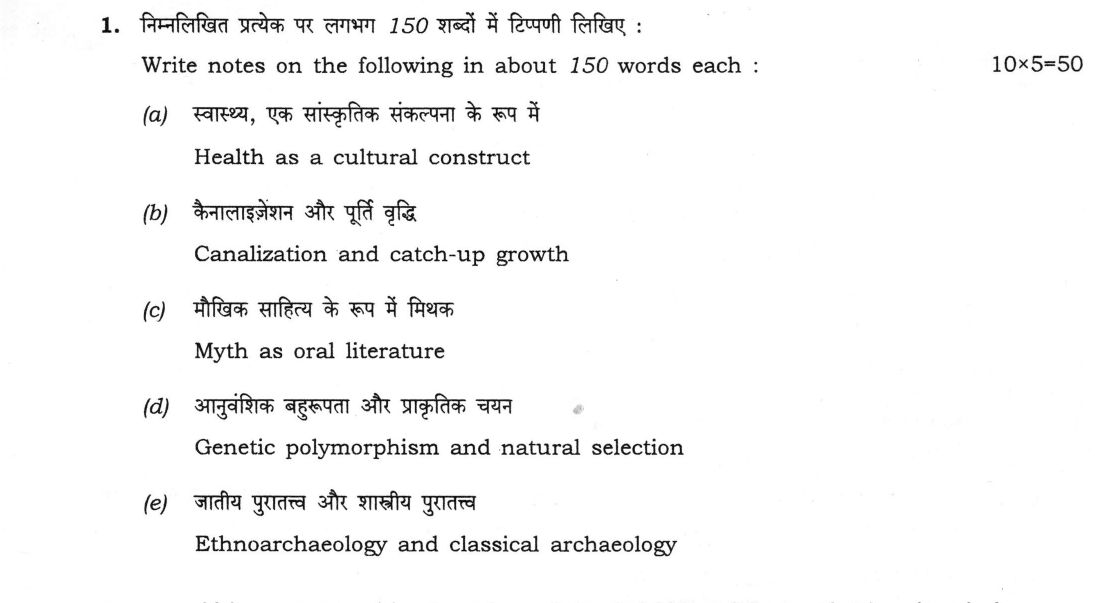
Write notes on the following in about 150 words each :
Health as a cultural construct 10 marks
Canalization and catch-up growth 10 marks
Myth as oral literature 10 marks
Genetic polymorphism and natural selection 10 marks
Ethnoarchaeology and classical archaeology 10 marks
हिंदी में प्रश्न पढ़ें
निम्नलिखित प्रत्येक पर लगभग 150 शब्दों में टिप्पणी लिखिए :
स्वास्थ्य, एक सांस्कृतिक संकल्पना के रूप में (10 अंक)
कैनालाइज़ेशन और पूर्ति वृद्धि (10 अंक)
मौखिक साहित्य के रूप में मिथक (10 अंक)
आनुवंशिक बहुरूपता और प्राकृतिक चयन (10 अंक)
जातीय पुरातत्व और शास्त्रीय पुरातत्व (10 अंक)
Model answer
Drafted with AI by UPSC Answer Check against this question's marking rubric, to the 150-word length. UPSC does not publish answers for Mains — this is one way to score well, not an official key. How we build rubrics and answers.
(a) Health as a cultural construct
Health is not a neutral biological given but a category constituted by culture: what one society calls pathology another calls normal. The WHO (1948) definition - complete physical, mental and social well-being - is itself criticised as culturally loaded and unattainable.
Disease, illness, sickness: Kleinman and Eisenberg separate disease, the practitioner's biomedical construct, from illness, the sufferer's lived experience organised by explanatory models; sickness, the socially recognised role, is the third term, from Twaddle, Young and Frankenberg.
Aetiologies vary: Foster and Anderson contrast personalistic systems (sorcery, ancestral wrath, nazar) with naturalistic ones (humoral hot-cold, Ayurvedic tridosha).
Culture-bound syndromes confirm this: susto in Latin America, koro in Southeast Asia and China, latah in Malaysia and Indonesia, dhat in South Asia.
In India smallpox was read as Shitala mata's visitation; Santal and Baiga ethnomedicine combines herbs with ojha healing, and medical pluralism moves patients between biomedicine, AYUSH and folk healers.
Culturally insensitive health programmes therefore fail; anthropology supplies the cultural competence public health needs.
(b) Canalization and catch-up growth
Canalization, coined by C. H. Waddington (1942), is the tendency of development to run along a genetically buffered channel or creode on the epigenetic landscape, resisting genetic and environmental perturbation. Human growth is strongly canalized: a child holds a stable centile despite minor environmental fluctuation.
Catch-up growth is the proof of this buffering. When a severe insult - starvation, chronic infection - pushes the child off the canal, growth is arrested; on removal of the insult velocity rises far above the age norm until the original centile is regained. The term was established by Prader, Tanner and von Harnack (1963).
Mechanism: Tanner proposed a central target-seeking controller comparing achieved size with a target; rivals site it in the growth plate. Type A raises velocity, Type B delays maturation and prolongs growing.
Limits: completeness depends on severity, duration and timing. Treated coeliac disease or corrected hypothyroidism permits full recovery; severe insults within the first 1000 days leave largely irreversible stunting - hence the policy stress on early-life nutrition.
(c) Myth as oral literature
Oral literature (verbal art) covers unwritten narrative, song and proverb. Within it William Bascom distinguished myth, legend and folktale: myth is a sacred prose narrative of origins, set in a remote past and held true by its tellers - unlike the fictional folktale.
Orality matters: no fixed text exists, versions vary with performer and occasion, and transmission rests on Parry and Lord's oral-formulaic composition. Vansina showed such traditions, critically handled, are historical evidence.
Functionally, Malinowski (Myth in Primitive Psychology, 1926) showed among the Trobrianders that myth is not bad science but a charter: subclan origin myths validate land rights, rank and ritual.
Structurally, Lévi-Strauss's The Structural Study of Myth (1955) treats myth as unconscious logic - mythemes in bundles of binary oppositions mediating irresolvable contradictions, as in his Oedipus analysis.
Indian illustration: the Santal myth of Pilchu Haram and Pilchu Budhi grounds clan organisation; Gond and Bhil myths legitimise territory and totem.
Myth is thus at once aesthetic performance, social charter and cognitive structure.
(d) Genetic polymorphism and natural selection
E. B. Ford defined polymorphism as the coexistence in one population of two or more discontinuous forms, the rarest being too frequent (conventionally above one per cent) to be maintained by recurrent mutation alone. Selection both creates and preserves it.
Transient polymorphism exists while directional selection replaces one allele by another - industrial melanism in Biston betularia.
Balanced polymorphism is actively maintained, chiefly by heterozygote advantage. The classic case is haemoglobin S: AS heterozygotes resist Plasmodium falciparum, as A. C. Allison showed in 1954 in East Africa, while SS suffer sickle-cell anaemia and AA are malaria-vulnerable. Hence high HbS frequencies in malarial belts, including the Gond, Bhil, Baiga and the Irula.
Parallel cases: G6PD deficiency and beta-thalassaemia in malarial zones; Duffy-negative genotype against vivax malaria in West Africa; pathogen-driven HLA diversity.
Other mechanisms are frequency-dependent selection and selection varying in space and time. Departure from Hardy-Weinberg expectation is the tool for detecting them.
Polymorphism is thus both the raw material and the record of selection.
(e) Ethnoarchaeology and classical archaeology
The pairing contrasts an anthropological, analogy-building archaeology with a text-aided, humanistic one.
Ethnoarchaeology studies living communities specifically to interpret material remains - how behaviour makes, uses, discards and transforms objects, and how sites form. Binford's Nunamiut Ethnoarchaeology (1978) made it the empirical base of middle-range theory, linking static archaeological traces to dynamic past behaviour. Gould worked among Western Desert Aborigines on stone-tool use and discard; Hodder's Symbols in Action (1982) among the Nuba showed material culture actively signalling identity. Indian work covers traditional potters and the itinerant Gaduliya Lohar blacksmiths.
Classical archaeology studies Greek and Roman antiquity - temples, sculpture, inscriptions, coins, Pompeii - in the antiquarian and art-historical tradition descending from Winckelmann. Literary and epigraphic texts anchor its chronology and stylistic typology.
Contrast: Ethnoarchaeology is nomothetic, anthropological, behaviour-focused, using observed living practice; classical archaeology is particularising, historical and art-historical, using excavated monuments of a literate civilization.
Both are legitimate and complementary: one supplies interpretive method, the other documented context.
How this answer will be evaluated
Evaluation rubric
Each sub-part is marked on its own, against the marks and word limit printed on the paper.
- (a) A compact 150-word note establishing that health, illness and the body are culturally defined categories rather than purely biological givens. The directive is implicit ('write a note'), so the answer must define, illustrate with named cross-cultural material, and close with applied relevance. 10 marks · 150 words
Must cover
- Defines health as a culturally constructed category, noting the WHO 1948 definition and its critique
- Disease vs illness (Kleinman and Eisenberg) and sickness as a social role (Twaddle / Young / Frankenberg)
- Culturally varying aetiologies: Foster and Anderson's personalistic vs naturalistic systems (humoral hot-cold, Ayurvedic tridosha)
- At least one culture-bound syndrome with its society (susto, koro, latah, dhat)
- An Indian example (Shitala mata, tribal ethnomedicine) and medical pluralism
Loses marks
- Writing a general essay on medical anthropology or on the definition of health without ever showing that it is culturally constructed
- Giving only the WHO definition and stopping, with no cross-cultural or Indian ethnographic example
- Confusing illness with disease, or using the two terms interchangeably, which destroys the core analytical point
- Listing culture-bound syndromes without naming the society each belongs to (susto - Latin America, koro - Southeast Asia and China, latah - Malaysia and Indonesia)
- Exceeding the 150-word limit by narrating case studies at length instead of compressing into named examples
Earns more
- Explains aetiological systems: Foster and Anderson's personalistic vs naturalistic disease theories, humoral hot-cold classification, Ayurvedic tridosha, breach of taboo, sorcery and evil eye as causes
- Gives an Indian ethnographic illustration (Shitala mata and smallpox, tribal ethnomedicine among the Santal or Baiga, bhagat / ojha healers) and notes medical pluralism and AYUSH as applied relevance
Extra mark
- Kleinman's 'explanatory models' concept, or Scheper-Hughes and Lock's 'The Mindful Body' (1987)
- Applied link to culturally competent health programmes (e.g., ASHA workers, engagement with traditional healers)
- (b) A 150-word note on two linked concepts in human growth and development: canalization (the buffering of a developmental trajectory) and catch-up growth (return to that trajectory after an insult). The answer must show the logical link between them, not treat them as two unrelated definitions. 10 marks · 150 words
Must cover
- Canalization defined and credited to C. H. Waddington (epigenetic landscape, creode)
- Catch-up growth defined as accelerated velocity returning the child to the original centile after an insult (Prader, Tanner and von Harnack, 1963)
- Explicit link: catch-up growth is evidence of canalization / target-seeking growth (Tanner)
- Limits: completeness depends on severity, duration and timing; the first 1000 days as a critical window
- At least one example (coeliac disease, hypothyroidism, adoptee studies)
Loses marks
- Treating canalization and catch-up growth as two disconnected definitions instead of showing that catch-up is evidence of canalization
- Attributing canalization to Tanner instead of Waddington, or omitting Waddington altogether
- Describing catch-up merely as 'growing fast later' without the key idea of a return to the original trajectory or target centile
- Ignoring the limits - implying catch-up is always complete, which contradicts the evidence on early-life stunting
- Wandering into a general essay on growth curves, growth spurts and secular trend, which the question does not ask for
Earns more
- Explains the target-seeking mechanism - Tanner's proposal of a central controller comparing achieved size with a target, against the rival peripheral growth-plate explanation - and distinguishes Type A (increased velocity) from Type B (delayed maturation with prolonged growth period)
- States the limiting conditions: catch-up may be complete or only partial, and depends on the severity, duration and timing of the insult, with the first 1000 days as a critical window beyond which stunting becomes permanent
- Gives at least one documented example - recovery after treatment of coeliac disease or hypothyroidism, the Dutch Hunger Winter cohort, or growth recovery in inter-country adoptees
Extra mark
- Policy context from NFHS data: under-five stunting 35.5% in NFHS-5 (2019-21) and 29.3% in NFHS-6 (2023-24)
- Names the rival explanations precisely: Tanner's central 'time-tally' controller vs the growth-plate (senescence) hypothesis
- (c) A 150-word note situating myth within the study of oral literature / verbal art: what distinguishes myth from other oral genres, how it is transmitted orally, and what the major theoretical approaches to it are. 10 marks · 150 words
Must cover
- Myth as a genre of oral literature / verbal art, distinguished from legend and folktale (Bascom): sacred, believed true, set in a remote past
- Orality: variation between versions, performance, oral-formulaic transmission (Parry and Lord) or Vansina
- Malinowski's functionalist view: myth as social charter ('Myth in Primitive Psychology', 1926; Trobriand)
- Lévi-Strauss's structural analysis (1955): mythemes, binary oppositions, mediation of contradiction
- A named Indian or tribal myth example
Loses marks
- Retelling a myth at length instead of analysing myth as a genre of oral literature
- Treating myth, legend and folktale as synonyms, losing the classificatory point that myth is sacred and believed true
- Naming Levi-Strauss without explaining the analytic apparatus (mythemes, binary oppositions, mediation of contradiction)
- Ignoring orality entirely - no mention of variation across versions, performance or transmission
- Presenting myth as false belief or primitive science, a position Malinowski explicitly rejected
Earns more
- Addresses orality itself: absence of a fixed text, variation between versions and performances, mnemonic and formulaic composition (Parry and Lord's oral-formulaic theory), audience and performance context, and Vansina's treatment of oral tradition as historical source
- Gives Indian or tribal illustration - Santal creation myth of Pilchu Haram and Pilchu Budhi, Gond and Bhil origin myths legitimising clan structure, or regional oral variants of the Ramayana
Extra mark
- Other approaches named: Max Müller's 'disease of language', the myth-ritual school (Frazer), or Eliade's myth as sacred history
- Indian oral-literature scholarship: Verrier Elwin's 'Myths of Middle India' (1949) or A. K. Ramanujan's 'Three Hundred Ramayanas'
- (d) A 150-word note defining genetic polymorphism precisely and showing how natural selection creates and maintains it. The two terms must be connected causally; a definition-only answer misses the demand. 10 marks · 150 words
Must cover
- Ford's definition of genetic polymorphism (rarest form above about 1%, not maintained by recurrent mutation alone)
- Transient vs balanced polymorphism
- Heterozygote advantage illustrated by HbS and P. falciparum malaria (Allison, 1954)
- Indian tribal HbS data (e.g., Gond, Bhil, Baiga, Irula)
- Other selective mechanisms (frequency-dependent selection) and Hardy-Weinberg as the null model
Loses marks
- Defining polymorphism loosely as 'variation' without Ford's frequency criterion that excludes recurrent mutation
- Describing sickle-cell anaemia as a disease only, without the heterozygote advantage argument that makes it a polymorphism
- Confusing balanced polymorphism with transient polymorphism, or calling industrial melanism a balanced polymorphism
- Listing ABO, MN and Rh blood groups as polymorphisms with no selective explanation attached
- Omitting Indian population data although Indian tribal HbS and G6PD frequencies are standard syllabus material
Earns more
- Names at least two further polymorphisms with a selective explanation - G6PD deficiency and thalassaemia in malarial zones, Duffy-negative FY genotype and Plasmodium vivax resistance in West Africa, HLA / MHC diversity under pathogen-driven selection, lactase persistence under dairying
- Notes other balancing mechanisms (frequency-dependent selection, selection varying in space and time) and the Hardy-Weinberg equilibrium as the null model against which selection is detected; may contrast with industrial melanism in Biston betularia as transient polymorphism
Extra mark
- Applied relevance: National Sickle Cell Anaemia Elimination Mission (launched 1 July 2023 at Shahdol; elimination as a public-health problem by 2047)
- Notes that the same allele is both advantageous and deleterious (genetic / segregational load of balanced polymorphism)
- (e) A 150-word note on two branches of archaeology paired for contrast: ethnoarchaeology and classical archaeology. The answer must define each precisely and bring out the contrast in aim, data and theoretical orientation - not write two disconnected paragraphs. 10 marks · 150 words
Must cover
- Ethnoarchaeology defined: study of living communities to build analogies for interpreting the archaeological record and site formation
- Binford's 'Nunamiut Ethnoarchaeology' (1978) and middle-range theory
- At least one other practitioner (Gould among Western Desert Aborigines; Hodder's 'Symbols in Action', 1982)
- Classical archaeology defined: Greek and Roman civilizations, text-aided and art-historical, using inscriptions, coins, monuments and stylistic typology
- Explicit contrast of aims, data and orientation, with an Indian ethnoarchaeological example
Loses marks
- Defining ethnoarchaeology simply as 'study of tribes by archaeologists' and missing that its purpose is to build interpretive analogy for the archaeological record
- Confusing classical archaeology with prehistoric or historical archaeology in general, or treating 'classical' as meaning 'old-fashioned'
- Writing two separate definitions with no comparison, when the pairing in the question invites contrast
- Failing to name a single practitioner or case study on either side
- Overrunning the word limit by narrating one ethnoarchaeological study in full
Earns more
- Names concrete ethnoarchaeological studies - Binford among the Nunamiut, Richard Gould among Western Desert Aborigines, Ian Hodder among the Nuba ('Symbols in Action', 1982) - and Indian work on traditional potters, the Gaduliya Lohar and hunting-gathering groups
- Draws an explicit contrast: nomothetic and processual aims versus particularising and humanistic ones; observation of living behaviour and site-formation processes versus excavated monuments and texts; generalisation about past behaviour versus chronology, style and the elucidation of known historical civilizations
Extra mark
- Schiffer's behavioural archaeology and site-formation processes (1976)
- Indian link: K. Paddayya's ethnoarchaeology of Deccan pastoralists, or Wheeler's Arikamedu excavation (1945) linking Indian sites to Roman trade
What "Write short notes" is asking you to do
Five or six self-contained answers, marked separately, typically 10 marks and about 150 words each. Each note must carry its own definition, its two or three defining features and a line on why it matters; a common introduction or conclusion across the notes earns nothing.
Structure that answers it
Per note: one-line definition or identification → two or three features, mechanisms or named examples → one line of significance or Indian application
Where marks are lost
Writing the first two notes at essay length and rationing the rest. Each note is marked on its own, so marks surrendered on a compressed or unattempted note cannot be won back by the long ones.
Practice this exact question
Write your answer and it is marked point by point against the model answer above — what you covered, what you missed, what you got wrong.
Evaluate my answer →More from Anthropology 2026 Paper I
- Q1 Write notes on the following in about 150 words each : (a) Health as a cultural construct…
- Q2 (a) What is meant by a somatotype? Discuss the Heath-Carter anthropometric method, giving…
- Q3 (a) How do the concepts of power, authority, legitimacy and social control change with ch…
- Q4 (a) Discuss the phylogenetic status, characteristic features, geographical distribution a…