Paper I — Q3
(a) How do the concepts of power, authority, legitimacy and social control change with changing political organization? Discuss…
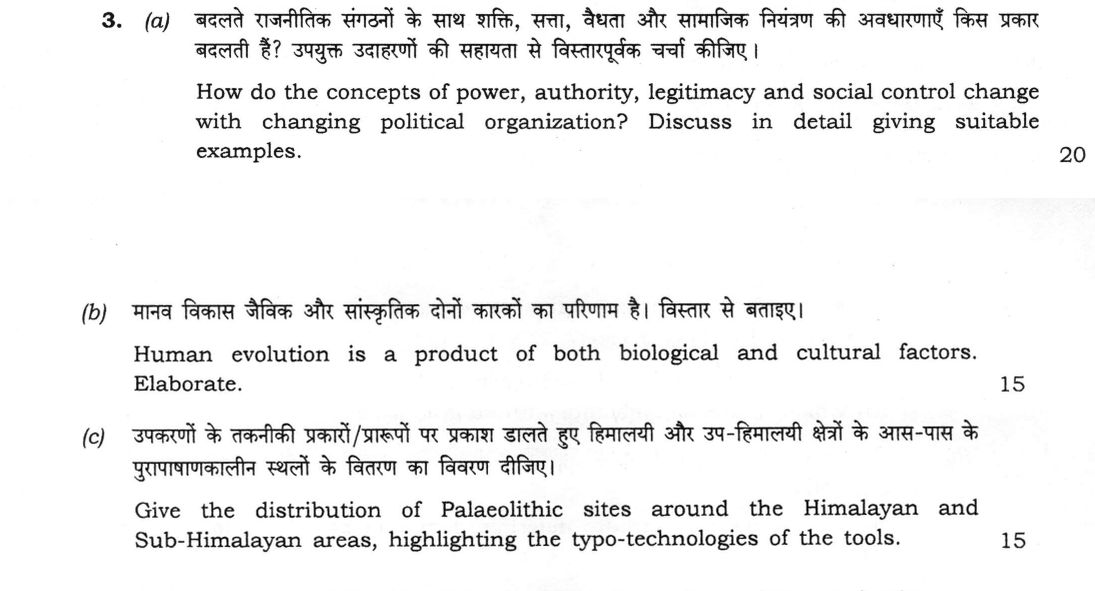
How do the concepts of power, authority, legitimacy and social control change with changing political organization? Discuss in detail giving suitable examples. 20 marks
Human evolution is a product of both biological and cultural factors. Elaborate. 15 marks
Give the distribution of Palaeolithic sites around the Himalayan and Sub-Himalayan areas, highlighting the typo-technologies of the tools. 15 marks
हिंदी में प्रश्न पढ़ें
बदलते राजनीतिक संगठनों के साथ शक्ति, सत्ता, वैधता और सामाजिक नियंत्रण की अवधारणाएँ किस प्रकार बदलती हैं? उपयुक्त उदाहरणों की सहायता से विस्तारपूर्वक चर्चा कीजिए। (20 अंक)
मानव विकास जैविक और सांस्कृतिक दोनों कारकों का परिणाम है। विस्तार से बताइए। (15 अंक)
उपकरणों के तकनीकी प्रकारों/प्रारूपों पर प्रकाश डालते हुए हिमालयी और उप-हिमालयी क्षेत्रों के आस-पास के पुरापाषाणकालीन स्थलों के वितरण का विवरण दीजिए। (15 अंक)
Model answer
Drafted with AI by UPSC Answer Check against this question's marking rubric, to the expected length. UPSC does not publish answers for Mains — this is one way to score well, not an official key. How we build rubrics and answers.
(a) Power, authority, legitimacy and social control across political organization
Weber anchors the four terms: power is the capacity to impose one's will despite resistance; authority is power accepted as legitimate and vested in an office; legitimacy is the belief sustaining it (traditional, charismatic, rational-legal); social control is the machinery, formal and informal, securing conformity. None is absent in stateless societies; all become progressively centralised, formalised and coercive across Service's band-tribe-chiefdom-state sequence.
Band: power is diffuse and egalitarian. The Ju/'hoansi San or Andamanese headman (Radcliffe-Brown) has influence, not command, resting on generosity, age and skill, and evaporating if resented. Authority is barely differentiated; legitimacy is personal. Control is informal - gossip, ridicule, ostracism, witchcraft accusation, the Inuit song duel - with fission of the group as ultimate sanction.
Tribe: order without rulers. Evans-Pritchard's The Nuer (1940) describes an 'ordered anarchy' held by segmentary lineages and complementary opposition; the leopard-skin chief mediates feud but commands no force. Age-sets and pan-tribal sodalities cross-cut kinship. Sahlins (1963) showed the Melanesian Big Man's leadership to be achieved, personal and non-transferable.
Chiefdom: authority becomes a permanent, usually hereditary office. Descent groups are ranked, the chief controls redistribution of surplus, and legitimacy flows from genealogy and sacred sanction - Polynesian mana and tabu, Firth's Tikopia. Furer-Haimendorf's contrast between the autocratic Konyak Ang and the Angami village republics shows the range within India.
State: centralised government claiming a monopoly of legitimate force, with codified law, police, courts, taxation and bureaucracy; legitimation is rational-legal or divine-kingly. Fortes and Evans-Pritchard's African Political Systems (1940) formalised this as Group A centralised states (Zulu, Ngwato) against Group B stateless societies (Nuer, Tallensi, Logoli).
Law shifts in step: Malinowski's Crime and Custom (1926) found obligation enforced by reciprocity, not courts; Llewellyn and Hoebel's trouble-case method in The Cheyenne Way (1941) traced emergent adjudication. In India the levels coexist: khap panchayats assert customary control while PESA 1996 and Sixth Schedule councils give statutory form to tribal self-government.
Thus power moves from diffuse personal influence to hereditary office in the chiefdom and to institutionalised authority backed by a monopoly of legitimate force in the state.
(b) Human evolution as a bio-cultural process
Human evolution is a feedback system, not two parallel stories: anatomical change enabled culture, and culture then reshaped the selective environment acting on anatomy. Sherwood Washburn's 'new physical anthropology' made this bio-cultural feedback - bipedalism, tool use, brain expansion, dental reduction - the organising model; modern niche-construction theory restates it.
Biology enabling culture: habitual bipedalism came first, attested by the Laetoli footprint trail of about 3.6 million years ago and by the postcranium of Australopithecus afarensis. Freed hands permitted systematic knapping - Oldowan cores and flakes by about 2.6 million years ago at Gona, Ethiopia (the Lomekwi claim of 3.3 million years remains disputed).
Culture selecting on biology: tools widened the diet to meat and marrow; on Aiello and Wheeler's expensive tissue hypothesis (1995) this high-quality food allowed gut reduction and brain enlargement. Cranial capacity rose from roughly 450 cc in afarensis to 600-700 cc in Homo habilis, 900-1100 cc in Homo erectus and about 1350 cc in modern humans. Fire and cooking, argued by Wrangham and evidenced at Wonderwerk Cave and Gesher Benot Ya'aqov, raised net energy and reduced the masticatory apparatus.
Consequences: a bipedal pelvis with large neonatal brains creates the obstetric dilemma, hence secondary altriciality, prolonged childhood and dependence on social learning; endocast impressions of Broca's area, the hyoid and FOXP2 mark language capacity; clothing, shelter and fire opened cold Eurasia.
Living populations confirm the loop: dairying selected lactase persistence, starchy diets higher amylase copy number, forest-clearing yam agriculture raised malaria and with it the sickle-cell allele (Livingstone, 1958), and ultraviolet gradients shaped pigmentation (Jablonski and Chaplin).
Biology and culture are thus two arms of one adaptive process.
(c) Palaeolithic sites of the Himalayan and sub-Himalayan belt
The Himalayan-sub-Himalayan Palaeolithic lies mainly in the Siwalik foothill belt and its valleys, the type area being the Soan (Sohan) valley of the Potwar plateau.
Distribution: Soan-Potwar in the west; eastward the Beas-Banganga, Sirsa, Markanda and Ghaggar basins of Punjab, Haryana and Himachal Pradesh; the Kashmir Karewas near Pahalgam (Liddar valley) and Sombur, Pampore - claims long disputed; the Nepal Siwaliks around Dang and the Arjun Khola, studied by Corvinus; and the Rongram valley, Garo Hills, Meghalaya, in the eastern sub-Himalaya. Very early claims from Riwat and the Pabbi Hills in the Pakistani Siwaliks (Dennell) remain debated.
Framework: de Terra and Paterson's Yale-Cambridge expedition (1939) defined the Soanian, correlating artefact-bearing terraces with a Himalayan glacial-interglacial sequence and proposing Pre-Soan, Early Soan, Evolved Soan and Late Soan phases. That terrace-glacial chronology is no longer accepted; most Soanian material is now placed in the Middle to Late Pleistocene.
Typo-technology: raw material is overwhelmingly quartzite pebble and cobble from Siwalik boulder conglomerate. Typologically the industry is dominated by unifacial and bifacial choppers and chopping tools, with discoids, cores and a substantial flake element worked into side and end scrapers. Technologically it moves from simple hard-hammer pebble flaking to controlled flake production, prepared cores and Levallois-like flakes in the later phases.
Acheulian element: handaxes and cleavers from Atbarapur and related Beas-Banganga localities in Hoshiarpur district, and bifaces reported from Guler and Dehra Gopipur in Kangra, show true bifaces within the belt, weakening Movius's line separating a northern chopper-chopping tool zone from a southern handaxe zone.
The belt therefore records a long quartzite pebble-and-flake tradition coexisting with genuine biface industries.
How this answer will be evaluated
Evaluation rubric
Each sub-part is marked on its own, against the marks and word limit printed on the paper.
- (a) The question asks how four specific concepts - power, authority, legitimacy and social control - transform as political organization changes. The answer must define the four, then track them across the band-tribe-chiefdom-state sequence with named ethnographic examples, showing change rather than merely describing each type. 20 marks
Must cover
- Max Weber: power, authority, legitimacy; traditional, charismatic and rational-legal authority
- band, tribe, chiefdom, state typology (Service)
- Evans-Pritchard, 'The Nuer' (1940), segmentary lineage, leopard-skin chief
- Fortes and Evans-Pritchard, 'African Political Systems' (1940), Group A and Group B
- Marshall Sahlins (1963) on the Big Man
- Ju/'hoansi San or Andamanese headman; Inuit song duel
- Malinowski, 'Crime and Custom in Savage Society' (1926); Llewellyn and Hoebel, 'The Cheyenne Way' (1941)
- PESA 1996 / Sixth Schedule / khap panchayat as contemporary Indian illustration
Loses marks
- Describing the four types of political organization one after another without ever tracking what happens to power, authority, legitimacy and social control across them
- Assuming that bands and tribes have no social control at all, instead of showing that control there is informal and diffuse
- Confusing the Nuer leopard-skin chief with a ruler - he is a ritual mediator in feuds with no coercive authority
- Confusing power with authority throughout, or omitting legitimacy, which is separately named in the question
- Naming no ethnographic society at all, despite the explicit instruction to give suitable examples
Earns more
- Tribal level: still largely acephalous; order maintained by segmentary lineage organisation and complementary opposition, as in Evans-Pritchard's 'The Nuer' (1940) with the leopard-skin chief as ritual mediator without coercive power; age-sets and pan-tribal sodalities; achieved leadership of the Melanesian Big Man analysed by Sahlins (1963)
- Chiefdom: a permanent, usually hereditary office with ranked descent groups and redistributive control of surplus; legitimacy drawn from genealogy and sacred sanction such as mana and tabu in Polynesia, illustrated by Firth's Tikopia and, in India, by the contrast Furer-Haimendorf drew between the autocratic Konyak Ang and the more democratic Angami village republics
- Tracks the parallel change in law and social control - Malinowski's demonstration in 'Crime and Custom in Savage Society' (1926) that reciprocity and self-interest enforce rules without courts, and Llewellyn and Hoebel's trouble-case method in 'The Cheyenne Way' (1941) - and illustrates the coexistence of levels in contemporary India through khap panchayats alongside statutory panchayats, PESA 1996 and Sixth Schedule autonomous district councils
Extra mark
- Indian illustrations of traditional authority: the Munda-Manki system of Kolhan, Santal manjhi-pargana councils, or Naga chiefship
- Gluckman's 'rituals of rebellion' (1954) or Weber's routinisation of charisma, showing how legitimacy is renewed or transformed
- (b) The directive 'elaborate' on a given statement requires the candidate to substantiate the bio-cultural proposition: show that biological change enabled culture, that culture in turn became a selective force on biology, and support each link with dated fossil, archaeological or genetic evidence. 15 marks
Must cover
- bio-cultural / feedback model; Sherwood Washburn
- Laetoli footprints (c. 3.6 mya) and Australopithecus afarensis
- cranial capacity trend from australopithecines to Homo sapiens
- Oldowan tools c. 2.6 mya, Gona
- control of fire and Richard Wrangham's cooking hypothesis
- Aiello and Wheeler, expensive tissue hypothesis (1995)
- lactase persistence and dairying; sickle cell, yam cultivation and malaria (Livingstone 1958)
- secondary altriciality and prolonged childhood
Loses marks
- Narrating the fossil sequence from Australopithecus to Homo sapiens with no cultural dimension at all, which answers only half the statement
- Asserting that culture influenced biology without a single documented case such as lactase persistence or the sickle-cell and agriculture link
- Reversing the chronology - for example placing brain expansion before bipedalism, or dating Oldowan tools to the australopithecine stage without naming the site
- Confusing Lamarckian inheritance of acquired characters with gene-culture coevolution
- Ignoring the feedback logic and simply listing biological factors in one paragraph and cultural factors in another
Earns more
- Gives documented cases of gene-culture coevolution in living populations: lactase persistence spreading with dairying, amylase gene copy number correlating with starch-rich diets, the sickle-cell allele rising with forest-clearing yam agriculture and malaria as argued by Frank Livingstone (1958), and skin pigmentation clines shaped by ultraviolet radiation, folate and vitamin D as analysed by Jablonski and Chaplin
- Draws out life-history and communicative consequences: the obstetric dilemma of bipedalism and enlarged neonatal brains producing secondary altriciality, a prolonged childhood and an extended period of social learning; the evolution of language capacity (Broca's area impressions on endocasts, the hyoid, FOXP2); and clothing, shelter and fire allowing colonisation of cold latitudes alongside biological cold adaptation in Neanderthals
Extra mark
- Adaptive introgression: the Denisovan-derived EPAS1 variant in Tibetans as high-altitude adaptation
- Dual-inheritance theory (Boyd and Richerson) or Durham's gene-culture coevolution named as the theoretical frame
- (c) Two linked demands: give the spatial distribution of Palaeolithic sites in the Himalayan and sub-Himalayan (Siwalik) belt, and highlight the typological and technological character of the tools. Distribution without typo-technology, or typology without named localities, is a half answer. 15 marks
Must cover
- Siwalik / sub-Himalayan zone; Soan or Sohan valley, Potwar plateau
- de Terra and Paterson (1939), Yale-Cambridge expedition, terrace sequence
- Pre-Soan, Early Soan, Late Soan phases
- choppers and chopping tools, discoids, flake scrapers, Levallois technique
- quartzite pebbles from Siwalik conglomerate
- Atbarapur / Hoshiarpur Acheulian handaxes and cleavers; Guler and Dehra Gopipur
- Movius Line
- Kashmir Karewa localities (Pahalgam, Sombur); Nepal Siwaliks; Rongram valley, Garo Hills
Loses marks
- Listing Palaeolithic sites from peninsular India - Hunsgi, Attirampakkam, Bhimbetka, Didwana - which lie outside the Himalayan and sub-Himalayan frame the question sets
- Naming Burzahom or Gufkral as Palaeolithic when they are Neolithic sites of the Kashmir valley
- Giving distribution only, with no description of chopper, chopping tool, discoid, scraper or Levallois technique, although the question specifically asks for typo-technology
- Presenting de Terra and Paterson's glacial-terrace correlation as currently accepted fact rather than as a superseded chronological framework
- Denying any Acheulian presence in the Siwaliks, which ignores the Hoshiarpur handaxe evidence and the resulting revision of the Movius Line
Earns more
- Notes Acheulian bifaces in the Siwalik belt - handaxes and cleavers reported from Atbarapur and related localities in the Hoshiarpur district of Punjab within the Beas-Banganga system, and from the Guler and Dehra Gopipur area of the Kangra valley - and explains that these weaken Movius's proposed division between a northern chopper-chopping tool complex and a southern handaxe complex
- Covers the remaining regions and the dating cautions: reported but long-disputed Palaeolithic material from the Kashmir Karewas around Pahalgam in the Liddar valley and at Sombur near Pampore; the contested very early claims from Riwat and the Pabbi Hills in the Pakistani Siwaliks associated with Dennell; Palaeolithic occurrences in the Nepal Siwaliks such as the Dang and Arjun Khola area investigated by Corvinus; the Rongram valley in the Garo Hills of Meghalaya in the eastern sub-Himalaya; and the point that the glacial-terrace chronology of de Terra and Paterson is no longer accepted, with the Soanian now generally placed in the Middle to Late Pleistocene
Extra mark
- Masol (Chandigarh Siwaliks) cut-marked bones claimed at about 2.6 million years (2016) and treated as contested
- Contrast of the Soanian pebble-flake tradition with the peninsular Acheulian (Madrasian) tradition
What "Discuss" is asking you to do
Lay the issue out from more than one side — how it arose, what is claimed for it, what is held against it, and where it now stands. UPSC attaches discuss to broad topics with several live dimensions, so coverage of the dimensions earns more than the strength of your opinion.
Structure that answers it
Set the issue up → the case as it is made → the case against → the dimension both sides leave out → where the balance now lies
Where marks are lost
Listing facts with no thread between them, or arguing one side throughout and calling it a discussion.
Practice this exact question
Write your answer and it is marked point by point against the model answer above — what you covered, what you missed, what you got wrong.
Evaluate my answer →More from Anthropology 2026 Paper I
- Q1 Write notes on the following in about 150 words each : (a) Health as a cultural construct…
- Q2 (a) What is meant by a somatotype? Discuss the Heath-Carter anthropometric method, giving…
- Q3 (a) How do the concepts of power, authority, legitimacy and social control change with ch…
- Q4 (a) Discuss the phylogenetic status, characteristic features, geographical distribution a…
- Q5 Write notes on the following in about 150 words each : (a) Ethics in anthropological fiel…
- Q6 (a) How would you find out that a particular disease/disorder is inherited and, if so, in…