Paper I — Q5
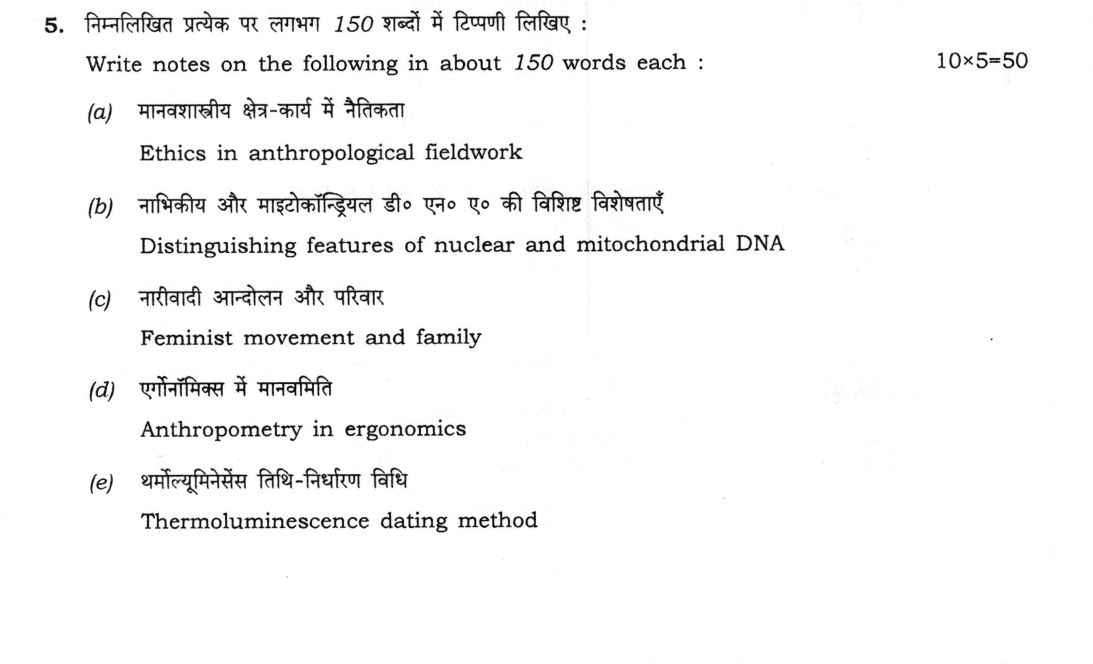
(a) Ethics in anthropological fieldwork (10 marks) (b) Distinguishing features of nuclear and mitochondrial DNA (10 marks) (c)…
Write notes on the following in about 150 words each :
Ethics in anthropological fieldwork 10 marks
Distinguishing features of nuclear and mitochondrial DNA 10 marks
Feminist movement and family 10 marks
Anthropometry in ergonomics 10 marks
Thermoluminescence dating method 10 marks
हिंदी में प्रश्न पढ़ें
निम्नलिखित प्रत्येक पर लगभग 150 शब्दों में टिप्पणी लिखिए :
मानवशास्त्रीय क्षेत्र-कार्य में नैतिकता (10 अंक)
नाभिकीय और माइटोकॉन्ड्रियल डी० एन० ए० की विशिष्ट विशेषताएँ (10 अंक)
नारीवादी आन्दोलन और परिवार (10 अंक)
एर्गोनॉमिक्स में मानवमिति (10 अंक)
थर्मोल्यूमिनेसेंस तिथि-निर्धारण विधि (10 अंक)
Model answer
Drafted with AI by UPSC Answer Check against this question's marking rubric, to the 150-word length. UPSC does not publish answers for Mains — this is one way to score well, not an official key. How we build rubrics and answers.
(a) Ethics in anthropological fieldwork
The anthropologist's primary obligation is to the people studied: do no harm. Consent must be informed, voluntary and revocable; purpose, methods, sponsorship and funding disclosed honestly; identities protected, since data are easily traced in small communities.
Codes: AAA Principles of Professional Responsibility (1971, revised 2012) and Code of Ethics (1998); ASA (UK) Ethical Guidelines (1999); in India ICMR's National Ethical Guidelines (2017) with institutional ethics committee clearance.
These grew from scandals: Project Camelot (1964-65) and the Thailand affair, on anthropology serving military ends; the Yanomami dispute after Tierney's Darkness in El Dorado (2000); the Havasupai case (settled 2010), where diabetes-study blood was reused for unrelated research; the AAA's rejection of the Human Terrain System.
Dilemmas: covert participant observation involves deception; power asymmetry; vulnerable tribal groups and PVTGs; consent and benefit-sharing for genetic samples; repatriation of remains and sacred objects.
Positive duties include reciprocity, sharing findings accessibly, reflexivity, and Nader's call to 'study up'.
Ethics is a continuing negotiation, not a one-time clearance.
(b) Nuclear and mitochondrial DNA
The two genomes differ in structure, organisation, inheritance and mutation rate; hence their distinct uses.
Structure: Nuclear: linear, on 23 chromosome pairs, about 3.2 billion base pairs, histone-packaged, two copies per cell. mtDNA: circular, about 16,569 base pairs, histone-free, hundreds to thousands of copies per cell.
Genes: Nuclear: roughly 20,000 protein-coding genes, introns, much non-coding DNA. mtDNA: only 37 genes - 13 oxidative-phosphorylation polypeptides, 22 tRNAs, 2 rRNAs - intron-free, plus a control region (D-loop) containing HVR-I and HVR-II.
Inheritance: Nuclear: biparental, Mendelian, recombining each generation. mtDNA: maternal, non-recombining, preserving an unbroken matriline; subject to heteroplasmy, a germline bottleneck and a threshold effect.
Mutation: mtDNA mutates several times faster, with weaker repair - a fine molecular clock.
Uses: mtDNA underpins haplogroup phylogeography (Cann, Stoneking and Wilson, 1987, 'Mitochondrial Eve'; macrohaplogroup M in India), degraded forensic and ancient DNA, and maternal disorders such as LHON and MELAS. Nuclear DNA carries the biparental record; the Y chromosome is its paternal counterpart.
(c) Feminist movement and family
Feminism treats the family not as natural but as a constructed institution organising male authority and female labour.
Waves: first, suffrage and legal personhood; second, after de Beauvoir's The Second Sex (1949) and Friedan's The Feminine Mystique (1963), the home itself - 'the personal is political'; third, intersectional after Crenshaw (1989); fourth, digital.
Critique: Engels (1884) tied monogamy and private property to the 'world-historical defeat of the female sex'. Millett's Sexual Politics and Firestone's Dialectic of Sex (1970) called the family patriarchy's primary institution; Oakley showed housework is work; Marxist feminists debated unpaid social reproduction.
Anthropology added Ortner's nature-culture argument and Rosaldo and Lamphere's domestic-public dichotomy (1974); Leacock disputed universal subordination, Mohanty the universalising Western subject.
India: Towards Equality (1974), Leela Dube on kinship and socialisation, the Hindu Succession (Amendment) and Domestic Violence Acts, 2005; Khasi, Garo and Nayar matriliny complicates equating family with patriarchy.
Feminism has pluralised rather than abolished the family: dual-earner households, later marriage, easier divorce, single-parent and non-heteronormative forms.
(d) Anthropometry in ergonomics
Ergonomics fits the task, tool and workspace to the worker, not the worker to the job; anthropometry is its dimensional base.
Dimensions: static (structural), in fixed posture - stature, sitting height, eye and elbow height, popliteal height, buttock-popliteal length, hip breadth, thigh clearance; dynamic (functional), in motion - forward and lateral reach envelope, grip span, workspace clearance.
Design rules: data are expressed as percentiles. Clearances (headroom, legroom, doorways) follow the 95th percentile so the largest user fits; reaches, controls and shelf heights the 5th, so the smallest can operate them. Adjustability across the 5th-95th range is preferred; designing for the 'average man' fits almost nobody.
Applications: workstations, chairs and school furniture (student-furniture mismatch); hand tools and tractors for Indian farmers, especially farm women; helmet and garment sizing; cockpit layout; DRDO defence surveys; 3D scanning and digital human modelling.
Mismatch causes musculoskeletal disorders, low back pain, repetitive strain injury and lost productivity. As Indian dimensions differ from Western reference data, population-specific surveys are essential.
(e) Thermoluminescence dating
Thermoluminescence (TL): an absolute radiation-dosimetry method dating the last strong heating of a crystalline material.
Principle: after burial, quartz and feldspar absorb alpha, beta, gamma radiation from uranium, thorium, potassium in object and sediment, plus cosmic rays; freed electrons accumulate in lattice defects. Heating above about 500 degrees Celsius expels them as light, zeroing the clock: firing a pot or burning flint starts the count.
Age equation: age = equivalent dose (palaeodose) / annual dose rate Palaeodose: natural TL against calibrated artificial irradiation; dose rate: sample radioactivity and burial environment, ideally in situ.
Materials and range: fired pottery, burnt flint, hearths, baked floors, bricks, volcanic products; a few centuries to roughly 100,000-500,000 years, 5-10 per cent error; beyond radiocarbon.
Limitations: changing sediment moisture, radon escape, disturbance, incomplete zeroing, later reheating; anomalous fading in feldspars.
Optically stimulated luminescence (OSL) applies the same physics to sunlight-bleached sediment grains, standard for Indian Palaeolithic sequences (Jwalapuram, Attirampakkam).
How this answer will be evaluated
Evaluation rubric
Each sub-part is marked on its own, against the marks and word limit printed on the paper.
- (a) A 150-word note on the ethical obligations governing anthropological fieldwork: the core principles, the codes that state them, the controversies that produced those codes, and the dilemmas specific to participant observation. 10 marks · 150 words
Must cover
- do no harm and primary obligation to the people studied
- informed consent, confidentiality, right to withdraw
- AAA Code of Ethics / Principles of Professional Responsibility
- ICMR National Ethical Guidelines (2017) and institutional ethics committee
- Project Camelot (1964-65)
- 'Darkness in El Dorado' / Yanomami controversy
- Havasupai DNA case
- covert observation and the deception problem
Loses marks
- Writing a general essay on fieldwork methods - rapport, key informants, participant observation - with ethics mentioned only in passing
- Listing abstract virtues such as honesty and objectivity without naming a single code, body or case
- Ignoring the biological-anthropology side of ethics: genetic sampling, benefit sharing and repatriation of remains
- Claiming that covert research is acceptable if it produces good data, which contradicts current professional codes
- Overshooting the 150-word limit by narrating one controversy in detail rather than citing several briefly
Earns more
- Identifies dilemmas specific to fieldwork: the element of deception inherent in covert or partly covert participant observation; the power asymmetry between researcher and researched; the special vulnerability of tribal groups and PVTGs; consent for biological and genetic samples and benefit sharing; ownership and publication of photographs and personal data; and repatriation of human remains and sacred objects
- Notes positive duties: reciprocity and giving back to the community, sharing findings in accessible form, the tension between advocacy and analytical detachment, reflexivity about the researcher's own position, and Laura Nader's call to 'study up' rather than only study the powerless
Extra mark
- Repatriation law such as the US NAGPRA (1990; regulations revised 2024)
- Indigenous data sovereignty (CARE principles, 2019), or the Andaman and Nicobar Islands (Protection of Aboriginal Tribes) Regulation, 1956 restricting access to tribal reserves
- (b) A 150-word comparative note setting out the features that distinguish nuclear from mitochondrial DNA. The demand is explicitly contrastive, so a point-by-point comparison, ideally with the anthropological uses that follow from the differences, is what earns marks. 10 marks · 150 words
Must cover
- circular vs linear; about 16,569 bp; 3.2 billion bp nuclear genome
- 37 mitochondrial genes: 13 proteins, 22 tRNA, 2 rRNA
- D-loop / control region, HVR-I and HVR-II
- maternal, non-recombining inheritance vs biparental Mendelian inheritance
- heteroplasmy and threshold effect
- higher mutation rate and molecular clock use
- Cann, Stoneking and Wilson (1987), Mitochondrial Eve
- mitochondrial disorders such as LHON or MELAS
Loses marks
- Stating that mitochondrial DNA is inherited from both parents, or that it recombines
- Giving the mtDNA size wrongly, for example in millions of base pairs, or confusing the 37 genes with 37 chromosomes
- Describing only mtDNA without ever contrasting it with nuclear DNA, when the note is explicitly comparative
- Omitting the applications - haplogroups, ancient DNA, forensics, mitochondrial disease - which are what make the distinction anthropologically significant
- Confusing heteroplasmy with heterozygosity
Earns more
- Contrasts mutation rate and draws the applied consequences: mtDNA mutates several times faster than nuclear DNA and has less efficient repair, which makes it a sensitive molecular clock; hence its use in haplogroup phylogeography (Cann, Stoneking and Wilson's 1987 'Mitochondrial Eve' inference of an African origin, and the predominance of macrohaplogroup M in India), in forensic and ancient DNA work on degraded remains because of high copy number, and in the study of maternally transmitted mitochondrial disorders such as Leber's hereditary optic neuropathy and MELAS; the Y chromosome provides the paternal counterpart
Extra mark
- NUMTs (nuclear copies of mitochondrial DNA) as a contamination pitfall in mtDNA studies
- Exceptions noted with caution: the debated report of paternal mtDNA transmission (Luo et al., 2018) or mitochondrial replacement therapy
- (c) A 150-word note on the relationship between the feminist movement and the family: how feminism has analysed and criticised the family as an institution, and how family forms have changed in consequence. 10 marks · 150 words
Must cover
- Simone de Beauvoir, 'The Second Sex' (1949); Betty Friedan, 'The Feminine Mystique' (1963)
- Engels, 'The Origin of the Family, Private Property and the State' (1884)
- Kate Millett or Shulamith Firestone (1970)
- domestic labour / unpaid care debate; Ann Oakley
- Rosaldo and Lamphere (1974), domestic-public dichotomy; Sherry Ortner
- Kimberle Crenshaw and intersectionality
- Towards Equality report 1974; Hindu Succession (Amendment) Act 2005; Domestic Violence Act 2005
- Leela Dube
Loses marks
- Writing a general history of feminism with no analysis of the family, which is half the question
- Treating feminism as monolithic instead of distinguishing liberal, Marxist, radical and intersectional or postcolonial positions
- Using no Indian material, although Indian legal reform and matriliny debates are directly relevant and expected
- Asserting that feminism seeks to destroy the family, rather than that it seeks to democratise and pluralise it
- Naming no theorist or text, so the note reads as opinion rather than as anthropology
Earns more
- Grounds the note in the Indian context: the Towards Equality report (1974), Leela Dube's work on kinship, gender and socialisation, the Hindu Succession (Amendment) Act 2005 making daughters coparceners, the Protection of Women from Domestic Violence Act 2005 which brought the household itself within legal scrutiny, and debates on matriliny among the Khasi, Garo and Nayar including male counter-mobilisation in Meghalaya
- States consequences for family form: renegotiated conjugal roles and the idea of the symmetrical family, dual-earner households, rising age at marriage, greater acceptance of separation and divorce, and recognition of single-parent, cohabiting and non-heteronormative families
Extra mark
- Young and Willmott's 'symmetrical family' (1973) or Hochschild's 'second shift' (1989)
- Patricia Uberoi's 'Family, Kinship and Marriage in India' (1993) or another named Indian feminist scholar on the family
- (d) A 150-word note on the use of anthropometric data in ergonomics: what ergonomics is, which body dimensions matter, the design rules that convert measurement into product, and Indian applications. 10 marks · 150 words
Must cover
- definition of ergonomics: fitting the job to the worker
- static / structural vs dynamic / functional anthropometry
- popliteal height, buttock-popliteal length, elbow height, functional reach, grip span
- percentiles: 5th and 95th
- design for extremes, design for adjustability, fallacy of the average man
- school furniture mismatch or agricultural tool design
- musculoskeletal disorders from mismatch
- need for population-specific Indian anthropometric data
Loses marks
- Describing anthropometric techniques and instruments in general - anthropometer, spreading caliper, landmarks - without connecting them to ergonomic design
- Recommending design for the average user, which is the standard error the discipline warns against
- Inverting the percentile rule, for example setting clearances by the 5th percentile and reach by the 95th
- Giving no concrete application at all, so the note remains abstract
- Confusing ergonomics with occupational health or with physical fitness assessment
Earns more
- Gives applications: workstation, chair and school furniture design and the well-documented furniture-student mismatch; agricultural hand tool and tractor design for Indian farmers, including tools redesigned for women workers; protective equipment, helmet and garment sizing based on national sizing surveys; vehicle, cockpit and control-panel layout; defence anthropometric surveys conducted by DRDO institutions; and the use of three-dimensional body scanning and digital human modelling
- Notes the consequences and the Indian relevance: anthropometric mismatch produces musculoskeletal disorders, low back pain, repetitive strain injury, fatigue and reduced productivity; and because Indian body dimensions differ from Western reference populations, population-specific data are essential - a concern reflected in the growth of ergonomics within Indian anthropology departments, a field pioneered in India by the physiologist R. N. Sen of Calcutta
Extra mark
- Indian data sources such as the CIAE Bhopal anthropometric database of agricultural workers
- Standard measurement definitions (ISO 7250) or design for adjustability spanning the 5th-percentile female to the 95th-percentile male
- (e) A 150-word note on thermoluminescence as an absolute dating method: the physical principle, the age equation, the materials and time range it suits, and its limitations. The note must show why a heating event is what is dated. 10 marks · 150 words
Must cover
- trapped electrons in lattice defects of quartz and feldspar
- ionising radiation from uranium, thorium, potassium and cosmic rays
- zeroing by heating above about 500 degrees Celsius
- age = equivalent dose (palaeodose) / annual dose rate
- pottery, burnt flint, hearths, baked clay
- approximate range and about 5-10 per cent error
- anomalous fading and moisture content as error sources
- optically stimulated luminescence (OSL) as the sediment-dating counterpart
Loses marks
- Classifying thermoluminescence as a relative dating method - it is an absolute or chronometric method
- Omitting the zeroing concept, so the answer never explains that it is the last heating that is dated
- Giving the age formula upside down, dividing annual dose by palaeodose
- Confusing TL with radiocarbon or potassium-argon dating, or claiming it dates organic material
- Stating an implausible range, such as millions of years, or claiming precision far greater than the method allows
Earns more
- States materials and range: fired pottery and terracotta, burnt flint and burnt stones, hearths and baked clay floors, bricks, kiln and furnace debris, and volcanic products; the method is commonly cited as useful from a few hundred years up to the order of 100,000 to 500,000 years, with a typical precision of about 5 to 10 per cent, thus extending beyond the radiocarbon range
- Notes limitations and the related method: the result depends on accurate reconstruction of the burial radiation environment, so changes in sediment moisture content, radon escape or disturbance introduce error; feldspars suffer anomalous fading; incomplete zeroing, later reheating or laboratory exposure to light and heat can corrupt the signal; and the optically stimulated luminescence variant applies the same physics to sediments whose traps were emptied by sunlight rather than heat, which is why OSL rather than TL is used for dating Palaeolithic sediment sequences in India, as at Jwalapuram and Attirampakkam
Extra mark
- M. J. Aitken (Oxford) and the development of TL dating from the 1960s
- Indian luminescence dating laboratories (e.g., PRL Ahmedabad) or TL dates on Indian pottery and hearths
What "Write short notes" is asking you to do
Five or six self-contained answers, marked separately, typically 10 marks and about 150 words each. Each note must carry its own definition, its two or three defining features and a line on why it matters; a common introduction or conclusion across the notes earns nothing.
Structure that answers it
Per note: one-line definition or identification → two or three features, mechanisms or named examples → one line of significance or Indian application
Where marks are lost
Writing the first two notes at essay length and rationing the rest. Each note is marked on its own, so marks surrendered on a compressed or unattempted note cannot be won back by the long ones.
Practice this exact question
Write your answer and it is marked point by point against the model answer above — what you covered, what you missed, what you got wrong.
Evaluate my answer →More from Anthropology 2026 Paper I
- Q2 (a) What is meant by a somatotype? Discuss the Heath-Carter anthropometric method, giving…
- Q3 (a) How do the concepts of power, authority, legitimacy and social control change with ch…
- Q4 (a) Discuss the phylogenetic status, characteristic features, geographical distribution a…
- Q5 Write notes on the following in about 150 words each : (a) Ethics in anthropological fiel…
- Q6 (a) How would you find out that a particular disease/disorder is inherited and, if so, in…
- Q7 (a) Discuss the mixed method approach in anthropological research. (20 marks) (b) What do…
- Q8 (a) Compare Edmund Leach's structuralism with interpretive anthropology of Clifford Geert…