Paper I — Q4
(a) Discuss the phylogenetic status, characteristic features, geographical distribution and lifeways of Paranthropus. (20…
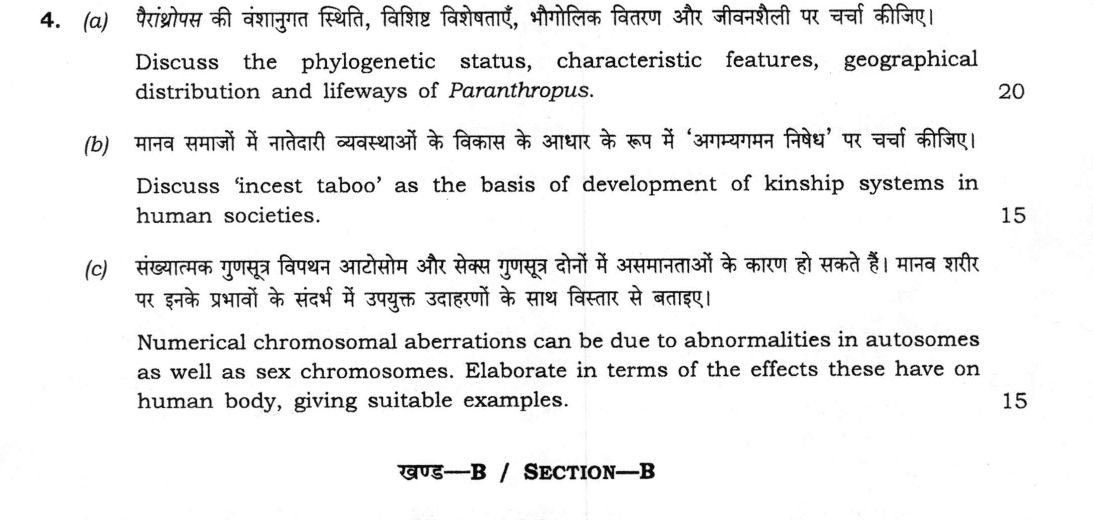
Discuss the phylogenetic status, characteristic features, geographical distribution and lifeways of Paranthropus. 20 marks
Discuss ‘incest taboo’ as the basis of development of kinship systems in human societies. 15 marks
Numerical chromosomal aberrations can be due to abnormalities in autosomes as well as sex chromosomes. Elaborate in terms of the effects these have on human body, giving suitable examples. 15 marks
हिंदी में प्रश्न पढ़ें
पैरांथ्रोपस की जातिवृत्तीय (फ़ाइलोजेनेटिक) स्थिति, विशिष्ट विशेषताएँ, भौगोलिक वितरण और जीवनशैली पर चर्चा कीजिए। (20 अंक)
मानव समाजों में नातेदारी व्यवस्थाओं के विकास के आधार के रूप में ‘अगम्यागमन निषेध’ पर चर्चा कीजिए। (15 अंक)
संख्यात्मक गुणसूत्र विपथन आटोसोम और सेक्स गुणसूत्र दोनों में असामान्यताओं के कारण हो सकते हैं। मानव शरीर पर इनके प्रभावों के संदर्भ में उपयुक्त उदाहरणों के साथ विस्तार से बताइए। (15 अंक)
Model answer
Drafted with AI by UPSC Answer Check against this question's marking rubric, to the expected length. UPSC does not publish answers for Mains — this is one way to score well, not an official key. How we build rubrics and answers.
(a) Paranthropus: status, features, distribution and lifeways
Paranthropus, erected by Robert Broom in 1938, is the robust australopithecine genus - a megadont, dietarily specialised side branch.
Phylogenetic status: three species are commonly recognised - P. aethiopicus, P. boisei and P. robustus. The genus is generally read as a specialised clade, extinct about one million years ago and not ancestral to Homo. Debated: whether the clade is monophyletic (P. aethiopicus ancestral to the later two) or robust features arose convergently in East and South Africa; and whether to sink it into Australopithecus.
Key fossils: TM 1517 from Kromdraai, type of P. robustus, with Swartkrans and Drimolen material; OH 5, the 'Zinjanthropus' or Nutcracker Man cranium found by Mary Leakey at Olduvai Bed I in 1959 (c. 1.75 mya), type of P. boisei, plus KNM-ER 406 from Koobi Fora and the Peninj mandible; KNM-WT 17000, the Black Skull from West Turkana (1985, c. 2.5 mya), assigned to P. aethiopicus.
Characteristic features: a masticatory adaptive complex - hugely enlarged, thickly enamelled molars and premolars, reduced incisors and canines, a sagittal crest for an enlarged temporalis, widely flaring zygomatic arches set anteriorly, a dished face, a deep massive mandible with broad ramus, heavy supraorbital structures. Endocranial capacity is only c. 410-550 cc; body mass c. 32-49 kg with marked sexual dimorphism; locomotion habitually bipedal, with a manipulative hand indicated at Swartkrans.
Distribution (exclusively African): East Africa - Omo, West Turkana, Koobi Fora, Olduvai, Peninj, Chesowanja, c. 2.7-1.2 mya; South Africa - Kromdraai, Swartkrans, Drimolen in the Cradle of Humankind dolomitic caves, c. 2.0-1.0 mya.
Lifeways: mosaic woodland-grassland near water. The hard-object 'nutcracker' inference is now revised: stable carbon isotopes indicate a C4-dominated diet of grasses and sedges in P. boisei and mixed C3-C4 in P. robustus, while microwear lacks the pitting of habitual crushing. Worn bone tools at Swartkrans and Drimolen suggest digging, plausibly for termites. Paranthropus overlapped with early Homo and Oldowan technology.
A long-lived specialisation that ended as an evolutionary dead end beside the generalist Homo lineage.
(b) Incest taboo as the basis of kinship systems
The incest taboo prohibits sexual relations, and usually marriage, within defined categories of kin. Universal in occurrence, it varies in content: which kin it covers is culturally drawn. It is negative, unlike exogamy, the positive rule prescribing whom one must marry.
Origin theories: Westermarck (1891) derived it from sexual aversion between children reared together, supported by Shepher's kibbutz and Arthur Wolf's Taiwanese sim-pua evidence. Freud (Totem and Taboo, 1913) reversed this, positing an innate desire requiring repression. Others invoke inbreeding depression through deleterious recessives, or family disruption - protecting the household from sexual rivalry.
None explains why kinship takes the shapes it does. Tylor (1889) - societies must 'marry out or be killed out' - and Leslie White (1948) on cooperation shifted attention from origin to consequence. Lévi-Strauss's The Elementary Structures of Kinship (1949) completed the argument: the taboo is the negative face of a positive obligation to give women to other groups, and marks the passage from nature to culture. Reciprocity follows - restricted exchange between two groups, generalised exchange in a wife-giver/wife-taker circle - so marriage becomes the durable bond between descent groups.
From this flow kinship's core features: the consanguine-affine distinction, clan and lineage exogamy, descent-group boundaries, and terminology. India shows the line's cultural drawing: gotra exogamy and sapinda prohibition (Hindu Marriage Act, 1955) in the north, against prescriptive cross-cousin and elder-sister's-daughter marriage in the south (Karve, Dumont, Trautmann).
Exceptions - royal sibling marriage in Pharaonic Egypt, Inca Peru and Hawaii - and its extension to non-biological clan and step-kin confirm a social device, not an instinct.
The taboo thus converts the biological family into a system of alliance and descent.
(c) Numerical chromosomal aberrations and their effects
Numerical aberrations are departures from the normal diploid complement: aneuploidy (loss or gain of single chromosomes - monosomy, trisomy) or euploid change of whole sets (triploidy, 69,XXX, lethal). The usual mechanism is nondisjunction at meiosis I or II; anaphase lag and post-zygotic nondisjunction give monosomy and mosaicism. Risk rises sharply with maternal age.
Autosomal: Trisomy 21 (47,XX,+21 / 47,XY,+21), Down syndrome, identified by Lejeune (1959): hypotonia, brachycephaly with flat occiput and flat facial profile, epicanthic folds, upslanting palpebral fissures, single transverse palmar crease, clinodactyly, sandal gap, protruding tongue, intellectual disability, atrioventricular septal defects, duodenal atresia, raised risk of childhood leukaemia and early Alzheimer-type change. Trisomy 18, Edwards: clenched fists with overlapping fingers, rocker-bottom feet, micrognathia, prominent occiput, severe growth retardation, cardiac and renal defects, very high first-year mortality. Trisomy 13, Patau: cleft lip and palate, polydactyly, microphthalmia, holoprosencephaly, scalp defects, severe cardiac anomalies. Autosomal monosomy is lethal in utero and most autosomal trisomies abort spontaneously - the body tolerates autosomal imbalance poorly.
Sex-chromosomal (milder, because Lyonisation inactivates surplus X): Turner, 45,X: short stature, webbed neck, low posterior hairline, shield chest with widely spaced nipples, cubitus valgus, neonatal lymphoedema, coarctation of the aorta, streak ovaries with primary amenorrhoea and infertility; intelligence usually normal; no Barr body. Klinefelter, 47,XXY: tall with long limbs, gynaecomastia, small firm testes, azoospermia, low testosterone, sparse body hair; one Barr body. 47,XYY: tall stature, usually normal fertility and phenotype - the old criminality claim is discredited. 47,XXX: usually mild, often undiagnosed.
Detection is by karyotyping with banding, FISH and microarray, prenatally through amniocentesis, chorionic villus sampling or NIPT, feeding genetic counselling.
How this answer will be evaluated
Evaluation rubric
Each sub-part is marked on its own, against the marks and word limit printed on the paper.
- (a) Four explicitly named heads must all be covered for Paranthropus: phylogenetic status, characteristic features, geographical distribution and lifeways. Marks are effectively distributed across the four, so omitting any one - most often lifeways - is costly. 20 marks
Must cover
- Robert Broom (1938); robust australopithecines
- P. robustus, P. boisei, P. aethiopicus
- OH 5 'Zinjanthropus', Mary Leakey, Olduvai Bed I, 1959, c. 1.75 mya
- KNM-WT 17000 'Black Skull', West Turkana, c. 2.5 mya
- TM 1517 Kromdraai; Swartkrans; Drimolen
- sagittal crest, flaring zygomatic arches, post-canine megadontia, thick enamel, dished face
- cranial capacity roughly 410-550 cc
- stable carbon isotope evidence for C4 diet; bone tools for termite foraging; extinction c. 1 mya
Loses marks
- Treating Paranthropus as ancestral to Homo, or as a direct stage in human ancestry, rather than as a specialised side branch
- Confusing the sagittal crest with the sagittal keel of Homo erectus, or attributing a sagittal crest to gracile australopithecines generally
- Wildly overstating brain size - quoting figures near 700-800 cc instead of the roughly 410-550 cc range
- Repeating the 'Nutcracker Man' hard-object diet as settled fact without the isotopic and microwear revision, which is exactly the kind of current knowledge the examiner rewards
- Omitting lifeways or distribution entirely, when both are explicitly listed in the question
Earns more
- Covers postcrania and body form: habitual bipedality with a broadly australopithecine postcranial pattern, body mass estimated at roughly 32 to 49 kilograms with males substantially larger than females, marked sexual dimorphism, and a relatively small brain-to-body ratio compared with contemporaneous early Homo; a grasping and manipulative hand is indicated by Swartkrans material
Extra mark
- Nyayanga, Kenya (2023): Oldowan tools dated about 3.0-2.6 million years found with Paranthropus molars, raising the possibility of Paranthropus tool use
- Range extensions such as Malema (Chiwondo Beds, Malawi) or Konso (Ethiopia)
- (b) The directive 'discuss' is tied to a specific proposition - that the incest taboo is the basis on which kinship systems develop. So theories of the taboo must be marshalled to explain how kinship structures arise from it, not merely listed as competing explanations of its origin. 15 marks
Must cover
- Edward Westermarck (1891) and the Westermarck effect; kibbutz and Taiwanese sim-pua evidence
- Freud, 'Totem and Taboo' (1913)
- E. B. Tylor (1889), 'marry out or be killed out'
- Leslie White (1948) on incest and cooperation
- Levi-Strauss, 'The Elementary Structures of Kinship' (1949), exchange of women, restricted and generalised exchange, nature to culture
- consanguine vs affine; clan and gotra exogamy; sapinda rules, Hindu Marriage Act 1955
- north-south Indian contrast in cross-cousin marriage (Karve, Dumont, Trautmann)
- royal sibling marriage in Egypt, Inca, Hawaii
Loses marks
- Listing theories of incest taboo origin and stopping there, never showing how kinship systems are generated from it, which is the actual demand
- Claiming the incest taboo is biologically instinctive and therefore universal in content, ignoring that its scope varies sharply between societies
- Equating the incest taboo with exogamy instead of distinguishing prohibition on sexual relations from prescription of marriage partners
- Denying exceptions altogether, when royal Egyptian, Inca and Hawaiian sibling marriage are standard counter-examples
- Using no Indian material, although gotra exogamy, sapinda rules and the north-south cousin-marriage contrast are directly relevant and expected
Earns more
- Shows how kinship systems flow from the taboo: it creates the consanguine-affine distinction and hence affinity as a category, forces exogamy at clan and lineage level, underwrites descent-group boundaries, and shapes kinship terminology; illustrates with gotra and sapinda rules and the Hindu Marriage Act 1955 prohibited degrees, with the contrast between north Indian prohibition of all cousin marriage and the south Indian prescription of cross-cousin and elder-sister's-daughter marriage described by Karve, Dumont and Trautmann, which proves that the boundary of incest is culturally drawn
- Offers exceptions and critical evaluation: royal brother-sister marriage in Pharaonic Egypt, among the Inca and among the Hawaiian chiefly class shows the rule can be suspended for ruling lineages; and the critique that the taboo cannot be reduced to inbreeding avoidance since it typically covers non-biological kin such as clan members and step-relations while sometimes permitting close biological kin
Extra mark
- Frames alliance vs descent theory explicitly (Lévi-Strauss and Dumont vs Radcliffe-Brown and Fortes), or cites Robin Fox's 'Kinship and Marriage' (1967)
- Irawati Karve's 'Kinship Organisation in India' (1953) for regional marriage patterns
- (c) The question restricts the scope to numerical aberrations only, and explicitly requires both autosomal and sex-chromosomal cases, elaborated in terms of their effects on the human body, with examples. Structural aberrations such as deletions and translocations are outside the asked scope. 15 marks
Must cover
- nondisjunction; aneuploidy vs euploidy; monosomy, trisomy, polyploidy, mosaicism
- trisomy 21 Down syndrome, 47,+21, Lejeune 1959
- trisomy 18 Edwards syndrome; trisomy 13 Patau syndrome
- Turner syndrome 45,X; streak ovaries, short stature, webbed neck, no Barr body
- Klinefelter syndrome 47,XXY; gynaecomastia, azoospermia, Barr body present
- 47,XYY and 47,XXX
- maternal age effect
- karyotyping, amniocentesis, chorionic villus sampling, FISH
Loses marks
- Including structural aberrations - deletions such as cri du chat, translocations, inversions, duplications - which fall outside the numerical scope the question sets
- Giving the wrong karyotype notation, for example writing Turner syndrome as 47,X or Klinefelter as 47,XXX
- Naming syndromes without describing their effects on the body, although the question asks specifically for effects
- Repeating the discredited claim that 47,XYY produces criminal behaviour
- Covering only autosomal cases or only sex-chromosomal cases when the question explicitly requires both
Earns more
- Other autosomal trisomies: Edwards syndrome, trisomy 18, with clenched fists and overlapping fingers, rocker-bottom feet, micrognathia, prominent occiput, severe growth retardation, cardiac and renal malformation and very high mortality in the first year; Patau syndrome, trisomy 13, with cleft lip and palate, polydactyly, microphthalmia or anophthalmia, holoprosencephaly, scalp defects and severe cardiac anomalies; and the general rule that autosomal monosomy is lethal in utero and that most autosomal trisomies abort spontaneously
- Further sex-chromosome variants: 47,XYY, first reported by Sandberg et al. (1961), characterised chiefly by tall stature, often normal fertility and a largely normal phenotype - the criminality link drawn from Jacobs et al. (1965) is now discredited; and 47,XXX or triple X, generally a mild phenotype with tall stature and a modest risk of learning difficulty, often undiagnosed
- Notes detection and applied relevance: conventional karyotyping with banding, FISH, chromosomal microarray, and prenatal approaches including amniocentesis, chorionic villus sampling and non-invasive prenatal testing on cell-free fetal DNA; relevance to fertility, recurrent pregnancy loss and genetic counselling; Lyon's hypothesis of X inactivation explains why extra X chromosomes are relatively well tolerated
Extra mark
- Distinguishes Robertsonian translocation Down syndrome (about 4% of cases) from standard trisomy 21, noting its familial recurrence risk
- A labelled diagram of meiotic nondisjunction producing n+1 and n-1 gametes
What "Discuss" is asking you to do
Lay the issue out from more than one side — how it arose, what is claimed for it, what is held against it, and where it now stands. UPSC attaches discuss to broad topics with several live dimensions, so coverage of the dimensions earns more than the strength of your opinion.
Structure that answers it
Set the issue up → the case as it is made → the case against → the dimension both sides leave out → where the balance now lies
Where marks are lost
Listing facts with no thread between them, or arguing one side throughout and calling it a discussion.
Practice this exact question
Write your answer and it is marked point by point against the model answer above — what you covered, what you missed, what you got wrong.
Evaluate my answer →More from Anthropology 2026 Paper I
- Q1 Write notes on the following in about 150 words each : (a) Health as a cultural construct…
- Q2 (a) What is meant by a somatotype? Discuss the Heath-Carter anthropometric method, giving…
- Q3 (a) How do the concepts of power, authority, legitimacy and social control change with ch…
- Q4 (a) Discuss the phylogenetic status, characteristic features, geographical distribution a…
- Q5 Write notes on the following in about 150 words each : (a) Ethics in anthropological fiel…
- Q6 (a) How would you find out that a particular disease/disorder is inherited and, if so, in…
- Q7 (a) Discuss the mixed method approach in anthropological research. (20 marks) (b) What do…