Paper I — Q7
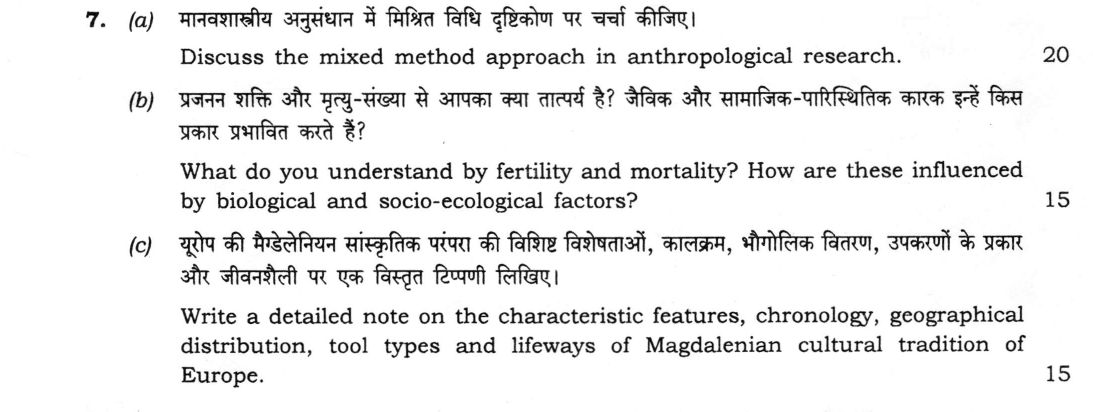
(a) Discuss the mixed method approach in anthropological research. (20 marks) (b) What do you understand by fertility and…
Discuss the mixed method approach in anthropological research. 20 marks
What do you understand by fertility and mortality? How are these influenced by biological and socio-ecological factors? 15 marks
Write a detailed note on the characteristic features, chronology, geographical distribution, tool types and lifeways of Magdalenian cultural tradition of Europe. 15 marks
हिंदी में प्रश्न पढ़ें
मानवशास्त्रीय अनुसंधान में मिश्रित विधि दृष्टिकोण पर चर्चा कीजिए। (20 अंक)
प्रजनन शक्ति और मृत्यु-संख्या से आपका क्या तात्पर्य है? जैविक और सामाजिक-पारिस्थितिक कारक इन्हें किस प्रकार प्रभावित करते हैं? (15 अंक)
यूरोप की मैग्डेलेनियन सांस्कृतिक परंपरा की विशिष्ट विशेषताओं, कालक्रम, भौगोलिक वितरण, उपकरणों के प्रकार और जीवनशैली पर एक विस्तृत टिप्पणी लिखिए। (15 अंक)
Model answer
Drafted with AI by UPSC Answer Check against this question's marking rubric, to the expected length. UPSC does not publish answers for Mains — this is one way to score well, not an official key. How we build rubrics and answers.
(a) The mixed method approach in anthropological research
Mixed method research is the planned integration of qualitative and quantitative data collection, analysis and inference within one study, so that each strand informs the other - not the mere co-presence of two data types. Its warrant is pragmatism: the research question, not the paradigm, dictates method. For anthropology it institutionalises the emic-etic complementarity - meaning from within, comparison from without.
Designs (Creswell and Plano Clark): convergent parallel; explanatory sequential (survey results then explored ethnographically); exploratory sequential (ethnography generates an instrument for testing); embedded, transformative and multiphase. Notation records priority and sequence - capitals for the dominant strand, '+' for concurrent, an arrow for sequential. Denzin (1970) distinguished data, investigator, theory and methodological triangulation.
Lineage: Malinowski's Argonauts of the Western Pacific (1922) demanded 'statistical documentation by concrete evidence' and synoptic charts alongside the imponderabilia of actual life; Boas combined anthropometry with recorded texts; Murdock's HRAF, Ethnographic Atlas and Standard Cross-Cultural Sample enabled statistical cross-cultural testing; the Whitings' Six Cultures study fused systematic behaviour observation with ethnography.
Toolkit: household census, genealogical method and structured schedules run with participant observation and key-informant interviews; free listing, pile sorting, ranking and cultural consensus analysis (Romney, Weller and Batchelder, 1986); social network analysis; PRA techniques after Robert Chambers - social mapping, wealth ranking, seasonal calendars, transect walks; anthropometry and dietary recall with focus groups and illness narratives; GIS.
Indian applications: the Anthropological Survey of India's People of India project; village ethnography read against NFHS, SRS and Census data; rapid assessment procedures in health and nutrition programmes.
Assessment: gains are completeness, corroboration, explanation of statistical outliers, testing of ethnographic insight, and policy credibility. Costs are time, funding and training; the paradigm-incompatibility objection; tension between small-n depth and representativeness; unequal weighting. The characteristic failure is the parallel monologue.
Integration must therefore be designed in, not added at write-up.
(b) Fertility, mortality and their determinants
Fertility is actual reproductive performance, measured in live births; fecundity is the capacity to reproduce, the gap being filled by social regulation. Mortality is the incidence of death; together they determine natural increase.
Measures: Fertility: crude birth rate per 1,000 population; general fertility rate per 1,000 women aged 15-49; age-specific fertility rates; total fertility rate, replacement level about 2.1; gross and net reproduction rates. Mortality: crude death rate; age-specific death rates; infant mortality per 1,000 live births; neonatal and under-five mortality; maternal mortality ratio per 100,000 live births; life expectancy at birth.
Biological determinants: age at menarche and menopause, hence reproductive span; fecundability; sub-fecundity and infertility; lactational amenorrhoea spacing births; maternal nutrition, body composition and parity; sperm quality; endocrine and genetic factors; pathogen load (the STI-driven African infertility belt). For mortality: congenital and genetic disorders, birth weight, immunity, infection and degenerative disease.
Socio-ecological determinants: Davis and Blake's intermediate variables (1956) and Bongaarts's proximate determinants (1978) channel most variation through proportion married, contraception, induced abortion and postpartum infecundability. Behind these lie age at marriage, female education and autonomy, son preference, caste and religion, occupation and urbanisation. Ecology matters: high-altitude hypoxia lowers birth weight, seasonal food stress affects conception, and sanitation, safe water and health-service access dominate infant survival.
Application: the demographic transition and Omran's epidemiological transition (1971) chart the historical fall in both. In India, SRS 2023 puts the total fertility rate at 1.9 (NFHS-6, 2023-24: 2.0) and infant mortality at 25 per 1,000 live births; PVTGs show higher infant mortality, the Great Andamanese collapsed, and sickle-cell disease depresses child survival in central Indian tribes.
Fertility and mortality are thus bio-social outcomes.
(c) The Magdalenian cultural tradition of Europe
The Magdalenian is the final Upper Palaeolithic culture of western Europe, named after the La Madeleine rockshelter in the Dordogne, excavated by Lartet and Christy and defined as a stage by de Mortillet.
Chronology: it follows the Solutrean and precedes the Azilian, roughly 17,000-12,000 BP (uncalibrated); Breuil's six stages (I-VI) remain the working framework.
Distribution: Franco-Cantabrian at core - Dordogne, Perigord and the French Pyrenees, with Cantabrian Spain and northern Portugal - extending to Switzerland (Kesslerloch), the German Rhineland (Gonnersdorf, Andernach), Belgium, Poland and Britain, where Creswell Crags marks the northern limit.
Tool types: a fully developed blade and bladelet industry from prismatic cores - backed bladelets for composite hafted tools, abundant burins including the distinctive parrot-beak burin, end scrapers on blades, borers, shouldered and tanged points, with increasing microlithisation late. The hallmark is the osseous industry: antler, bone and ivory at technical peak - barbed harpoons, uniserial then biserial (the biserial diagnostic of the final stages), bevelled-base sagaies, batons perces for shaft straightening, eyed needles, spear-throwers (the Mas d'Azil example).
Lifeways: reindeer-dominated hunting - Lartet and Christy's 'Age of the Reindeer' - with horse, bison, ibex and salmon. Eyed needles imply tailored sewn clothing; harpoons, systematic fishing. Settlement was seasonally mobile, combining rockshelters with open-air tented camps such as Pincevent, spatially analysed by Leroi-Gourhan, and Etiolles. Marine shell and fine flint moved long distances; formal burials occur. Art reached its Palaeolithic apogee: polychrome bison at Altamira, and Niaux, Font-de-Gaume, Les Trois Freres, the clay bison of Tuc d'Audoubert, plus rich mobiliary art on antler and plaquettes.
With Holocene warming the reindeer economy collapsed and the Magdalenian gave way to the Azilian and Mesolithic.
How this answer will be evaluated
Evaluation rubric
Each sub-part is marked on its own, against the marks and word limit printed on the paper.
- (a) The directive 'discuss' on mixed method approach in anthropological research requires definition, design typology, the anthropological lineage of the approach, the concrete techniques used, and a balanced assessment of strengths and difficulties. 20 marks
Must cover
- definition: planned integration of qualitative and quantitative strands; pragmatism
- Creswell and Plano Clark design typology - convergent, explanatory sequential, exploratory sequential, embedded
- Denzin (1970) and triangulation
- Malinowski, 'Argonauts of the Western Pacific' (1922), statistical documentation by concrete evidence
- HRAF, Ethnographic Atlas, Standard Cross-Cultural Sample (Murdock)
- free listing, pile sorting, cultural consensus analysis (Romney, Weller and Batchelder 1986)
- PRA/RRA techniques (Robert Chambers)
- emic and etic; risk of non-integration
Loses marks
- Writing a general essay on qualitative and quantitative methods separately, without ever addressing integration, which is the defining feature of the approach
- Omitting the design typology and notation, which is the most examinable technical content of the topic
- Failing to anchor the discussion in anthropology, so the answer reads as generic social science methodology
- Presenting mixed methods as automatically superior, with no discussion of the paradigm-incompatibility objection or the integration problem
- Naming no concrete technique, such as pile sorting, consensus analysis, wealth ranking or anthropometry with dietary recall
Earns more
- Traces the anthropological lineage: Malinowski's insistence in 'Argonauts of the Western Pacific' (1922) on the method of statistical documentation by concrete evidence and on synoptic charts alongside the imponderabilia of actual life; Boas combining anthropometric measurement with recorded texts; Murdock's Human Relations Area Files, Ethnographic Atlas and Standard Cross-Cultural Sample enabling statistical cross-cultural testing; and the Whitings' Six Cultures study of socialisation combining systematic behaviour observation with ethnography
- Gives Indian and applied illustrations: the Anthropological Survey of India's People of India project combining ethnographic profiles with biological and material-culture data; village ethnography read against NFHS, SRS and Census data; rapid assessment procedures and focused ethnographic studies used in public health and nutrition programmes; and evaluation studies of development interventions
- Assesses strengths and limitations: completeness and corroboration, the capacity of qualitative work to explain statistical outliers and of quantitative work to test the generalisability of ethnographic insight, greater credibility with policy audiences; against this the cost in time and training, the incompatibility-of-paradigms objection, the tension between small-n ethnographic depth and statistical representativeness, unequal weighting of the two strands, ethical complexity, and above all the risk of parallel monologues when integration is postponed to the writing-up stage instead of being designed in
Extra mark
- Standard references: H. Russell Bernard's 'Research Methods in Anthropology' or Tashakkori and Teddlie's 'Handbook of Mixed Methods'
- An Indian mixed-method classic such as T. Scarlett Epstein's 'Economic Development and Social Change in South India' (1962), combining household surveys with ethnography
- (b) Two parts: define fertility and mortality with their standard measures, and then explain how both are influenced by biological and by socio-ecological factors; the fertility-fecundity distinction is expected. 15 marks
Must cover
- fertility vs fecundity; mortality and morbidity
- CBR, GFR, ASFR, TFR, GRR, NRR
- CDR, IMR, neonatal and under-five mortality, MMR, life expectancy at birth
- replacement level fertility of about 2.1
- Davis and Blake (1956) intermediate variables; Bongaarts (1978) proximate determinants
- lactational amenorrhoea and birth spacing
- age at marriage, female education and autonomy, son preference
- demographic transition and Omran's epidemiological transition; Indian tribal demographic data
Loses marks
- Using fertility and fecundity interchangeably, which is the standard conceptual error on this topic
- Defining rates without their denominators - for example giving IMR without 'per thousand live births' or MMR without 'per hundred thousand live births'
- Listing social factors only, ignoring the biological determinants the question explicitly names
- Quoting outdated or invented Indian figures with false precision instead of citing a source and a range
- Omitting any analytic framework such as Davis and Blake or Bongaarts, leaving the answer as an unstructured list
Earns more
- Sets out socio-ecological determinants within recognised frameworks - Davis and Blake's (1956) intermediate variables and Bongaarts's (1978) proximate determinants, which reduce fertility variation largely to proportion married, contraceptive use, induced abortion and postpartum infecundability - and then the underlying social variables: age at marriage and legal minima, female education and autonomy, contraceptive availability, son preference and family size norms, religion and caste, occupation, income and urbanisation, family structure and the position of women, migration, and ecological factors such as high-altitude hypoxia affecting birth weight and fertility, seasonality of food supply, sanitation, safe water and access to health services
- Applies the analysis anthropologically: the demographic transition sequence and Omran's (1971) epidemiological transition; contrasts between tribal and non-tribal profiles in India, with higher infant and child mortality among particularly vulnerable tribal groups, the demographic decline of the Great Andamanese and the small size of the Onge and Jarawa populations, and the effect of haemoglobinopathies on child survival in central Indian tribes; and cites current national estimates with source - SRS 2023 total fertility rate 1.9 and infant mortality 25 per thousand live births, NFHS-6 (2023-24) total fertility rate 2.0
Extra mark
- Uses the latest figures correctly: SRS 2023 (TFR 1.9, IMR 25) and NFHS-6 2023-24 (TFR 2.0)
- Anthropological demography cases: Hutterite fertility as the natural-fertility benchmark, or !Kung birth spacing through lactation (Howell 1979; Konner and Worthman 1980)
- (c) Five heads are explicitly named for the Magdalenian: characteristic features, chronology, geographical distribution, tool types and lifeways. Each must be visible in the answer; omission of any one is directly penalised. 15 marks
Must cover
- La Madeleine rockshelter, Dordogne; Lartet and Christy; de Mortillet
- follows Solutrean, precedes Azilian; roughly 17,000-12,000 BP; Breuil's six stages
- Franco-Cantabrian distribution; Altamira; Creswell Crags; Gonnersdorf; Kesslerloch
- blades and bladelets, backed bladelets, burins including the parrot-beak burin, end scrapers, shouldered points
- barbed antler harpoons, uniserial and biserial; sagaies; baton perce; eyed needles; spear-thrower
- reindeer-dominated hunting, the 'Age of the Reindeer'
- Pincevent and Etiolles; Leroi-Gourhan
- cave art at Altamira, Niaux, Font-de-Gaume, Les Trois Freres
Loses marks
- Attributing the Venus figurines to the Magdalenian, when the well-known Venus statuettes such as Willendorf are Gravettian
- Misplacing the Magdalenian in the Upper Palaeolithic sequence, for example before the Solutrean or after the Mesolithic
- Describing the culture as a pure stone-tool industry and omitting the antler and bone work, which is precisely what distinguishes it
- Locating the culture outside Europe, or confusing it with the Aurignacian or Gravettian in its diagnostic tools
- Omitting lifeways or chronology, when the question explicitly lists five heads to be covered
Earns more
- Describes the osseous industry, the culture's hallmark: reindeer antler, bone and ivory working at its technical peak, including barbed harpoons - uniserial and then biserial, the biserial form being diagnostic of the final stages - bevelled-base antler sagaies or spear points, batons perces or perforated batons used in shaft straightening, eyed needles indicating sewn clothing, spear-throwers such as the well-known Mas d'Azil example, awls, fish gorges and decorated rods
- Covers art and lifeways: the apogee of Franco-Cantabrian cave art, with the polychrome bison ceiling of Altamira, Niaux, Font-de-Gaume, Les Trois Freres, Rouffignac and the clay bison of Tuc d'Audoubert, alongside abundant mobiliary art on engraved antler, spear-throwers and stone plaquettes, with Lascaux at the Solutrean to early Magdalenian transition; subsistence dominated by reindeer hunting, which led Lartet and Christy to speak of an Age of the Reindeer, supplemented by horse, bison, ibex and by salmon and freshwater fishing evidenced by harpoons; seasonal mobility between base camps and specialised kill sites, occupation of rockshelters and of open-air tented settlements such as Pincevent, directed and spatially analysed by Leroi-Gourhan, and Etiolles; sewn tailored clothing, long-distance movement of marine shell and good-quality flint, and formal burials
Extra mark
- Regional contemporaries or offshoots such as the Hamburgian and the Creswellian
- Calibrated age of roughly 19,000-14,000 years ago, linked to recolonisation of western Europe after the Last Glacial Maximum
What "Discuss" is asking you to do
Lay the issue out from more than one side — how it arose, what is claimed for it, what is held against it, and where it now stands. UPSC attaches discuss to broad topics with several live dimensions, so coverage of the dimensions earns more than the strength of your opinion.
Structure that answers it
Set the issue up → the case as it is made → the case against → the dimension both sides leave out → where the balance now lies
Where marks are lost
Listing facts with no thread between them, or arguing one side throughout and calling it a discussion.
Practice this exact question
Write your answer and it is marked point by point against the model answer above — what you covered, what you missed, what you got wrong.
Evaluate my answer →More from Anthropology 2026 Paper I
- Q4 (a) Discuss the phylogenetic status, characteristic features, geographical distribution a…
- Q5 Write notes on the following in about 150 words each : (a) Ethics in anthropological fiel…
- Q6 (a) How would you find out that a particular disease/disorder is inherited and, if so, in…
- Q7 (a) Discuss the mixed method approach in anthropological research. (20 marks) (b) What do…
- Q8 (a) Compare Edmund Leach's structuralism with interpretive anthropology of Clifford Geert…