Paper I — Q8
(a) Compare Edmund Leach's structuralism with interpretive anthropology of Clifford Geertz. (20 marks) (b) In what manner is our…
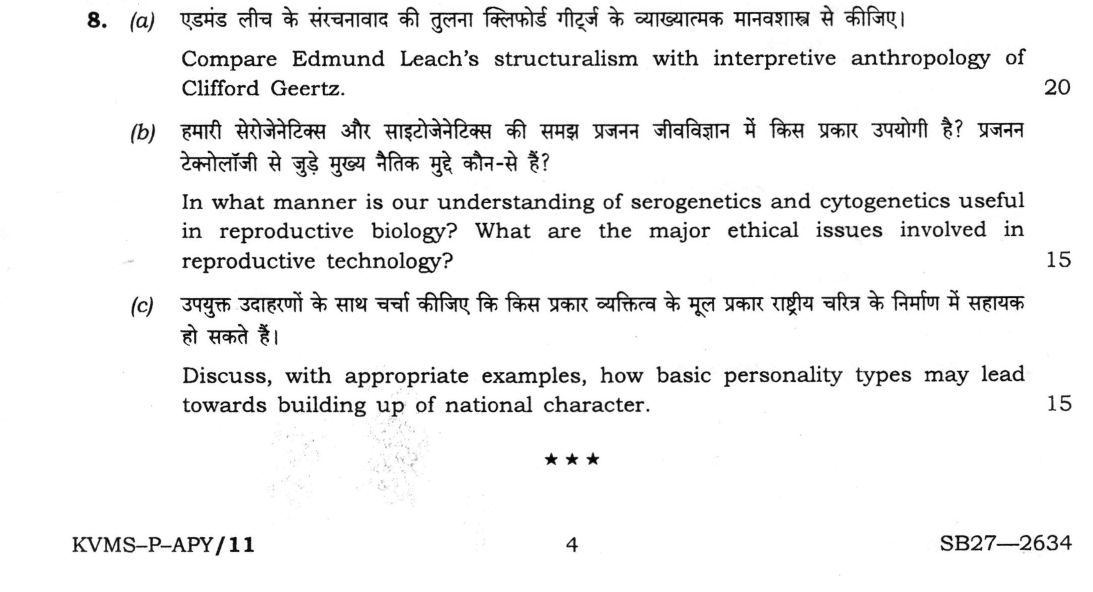
Compare Edmund Leach's structuralism with interpretive anthropology of Clifford Geertz. 20 marks
In what manner is our understanding of serogenetics and cytogenetics useful in reproductive biology? What are the major ethical issues involved in reproductive technology? 15 marks
Discuss, with appropriate examples, how basic personality types may lead towards building up of national character. 15 marks
हिंदी में प्रश्न पढ़ें
एडमंड लीच के संरचनावाद की तुलना क्लिफोर्ड गीर्ट्ज़ के व्याख्यात्मक मानवशास्त्र से कीजिए। (20 अंक)
हमारी सीरोजेनेटिक्स और साइटोजेनेटिक्स की समझ प्रजनन जीवविज्ञान में किस प्रकार उपयोगी है? प्रजनन टेक्नोलॉजी से जुड़े मुख्य नैतिक मुद्दे कौन-से हैं? (15 अंक)
उपयुक्त उदाहरणों के साथ चर्चा कीजिए कि किस प्रकार व्यक्तित्व के मूल प्रकार राष्ट्रीय चरित्र के निर्माण में सहायक हो सकते हैं। (15 अंक)
Model answer
Drafted with AI by UPSC Answer Check against this question's marking rubric, to the expected length. UPSC does not publish answers for Mains — this is one way to score well, not an official key. How we build rubrics and answers.
(a) Leach's structuralism and Geertz's interpretive anthropology
Both moved anthropology beyond functionalism in opposite directions: Leach towards the structures behind social forms, Geertz towards the meanings actors themselves construct.
Leach (1910-1989), trained under Malinowski at the LSE, used structuralism in a sceptical, empiricist British form. Political Systems of Highland Burma (1954) showed the Kachin oscillating between egalitarian gumlao and hierarchical gumsa - alternating configurations of one system, not two tribes - structure being a model in people's minds, not a stable equilibrium. Pul Eliya (1961) set ecology and land tenure above kinship ideology. Rethinking Anthropology (1961) dismissed typological comparison as 'butterfly collecting' and urged generalising models. Genesis as Myth (1969) and Culture and Communication (1976) read myth and ritual as codes of binary oppositions: culture as a communication system.
Geertz (1926-2006), of Chicago and Princeton, founded interpretive anthropology. The Interpretation of Cultures (1973) begins from the semiotic premise that man is suspended in 'webs of significance' he himself has spun; analysis is therefore interpretive, not experimental. Thick description, from Gilbert Ryle, separates a twitch from a wink from a parody of a wink. Deep Play (1972) reads the Balinese cockfight as a text, a story the Balinese tell themselves about themselves; Religion as a Cultural System (1966) defines religion as symbols fusing ethos and worldview; Islam Observed (1968), Negara (1980) and Local Knowledge (1983) extend it.
Comparison (Leach / Geertz):
- Culture: a code to be decoded / a text to be read.
- Meaning: unconscious structures / public symbols and local knowledge.
- Method: formal binary models / hermeneutic thick description.
- Aim: explanation and generalisation / interpretation, Weberian verstehen.
- Actor: marginal / central.
- Epistemic status: nomothetic / idiographic.
- Validation: fit of the model / never conclusively verifiable.
Convergences: both reject Radcliffe-Brownian functionalism and treat culture semiotically, drawing respectively on Saussure and Jakobson, and on Ryle and Ricoeur.
Critiques: Leach for imposing the analyst's model and structuralist-empiricist inconsistency; Geertz for unfalsifiability, ethnographic authority and neglect of power and history - Crapanzano, Writing Culture (1986), Asad.
Two post-functionalist options, then: decode the structure, or read the meaning.
(b) Serogenetics, cytogenetics and reproductive technology
Serogenetics studies inherited blood group and serum protein polymorphisms - ABO, Rh, MNSs, Duffy, Kell, HLA, haptoglobin. Cytogenetics studies chromosome number and structure by karyotyping with banding, FISH and microarray.
Serogenetics: the central reproductive problem is Rh incompatibility - an Rh-negative mother carrying an Rh-positive fetus may be sensitised, so later pregnancies risk haemolytic disease of the newborn (erythroblastosis fetalis); anti-D immunoglobulin, given antenatally and postpartum, largely prevents it. ABO incompatibility (O-group mother, A or B fetus) is milder. HLA governs maternal-fetal tolerance; HLA sharing between spouses has been linked to recurrent abortion, though the association is disputed. Blood grouping is essential for obstetric haemorrhage; blood groups once served in disputed paternity, now superseded by DNA profiling.
Cytogenetics: parental balanced reciprocal or Robertsonian translocations and inversions cause recurrent pregnancy loss and unbalanced offspring. Chromosomal infertility includes Turner syndrome (45,X, streak gonads, primary amenorrhoea), Klinefelter (47,XXY, azoospermia), Y-chromosome AZF microdeletions, SRY translocation, and fragile X premutation with premature ovarian insufficiency. Amniocentesis, chorionic villus sampling, NIPT and preimplantation genetic testing identify risk early and feed genetic counselling.
Ethics: sex determination and sex-selective abortion, barred in India by the PCPNDT Act 1994 (amended 2003); clinic and surrogacy regulation under the ART (Regulation) and Surrogacy (Regulation) Acts, 2021, permitting only altruistic surrogacy; commodification and exploitation of poor surrogates and gamete donors; status and disposal of surplus embryos; donor anonymity against the child's right to genetic origins; germline editing and designer babies after He Jiankui (2018); non-medical trait selection and saviour siblings; equity of access and cost; ovarian hyperstimulation syndrome and multiple pregnancy; genetic privacy and insurance discrimination.
Genetic knowledge widens reproductive choice; regulation keeps that choice from becoming coercion.
(c) Basic personality and national character
The Culture and Personality school held that shared child-rearing produces a shared personality configuration - which, extended to a whole society, becomes 'national character'.
Basic personality structure: Abram Kardiner, with Ralph Linton and Cora Du Bois (The Individual and His Society, 1939; The Psychological Frontiers of Society, 1945), argued that primary institutions - feeding, weaning, discipline, family form, subsistence - mould a personality core shared by most members, projected outward into secondary institutions: religion, myth, folklore, art.
Refinement: Du Bois's The People of Alor (1944) replaced assumed uniformity with modal personality - the statistically most frequent type, from Rorschach and TAT. Benedict's Patterns of Culture (1934) drew cultures as personalities writ large (Apollonian Zuni, Dionysian Kwakiutl); Mead's Sex and Temperament (1935) showed temperament culturally patterned. Inkeles and Levinson (1954) defined national character as a society's modal adult personality.
National character studies: the wartime 'culture at a distance' method used emigres, internees, films and documents. Benedict's The Chrysanthemum and the Sword (1946) read Japan through on and giri, contrasting shame with guilt culture; Mead's And Keep Your Powder Dry (1942) treated America; Gorer and Rickman (1949) offered the swaddling hypothesis for Russia.
India: Carstairs's The Twice-Born (1957) on high-caste Rajasthani personality; Erikson's Gandhi's Truth (1969); Kakar's The Inner World (1978) on prolonged maternal indulgence within the extended family.
Critique: small, skewed samples; contested validity of projective tests; circular inference; reification of nations divided by class, caste, region and gender; political commissioning. Wallace answered the 'replication of uniformity' with the 'organization of diversity'; Freeman's 1983 attack on Mead's Samoa deepened scepticism.
Coherent but empirically fragile, it survives only in modified statistical form (Hofstede-type dimensions).
How this answer will be evaluated
Evaluation rubric
Each sub-part is marked on its own, against the marks and word limit printed on the paper.
- (a) An explicitly comparative question: Leach's structuralism must be set against Geertz's interpretive anthropology. Both positions must be expounded with their key works and then compared along stated axes; a two-part answer with no actual comparison loses heavily. 20 marks
Must cover
- Edmund Leach, 'Political Systems of Highland Burma' (1954), Kachin gumsa and gumlao oscillation
- 'Rethinking Anthropology' (1961); 'Pul Eliya' (1961); 'Culture and Communication' (1976)
- Clifford Geertz, 'The Interpretation of Cultures' (1973), thick description, Gilbert Ryle
- culture as webs of significance; 'Deep Play: Notes on the Balinese Cockfight' (1972)
- 'Religion as a Cultural System' (1966), ethos and worldview
- binary oppositions and structural models versus hermeneutic interpretation
- nomothetic versus idiographic; explanation versus understanding
- critiques: Crapanzano, 'Writing Culture' (Clifford and Marcus 1986), Talal Asad
Loses marks
- Writing about Levi-Strauss instead of Leach, so the specifically British and sceptical character of Leach's structuralism is lost
- Describing the two scholars in separate blocks with no comparative axes, when the directive is 'compare'
- Attributing thick description to Geertz alone without acknowledging Gilbert Ryle, or misdescribing it as merely detailed description rather than layered interpretation of meaning
- Getting the Kachin material wrong - for example treating gumsa and gumlao as two separate tribes rather than as alternating political configurations of one system
- Offering no critique of either position, which flattens the answer into summary
Earns more
- Places both figures accurately: Edmund Leach (1910-1989), British social anthropologist trained under Malinowski and Firth at the LSE and later at Cambridge, who adopted Levi-Straussian structuralism in a sceptical, empiricist British form; and Clifford Geertz (1926-2006), American, at Chicago and then the Institute for Advanced Study at Princeton, the founder of interpretive or symbolic anthropology
- Notes convergences: both broke with Radcliffe-Brownian functionalism and its natural-science-of-society ambition; both treat culture semiotically as sign systems rather than as institutions meeting needs; both draw on outside disciplines - Saussure and Jakobson behind Leach, Ryle, Ricoeur and Kenneth Burke behind Geertz; and both privilege meaning over function, though they locate it differently
- Offers critiques of each: Leach has been charged with imposing the analyst's model on the data, with formalism and with theoretical inconsistency between his structuralist and empiricist commitments; Geertz has been criticised for unfalsifiability, for the unexamined authority of the ethnographer's voice, and for neglecting power and history - by Vincent Crapanzano in 'Hermes' Dilemma', by Clifford and Marcus in 'Writing Culture' (1986), and by Talal Asad, whose critique of the definition of religion as a cultural system stresses power and historical process
Extra mark
- Late statements of each position, such as Leach's 'Social Anthropology' (1982) or Geertz's 'Anti Anti-Relativism' (1984)
- Adam Kuper's 'Culture: The Anthropologists' Account' (1999) as a critical overview of Geertz
- (b) Two distinct questions: the usefulness of serogenetics and cytogenetics in reproductive biology, and the major ethical issues in reproductive technology. Roughly two thirds of the answer belongs to the first and one third to the second; neither may be dropped. 15 marks
Must cover
- ABO, Rh, MN, Duffy, Kell, HLA as serogenetic markers
- Rh incompatibility, haemolytic disease of the newborn, anti-D immunoglobulin prophylaxis
- karyotyping, banding, FISH; balanced and Robertsonian translocations in recurrent pregnancy loss
- Turner 45,X and Klinefelter 47,XXY as chromosomal causes of infertility; Y chromosome AZF microdeletions
- amniocentesis, chorionic villus sampling, NIPT, preimplantation genetic testing
- PCPNDT Act 1994 (amended 2003)
- ART (Regulation) Act 2021 and Surrogacy (Regulation) Act 2021
- commodification and exploitation of surrogates; embryo status; germline editing and He Jiankui (2018)
Loses marks
- Answering only the ethics half, which is the shorter part, and neglecting the substantial genetics the question asks for first
- Reversing Rh incompatibility - describing an Rh-positive mother and Rh-negative fetus instead of the reverse
- Confusing serogenetics with serology in general, or with immunology unrelated to reproduction
- Omitting the Indian statutory framework, when PCPNDT and the 2021 ART and Surrogacy Acts are directly relevant and examinable
- Listing ethical issues as slogans - commodification, playing God - without specifying the technology and the harm involved
Earns more
- Explains the Rh sensitisation mechanism across pregnancies and anti-D immunoglobulin prophylaxis, with ABO incompatibility as the milder form and HLA sharing in recurrent abortion flagged as contested
- Names cytogenetic causes of infertility and recurrent pregnancy loss - balanced reciprocal and Robertsonian translocations, Turner and Klinefelter syndromes, Y-chromosome AZF microdeletions - and the prenatal and preimplantation tests that detect them
- Specifies each ethical issue with its technology and harm - sex selection, exploitation of surrogates and gamete donors, embryo status, donor anonymity, germline editing - and cites the Indian statutes (PCPNDT Act; ART and Surrogacy Acts, 2021)
Extra mark
- Surrogacy (Regulation) Amendment Rules, 2024 permitting one donor gamete where a District Medical Board certifies a medical need
- Indian haemoglobinopathy context: prenatal diagnosis for sickle cell and thalassaemia in high-carrier communities
- (c) The question asks how basic personality types may lead to the building up of national character, with appropriate examples. It requires the Culture and Personality apparatus - basic personality structure and modal personality - to be connected explicitly to the national character studies, and a critical assessment of that move. 15 marks
Must cover
- Abram Kardiner; primary and secondary institutions; basic personality structure
- Ralph Linton; Cora Du Bois, 'The People of Alor' (1944); modal personality; Rorschach and TAT
- Ruth Benedict, 'Patterns of Culture' (1934); Apollonian Zuni and Dionysian Kwakiutl
- Ruth Benedict, 'The Chrysanthemum and the Sword' (1946); shame versus guilt culture; on and giri
- culture at a distance; Mead and Metraux (1953); Gorer's swaddling hypothesis
- Inkeles and Levinson (1954), national character as modal personality
- Carstairs, 'The Twice-Born' (1957); Sudhir Kakar, 'The Inner World' (1978)
- critiques: circularity, projective test validity, stereotyping; Wallace's organization of diversity; Freeman on Mead
Loses marks
- Confusing basic personality structure with modal personality - the first is a postulated shared core, the second a statistically most frequent type - and attributing both to the same author
- Attributing basic personality structure to Benedict or Mead rather than to Kardiner
- Describing national character studies uncritically, as if national personalities were established facts
- Giving no example of a national character study at all, although the question asks for appropriate examples
- Using no Indian material, when Carstairs and Kakar are the obvious and expected illustrations
Earns more
- Gives Indian illustrations: G. M. Carstairs's 'The Twice-Born' (1957), a psychoanalytic study of high-caste personality in a Rajasthan community; Erik Erikson's 'Childhood and Society' (1950) on identity and his later 'Gandhi's Truth' (1969); and Sudhir Kakar's 'The Inner World' (1978) on Indian child-rearing, the extended family, the mother-son bond and the cultural shaping of the Indian psyche
- Delivers the critical evaluation: samples were small and unrepresentative, often drawn from emigres, prisoners of war and internees; projective tests such as the Rorschach and TAT have contested cross-cultural validity; the reasoning is circular when personality is inferred from culture and then used to explain that same culture; the approach reifies and stereotypes whole nations, ignoring class, caste, region, gender and generational variation; it was politically commissioned and open to propagandistic misuse; Anthony Wallace countered the replication of uniformity fallacy with the organization of diversity; Derek Freeman's 1983 critique of Mead's Samoan work damaged confidence in the school's methods; and the modern successor is cross-cultural psychology and values research of the Hofstede type, which works with distributions and dimensions rather than national personalities
Extra mark
- Francis Hsu's 'Clan, Caste and Club' (1963) comparing Chinese, Hindu and American personality
- Hofstede's cultural dimensions ('Culture's Consequences', 1980) as the statistical successor
What "Compare" is asking you to do
Set the items against each other on named dimensions. In UPSC practice compare already carries both halves — likeness and difference — and where the stem names the dimensions, as in region, nature and climatic impact, those are the headings the examiner expects to see.
Structure that answers it
Dimensions named → both items on dimension 1 → dimension 2 → dimension 3 → where they converge and where they part
Where marks are lost
Two self-contained descriptive blocks with the comparison left for the reader to make. Marks here sit on the dimensions, so an answer that names none of them gives the examiner nothing to award.
Practice this exact question
Write your answer and it is marked point by point against the model answer above — what you covered, what you missed, what you got wrong.
Evaluate my answer →More from Anthropology 2026 Paper I
- Q5 Write notes on the following in about 150 words each : (a) Ethics in anthropological fiel…
- Q6 (a) How would you find out that a particular disease/disorder is inherited and, if so, in…
- Q7 (a) Discuss the mixed method approach in anthropological research. (20 marks) (b) What do…
- Q8 (a) Compare Edmund Leach's structuralism with interpretive anthropology of Clifford Geert…