Paper I — Q6
(a) How would you find out that a particular disease/disorder is inherited and, if so, in which manner? Elaborate with suitable…
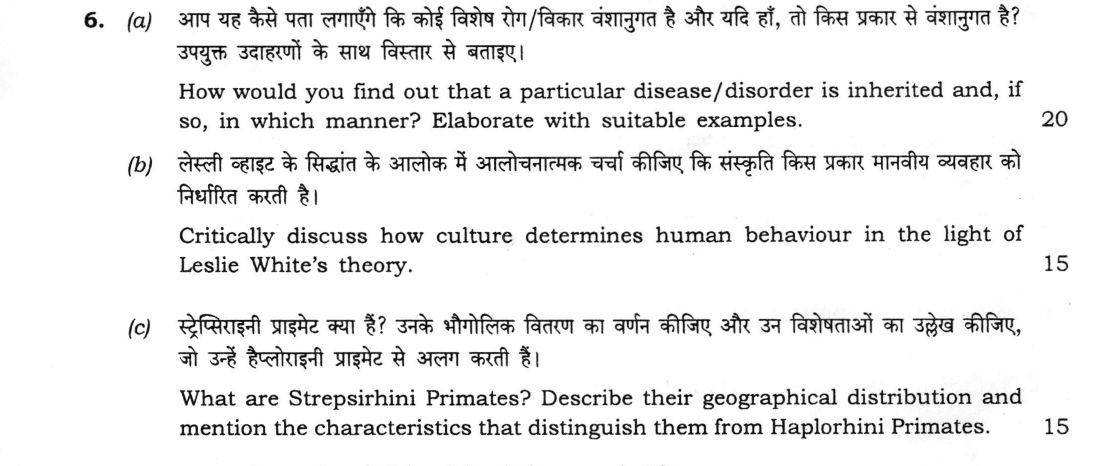
How would you find out that a particular disease/disorder is inherited and, if so, in which manner? Elaborate with suitable examples. 20 marks
Critically discuss how culture determines human behaviour in the light of Leslie White's theory. 15 marks
What are Strepsirhini Primates? Describe their geographical distribution and mention the characteristics that distinguish them from Haplorhini Primates. 15 marks
हिंदी में प्रश्न पढ़ें
आप यह कैसे पता लगाएँगे कि कोई विशेष रोग/विकार वंशानुगत है और यदि हाँ, तो किस प्रकार से वंशानुगत है? उपयुक्त उदाहरणों के साथ विस्तार से बताइए। (20 अंक)
लेस्ली व्हाइट के सिद्धांत के आलोक में आलोचनात्मक चर्चा कीजिए कि संस्कृति किस प्रकार मानवीय व्यवहार को निर्धारित करती है। (15 अंक)
स्ट्रेप्सिरहीनी प्राइमेट क्या हैं? उनके भौगोलिक वितरण का वर्णन कीजिए और उन विशेषताओं का उल्लेख कीजिए, जो उन्हें हैप्लोरहीनी प्राइमेट से अलग करती हैं। (15 अंक)
Model answer
Drafted with AI by UPSC Answer Check against this question's marking rubric, to the expected length. UPSC does not publish answers for Mains — this is one way to score well, not an official key. How we build rubrics and answers.
(a) Establishing inheritance and its mode
Heritability is established stepwise: family observation, statistical genetics, molecular confirmation.
A. Is it inherited?
- Pedigree analysis from the proband with standard symbols; segregation analysis tests Mendelian proportions.
- Familial aggregation: recurrence-risk ratio versus population prevalence.
- Twin studies: higher monozygotic than dizygotic concordance indicates a genetic component; twins reared apart separate genes from environment.
- Adoption/foster studies: biological versus rearing parents.
- Raised parental consanguinity suggests autosomal recessive inheritance.
- Differential prevalence across populations/ethnic groups.
- Confirmation: linkage analysis with LOD scores (≥ 3 significant, Morton 1955); association studies/GWAS for complex traits; candidate-gene and exome sequencing; karyotyping, FISH, chromosomal microarray for suspected chromosomal causes; enzyme assays for metabolic disorders.
B. In which manner? Autosomal dominant: vertical transmission every generation, each affected has an affected parent, both sexes equally, male-to-male transmission possible, 50 per cent recurrence risk; incomplete penetrance, variable expressivity, late onset: Huntington disease (HTT CAG expansion, chromosome 4), achondroplasia (FGFR3), Marfan syndrome (FBN1), familial hypercholesterolaemia. Autosomal recessive: skips generations, affected children born to two carrier parents, both sexes, 25 per cent recurrence risk, two-thirds of unaffected sibs carriers, consanguinity raised: sickle-cell anaemia (HBB codon 6 Glu-to-Val), beta-thalassaemia, phenylketonuria, cystic fibrosis (CFTR), Tay-Sachs. X-linked recessive: mostly affected males via carrier mothers, never father-to-son, criss-cross maternal grandfather to grandson: haemophilia (the royal haemophilia of Queen Victoria's descendants, identified as haemophilia B), Duchenne muscular dystrophy, red-green colour blindness, G6PD deficiency. X-linked dominant: affected father transmits to all daughters, no sons: vitamin D-resistant rickets, Rett syndrome; Y-linked (holandric): father to all sons. Mitochondrial: affected mothers transmit to all children, fathers never: LHON, MELAS; heteroplasmy varies expression. Non-Mendelian: multifactorial liability-threshold traits use empirical risks (type 2 diabetes, hypertension, cleft lip and palate, neural tube defects); imprinting (Prader-Willi/Angelman, 15q11-13, parental origin); anticipation in repeat disorders (fragile X, myotonic dystrophy).
Pedigree evidence yields the pattern, molecular work the locus; both feed genetic counselling, carrier screening and prenatal diagnosis.
(b) Leslie White: culture as the determinant of behaviour
Leslie A. White revived cultural evolutionism against Boasian historical particularism, in The Symbol (1940), The Science of Culture (1949) and The Evolution of Culture (1959), popularising 'culturology'.
Position: his starting point is symboling - the uniquely human capacity to assign arbitrary meaning - which makes culture possible. Culture is therefore extrasomatic, superorganic and sui generis: an order that flows on its own terms, using individuals as carriers. Hence culturology: culture is explained by culture, not by psychology or biology, and behaviour is determined by the tradition into which one is born.
Motor of evolution: White's Law states that culture advances as the energy harnessed per capita per year increases, or as the efficiency of the technological means of using it improves - C = E x T giving stages from human muscle, through domestication of plants and animals, to the fuel revolution and nuclear power.
Structure: culture comprises technological, sociological and ideological subsystems, the technological determining the other two - close to Marx's base and superstructure. This universal evolution of culture-as-a-whole contrasted with Steward's multilinear evolution; Sahlins and Service (1960) later reconciled the two as general and specific evolution.
Critique: the theory buys explanatory power by abolishing the individual - no agency, creativity or resistance. Energy per capita is crude and hard to measure, and cannot explain kinship, art or religion. Ideology is left epiphenomenal despite symboling being his own foundation. Diffusion, historical contingency and intra-cultural variation drop out, and a teleological residue of unilinear evolutionism persists. Geertz answered with interpretive meaning, Bourdieu and Ortner with practice and agency, Sahlins (Culture and Practical Reason) with the irreducibility of cultural reason to utility.
White nonetheless restored an evolutionary, materialist, scientific frame to anthropology - at the price of the acting person.
(c) Strepsirhini: distribution and contrast with Haplorhini
Modern primate taxonomy divides the order into Strepsirhini ('curved nose') and Haplorhini ('simple nose'), replacing the older grade division of Prosimii and Anthropoidea, because tarsiers share derived characters with monkeys and apes. Strepsirhini comprises Lemuriformes - the Malagasy lemurs (Lemuridae, Indriidae, Cheirogaleidae, Lepilemuridae, and the aye-aye, Daubentoniidae) - and Lorisiformes (Lorisidae: slender loris, slow loris, potto, angwantibo; Galagidae: bushbabies).
Distribution: lemurs are endemic to Madagascar and the Comoros; galagos and pottos occur across sub-Saharan Africa; lorises range through South and Southeast Asia. In India the grey slender loris (Loris lydekkerianus) occupies the peninsula and the Bengal slow loris (Nycticebus bengalensis) the north-east; the red slender loris (Loris tardigradus) is Sri Lankan. The suborder is absent from the Americas.
Diagnostic characters: moist naked rhinarium with the upper lip tethered by a philtrum and strong olfactory dependence; relatively long snout; postorbital bar without postorbital closure; unfused mandibular symphysis and frontal suture; a dental toothcomb of procumbent lower incisors and canines used in grooming; grooming claw on the second digit; tapetum lucidum, matching largely nocturnal habits (ring-tailed lemurs, sifakas and indris are diurnal); dental formula generally 2.1.3.3, the aye-aye excepted; epitheliochorial diffuse placenta, frequent twinning and nesting; retained ability to synthesise vitamin C.
Contrast with Haplorhini: dry hairy nose with free mobile upper lip and reduced olfaction; postorbital closure (complete in anthropoids, partial in tarsiers); fused symphysis and frontal bone; no toothcomb; retinal fovea for acute vision; haemochorial placenta; longer gestation with single, slowly developing young; larger relative brain. Tarsiers, despite the prosimian grade, are haplorhines.
Strepsirhines thus retain an olfaction-dependent, largely nocturnal grade - and many, above all Madagascar's lemurs, are now critically endangered.
How this answer will be evaluated
Evaluation rubric
Each sub-part is marked on its own, against the marks and word limit printed on the paper.
- (a) Two linked demands: the methods by which one establishes that a disorder is genetically determined, and then the identification of its mode of inheritance, each illustrated with named disorders - first whether it is inherited, then in what manner. 20 marks
Must cover
- pedigree analysis, proband, segregation analysis
- twin concordance (MZ vs DZ) and heritability; adoption studies
- consanguinity as evidence of autosomal recessive inheritance
- linkage analysis and LOD score; GWAS
- Huntington disease, achondroplasia, Marfan syndrome (autosomal dominant)
- sickle-cell anaemia, beta-thalassaemia, phenylketonuria, cystic fibrosis (autosomal recessive)
- haemophilia (A and B), Duchenne muscular dystrophy, colour blindness, G6PD deficiency (X-linked recessive)
- mitochondrial inheritance - LHON or MELAS; multifactorial threshold traits; imprinting (Prader-Willi and Angelman)
Loses marks
- Listing modes of inheritance only, and never answering the first half of the question about how one establishes that a disorder is inherited at all
- Omitting twin and adoption studies, which are the classic anthropological tools for separating heredity from environment
- Assigning disorders to the wrong mode - most often calling haemophilia autosomal, or sickle-cell dominant
- Claiming male-to-male transmission for an X-linked recessive trait, which is the defining impossibility of that pattern
- Ignoring multifactorial inheritance, so that common disorders such as diabetes and hypertension are forced into Mendelian categories
Earns more
- Describes molecular and cytogenetic confirmation: linkage analysis with LOD scores, where a score of 3 or more is conventionally taken as significant following Morton (1955); association studies and genome-wide association studies for complex traits; candidate gene testing and exome or whole-genome sequencing; karyotyping, banding, FISH and chromosomal microarray where a chromosomal cause is suspected; and biochemical or enzyme assays for metabolic disorders
- Sex-linked and mitochondrial patterns: X-linked recessive inheritance with predominantly affected males, carrier mothers, absence of male-to-male transmission and criss-cross inheritance from maternal grandfather to grandson, illustrated by haemophilia (the royal haemophilia of Queen Victoria's descendants, identified in 2009 as haemophilia B), Duchenne muscular dystrophy, red-green colour blindness and G6PD deficiency; X-linked dominant inheritance in which an affected father transmits to all daughters and no sons, illustrated by vitamin D-resistant hypophosphataemic rickets and Rett syndrome; Y-linked or holandric transmission from father to all sons; and mitochondrial inheritance in which an affected mother transmits to all her children while affected fathers do not transmit, illustrated by Leber's hereditary optic neuropathy and MELAS
- Non-Mendelian complications and application: multifactorial and polygenic inheritance with a liability-threshold model, seen in type 2 diabetes, hypertension, coronary artery disease, cleft lip and palate and neural tube defects, where empirical rather than Mendelian recurrence risks are used; genomic imprinting, with Prader-Willi and Angelman syndromes arising from the same 15q11-13 region according to parental origin; anticipation in trinucleotide repeat disorders such as fragile X from FMR1 CGG expansion and myotonic dystrophy; and the use of all this in genetic counselling, carrier screening and prenatal diagnosis
Extra mark
- Indian relevance: high sickle-cell and beta-thalassaemia carrier frequencies in tribal and some caste populations, and the National Sickle Cell Anaemia Elimination Mission (2023)
- South Indian uncle-niece and cross-cousin marriage cited as raising the frequency of autosomal recessive disorders
- (b) The directive is 'critically discuss', anchored to Leslie White's theory. The answer must expound White's account of culture as a determinant of human behaviour and then evaluate it - a purely expository answer forfeits the critical marks. 15 marks
Must cover
- Leslie A. White; 'The Science of Culture' (1949); 'The Evolution of Culture' (1959)
- culturology; culture as superorganic and sui generis
- symboling; 'The Symbol' (1940)
- White's Law: energy harnessed per capita per year x efficiency of technology
- technological, sociological and ideological subsystems; technological determinism
- general evolution vs Steward's multilinear evolution
- critique: absence of agency, crudeness of energy measure, neglect of meaning and history
- counter-positions: Geertz, Bourdieu, Sahlins
Loses marks
- Confusing Leslie White with Julian Steward, or attributing multilinear evolution to White
- Reproducing White's Law inaccurately - for example as energy alone, omitting the efficiency of the technological means
- Writing a general essay on neo-evolutionism without engaging White's specific claim that culture determines behaviour
- Giving no critique at all, when the directive is explicitly 'critically discuss'
- Confusing White's cultural determinism with the Culture and Personality school's version in Benedict and Mead, which concerns personality formation rather than the superorganic
Earns more
- Sets out the three-subsystem model and technological determinism: culture comprises technological, sociological and ideological subsystems, with the technological as the primary and determining base on which social organisation and then ideology rest; and contrasts White's universal evolution of culture as a whole with Julian Steward's multilinear evolution of particular adaptive sequences
- Delivers the critical evaluation: the theory is reductionist and deterministic, leaving no room for individual agency, creativity or resistance; energy per capita is a crude and difficult measure that cannot capture cultural complexity; ideology, meaning and symbolism are subordinated to technology despite White's own emphasis on symboling; diffusion, historical contingency and intra-cultural variation are neglected; and the scheme retains a teleological residue from nineteenth-century unilinear evolutionism; the counter-positions of Geertz's interpretive anthropology, Bourdieu's practice theory, Ortner's emphasis on agency and Sahlins's 'Culture and Practical Reason' should be invoked, as should the parallel with Marx's base and superstructure
Extra mark
- Sahlins and Service's 'Evolution and Culture' (1960) reconciling the two as general and specific evolution
- Kroeber's 'The Superorganic' (1917) as precursor, or Marvin Harris's cultural materialism as successor
- (c) Three explicit demands: define Strepsirhini, describe their geographical distribution, and state the characters distinguishing them from Haplorhini. All three must appear; the contrast with Haplorhini is separately marked and is the commonest omission. 15 marks
Must cover
- Strepsirhini vs Haplorhini; replacement of the Prosimii-Anthropoidea grade division
- Lemuriformes and Lorisiformes
- Madagascar endemism of lemurs; sub-Saharan Africa for galagos and pottos
- Loris lydekkerianus in peninsular India; Nycticebus bengalensis in north-east India
- rhinarium, toothcomb, grooming claw, tapetum lucidum, postorbital bar without closure
- unfused mandibular symphysis and frontal suture
- haplorhine features: dry nose, postorbital closure, fovea, haemochorial placenta
- tarsiers are haplorhines despite the prosimian grade
Loses marks
- Equating Strepsirhini with Prosimii and therefore including tarsiers, which is the single most penalised error on this question
- Placing lemurs in mainland Africa or in Asia rather than recognising their endemism to Madagascar and the Comoros
- Describing only the strepsirhines and never stating the distinguishing haplorhine characters, although the question asks for them
- Confusing the postorbital bar, which strepsirhines possess, with postorbital closure, which they lack
- Omitting Indian species, although the slender loris and Bengal slow loris are the obvious home examples
Earns more
- Gives the composition of the suborder: the Malagasy lemurs including Lemuridae such as the ring-tailed lemur, Indriidae such as the indri and sifakas, Cheirogaleidae such as the mouse and dwarf lemurs, Lepilemuridae, and the aye-aye in Daubentoniidae; and the lorisiforms comprising Lorisidae - slender loris, slow loris, potto and angwantibo - and Galagidae, the bushbabies or galagos
- Draws the contrast with Haplorhini: a dry hairy nose with a free mobile upper lip and reduced olfaction; postorbital closure by a bony plate, complete in anthropoids and partial in tarsiers; fused mandibular symphysis and fused frontal bone; loss of the toothcomb; a retinal fovea for acute vision; a haemochorial placenta; longer gestation with typically single, more slowly developing offspring; larger relative brain size and a mainly diurnal, vision-dominated adaptation in anthropoids - and notes that the tarsier, though traditionally grouped with prosimians, is a haplorhine
Extra mark
- Indian conservation: Kadavur Slender Loris Sanctuary (Tamil Nadu, 2022), India's first, and Schedule I protection of the slender loris under the amended Wild Life (Protection) Act
- Notes that a large majority of lemur species are threatened on the IUCN Red List
What "Elaborate" is asking you to do
Give the full detailed account the question has compressed into a line — every dimension of it, with specifics. Elaborate rewards completeness and detail rather than clarification or argument: the examiner is checking whether you can fill out a topic without being told what its parts are.
Structure that answers it
State the proposition → first dimension in detail → second dimension in detail → the part the statement leaves implicit → the consolidated picture
Where marks are lost
Repeating the statement at greater length instead of adding substance. Elaborate also punishes narrowness: omitting a whole dimension costs more here than anywhere else in this family.
Practice this exact question
Write your answer and it is marked point by point against the model answer above — what you covered, what you missed, what you got wrong.
Evaluate my answer →More from Anthropology 2026 Paper I
- Q3 (a) How do the concepts of power, authority, legitimacy and social control change with ch…
- Q4 (a) Discuss the phylogenetic status, characteristic features, geographical distribution a…
- Q5 Write notes on the following in about 150 words each : (a) Ethics in anthropological fiel…
- Q6 (a) How would you find out that a particular disease/disorder is inherited and, if so, in…
- Q7 (a) Discuss the mixed method approach in anthropological research. (20 marks) (b) What do…
- Q8 (a) Compare Edmund Leach's structuralism with interpretive anthropology of Clifford Geert…