Paper I — Q2
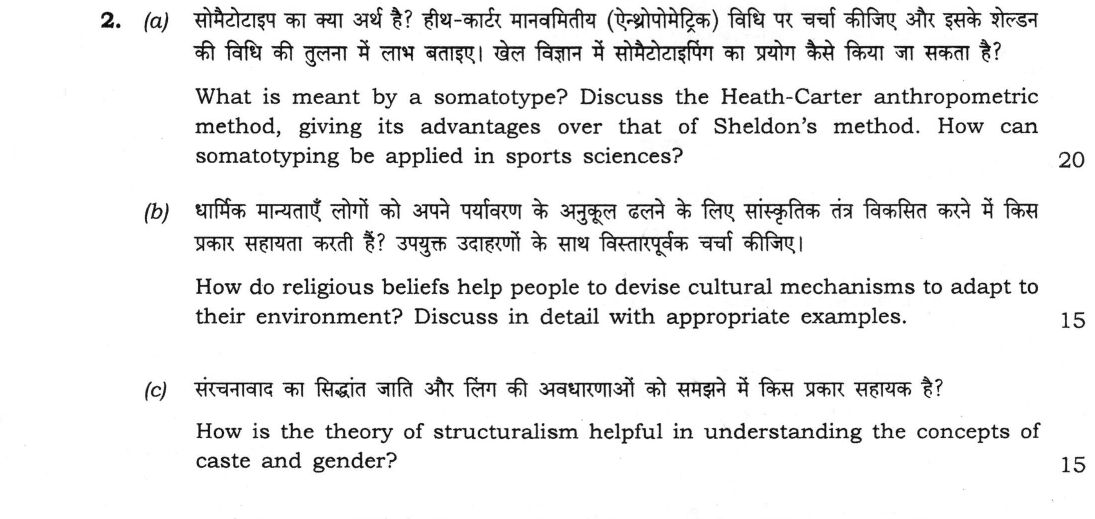
(a) What is meant by a somatotype? Discuss the Heath-Carter anthropometric method, giving its advantages over that of Sheldon's…
What is meant by a somatotype? Discuss the Heath-Carter anthropometric method, giving its advantages over that of Sheldon's method. How can somatotyping be applied in sports sciences? 20 marks
How do religious beliefs help people to devise cultural mechanisms to adapt to their environment? Discuss in detail with appropriate examples. 15 marks
How is the theory of structuralism helpful in understanding the concepts of caste and gender? 15 marks
हिंदी में प्रश्न पढ़ें
सोमैटोटाइप का क्या अर्थ है? हीथ-कार्टर मानवमितीय (एन्थ्रोपोमेट्रिक) विधि पर चर्चा कीजिए और इसके शेल्डन की विधि की तुलना में लाभ बताइए। खेल विज्ञान में सोमैटोटाइपिंग का प्रयोग कैसे किया जा सकता है? (20 अंक)
धार्मिक मान्यताएँ लोगों को अपने पर्यावरण के अनुकूल ढलने के लिए सांस्कृतिक तंत्र विकसित करने में किस प्रकार सहायता करती हैं? उपयुक्त उदाहरणों के साथ विस्तारपूर्वक चर्चा कीजिए। (15 अंक)
संरचनावाद का सिद्धांत जाति और लिंग की अवधारणाओं को समझने में किस प्रकार सहायक है? (15 अंक)
Model answer
Drafted with AI by UPSC Answer Check against this question's marking rubric, to the expected length. UPSC does not publish answers for Mains — this is one way to score well, not an official key. How we build rubrics and answers.
(a) Somatotype: the Heath-Carter method and sports applications
Somatotype: a three-numeral rating of present morphological conformation - endomorphy (relative fatness), mesomorphy (relative musculoskeletal robustness), ectomorphy (relative linearity), e.g. 3-5-2 - describing shape and composition independently of absolute size.
Sheldon's photoscopic method: W. H. Sheldon (The Varieties of Human Physique, 1940) rated physique visually from standardised nude photographs in frontal, lateral and dorsal planes, each component on a seven-point scale, using the Ponderal Index (stature divided by cube root of weight); he held somatotype a fixed genotypic constant, the morphogenotype.
Heath-Carter anthropometric method: Barbara Heath and Lindsay Carter (1967) replaced rating by measurement. Ten items: stature; body mass; four skinfolds (triceps, subscapular, supraspinale, medial calf); two bone breadths (biepicondylar humerus, biepicondylar femur); two girths (flexed and tensed arm, calf). Endomorphy: height-corrected sum of the first three skinfolds; mesomorphy: bone breadths plus girths corrected for triceps and calf skinfolds, relative to stature; ectomorphy: height-weight ratio. Ratings are open-ended.
Advantages over Sheldon:
- objective, quantified, replicable, not subjective visual judgement;
- no nude photography, removing ethical and practical obstacles;
- open-ended scale, not a ceiling of seven;
- valid for both sexes and all ages, not young adult American males alone;
- somatotype phenotypic, altering with age, training and nutrition;
- portable, needing only calipers, tape and scales.
Somatochart: the somatoplot is fixed by X = ectomorphy - endomorphy Y = 2 x mesomorphy - (endomorphy + ectomorphy) allowing mean somatoplots and somatotype attitudinal distance between groups. On the triangular somatochart, with endomorphic, mesomorphic and ectomorphic poles, each individual appears as a single somatoplot.
Sports sciences: talent identification by screening against elite reference somatoplots; event-specific profiling - balanced mesomorphy in gymnasts, mesomorph dominance in sprinters and weightlifters, endo-mesomorphy in throwers and heavyweight wrestlers, ecto-mesomorphy in distance runners; position allocation in team games; monitoring physique change across a season to steer conditioning and diet; flagging injury risk.
Physique nevertheless remains one predictor among physiology, skill and training.
(b) Religious beliefs as cultural mechanisms of environmental adaptation
Religion is not merely ideology: in many societies it works as a regulatory sub-system that encodes ecological rules in sacred form and secures compliance through belief.
Theoretical frame: Julian Steward's cultural ecology holds that the cultural core, ritual included, is shaped by the problems of subsistence in a given habitat. Roy Rappaport went further, treating ritual as a cybernetic regulator of the ecosystem.
Ritual as homeostat: in Pigs for the Ancestors (1968) Rappaport showed that among the Tsembaga Maring of highland New Guinea growing pig herds raid gardens and consume labour; ancestral obligation then triggers the kaiko festival and mass slaughter, releasing protein at moments of stress, relieving pressure on land, and timing the resumption of warfare and redistribution of territory.
Cultural materialism: Marvin Harris read the Hindu ban on cow slaughter as preserving draught bullocks, dung fuel and manure, and milk through drought, when short-term slaughter would be ruinous. The West Asian pig taboo he read as sacralised rejection of an animal ecologically costly in an arid, deforested zone.
Indian evidence: sacred groves - Sarna in Chotanagpur, Devrai in Maharashtra, Kavu in Kerala, Law Kyntang in Meghalaya, Oran in Rajasthan - conserve biodiversity and water through deity-backed prohibition. Totemic taboos protect particular species; the Bishnoi, following Jambheshwar, defend the khejri tree and blackbuck. Balinese subak water temples schedule irrigation and fallowing.
Uncertainty: Malinowski found elaborate magic for hazardous open-sea fishing among the Trobrianders and none for the safe lagoon.
Sacred sanction thus gives ecological rules durability that secular rules lack - though such readings risk functional circularity, eco-romanticism, and neglect of ecologically damaging rituals.
(c) Structuralism, caste and gender
Structuralism, developed by Lévi-Strauss from Saussurean linguistics, holds that meaning lies in relations rather than elements, and that observable practice is the surface expression of an unconscious deep structure built of binary oppositions.
Caste: Louis Dumont's Homo Hierarchicus (1966) derives the whole caste order from one opposition, pure versus impure. It generates separation (in marriage, food, touch), hierarchy of status, and interdependence through the division of labour. Hierarchy for Dumont encompasses its contrary, and status is disjoined from power - the Brahman ranks above the king. Empirically disparate rules on water, barbers, menstruation and untouchability are thus shown to share a single grammar.
Gender: Sherry Ortner's Is Female to Male as Nature Is to Culture? (1974) reads the near-universal devaluation of women as an instance of the nature-culture opposition, women being aligned with the bodily and natural. Lévi-Strauss's The Elementary Structures of Kinship (1949) had already shown that the incest taboo compels exogamy, making women the objects exchanged between male-defined groups, so asymmetry is built into alliance itself.
Interlock: Leela Dube's seed-and-earth metaphor, and pollution of menstruation and childbirth, make female sexuality the guarantor of caste purity, enforced through endogamy, hypergamy and restricted mobility.
Limits: the approach is ahistorical, treats ideology as autonomous of material interest, and allows no agency or change. Berreman insisted on caste as stratification and conflict; Dipankar Gupta rejected a single hierarchical continuum; Raheja's The Poison in the Gift found dominant-caste rather than Brahmanical centrality; Gayle Rubin recast the exchange of women as a political economy of sex.
Structuralism therefore supplies the ideological grammar, which power, history and agency must complete.
How this answer will be evaluated
Evaluation rubric
Each sub-part is marked on its own, against the marks and word limit printed on the paper.
- (a) A three-part question: define somatotype, 'discuss' the Heath-Carter anthropometric method and state its 'advantages over' Sheldon's photoscopic method, then show 'how' somatotyping is applied in sports science. All three parts must be attempted; the comparative element and the application are separately marked. 20 marks
Must cover
- endomorphy, mesomorphy, ectomorphy
- W. H. Sheldon, 'The Varieties of Human Physique' (1940), photoscopic method, Ponderal Index
- Barbara Heath and Lindsay Carter (1967)
- the four skinfolds: triceps, subscapular, supraspinale, medial calf
- biepicondylar humerus and femur breadths; flexed arm and calf girths
- open-ended rating scale
- somatochart, X and Y coordinates, somatoplot
- sport-specific somatotype profiles and talent identification
Loses marks
- Listing only the three components and their meaning, then jumping to sports, without describing the Heath-Carter measurement protocol
- Failing to state the specific advantages over Sheldon, which is separately asked and separately marked
- Naming the wrong measurements - for example citing waist or chest circumference instead of the flexed arm and calf girths, or omitting the supraspinale skinfold
- Asserting that somatotype is unchangeable - that was Sheldon's disproved assumption and the opposite of the Heath-Carter position
- Giving vague sports applications ('useful for athletes') instead of naming event-specific physique profiles
Earns more
- Explains the somatochart: the somatoplot is located using X equal to ectomorphy minus endomorphy and Y equal to twice mesomorphy minus the sum of endomorphy and ectomorphy, allowing groups to be compared by somatotype attitudinal distance and mean somatoplots
Extra mark
- Parnell's M.4 deviation chart (1950s) as the bridge between Sheldon and Heath-Carter, or Carter and Heath's 'Somatotyping: Development and Applications' (1990)
- States the limits: physique is one predictor among physiology, skill and training, and sex- and population-specific reference data are needed
- (b) The directive is 'discuss in detail with appropriate examples' - the answer must explain the mechanism by which religious belief operates as an ecological regulator, and must be built around named ethnographic cases rather than generalities. 15 marks
Must cover
- Roy Rappaport, 'Pigs for the Ancestors' (1968), Tsembaga Maring, kaiko
- Julian Steward, cultural ecology, cultural core
- Marvin Harris, cultural materialism, sacred cow, pig taboo
- sacred groves - Sarna, Devrai, Kavu, Law Kyntang, Oran
- Bishnoi, khejri tree and blackbuck
- totemism as species protection
- Malinowski on Trobriand deep-sea fishing magic
- critique of functionalist circularity
Loses marks
- Writing a general essay on the anthropology of religion (animism, magic, totemism, taboo as theory) without connecting any of it to environmental adaptation
- Offering only Indian sacred-grove examples without the classic theoretical cases of Rappaport and Harris that the examiner expects
- Getting Rappaport's argument backwards - claiming the ritual increases pig numbers, or omitting the link to warfare and land
- Presenting the adaptationist case uncritically, with no acknowledgement of the circularity objection or of cases where religion damages ecology
- Using the word 'examples' but naming no society, grove, community or ritual
Earns more
- Cites religiously protected resources in India: sacred groves such as the Sarna of Chotanagpur, Devrai of Maharashtra, Kavu of Kerala, Law Kyntang of Meghalaya and Oran of Rajasthan; totemic prohibitions protecting specific species and clans; the Bishnoi protection of the khejri tree and blackbuck under Jambheshwar's tenets; sacred rivers, tanks and hill deities regulating water and forest use
- Adds religion's role in managing environmental uncertainty - Malinowski's contrast between magic-laden open-sea fishing and magic-free lagoon fishing among the Trobrianders - and offers a critical evaluation: adaptationist arguments risk functional circularity, unfalsifiability, eco-romanticism about indigenous peoples, and neglect of cases where religious practice is ecologically damaging
Extra mark
- Balinese subak water temples (Lansing, 'Priests and Programmers', 1991)
- Policy link: sacred groves protected as community reserves under the 2002 amendment to the Wild Life (Protection) Act, or as community forest resources under FRA 2006
- (c) The question asks 'how is the theory of structuralism helpful' - so the answer must first state structuralist premises and then apply them specifically to caste and to gender, two distinct sub-parts of equal weight. A balanced answer also gauges the limits of that helpfulness. 15 marks
Must cover
- Claude Levi-Strauss, binary opposition, deep structure vs surface structure
- Louis Dumont, 'Homo Hierarchicus' (1966), purity and impurity, hierarchy, encompassing of the contrary
- status-power disjunction
- Sherry Ortner (1974), nature : culture :: female : male
- 'The Elementary Structures of Kinship' (1949), exchange of women, incest taboo
- Leela Dube, seed and earth, control of female sexuality and caste endogamy
- critiques: Berreman, Dipankar Gupta, Gloria Raheja, Gayle Rubin
Loses marks
- Writing a long general account of structuralism (Saussure, langue and parole, myth analysis) and applying it to neither caste nor gender
- Treating only caste and ignoring gender, or vice versa, when the question weights both equally
- Presenting Dumont's argument as a description of caste practice rather than as a structural analysis of caste ideology - and thereby missing the purity-impurity opposition as the generative principle
- Attributing the nature-culture formulation for gender to Levi-Strauss rather than to Ortner, or omitting Ortner altogether
- Offering no critique, so that the answer reads as advocacy rather than as an assessment of how far structuralism is 'helpful'
Earns more
- Shows the caste-gender interlock in the Indian case: Leela Dube's analysis of the seed-and-earth metaphor, menstrual and childbirth pollution, and the control of female sexuality as the guarantee of caste purity through endogamy, hypergamy and restrictions on women's mobility
- Evaluates the limits: structuralism is ahistorical, treats ideology as autonomous of material interest and power, and cannot account for change or agency - hence Berreman's insistence on caste as stratification and conflict, Dipankar Gupta's critique of a single hierarchical continuum, Raheja's 'The Poison in the Gift' showing dominant-caste centrality rather than Brahmanical purity, Appadurai's charge of Orientalism, and Gayle Rubin's 'The Traffic in Women' (1975) recasting the exchange of women as a political economy of sex
Extra mark
- Uma Chakravarti's 'brahmanical patriarchy' (1993) linking caste endogamy to the control of women
- Ambedkar's 'Castes in India' (1916): endogamy superimposed on exogamy, maintained through sati, enforced widowhood and child marriage
What "Discuss" is asking you to do
Lay the issue out from more than one side — how it arose, what is claimed for it, what is held against it, and where it now stands. UPSC attaches discuss to broad topics with several live dimensions, so coverage of the dimensions earns more than the strength of your opinion.
Structure that answers it
Set the issue up → the case as it is made → the case against → the dimension both sides leave out → where the balance now lies
Where marks are lost
Listing facts with no thread between them, or arguing one side throughout and calling it a discussion.
Practice this exact question
Write your answer and it is marked point by point against the model answer above — what you covered, what you missed, what you got wrong.
Evaluate my answer →More from Anthropology 2026 Paper I
- Q1 Write notes on the following in about 150 words each : (a) Health as a cultural construct…
- Q2 (a) What is meant by a somatotype? Discuss the Heath-Carter anthropometric method, giving…
- Q3 (a) How do the concepts of power, authority, legitimacy and social control change with ch…
- Q4 (a) Discuss the phylogenetic status, characteristic features, geographical distribution a…
- Q5 Write notes on the following in about 150 words each : (a) Ethics in anthropological fiel…