Paper II — Q1
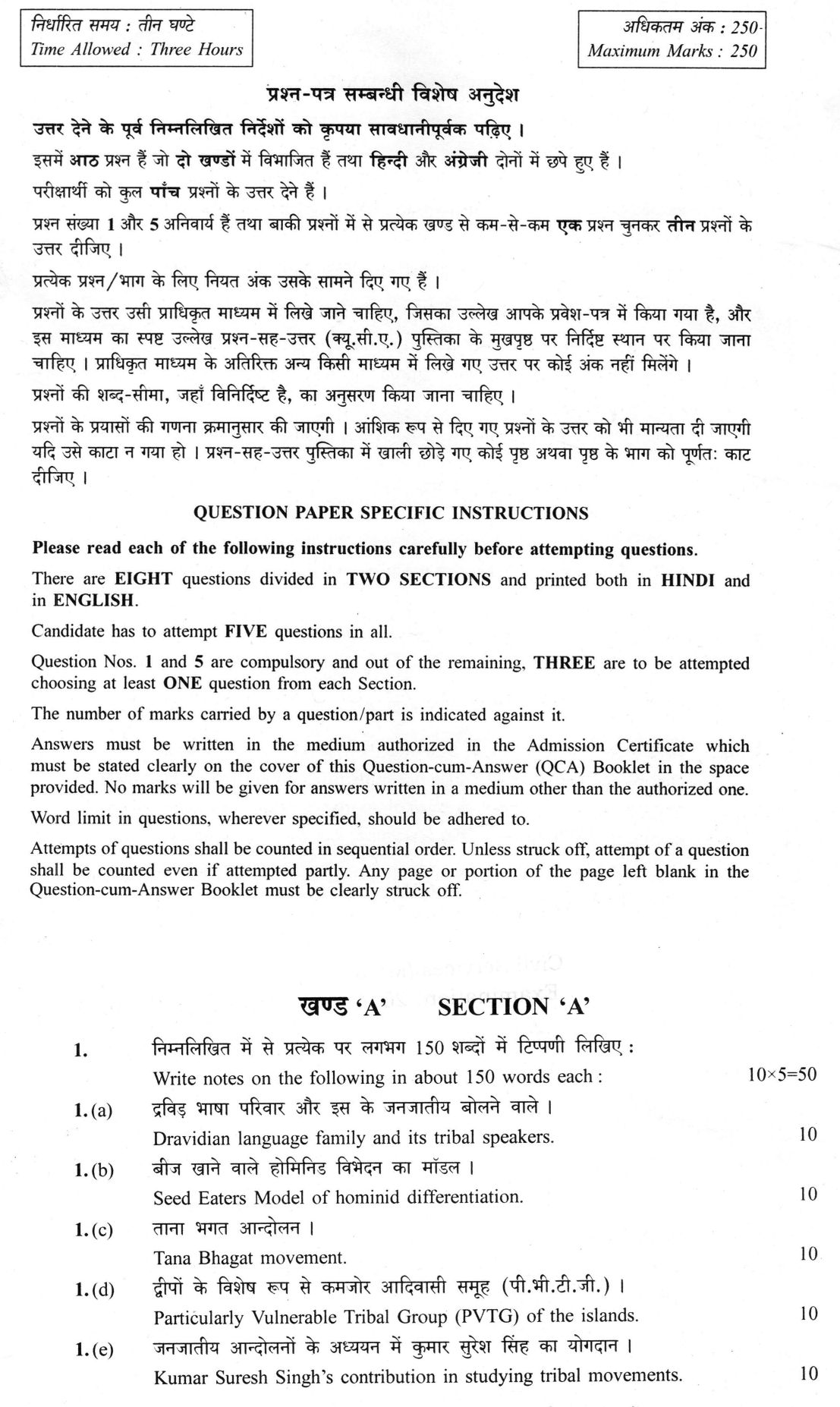
(a) Dravidian language family and its tribal speakers. (10 marks) (b) Seed Eaters Model of hominid differentiation. (10…
Write notes on the following in about 150 words each :
Dravidian language family and its tribal speakers. 10 marks
Seed Eaters Model of hominid differentiation. 10 marks
Tana Bhagat movement. 10 marks
Particularly Vulnerable Tribal Group (PVTG) of the islands. 10 marks
Kumar Suresh Singh’s contribution in studying tribal movements. 10 marks
हिंदी में प्रश्न पढ़ें
निम्नलिखित में से प्रत्येक पर लगभग 150 शब्दों में टिप्पणी लिखिए :
द्रविड़ भाषा परिवार और इस के जनजातीय बोलने वाले । (10 अंक)
बीज खाने वाले होमिनिड विभेदन का मॉडल । (10 अंक)
ताना भगत आन्दोलन । (10 अंक)
द्वीपों के विशेष रूप से कमजोर आदिवासी समूह (पी.वी.टी.जी.) । (10 अंक)
जनजातीय आन्दोलनों के अध्ययन में कुमार सुरेश सिंह का योगदान । (10 अंक)
Model answer
Drafted with AI by UPSC Answer Check against this question's marking rubric, to the 150-word length. UPSC does not publish answers for Mains — this is one way to score well, not an official key. How we build rubrics and answers.
(a) Dravidian language family and its tribal speakers
Family: About 26 Dravidian languages are spoken by roughly one-fifth of India's population (Census 2011: 19.6 per cent). Robert Caldwell (1856) established it as a family independent of Indo-Aryan; Bh. Krishnamurti divides it into South, South-Central, Central and North Dravidian.
Tribal speakers by branch:
- South Dravidian: beside the literary languages, the Nilgiri tribes Toda, Kota, Irula and Kurumba.
- South-Central: Telugu plus Gondi (Gond), Kui and Kuvi (Kondh), Pengo and Manda.
- Central: Kolami (Kolam), Parji and Ollari (Gadaba).
- North: Kurukh (Oraon), Malto (Sauria and Mal Paharia) and Brahui.
Discontinuity: Brahui in Balochistan and Kurukh-Malto in the Chotanagpur-Rajmahal belt are isolated outliers, suggesting a once wider Dravidian spread and cited in Parpola's disputed Dravidian reading of the Indus script.
Status: Unlike the four scheduled literary languages, tribal Dravidian tongues are unwritten, non-scheduled and often endangered (Toda, Kota, Kolami, Pengo).
Conclusion: The tribal periphery, not the literary core, carries the family's deepest diversity and gravest risk of loss.
(b) Seed-Eaters model of hominid differentiation
Model: Clifford J. Jolly's 'The Seed-Eaters' (Man, 1970) derived hominid differentiation from feeding ecology, not hunting, using the gelada (Theropithecus gelada) as living analogue.
Premise: Hominoids entering open grassland took to small-object feeding on grass seeds, rhizomes and tubers, which demands sustained grinding of small hard items.
T-complex: Unused anterior teeth shrink, so incisor and canine reduction needs no tool-or-weapon explanation; grinding enlarges thick-enamelled, flat-wearing molars and molarises premolars; heavy loading deepens the mandible and shortens the face, with enlarged masseter and anterior temporalis.
Posture and hand: Squatting and short bipedal shuffles preadapted the body to bipedalism; picking single seeds favoured a thumb-index precision grip.
Phases: Phase I is seed-eating differentiation from pongids; Phase II the shift to omnivory and hunting, displacing Dart's and Washburn's hunting hypothesis.
Evaluation: Geladas graze grass blades and are not bipedal; dental microwear and carbon-isotope data show no hard-object feeding in Australopithecus afarensis. It best explains Paranthropus megadontia.
(c) Tana Bhagat movement
Origin: The Tana Bhagat movement began in 1914 among the Oraon (Kurukh) of Chotanagpur, launched by Jatra Bhagat (Jatra Oraon) of Chingri-Navatoli, Gumla, after earlier Bhagat currents.
Religious reform: Jatra preached exclusive devotion to Dharmes, the Oraon supreme deity, rejecting bhut-pret propitiation, the ojha-exorcist and animal sacrifice, with vegetarianism and teetotalism: Sanskritisation (Srinivas) and a revitalisation movement (Wallace).
Agrarian protest: Tana Bhagats refused rent, cesses and begari to zamindars and thekedars, and taxes to the colonial state, a no-rent, no-tax campaign that brought Jatra Bhagat's arrest in 1914.
Nationalist convergence: From 1920-22 the movement merged with the Non-Cooperation Movement, adopting khadi, charkha and satyagraha; after independence Bihar legislated (1948) to restore alienated Tana Bhagat lands.
Scholarship: S. C. Roy recorded it; K. S. Singh and Stephen Fuchs compared it with other tribal movements.
Conclusion: Surviving as an austere Gandhian sect, the Tana Bhagats show that religious reform and agrarian protest were one process in tribal India.
(d) PVTGs of the islands
Identity: India's island PVTGs are in the Andaman and Nicobar Islands: the Great Andamanese, Onge, Jarawa and Sentinelese (Andaman Negritos) and the Mongoloid Shompen of Great Nicobar; only the Nicobarese are not PVTG.
Category: After the Dhebar Commission (1960-61), 52 Primitive Tribal Groups were listed in 1975, 75 by 1993, renamed PVTG in 2006, on four criteria: pre-agricultural technology, stagnant or declining population, very low literacy, subsistence economy.
Demography: Census 2011 counted about 44 Great Andamanese, 101 Onge, 380 Jarawa, 229 Shompen and 15 Sentinelese (an estimate).
Protection: ANPATR 1956 created tribal reserves; the Policy on the Jarawa Tribe (2004) prescribes minimum intervention; the Supreme Court ordered the Andaman Trunk Road closed (2002) and curbed 'human safaris' (2013).
Threats: ATR poaching, the 2018 RAP relaxation, John Allen Chau's death at North Sentinel Island and the Great Nicobar project keep the isolation-versus-integration debate alive.
Conclusion: For such small foraging populations, habitat and immunological protection matter more than welfare delivery.
(e) K. S. Singh and the study of tribal movements
Identity: Kumar Suresh Singh (1935-2006), administrator-anthropologist and Director-General of the Anthropological Survey of India (1984-93), pioneered the anthropo-historical study of tribal movements and led the People of India project.
Birsa monograph: 'The Dust-Storm and the Hanging Mist' (1966) reconstructed the Ulgulan (1899-1900) from colonial records and Munda oral tradition, showing it as both agrarian (khuntkatti rights against dikus) and millenarian.
Comparative field: His edited 'Tribal Movements in India' (two volumes, 1982-83) and 'Tribal Society in India: An Anthropo-historical Perspective' (1985) made all-India comparison possible.
Periodisation: primary resistance to colonial intrusion (1795-1860); agrarian, Sanskritising and messianic movements (1860-1920); convergence with nationalism (1920-47); post-independence autonomy and statehood struggles, rooted in land alienation and forest law.
Argument and limits: Rejecting the 'tribe in a vacuum', he treated tribal and peasant protest as a continuum; critics note his dependence on colonial archives and Chotanagpur bias.
Singh made tribal movements a field of anthropological history, not a footnote to the freedom struggle.
How this answer will be evaluated
Evaluation rubric
Each sub-part is marked on its own, against the marks and word limit printed on the paper.
- (a) A compact note with two linked halves: (i) what the Dravidian language family is - its internal classification, antiquity and demographic weight in India, and (ii) which Indian tribal communities actually speak Dravidian languages, named branch by branch. A list of the four literary languages alone does not answer the second half. 10 marks · 150 words
Must cover
- Robert Caldwell (1856)
- South / South-Central / Central / North Dravidian
- Gondi (Gond)
- Kurukh (Oraon)
- Malto (Sauria Paharia / Mal Paharia)
- Kui and Kuvi (Kondh)
- Toda, Kota, Irula
- Kolami (Kolam)
- Brahui (Balochistan)
- about one-fifth of India's population
Loses marks
- Writing only about Tamil, Telugu, Kannada and Malayalam and never naming a single tribal language or tribe - this loses the entire second half of the question.
- Mis-assigning tribes to families: calling Santal, Munda, Ho, Khasi or Bhil 'Dravidian speakers' (Santal/Munda/Ho/Khasi are Austro-Asiatic; Bhili is Indo-Aryan).
- Placing Kurukh or Malto in South Dravidian, or Gondi in South Dravidian rather than South-Central.
- Asserting flatly that the Indus script is Dravidian instead of presenting it as a contested hypothesis.
- Padding with the Aryan-Dravidian 'race' debate, which is a racial and not a linguistic classification.
Earns more
- Geographical discontinuity and its significance: Brahui in Balochistan and Kurukh/Malto in eastern India as isolated northern outliers, used to argue a formerly wider Dravidian distribution and cited in the Dravidian reading of the Indus script (Asko Parpola, Kamil Zvelebil) - which the answer should mark as disputed, not settled
- Sociolinguistic status: tribal Dravidian languages are largely unwritten, non-scheduled and several are endangered (Toda, Kota, Kolami, Ollari, Pengo, Manda, Parji), in contrast with the four scheduled literary languages Tamil, Telugu, Kannada and Malayalam; language shift towards regional dominant languages is accelerating
Extra mark
- Classification sources named: Kamil Zvelebil, or Grierson's Linguistic Survey of India
- Census 2011 speaker counts, e.g., Gondi about 2.98 million and Kurukh about 2 million
- (b) Explain Clifford Jolly's 1970 'Seed-Eaters' model: the gelada baboon analogy, the dietary-ecological premise, the suite of dental, masticatory, postural and manual changes it predicts, and its two-phase scheme - plus a line of evaluation. It is a note on a specific named model, not a general account of hominid origins. 10 marks · 150 words
Must cover
- Clifford J. Jolly (1970), Man
- Theropithecus gelada
- small-object / seed feeding
- T-complex
- canine and incisor reduction
- thick-enamelled molars, robust deep mandible
- precision grip
- Phase I and Phase II
- critique from dental microwear / isotopes
- alternative to the hunting hypothesis (Washburn, Dart)
Loses marks
- Attributing the model to Washburn, Dart or Robert Ardrey, or dating it to the 1960s instead of 1970.
- Using the savanna baboon (Papio) instead of the gelada (Theropithecus gelada) as the analogue.
- Listing morphological traits without linking each one causally to small-object feeding - the marks are for the functional argument, not the list.
- Omitting the Phase I / Phase II distinction, or writing a general essay on hominid bipedalism instead of the model.
- Offering no evaluation at all - at 10 marks one or two lines of critique are expected.
Earns more
- Postural and manual consequences: prolonged squatting-shuffling feeding posture with erect trunk and short bipedal shuffles as a preadaptation to habitual bipedalism, and a fine precision grip between thumb and index finger for picking up individual seeds
- Phase I / Phase II scheme and evaluation: Phase I is the seed-eating differentiation of hominids from pongids, Phase II the later shift to omnivory, meat and hunting; critiques - geladas in fact eat mostly grass blades rather than seeds, dental microwear and stable-isotope data do not support hard-object feeding in Australopithecus afarensis, geladas are not bipedal, and the model fits Paranthropus megadontia better than early Homo
Extra mark
- Places the model beside other single-cause models (Lovejoy's provisioning model, 1981; Rodman and McHenry's energetic-efficiency model, 1980)
- Cites the C4 isotope evidence that Paranthropus boisei ate grasses and sedges (Cerling et al., 2011) as partial vindication of a grass-based diet
- (c) A note on the Tana Bhagat movement: who began it, when and among whom; its socio-religious reformist content; its agrarian and anti-colonial turn; its convergence with the national movement; and how anthropologists classify it. Both the religious and the agrarian-political faces must appear. 10 marks · 150 words
Must cover
- 1914
- Jatra Bhagat (Jatra Oraon)
- Oraon / Kurukh of Chotanagpur
- Dharmes (supreme deity)
- rejection of spirit worship, ojha and animal sacrifice
- no-rent / no-begari campaign
- Non-Cooperation Movement 1920-22, khadi and charkha
- Sanskritisation (Srinivas)
- revitalisation movement (Wallace)
- S. C. Roy / K. S. Singh
Loses marks
- Confusing the Tana Bhagat movement with Birsa Munda's Ulgulan (1899-1900) - a different tribe (Munda), leader and decade; the Birsaite movement is an antecedent, not the same event.
- Treating it as purely religious and omitting the no-rent, no-tax and anti-begari agrarian struggle, or vice versa.
- Wrong tribe (writing Munda, Santal or Ho instead of Oraon) or wrong region.
- Dating it to 1895, 1899 or the 1920s rather than 1914.
- Not using any analytical category - a bare narrative without Sanskritisation/revitalisation framing scores low at optional level.
Earns more
- Convergence with the freedom movement: merger with Gandhi's Non-Cooperation Movement (1920-22), adoption of khadi, charkha, the tricolour and satyagraha, participation at the Congress session of 1922; after independence Bihar legislated to restore Tana Bhagat land alienated during the movement, and the sect persists today as an austere Gandhian group
- Analytical placement: a revitalisation movement in A. F. C. Wallace's sense, involving Sanskritisation (M. N. Srinivas) with a strong agrarian base; documented by S. C. Roy for the Oraon and analysed within the comparative literature on tribal movements by K. S. Singh and Stephen Fuchs ('Rebellious Prophets')
Extra mark
- Bihar Tana Bhagat Raiyats Agricultural Lands Restoration Act, 1948
- Placement in K. S. Singh's periodisation (the 1860-1920 agrarian-religious phase merging into the nationalist phase)
- (d) Identify and describe the Particularly Vulnerable Tribal Groups of India's islands - i.e. the Andaman and Nicobar Islands. The note must name them correctly, state the PVTG criteria and their origin, give demographic and cultural facts, and cover the protective legal regime and current threats. 10 marks · 150 words
Must cover
- Great Andamanese, Onge, Jarawa, Sentinelese, Shompen
- Andaman and Nicobar Islands
- Nicobarese - not a PVTG
- Dhebar Commission (1960-61)
- 75 PVTGs; 1975 and 1993; renamed 2006
- four PVTG criteria
- ANPATR 1956
- Andaman Trunk Road
- Policy on the Jarawa Tribe, 2004
- North Sentinel Island
Loses marks
- Including the Nicobarese among the PVTGs, or omitting the Shompen (the only Nicobar PVTG) and writing only about the Andaman Negritos.
- Adding mainland PVTGs such as the Birhor, Kattunayakan, Cholanaickan or Toda to an answer about island groups.
- Getting the count wrong - stating four island PVTGs, or that all Andaman and Nicobar tribes are PVTGs.
- Listing only population figures with no mention of ANPATR 1956, the Jarawa policy or the Supreme Court's ATR orders.
- Racial mislabelling - calling the Shompen a Negrito group (they are Mongoloid) or the Jarawa 'Nicobarese'.
Earns more
- Demography, habitat, subsistence and language: 2011 Census counts of roughly Great Andamanese 44 (settled on Strait Island), Onge 101 (Dugong Creek and South Bay, Little Andaman), Jarawa 380 (western South and Middle Andaman), Shompen 229 (interior Great Nicobar) and Sentinelese 15 enumerated from a distance (true size only estimated); hunting-gathering and fishing economies; the Ongan (Jarawa-Onge) and Great Andamanese language families, the latter nearly extinct - Anvita Abbi's documentation and the death of Bo with Boa Sr. in 2010
- Contemporary threats and the debate: epidemic vulnerability on contact (the historical collapse of the Great Andamanese), poaching and sexual exploitation along the ATR, the 2018 relaxation of the Restricted Area Permit for several islands and the killing of John Allen Chau at North Sentinel, and the Great Nicobar mega-project raising the question of Shompen consent; frames the isolation-assimilation-integration debate (Elwin's protectionism versus Ghurye's assimilation, Nehru's Panchsheel)
Extra mark
- PM-JANMAN (2023) for PVTG habitations, and the Shompen Policy (2015)
- The Great Nicobar development project debate, including the Great Nicobar Tribal Council's withdrawal of its no-objection (2022)
- (e) Assess K. S. Singh's specific contribution to the study of tribal movements - his Birsa Munda monograph, his edited comparative volumes, his periodisation and typology of movements, and his anthropo-historical method. A general biography of Singh or an account of the People of India project alone will not answer it. 10 marks · 150 words
Must cover
- Kumar Suresh Singh (1935-2006)
- Director-General, Anthropological Survey of India
- 'The Dust-Storm and the Hanging Mist' (1966)
- Birsa Munda and the Ulgulan (1899-1900)
- 'Tribal Movements in India' (edited volumes)
- 'Tribal Society in India: An Anthropo-historical Perspective' (1985)
- anthropo-historical method
- diku and land alienation
- People of India project
- phases/typology of tribal movements
Loses marks
- Writing a general note on tribal movements in India with Singh's name attached only in the first line - the question is about his contribution.
- Confusing K. S. Singh with K. S. Mathur, S. C. Roy or Surajit Sinha, or crediting him with the classification actually associated with another scholar without saying so.
- Spending the whole note on the People of India project, which is his ethnographic-survey contribution rather than his tribal-movements contribution.
- Getting the Birsa Munda dates wrong - Birsa died in 1900 and the Ulgulan was 1899-1900, not 1874 (1874 is the start of the period covered by Singh's title).
- Offering no critical line at all; at optional level a sentence on the archival bias or middle-India focus adds value.
Earns more
- Identity and institutional base: Kumar Suresh Singh (1935-2006), civil servant and anthropologist, Director-General of the Anthropological Survey of India in the 1980s-early 1990s, who directed the People of India project covering 4,635 communities - the platform from which his comparative work on tribal society proceeded
- Analytical thrust and its limits: he rejected the isolationist 'tribe in a vacuum' and located movements in colonial land settlement, the creation of a land market, forest legislation and the rise of a tribal middle class, treating tribal and peasant protest as a continuum and tribal ethnicity as historically produced; critics note his heavy reliance on colonial archives and a middle-India (Chotanagpur) bias, with the North-East less well covered
Extra mark
- Contrast with other typologies (Surajit Sinha, L. P. Vidyarthi, Ghanshyam Shah), correctly attributed
- His 'The Scheduled Tribes' (People of India series, 1994) or work on tribal ethnicity and identity
What "Write short notes" is asking you to do
Five or six self-contained answers, marked separately, typically 10 marks and about 150 words each. Each note must carry its own definition, its two or three defining features and a line on why it matters; a common introduction or conclusion across the notes earns nothing.
Structure that answers it
Per note: one-line definition or identification → two or three features, mechanisms or named examples → one line of significance or Indian application
Where marks are lost
Writing the first two notes at essay length and rationing the rest. Each note is marked on its own, so marks surrendered on a compressed or unattempted note cannot be won back by the long ones.
Practice this exact question
Write your answer and it is marked point by point against the model answer above — what you covered, what you missed, what you got wrong.
Evaluate my answer →More from Anthropology 2026 Paper II
- Q1 Write notes on the following in about 150 words each : (a) Dravidian language family and…
- Q2 (a) What are the major debates related to the concept of jajmani system ? (20 marks) (b)…
- Q3 (a) Critically examine the salience of F. G. Bailey’s study on Bisipara village of Odisha…
- Q4 (a) Write an account on the contribution of Verrier Elwin in developing policies for the…