Paper II — Q4
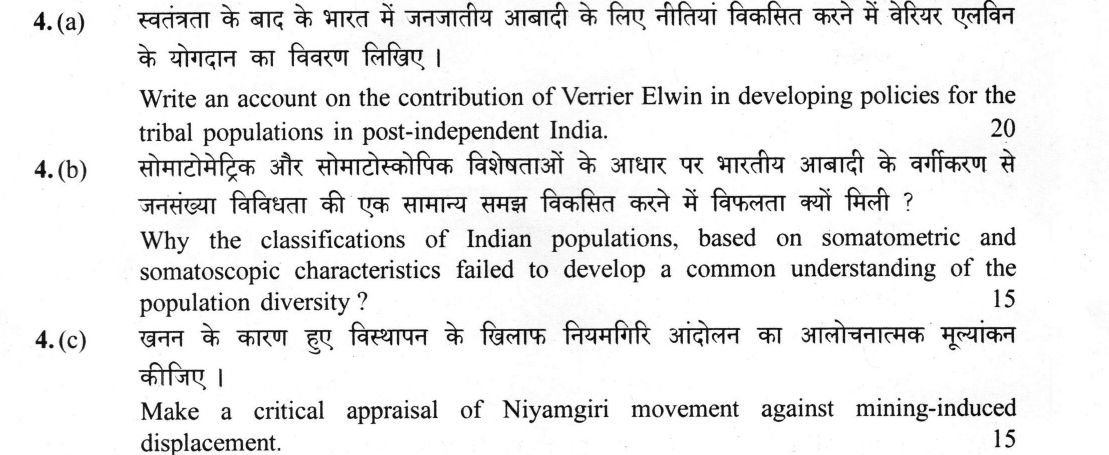
(a) Write an account on the contribution of Verrier Elwin in developing policies for the tribal populations in post-independent…
Write an account on the contribution of Verrier Elwin in developing policies for the tribal populations in post-independent India. 20 marks
Why the classifications of Indian populations, based on somatometric and somatoscopic characteristics failed to develop a common understanding of the population diversity ? 15 marks
Make a critical appraisal of Niyamgiri movement against mining-induced displacement. 15 marks
हिंदी में प्रश्न पढ़ें
स्वतंत्रता के बाद के भारत में जनजातीय आबादी के लिए नीतियां विकसित करने में वेरियर एलविन के योगदान का विवरण लिखिए । (20 अंक)
सोमाटोमेट्रिक और सोमाटोस्कोपिक विशेषताओं के आधार पर भारतीय आबादी के वर्गीकरण से जनसंख्या विविधता की एक सामान्य समझ विकसित करने में विफलता क्यों मिली ? (15 अंक)
खनन के कारण हुए विस्थापन के खिलाफ नियमगिरि आंदोलन का आलोचनात्मक मूल्यांकन कीजिए । (15 अंक)
Model answer
Drafted with AI by UPSC Answer Check against this question's marking rubric, to the expected length. UPSC does not publish answers for Mains — this is one way to score well, not an official key. How we build rubrics and answers.
(a) Verrier Elwin and post-independence tribal policy
Introduction: Verrier Elwin (1902-1964) after 1947 turned his central Indian ethnography into an official philosophy of tribal administration for the North-East Frontier Agency (NEFA), now Arunachal Pradesh.
Positions: Elwin, Deputy Director of the Anthropological Survey of India in the late 1940s, took Indian citizenship in 1954 and was appointed by Nehru Adviser for Tribal Affairs, NEFA.
From isolation to integration: 'The Baiga' (1939) had proposed a protective 'national park' for tribes, which G. S. Ghurye's 'The Aborigines - So-Called - and Their Future' (1943) attacked as denationalising, against N. K. Bose's 'Hindu method of tribal absorption'. Elwin repudiated isolation for integration: neither isolation nor assimilation, but development along a people's own lines.
'A Philosophy for NEFA' (1957; 2nd edition 1959): Nehru's foreword to it set out the tribal Panchsheel: (i) develop along the lines of their own genius, nothing imposed, arts and culture encouraged; (ii) rights in land and forest respected; (iii) tribals trained for administration and development, with few outsiders; (iv) no over-administration or multiplicity of schemes, working through their own institutions; (v) results judged by the quality of human character evolved, not statistics or money spent. Nehru enunciated the principles; Elwin supplied the philosophy.
Measures in NEFA: An anthropologically trained Indian Frontier Administrative Service; retention of the inner line under the Bengal Eastern Frontier Regulation, 1873; schooling in local languages and materials; government through village councils; restraint on traders and missions. 'Myths of the North-East Frontier of India' (1958) was meant to build tribal self-respect. Nationally, he chaired the Committee on Special Multipurpose Tribal Blocks (report 1960), which faulted uniform, target-driven schemes and urged a tribal bias in development.
Appraisal: Critics called it museumisation delaying political participation; Ramachandra Guha's 'Savaging the Civilized' (1999) records the romanticism and the shift from it. Above all the Panchsheel stayed declaratory: displacement, land alienation and forest exclusion (Xaxa Committee, 2014) show how little of principles (ii) and (v) was realised.
Conclusion: Elwin gave independent India its most coherent statement of tribal policy, whose principles outlive the practice that departed from them.
(b) Why somatometric and somatoscopic classifications failed
Introduction: From Risley to Guha, Indian anthropometry produced mutually incompatible racial maps; the failure lay in typological method, not measurement.
The classifications: H. H. Risley (Census 1901) derived seven types largely from the nasal index, claiming caste rank varied inversely with it. J. H. Hutton (Census 1931) offered a stratigraphy of migrations. B. S. Guha (1931 Census, published 1935) proposed six elements, Negrito, Proto-Australoid, Mongoloid, Mediterranean, Western Brachycephals and Nordic, from cephalic and nasal indices, stature. Eickstedt, S. S. Sarkar and D. N. Majumdar produced others; none agreed.
Typological fallacy: The schemes assumed discrete 'pure' ancestral types of which living people were approximations, whereas populations vary continuously and clinally, with within-group variability exceeding between-group difference; the UNESCO Statements on Race (1950, 1951) discarded typological race.
Technical failures: Trait weighting was arbitrary. Cephalic index, nasal index, stature and pigmentation are non-concordant. The traits are polygenic and plastic, as Franz Boas (1912) showed for immigrant head form. Somatoscopic scoring is observer-dependent, and samples were small, non-random and statistically untested.
Conceptual conflation: Race was equated with caste, language and region: 'Aryan' and 'Dravidian', linguistic labels, were read as biology serving colonial caste enumeration.
What replaced them: Blood groups, haemoglobin variants and G6PD deficiency distributed discordantly with the racial types; genomics revealed an admixture cline of Ancestral North Indian and Ancestral South Indian (Reich et al., Nature, 2009). The Anthropological Survey of India's People of India project shifted the unit from race to endogamous community.
Conclusion: Indian variation is clinal and endogamy-structured, which no typology could capture; racial typology, not measurement, failed.
(c) The Niyamgiri movement: a critical appraisal
Introduction: The Niyamgiri hills of Kalahandi and Rayagada districts, Odisha, are home to the Dongria Kondh, a PVTG who call themselves jharnia and worship Niyam Raja at Niyam Dongar.
The conflict: Odisha Mining Corporation, with Vedanta/Sterlite, sought hilltop bauxite for the Lanjigarh alumina refinery; the Niyamgiri Suraksha Samiti under Lado Sikaka resisted.
Legal trajectory: The N. C. Saxena Committee (2010) found violations of the Forest Rights Act, 2006 and environmental law, and Jairam Ramesh refused Stage-II clearance in August 2010. In Orissa Mining Corporation v. MoEF (18 April 2013) the Supreme Court held that whether mining affected religious, cultural and habitat rights was for the Gram Sabhas to decide under the FRA read with PESA, 1996 and Articles 25-26; it did not cancel the lease itself.
Outcome: In 2013 the twelve designated Gram Sabhas unanimously rejected mining, and MoEF refused final clearance in January 2014; in May 2016 the Supreme Court declined Odisha's plea for fresh Gram Sabha votes.
Achievements: Free, prior and informed consent, consistent with UNDRIP (2007), was operationalised, and a sacred landscape, L. P. Vidyarthi's nature-man-spirit complex in legal form, became a protectable interest.
Limits: Only twelve villages voted; the Lanjigarh refinery and plains displacement remain; some activists faced Maoist-link allegations, raising doubts about how free consent was. The principle has since been weakened: the Forest (Conservation) Rules, 2022 let forest clearance advance before Gram Sabha consent is secured, and Samatha (1997) and LARR Act section 41 are unevenly enforced. Among some sixty million development-displaced since 1947, about forty per cent tribal (Walter Fernandes's estimate), it is an exception.
Niyamgiri is India's strongest precedent for community consent, yet fragile, because its principle has not been institutionalised beyond the case.
How this answer will be evaluated
What earns full marks: Precise policy names, specific tribal groups, and clear analytical distinction between biological and social categories.
Evaluation rubric
Each sub-part is marked on its own, against the marks and word limit printed on the paper.
- (a) 'Write an account' calls for a descriptive-analytical record of Verrier Elwin's contribution to tribal policy after 1947: his shift from isolation to integration, 'A Philosophy for NEFA' and Nehru's tribal Panchsheel, the NEFA administrative measures, the Committee on Special Multipurpose Tribal Blocks (1959-60), and an appraisal of how far the policy was realised. 20 marks
describe— context → examples → significance → conclusion
Must cover
- Elwin's shift from the protective 'national park' idea (The Baiga, 1939) to integration, against Ghurye's assimilationist critique (1943)
- 'A Philosophy for NEFA' (1957; 1959) and Nehru's five principles of the tribal Panchsheel
- NEFA measures: Adviser for Tribal Affairs, an anthropologically trained frontier cadre, the Inner Line, local-language schooling, working through village councils
- Committee on Special Multipurpose Tribal Blocks (Elwin Committee, report 1960)
- Appraisal of how far the principles were realised in later policy
Loses marks
- Describing Elwin only as a missionary or ethnographer of the Baiga and Gond, with nothing on post-1947 policy
- Attributing the Panchsheel wholly to Elwin, or omitting Nehru's role
- Presenting Elwin as an unchanged isolationist, ignoring his move to integration
- Inventing statutes or bodies instead of citing real instruments
- Pure praise with no appraisal of implementation gaps
Earns more
- Places Elwin's career accurately: missionary turned ethnographer of the Gond, Baiga and Muria, Deputy Director of the Anthropological Survey of India, Indian citizenship in 1954 and Adviser for Tribal Affairs in NEFA
- Links Elwin's principles to later instruments - Fifth and Sixth Schedule protections, the Tribal Sub-Plan (1974-75), PESA 1996 and the Forest Rights Act 2006 - as partial realisations of the Panchsheel
- Balanced critique: charges of romanticism and 'museumisation' (Ghurye; Guha's 'Savaging the Civilized', 1999) set against the continuing relevance of development on the people's own terms
Extra mark
- Cites Elwin's autobiography 'The Tribal World of Verrier Elwin' (1964) or 'Myths of the North-East Frontier of India' (1958)
- Contrasts Elwin with N. K. Bose's 'Hindu method of tribal absorption' or with the Dhebar Commission (1960-61)
- (b) 'Why ... failed' asks for explanation: identify the somatometric and somatoscopic classifications of Indian populations (Risley, Hutton, Guha and others) and give the conceptual, technical and social reasons why they produced no common understanding of diversity, noting what replaced them. 15 marks
explain— definition/context → points in order → small example → short close
Must cover
- Defines somatometric (measured) and somatoscopic (observed) traits
- Names the main schemes: Risley (Census 1901, nasal index), Guha (1935, six elements) and others (Eickstedt, Sarkar, Majumdar)
- Typological fallacy versus continuous, clinal variation and high within-group variability
- Technical flaws: non-concordant, polygenic and environmentally plastic traits (Boas, 1912), observer bias, small non-random samples
- Conflation of race with caste, language and region (the 'Aryan' and 'Dravidian' labels)
Loses marks
- Treating 'race' as a fixed, discrete biological category
- Listing Risley's or Guha's types without explaining why the schemes failed
- Equating linguistic labels (Aryan, Dravidian) with biological groups
- Ignoring the genetic evidence that superseded anthropometric typology
Earns more
- Explains why different traits gave different maps: arbitrary weighting of cephalic index, nasal index, stature and pigmentation
- Shows what replaced typology: serological and genetic markers (blood groups, haemoglobin variants, G6PD), then genomic admixture clines (ANI-ASI, Reich et al., 2009)
- Notes the shift of unit from 'race' to endogamous community in the People of India project, and the UNESCO statements on race (1950, 1951)
Extra mark
- GenomeIndia (about 10,000 genomes) or Indian mtDNA and Y-chromosome studies showing endogamy-structured substructure
- Risley's claim that caste rank varied inversely with nasal index cited as an example of colonial circularity
- (c) 'Make a critical appraisal' requires the context of the Niyamgiri movement (Dongria Kondh; bauxite mining for the Lanjigarh refinery), its legal course and outcome, and a balanced judgement of its achievements and limits as a response to mining-induced displacement. 15 marks
critically evaluate— positives → negatives/limits → conditions/safeguards → conclusion
Must cover
- Dongria Kondh (a PVTG), the sacred Niyamgiri hills and Niyam Raja; Kalahandi and Rayagada, Odisha
- Bauxite mining by the Orissa Mining Corporation with Vedanta for the Lanjigarh alumina refinery
- Saxena Committee (2010) and the refusal of Stage-II forest clearance
- Supreme Court, Orissa Mining Corporation v. MoEF (April 2013): Gram Sabhas to decide under FRA 2006 read with PESA
- Rejection by all twelve Gram Sabhas (2013); MoEF refusal of clearance (January 2014)
Loses marks
- Treating Niyamgiri as a generic anti-mining protest with no tribal, sacred or legal specifics
- Confusing the Dongria Kondh with other tribes or placing the hills outside Odisha
- Omitting the 2013 Supreme Court judgment and the Gram Sabha decisions
- One-sided celebration or condemnation with no limits or achievements weighed
Earns more
- Achievements: operationalises free, prior and informed consent (UNDRIP, 2007) and recognises a sacred landscape as a protectable right
- Limits: only twelve villages consulted, the refinery and its displacement remain, contested claims of coercion, and later forest-clearance rules weakening Gram Sabha consent
- Situates Niyamgiri among wider displacement data and law - Walter Fernandes's estimate of about 60 million development-displaced, about 40 per cent tribal; Samatha (1997); LARR Act 2013, section 41
Extra mark
- The Supreme Court's May 2016 refusal of Odisha's plea for fresh Gram Sabha votes
- Anthropological framing: L. P. Vidyarthi's nature-man-spirit complex, or Padel and Das's 'Out of This Earth' (2010)
What "Describe" is asking you to do
Give a full, ordered account of the thing named — its parts, stages or mechanism — in the sequence in which it actually exists or occurs. Most describe questions come from the science optionals, where the marks sit in correct technical detail and, where the stem says so, a labelled diagram.
Structure that answers it
One-line identification of the subject → the parts or stages in their real order, each with its defining detail → labelled diagram where the subject is structural → closing line on function or significance
Where marks are lost
Loose general prose where the examiner is ticking named parts, correct terminology and their sequence; and in the General Studies papers, turning to evaluation before the description is finished.
Practice this exact question
Write your answer and it is marked point by point against the model answer above — what you covered, what you missed, what you got wrong.
Evaluate my answer →More from Anthropology 2026 Paper II
- Q1 Write notes on the following in about 150 words each : (a) Dravidian language family and…
- Q2 (a) What are the major debates related to the concept of jajmani system ? (20 marks) (b)…
- Q3 (a) Critically examine the salience of F. G. Bailey’s study on Bisipara village of Odisha…
- Q4 (a) Write an account on the contribution of Verrier Elwin in developing policies for the…
- Q5 Write notes on the following in about 150 words each : (a) Buddhist tribes of India. (10…
- Q6 (a) Make a critical appraisal of the mesolithic culture of Ganga basin with reference to…
- Q7 (a) Assess the contribution of colonial scholars in studying the tribal populations of No…