Paper II — Q7
(a) Assess the contribution of colonial scholars in studying the tribal populations of North-East India. (20 marks) (b) Does…
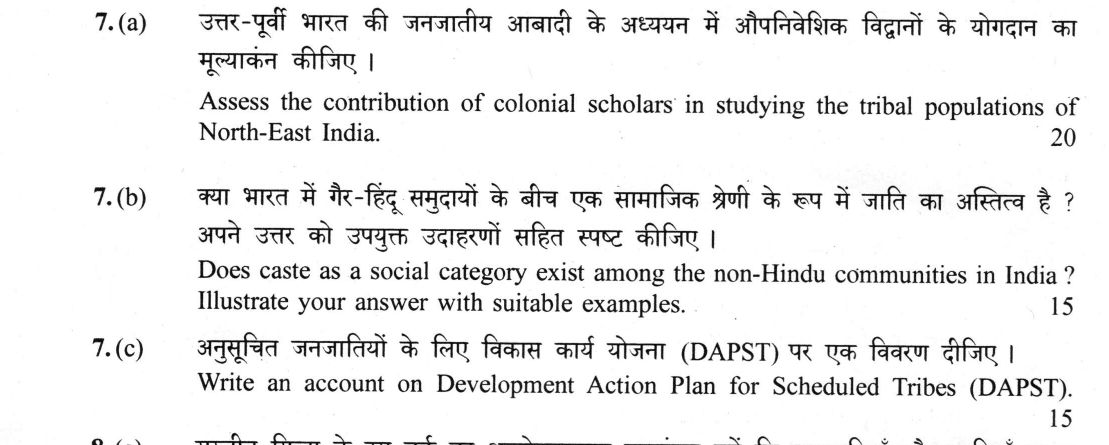
Assess the contribution of colonial scholars in studying the tribal populations of North-East India. 20 marks
Does caste as a social category exist among the non-Hindu communities in India ? Illustrate your answer with suitable examples. 15 marks
Write an account on Development Action Plan for Scheduled Tribes (DAPST). 15 marks
हिंदी में प्रश्न पढ़ें
उत्तर-पूर्वी भारत की जनजातीय आबादी के अध्ययन में औपनिवेशिक विद्वानों के योगदान का मूल्यांकन कीजिए । (20 अंक)
क्या भारत में गैर-हिन्दू समुदायों के बीच एक सामाजिक श्रेणी के रूप में जाति का अस्तित्व है ? अपने उत्तर को उपयुक्त उदाहरणों सहित स्पष्ट कीजिए । (15 अंक)
अनुसूचित जनजातियों के लिए विकास कार्य योजना (DAPST) पर एक विवरण दीजिए । (15 अंक)
Model answer
Drafted with AI by UPSC Answer Check against this question's marking rubric, to the expected length. UPSC does not publish answers for Mains — this is one way to score well, not an official key. How we build rubrics and answers.
(a) Colonial scholars and the tribes of North-East India
Introduction: Colonial ethnography of the North-East was written mostly by administrator-anthropologists on the Royal Anthropological Institute's 'Notes and Queries' schedule, plus missionary linguists and a few academics.
The canon: P. R. T. Gurdon's 'The Khasis' (1907); A. Playfair's 'The Garos' (1909); T. C. Hodson's 'The Meitheis' (1908) and 'The Naga Tribes of Manipur' (1911); J. Shakespear's 'The Lushei Kuki Clans' (1912); J. H. Hutton's 'The Angami Nagas' and 'The Sema Nagas' (1921); J. P. Mills's 'The Lhota Nagas' (1922), 'The Ao Nagas' (1926) and 'The Rengma Nagas' (1937); N. E. Parry's 'The Lakhers' (1932); with Dalton's 'Descriptive Ethnology of Bengal' (1872) behind them, and Fuerer-Haimendorf's 'The Naked Nagas' (1939) and Ursula Graham Bower's Zemi work closing the era.
Ethnographic yield: These are the fullest record of pre-Christian institutions: the morung dormitory, feasts of merit, head-hunting, the genna taboo system Hutton analysed, khel and clan exogamy, Angami village republics against Sema and Konyak chiefship, and jhum beside Angami terraced rice. Missionaries such as Thomas Jones (Khasi) and E. W. Clark (Ao) supplied scripts and dictionaries.
Knowledge for governance: The same ethnography underwrote the Inner Line (Bengal Eastern Frontier Regulation, 1873), the Excluded and Partially Excluded Areas of the Government of India Act, 1935, punitive expeditions against head-hunting, and the 1940s Crown Colony proposal; Hutton took the same categories into the 1931 Census.
Assessment: The colonial ethnographic state fixed fluid, situational identities into bounded, counted 'tribes', Naga, Kuki, Lushai, whose boundaries are still fought over; its idiom was racial and exoticising ('The Naked Nagas'); the observers were agents of conquest; voices came through dobashi interpreters; women are nearly absent. Yet the salvage value is real, since conversion transformed much recorded within a generation, which is why Sanjib Baruah and Dolly Kikon still mine it critically.
Conclusion: The archive is indispensable and compromised alike: a record of colonial governance as much as of tribal life.
(b) Caste among non-Hindu communities
Introduction: Yes: caste-like stratification exists among non-Hindus, though whether it is 'caste' is contested. Louis Dumont ('Homo Hierarchicus'), defining caste by the pure-impure opposition, calls it borrowed residue; Ghaus Ansari, Imtiaz Ahmad, Berreman and Beteille treat hierarchy, endogamy and hereditary occupation as constitutive wherever found.
Muslims: A threefold ranking of Ashraf (Sayyid, Sheikh, Mughal, Pathan), Ajlaf (occupational biradaris: Ansari/Julaha weavers, Qureshi butchers, Darzi) and Arzal (Halalkhor, Lalbegi, in polluting work), with biradari endogamy and panchayats, is documented by Ansari's 'Muslim Caste in Uttar Pradesh' (1960), Ahmad's edited volume (1973) and Susan Bayly, and confirmed by the Sachar Committee (2006).
Christians: Kerala's Syrian Christians keep the endogamous Knanaya division and stand apart from Latin Catholics; Dalit Christians of Pulaya and Madiga origin have faced separate seating, chapels and cemeteries (Duncan Forrester's 'Caste and Christianity', 1980; Rowena Robinson).
Sikhs: Despite Nanak's rejection of caste and the levelling langar, Jat, Khatri-Arora, Ramgarhia, Mazhabi and Ravidasia Sikhs remain endogamous, with separate gurdwaras and deras such as Dera Sachkhand Ballan, in India's highest-SC-share state (Surinder Jodhka, Ronki Ram).
Others: Jains rank endogamous Oswal and Porwal; Navayana Buddhists still face discrimination; tribes drawn into regional hierarchies acquire caste-like rank (N. K. Bose's 'Hindu method of tribal absorption', Surajit Sinha's Bhumij).
Legal stake: Paragraph 3 of the Constitution (Scheduled Castes) Order, 1950 limits SC status to Hindus, Sikhs (1956) and Buddhists (1990), excluding Dalit Muslims and Christians; the Ranganath Misra Commission (2007) urged de-linking.
Conclusion: Caste survives conversion because it inheres in land, occupation, locality and marriage, not doctrine, operating among non-Hindus without varna ideology.
(c) Development Action Plan for Scheduled Tribes (DAPST)
Introduction: The Development Action Plan for Scheduled Tribes (DAPST), in force since 2017-18, is the budgeting framework under which central ministries earmark a share of scheme outlays for Scheduled Tribes, not a scheme.
Lineage: It descends from the Tribal Sub-Plan introduced in the Fifth Five Year Plan (1974-79) after the Shilu Ao Study Team (1969) and S. C. Dube's Task Force (1972), later the Scheduled Tribe Component, renamed when NITI Aayog replaced the Planning Commission.
Mechanics: Each ministry earmarks a share of its scheme budget (about 4.3 to 17.45 per cent, set by NITI Aayog), meant to be non-divertible and non-lapsable. About forty ministries report allocations; the Ministry of Tribal Affairs is nodal, monitoring through an online portal and a separate ST statement in the Budget's Expenditure Profile. Delivery runs through ITDPs/ITDAs, MADA pockets, clusters and PVTG projects.
What it finances: The Ministry's own schemes: Eklavya Model Residential Schools, pre- and post-matric scholarships, MSP for minor forest produce with Van Dhan Vikas Kendras through TRIFED, Article 275(1) grants, and now PM-JANMAN and DAJGUA; plus ST components of other ministries' housing, road, water and health schemes. Allocation grew from about Rs 21,525 crore (2013-14) to about Rs 1.25 lakh crore (2024-25).
Assessment: Much outlay is notional, general expenditure attributed pro rata rather than designed for tribal needs; non-divertibility is weakly enforced; the Xaxa Committee's (2014) call for a statutory basis has been met by only a few states, such as Andhra Pradesh, Telangana and Karnataka; planning rarely passes through the Gram Sabha as PESA and FRA require.
DAPST has raised the visible quantum of tribal spending but not made it tribal-specific, Gram Sabha-driven or outcome-measured.
How this answer will be evaluated
Evaluation rubric
Each sub-part is marked on its own, against the marks and word limit printed on the paper.
- (a) 'Assess' requires both an account of what colonial scholars produced on the tribes of North-East India - named authors and named monographs - and a judgement on the value and the limitations of that body of work. A list of book titles without assessment, or a critique without the ethnography, will not score. 20 marks
Must cover
- J. H. Hutton, 'The Angami Nagas' and 'The Sema Nagas' (1921)
- J. P. Mills, 'The Lhota Nagas', 'The Ao Nagas', 'The Rengma Nagas'
- P. R. T. Gurdon, 'The Khasis' (1907)
- A. Playfair, 'The Garos' (1909)
- T. C. Hodson, 'The Meitheis' / 'The Naga Tribes of Manipur'
- J. Shakespear, 'The Lushei Kuki Clans' (1912)
- N. E. Parry, 'The Lakhers' (1932)
- morung, feasts of merit, head-hunting, genna
- Inner Line, Bengal Eastern Frontier Regulation 1873; Excluded Areas, Government of India Act 1935
- Fuerer-Haimendorf, 'The Naked Nagas' (1939); Ursula Graham Bower
- colonial construction of bounded tribal identities
Loses marks
- Naming no monograph at all - at 20 marks the examiner expects at least five author-title pairs.
- Attributing 'The Angami Nagas' or 'The Sema Nagas' to Mills and 'The Ao Nagas' to Hutton; Hutton wrote on the Angami and Sema, Mills on the Lhota, Ao and Rengma.
- Including Verrier Elwin's NEFA work as colonial scholarship; his North-East role was post-independence, as Nehru's adviser.
- Writing about central Indian tribes - Baiga, Gond, Santal - in a question restricted to the North-East.
- Offering only praise or only condemnation; 'assess' requires the salvage value and the colonial complicity to be weighed together.
- Ignoring the missionary contribution to script, grammar and dictionary, which is one of the most enduring effects.
Earns more
- Knowledge in the service of administration: the same officers' ethnography underwrote the Inner Line under the Bengal Eastern Frontier Regulation, 1873, the Scheduled Districts Act, 1874, the 'Backward Tracts' of the Government of India Act, 1919 and the 'Excluded and Partially Excluded Areas' of the Government of India Act, 1935, the suppression of head-hunting, the punitive expedition, the regulation of trade and of tea-garden labour recruitment, and finally the proposal in the 1940s associated with Robert Reid and Hutton for a separate Crown Colony of the north-eastern hill areas; Hutton's appointment as Census Commissioner for 1931 carried the same classificatory apparatus into the all-India census
- Critical assessment: the colonial ethnographic state converted fluid, overlapping and situational identities into bounded, named, counted and mapped 'tribes' - Naga, Kuki, Lushai and their sub-divisions - with consequences that persist in today's boundary and ethnic disputes; the idiom was racial, with Mongoloid typologies and Hutton's now-discarded scheme of successive migration layers, and often exoticising, as the titles 'The Naked Nagas' and 'Himalayan Barbary' show; the observers were simultaneously agents of conquest and pacification, so the ethnography cannot be separated from the expedition; indigenous voices reach us only through interpreters and dobashis and women's perspectives are almost absent, Ursula Graham Bower being a partial exception; yet the salvage value is genuine, since Christian conversion transformed much of what was recorded within a generation, which is why contemporary scholars such as Sanjib Baruah, Bodhisattva Kar, Arkotong Longkumer and Dolly Kikon continue to mine this archive while interrogating it
Extra mark
- Edward Gait's 'A History of Assam' (1906) or Hutton's 1931 Census as linked colonial projects
- Recent critical scholarship such as Arkotong Longkumer's 'The Greater India Experiment' (2020) or Bodhisattva Kar
- (b) Take a clear position on whether caste exists as a social category among India's non-Hindu communities, ground it in the theoretical debate, and then illustrate it with named groups among Muslims, Christians and Sikhs at least. The instruction 'illustrate with suitable examples' makes named communities mandatory. 15 marks
Must cover
- Ashraf, Ajlaf, Arzal
- Sayyid, Sheikh, Mughal, Pathan; Ansari/Julaha; Qureshi; Halalkhor
- Ghaus Ansari (1960); Imtiaz Ahmad (1973); Zarina Bhatty; Susan Bayly
- Louis Dumont, 'Homo Hierarchicus' - the contrary position
- Syrian Christians and the Knanaya/Southist division; Dalit Christians
- Duncan Forrester, 'Caste and Christianity' (1980); Rowena Robinson
- Jat, Khatri, Ramgarhia, Mazhabi, Ravidasia Sikhs; separate gurdwaras and deras
- Surinder Jodhka; Ronki Ram
- Constitution (Scheduled Castes) Order, 1950, paragraph 3; Sikhism 1956; Buddhism 1990
- Sachar Committee (2006); Ranganath Misra Commission (2007)
Loses marks
- Answering yes or no without any theoretical grounding, so the Dumont versus stratification debate never appears.
- Naming no specific community - 'caste exists among Muslims too' without Ashraf, Ajlaf, Arzal or a named biradari earns very little when the question demands examples.
- Covering only Muslims and ignoring Christians and Sikhs, when the question says non-Hindu communities in the plural.
- Asserting that because Islam, Christianity and Sikhism are doctrinally egalitarian, caste cannot exist among their followers - this confuses doctrine with social practice.
- Claiming Dalit Christians and Dalit Muslims have Scheduled Caste status; paragraph 3 of the 1950 Order excludes them, which is precisely the live controversy.
- Treating Ashraf-Ajlaf-Arzal as identical to varna, rather than as an analogous but differently constituted ranking based on descent and occupation.
Earns more
- Other cases that complete the picture: the endogamous, ranked Jain communities such as Oswal, Porwal, Agrawal and Khandelwal; Ambedkarite Navayana Buddhists, who retain Scheduled Caste status and continue to experience caste discrimination; and caste-like ranking emerging among tribal societies drawn into regional hierarchies - N. K. Bose's 'Hindu method of tribal absorption' (1941) among the Juang, Surajit Sinha on Bhumij Kshatriyisation, F. G. Bailey's Bisipara, and the presence of ranked service groups such as the Dom, Ghasi and Lohar living within tribal areas
- The legal and policy consequence, which shows the question is not merely academic: paragraph 3 of the Constitution (Scheduled Castes) Order, 1950 confines Scheduled Caste status to persons professing Hinduism, extended to Sikhism in 1956 and to Buddhism in 1990, so Dalit Muslims and Dalit Christians are excluded from Scheduled Caste benefits although they claim the same social origin and disabilities; the Ranganath Misra Commission (2007) recommended de-linking Scheduled Caste status from religion, the Sachar Committee documented the deprivation, the issue is pending before the Supreme Court, and the Justice K. G. Balakrishnan Commission was constituted in 2022 to examine it
Extra mark
- Zarina Bhatty's study of Muslims in Kasauli, or Osella and Osella on Kerala
- Pasmanda Muslim mobilisation as contemporary caste politics among Muslims
- (c) Give an account of DAPST: what it is, the Tribal Sub-Plan lineage from which it descends, how the earmarking and monitoring mechanism works, what it finances, and how well it has performed. An account of tribal welfare schemes in general, without the DAPST mechanism, misses the question. 15 marks
Must cover
- Development Action Plan for Scheduled Tribes; in force from 2017-18
- Tribal Sub-Plan, Fifth Five Year Plan (1974-79); Scheduled Tribe Component
- Shilu Ao Study Team (1969); S. C. Dube Task Force (1972)
- earmarked share of ministry scheme budgets; non-divertible and non-lapsable
- around 40 ministries and departments; Ministry of Tribal Affairs as nodal
- ITDP/ITDA, MADA pockets, clusters, PVTG projects
- Article 275(1) grants; Eklavya Model Residential Schools; MSP for Minor Forest Produce; Van Dhan Vikas Kendras; TRIFED
- PM-JANMAN and DAJGUA
- Xaxa Committee (2014) and the demand for a statutory basis
- Andhra Pradesh/Telangana and Karnataka sub-plan Acts
Loses marks
- Listing tribal welfare schemes without ever explaining the earmarking mechanism that DAPST actually is.
- Confusing DAPST with a single scheme; it is a budgeting and earmarking framework across many ministries, not a scheme.
- Getting the lineage wrong - the Tribal Sub-Plan dates from the Fifth Plan (1974-79), not from the First Plan or from 1991.
- Confusing DAPST with the Scheduled Caste Sub-Plan / Development Action Plan for Scheduled Castes, or with Article 275(1) grants, which are one component within it.
- Offering no critical assessment of notional allocation, under-spending and the absence of a statutory mandate.
- Quoting wildly wrong allocation figures; if unsure, describe the trend rather than invent a number.
Earns more
- Critical assessment and reform: much of the reported DAPST outlay is notional, general-sector expenditure on roads, power or housing being attributed to Scheduled Tribes pro rata rather than designed around tribal needs, so the accounting exaggerates tribal-specific spending; non-divertibility and non-lapsability are weakly enforced and several ministries lack a distinct accounting head, producing under-spending and year-end surrenders; the Xaxa Committee (2014) criticised the absence of any legal mandate and recommended a statutory basis, which only a few states such as Andhra Pradesh, Telangana and Karnataka have enacted while there is still no central legislation; planning is rarely routed through the Gram Sabha as PESA, 1996 and the Forest Rights Act, 2006 would require, the Tribes Advisory Councils of the Fifth Schedule are barely involved, and outcome indicators disaggregated by Scheduled Tribe status remain thin - as the persisting deficits documented by the Xaxa Committee and by the Expert Committee on Tribal Health (2018) show
Extra mark
- Allocation trend: about Rs 21,525 crore (2013-14) to about Rs 1.25 lakh crore (2024-25) across some 41 ministries
- The NITI Aayog-set earmarking range of about 4.3 to 17.45 per cent of ministry scheme budgets
What "Discuss" is asking you to do
Lay the issue out from more than one side — how it arose, what is claimed for it, what is held against it, and where it now stands. UPSC attaches discuss to broad topics with several live dimensions, so coverage of the dimensions earns more than the strength of your opinion.
Structure that answers it
Set the issue up → the case as it is made → the case against → the dimension both sides leave out → where the balance now lies
Where marks are lost
Listing facts with no thread between them, or arguing one side throughout and calling it a discussion.
Practice this exact question
Write your answer and it is marked point by point against the model answer above — what you covered, what you missed, what you got wrong.
Evaluate my answer →More from Anthropology 2026 Paper II
- Q4 (a) Write an account on the contribution of Verrier Elwin in developing policies for the…
- Q5 Write notes on the following in about 150 words each : (a) Buddhist tribes of India. (10…
- Q6 (a) Make a critical appraisal of the mesolithic culture of Ganga basin with reference to…
- Q7 (a) Assess the contribution of colonial scholars in studying the tribal populations of No…
- Q8 (a) Make a critical appraisal of Surajit Sinha's line of argument that tribes and castes…