Paper II — Q8
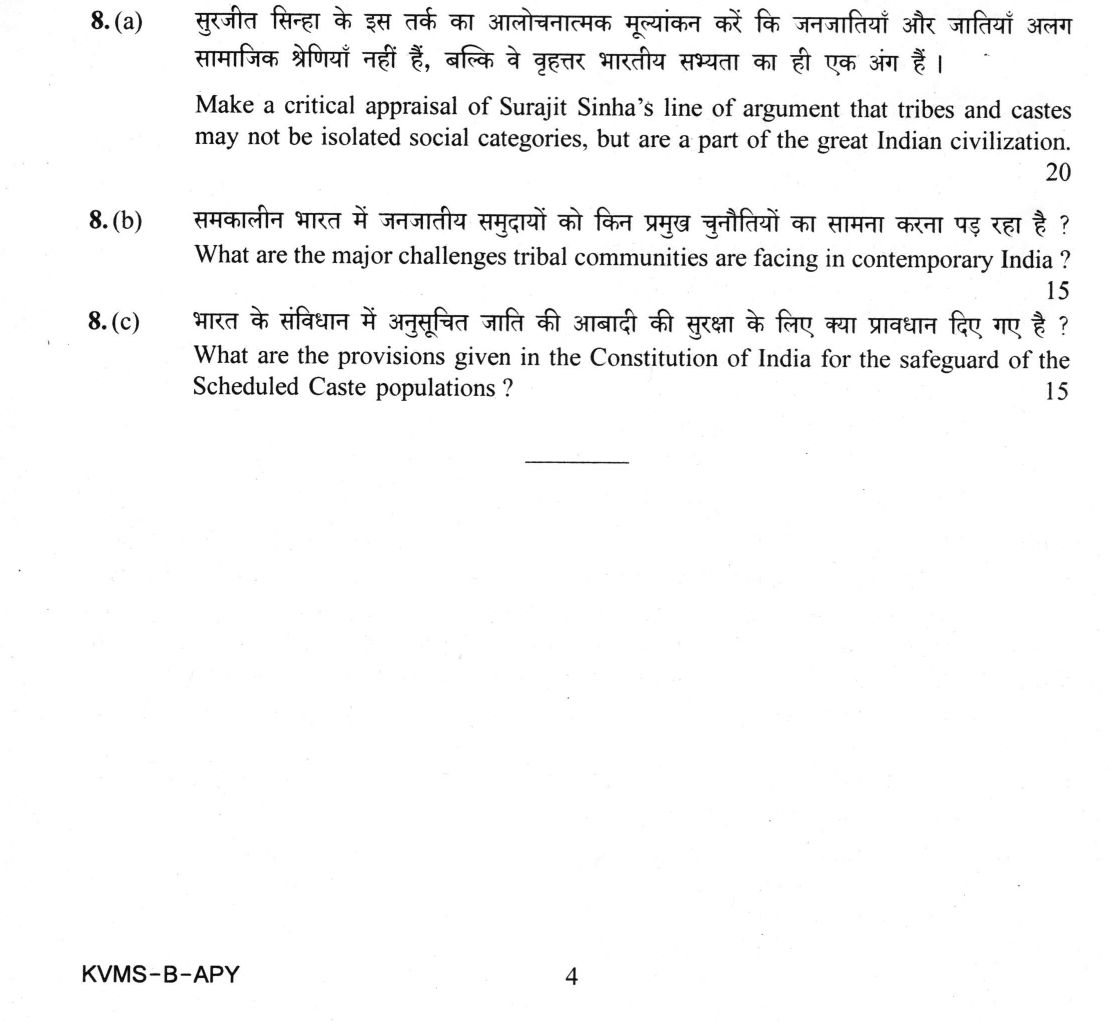
(a) Make a critical appraisal of Surajit Sinha's line of argument that tribes and castes may not be isolated social categories…
Make a critical appraisal of Surajit Sinha's line of argument that tribes and castes may not be isolated social categories, but are a part of the great Indian civilization. 20 marks
What are the major challenges tribal communities are facing in contemporary India ? 15 marks
What are the provisions given in the Constitution of India for the safeguard of the Scheduled Caste populations ? 15 marks
हिंदी में प्रश्न पढ़ें
सुरजीत सिन्हा के इस तर्क का आलोचनात्मक मूल्यांकन करें कि जनजातियाँ और जातियाँ अलग सामाजिक श्रेणियाँ नहीं हैं, बल्कि वे वृहत्तर भारतीय सभ्यता का ही एक अंग हैं । (20 अंक)
समकालीन भारत में जनजातीय समुदायों को किन प्रमुख चुनौतियों का सामना करना पड़ रहा है ? (15 अंक)
भारत के संविधान में अनुसूचित जाति की आबादी की सुरक्षा के लिए क्या प्रावधान दिए गए हैं ? (15 अंक)
Model answer
Drafted with AI by UPSC Answer Check against this question's marking rubric, to the expected length. UPSC does not publish answers for Mains — this is one way to score well, not an official key. How we build rubrics and answers.
(a) Surajit Sinha's tribe-caste-civilisation thesis: a critical appraisal
Introduction: Surajit Sinha (1926-2002), N. K. Bose's student and later Director of the Anthropological Survey of India, argued that tribe and caste are not bounded, exclusive types but positions on interpenetrating continua within one Indian civilisational field.
Works: 'State Formation and Rajput Myth in Tribal Central India' (1962), 'Tribe-Caste and Tribe-Peasant Continua in Central India' (1965) and 'Tribes and Indian Civilization' (1982).
Thesis: The continuum is multi-dimensional: economically from foraging through shifting cultivation to settled peasantry; politically from lineage organisation through chiefdom to the little kingdom; religiously from autonomous cults to Brahman priests and Sanskritic ritual; socially from clan exogamy towards caste endogamy. 'Tribalness' is a matter of degree, produced by long two-way interaction with the state-ordered Hindu civilisation.
Evidence: Rajputisation of tribal chiefs, the Bhumij of south Manbhum, the Raj Gond, the Chero, who acquired Brahman priests, temple patronage and fabricated Kshatriya genealogies while subjects stayed tribal; and the reverse flow of tribal deities into regional Hinduism, classically the Jagannath cult with its Sabara associations.
Lineage: He builds on Bose's 'Hindu method of tribal absorption' (1941), Redfield and Singer's great and little traditions, Marriott's universalisation and Srinivas's Sanskritisation; runs parallel to Bailey's land-based continuum and Beteille's relational 'Concept of Tribe' (1986); and rejects Ghurye's 'backward Hindus' and Elwin's isolate alike.
Critique: Virginius Xaxa argues the continuum idiom makes conquest and land alienation look like benign absorption; indigeneity and dispossession describe the tribal predicament better. Derived from Chotanagpur, Bastar and highland Odisha, the model fits poorly the Naga, Mizo, Khasi and Andamanese, never inside a Hindu civilisational field. It sits badly with adivasi assertion of Sarna and Donyi-Polo identities; its dimensions do not move together; the Rajputisation documented was an elite affair; and the civilisational-unity argument has been invoked by those who dispute adivasi indigeneity or favour de-listing.
Conclusion: The thesis is historically compelling for central and eastern India but neither universal nor politically innocent.
(b) Major challenges before tribal communities today
Introduction: Tribal India's challenges are structural, rooted in land, forest and the state, not cultural deficiency.
Land and displacement: Alienation continues despite the Chota Nagpur Tenancy Act, 1908, the Santhal Parganas Tenancy Act, 1949 and Samatha (1997); dams, mines and protected areas have displaced tribals far beyond their 8.6 per cent population share; Gram Sabha consent under section 41 of the LARR Act, 2013 is weakly enforced, further diluted by the Forest (Conservation) Rules, 2022 and Amendment Act, 2023.
Forest rights: The Forest Rights Act, 2006 is under-implemented: mass rejection of individual claims, minimal community forest resource and PVTG habitat rights, and relocation from tiger reserves (the stayed 2019 Wildlife First eviction order).
Health and education: STs show the highest multidimensional poverty, the worst NFHS-5 stunting, anaemia and child mortality, and the health gaps the Bang Committee (2018) documented; ST literacy was about 59 per cent against 73 nationally (Census 2011).
Governance and conflict: PESA, 1996 rules came decades late; Tribes Advisory Councils rarely meet. Communities are caught between state and Maoists (Salwa Judum struck down in Nandini Sundar, 2011); AFSPA persists in the North-East; Manipur's conflict has run since 2023.
Identity and gender: Endangered languages, the Sarna code demand versus de-listing; women denied inheritance under custom (Madhu Kishwar, 1996), witch-hunting, and custom against statutory equality in Nagaland.
Livelihood and differentiation: Declining shifting cultivation, indebtedness, distress migration, and a small elite capturing benefits while PVTGs stay most deprived (Xaxa Committee, 2014).
Conclusion: The common thread is the gap between protective law and its working; the remedy is Gram Sabha-anchored implementation.
(c) Constitutional safeguards for Scheduled Castes
Introduction: Scheduled Caste safeguards fall into five groups; the Fifth and Sixth Schedules concern Scheduled Tribes, not these.
Definition and machinery: Article 341 lets the President notify each State's Scheduled Castes, Parliament alone altering the list; Article 366(24) defines them; the Constitution (Scheduled Castes) Order, 1950 lists them, paragraph 3 limiting status to Hindus, Sikhs (1956) and Buddhists (1990); Article 338 creates the National Commission for Scheduled Castes (separated from the ST body by the 89th Amendment, 2003).
Social: Article 17 abolishes untouchability, enforced by the Protection of Civil Rights Act, 1955 and the SC/ST (Prevention of Atrocities) Act, 1989; Article 15(2) bars disability in access to shops, wells, tanks, roads and places of public resort; Article 23 prohibits forced labour; Article 25(2)(b) enables temple entry; Article 29(2) bars caste-based denial of admission.
Educational and economic: Article 15(4) (1951) permits special provision; Article 15(5) (2005) extends reservation to private unaided institutions; Article 46 directs the State to promote their educational and economic interests.
Service: Article 16(4) permits reservation in appointments, 16(4A) in promotion, 16(4B) backlog carry-forward; Article 335 balances claims with efficiency, its 82nd Amendment proviso allowing relaxed qualifying marks.
Political: Article 330 reserves 84 Lok Sabha seats, Article 332 assembly seats, Articles 243D and 243T panchayat and municipal seats; Article 325 secures a common roll; Article 334 (104th Amendment, 2019) runs reservation to 2030.
In operation: Indra Sawhney (1992) set the fifty per cent ceiling; Davinder Singh (2024) permits sub-classification within SCs; Dalit converts' exclusion remains contested.
They combine prohibition of disability, positive discrimination and monitoring machinery.
How this answer will be evaluated
Evaluation rubric
Each sub-part is marked on its own, against the marks and word limit printed on the paper.
- (a) 'Critical appraisal' of a named scholar's thesis: state Surajit Sinha's argument that tribe and caste are not isolated categories but parts of a single Indian civilisational field, show the evidence and the intellectual lineage on which it rests, and then weigh it against its critics - especially the North-East exception and the dispossession critique. 20 marks
Must cover
- Surajit Sinha (1926-2002); Director, Anthropological Survey of India
- 'State Formation and Rajput Myth in Tribal Central India' (1962)
- 'Tribe-Caste and Tribe-Peasant Continua in Central India' (1965)
- Bhumij-Kshatriya movement in south Manbhum
- Rajputisation / Kshatriyisation of tribal chiefs; the little kingdom
- N. K. Bose, 'Hindu method of tribal absorption' (1941)
- Redfield and Singer - great and little traditions; Marriott's universalisation and parochialisation
- M. N. Srinivas - Sanskritisation
- Andre Beteille, 'The Concept of Tribe with Special Reference to India' (1986)
- Virginius Xaxa - the indigeneity and dispossession critique
- Ghurye's 'backward Hindus' and Elwin's isolation as the rejected alternatives
Loses marks
- Writing a general essay on the tribe-caste continuum without attributing the specific argument to Surajit Sinha and his works.
- Confusing Sinha's continuum with F. G. Bailey's; Bailey's criterion is the mode of access to land, Sinha's is civilisational interaction and state formation.
- Attributing the 'Hindu method of tribal absorption' to Sinha; it is N. K. Bose's formulation, which Sinha builds upon.
- Missing the North-East and Andaman exception, which is the strongest empirical objection to the thesis.
- Ignoring the political stakes - the use of the civilisational-unity argument against the indigenous-peoples framework - which is what makes the appraisal 'critical'.
- Presenting Sinha as an assimilationist like Ghurye; his position is processual and two-way, not assimilationist.
Earns more
- Intellectual lineage and the positions rejected: Sinha builds on N. K. Bose's 'Hindu method of tribal absorption' (1941), on Robert Redfield and Milton Singer's great and little traditions and Redfield's civilisational analysis, on McKim Marriott's universalisation and parochialisation, on M. N. Srinivas's Sanskritisation and on Bernard Cohn's little kingdom, and runs parallel to F. G. Bailey's land-based tribe-caste continuum, to Andre Beteille's argument in 'The Concept of Tribe with Special Reference to India' (1986) that the tribe is defined relationally by its position outside the caste and state order, and to K. S. Singh's anthropo-historical approach; against G. S. Ghurye's view that tribals are simply backward or imperfectly integrated Hindus and against Verrier Elwin's early construction of the tribe as a pristine isolate, Sinha offers a third, historical and processual position
Extra mark
- Hermann Kulke's work on Odisha's little kingdoms and the Jagannath cult as parallel historical evidence
- India's position on the 'indigenous peoples' category at the UN (UNDRIP, 2007) as the policy stake of the debate
- (b) Identify and substantiate the principal challenges facing tribal communities in India today, across land and displacement, forest rights, health and education, governance, conflict, identity and gender. Breadth with evidence is required; an undifferentiated lament about 'backwardness' will not score. 15 marks
Must cover
- land alienation despite CNT Act 1908 and Santhal Parganas Tenancy Act 1949; Samatha (1997)
- development-induced displacement; STs about 8.6 per cent of population but a far larger share of the displaced
- Forest Rights Act, 2006 - low recognition of community forest resource and habitat rights
- Forest (Conservation) Amendment Act, 2023 and the Rules of 2022
- NFHS-5 and the National Multidimensional Poverty Index; Bang Committee on Tribal Health (2018)
- ST literacy about 59 per cent (Census 2011)
- PESA, 1996 implementation gap; Tribes Advisory Councils
- left-wing extremism; Nandini Sundar v. State of Chhattisgarh (2011); AFSPA; Manipur conflict from 2023
- Sarna code demand versus the de-listing campaign; endangered tribal languages
- Xaxa Committee (2014)
Loses marks
- Writing a generic list of 'poverty, illiteracy, superstition' with no statute, committee, figure or case to support it.
- Covering only land and displacement and ignoring health, education, governance, identity and gender.
- Confusing the protective statutes - attributing the Chota Nagpur Tenancy Act to the wrong region, or treating PESA as applying to Sixth Schedule areas.
- Treating tribal communities as homogeneous and ignoring PVTGs, urban tribals, the North-East and internal differentiation.
- Framing the challenges as cultural backwardness rather than as structural consequences of land, forest and governance arrangements.
- Omitting the North-East entirely, where the challenges take a distinct form.
Earns more
- Governance deficits, conflict and securitisation: PESA, 1996 remains unevenly implemented, several states having framed rules only decades late; Tribes Advisory Councils under the Fifth Schedule are advisory and rarely convened, and the Governor's powers under paragraph 5 are almost never exercised; Sixth Schedule councils face elite capture and weak finances while Ladakh and the Manipur hills press for inclusion; the central Indian tribal belt remains the theatre of left-wing extremism with communities caught between the state and the Maoists - the Supreme Court having struck down Salwa Judum in Nandini Sundar v. State of Chhattisgarh (2011) - while the Armed Forces (Special Powers) Act persists in parts of the North-East and ethnic violence recurs, from Kandhamal in 2008 to the Meitei-Kuki-Zo conflict in Manipur from 2023
- Identity, language, religion and gender: many tribal languages are unwritten, unscheduled and endangered, sustaining long-standing demands for the inclusion of languages such as Bhoti, Ho, Mundari and Kurukh in the Eighth Schedule; religious identity is contested between the demand for a separate Sarna or nature-worship code in the Census and the campaign to de-list converted tribals from the Scheduled Tribe lists; customary political institutions have been displaced by statutory bodies; and tribal women face a double bind - customary law frequently denies them inheritance, as under the Chota Nagpur Tenancy Act considered in Madhu Kishwar v. State of Bihar (1996), witch-hunting persists despite state legislation in Jharkhand, Assam and elsewhere, and statutory gender equality collides with custom, as in the resistance to reserving seats for women in Nagaland's urban local bodies
- Livelihood insecurity, distress migration and internal differentiation: the decline of shifting cultivation and of forest-based subsistence without an adequate substitute; indebtedness and dependence on traders; large-scale distress migration to brick kilns, construction sites and, for Adivasi women from Jharkhand and Chhattisgarh, to domestic work in metropolitan cities with attendant trafficking risk; the invisibility of urban Scheduled Tribes in policy; and growing differentiation within tribal society, with a small salaried and political elite capturing benefits while Particularly Vulnerable Tribal Groups remain the most deprived, compounded by contested claims to Scheduled Tribe status by non-listed communities
Extra mark
- NFHS-6 (2023-24) cited as the latest national baseline, noting its reduced set of published indicators
- PM-JANMAN (2023) and PVTG-specific deprivation as the current policy response
- (c) Enumerate and explain the constitutional provisions safeguarding Scheduled Castes - definitional, social, educational and economic, political and service-related - with the correct article numbers. The question is about Scheduled CASTES: the Fifth and Sixth Schedules and Scheduled Areas belong to Scheduled Tribes and are not the answer. 15 marks
Must cover
- Article 341 and Article 366(24); Constitution (Scheduled Castes) Order, 1950
- Article 338 - National Commission for Scheduled Castes; 89th Amendment, 2003
- Article 17 - abolition of untouchability; PCR Act 1955; SC/ST (Prevention of Atrocities) Act 1989
- Article 15(2) - access to shops, wells, tanks, roads and places of public resort
- Article 25(2)(b) - temple entry; Article 29(2)
- Articles 15(4) and 15(5); Article 16(4), 16(4A), 16(4B)
- Article 335 and its 82nd Amendment proviso; Article 46
- Articles 330 and 332 - 84 Lok Sabha seats reserved for SCs
- Articles 243D and 243T; Article 325; Article 334 and the 104th Amendment, 2019
- Article 23 - prohibition of forced labour
Loses marks
- Answering about Scheduled Tribes instead - writing on the Fifth Schedule, Sixth Schedule, Articles 244, 342, 275(1), PESA or the Forest Rights Act, none of which are Scheduled Caste safeguards.
- Citing articles without stating what they contain, so the answer becomes a bare numerical list.
- Getting the definitional articles the wrong way round - Article 341 is Scheduled Castes and Article 342 is Scheduled Tribes.
- Omitting Article 17 and the untouchability legislation, which is the single most important social safeguard.
- Omitting the Directive Principle in Article 46, or the service safeguard in Article 335 with its 82nd Amendment proviso.
- Wrong numbers - the Lok Sabha reserves 84 seats for Scheduled Castes and 47 for Scheduled Tribes, and reservation of seats now runs to 2030 under the 104th Amendment.
Earns more
- Political safeguards: Article 330 reserves seats for Scheduled Castes in the House of the People, currently 84 of the 543 elective seats; Article 332 reserves seats in the State Legislative Assemblies; Articles 243D and 243T reserve seats and chairpersonships in panchayats and municipalities in proportion to population; Article 325 provides that no person shall be ineligible for inclusion in the electoral roll on grounds of religion, race, caste or sex, securing the single common roll; and Article 334 fixes the duration of the reservation of seats, extended to 25 January 2030 by the Constitution (One Hundred and Fourth Amendment) Act, 2019, which simultaneously discontinued the nomination of Anglo-Indians
- Judicial development and live controversies, showing the provisions in operation: Indra Sawhney (1992) fixed the ordinary fifty per cent ceiling on reservation; M. Nagaraj (2006) and Jarnail Singh (2018) governed reservation in promotion for Scheduled Castes and Scheduled Tribes and applied the creamy-layer principle to promotions; State of Punjab v. Davinder Singh (2024), decided by a seven-judge bench, held that States may sub-classify within the Scheduled Castes for more targeted reservation; and the exclusion of Dalit converts to Christianity and Islam from Scheduled Caste status under paragraph 3 of the 1950 Order remains contested, the Ranganath Misra Commission (2007) having recommended de-linking Scheduled Caste status from religion and the Justice K. G. Balakrishnan Commission having been constituted in 2022 to examine the question
Extra mark
- The SC/ST (Prevention of Atrocities) Amendment Act, 2018 (section 18A) after Subhash Kashinath Mahajan (2018)
- The Justice K. G. Balakrishnan Commission (2022) on Dalit converts
What "Discuss" is asking you to do
Lay the issue out from more than one side — how it arose, what is claimed for it, what is held against it, and where it now stands. UPSC attaches discuss to broad topics with several live dimensions, so coverage of the dimensions earns more than the strength of your opinion.
Structure that answers it
Set the issue up → the case as it is made → the case against → the dimension both sides leave out → where the balance now lies
Where marks are lost
Listing facts with no thread between them, or arguing one side throughout and calling it a discussion.
Practice this exact question
Write your answer and it is marked point by point against the model answer above — what you covered, what you missed, what you got wrong.
Evaluate my answer →More from Anthropology 2026 Paper II
- Q5 Write notes on the following in about 150 words each : (a) Buddhist tribes of India. (10…
- Q6 (a) Make a critical appraisal of the mesolithic culture of Ganga basin with reference to…
- Q7 (a) Assess the contribution of colonial scholars in studying the tribal populations of No…
- Q8 (a) Make a critical appraisal of Surajit Sinha's line of argument that tribes and castes…