Paper II — Q6
(a) Make a critical appraisal of the mesolithic culture of Ganga basin with reference to artifacts, faunal and human skeletal…
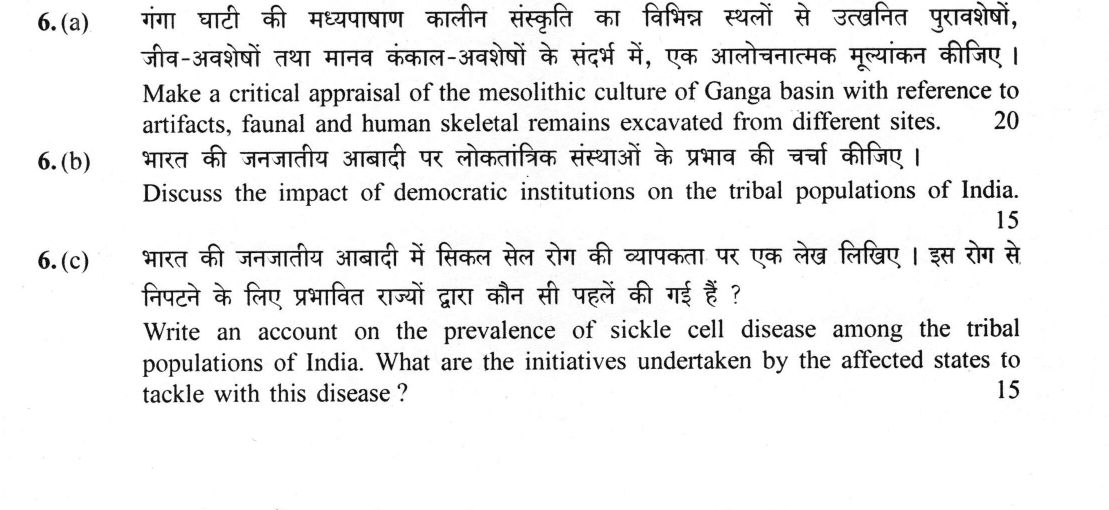
Make a critical appraisal of the mesolithic culture of Ganga basin with reference to artifacts, faunal and human skeletal remains excavated from different sites. 20 marks
Discuss the impact of democratic institutions on the tribal populations of India. 15 marks
Write an account on the prevalence of sickle cell disease among the tribal populations of India. What are the initiatives undertaken by the affected states to tackle with this disease ? 15 marks
हिंदी में प्रश्न पढ़ें
गंगा घाटी की मध्यपाषाण कालीन संस्कृति का विभिन्न स्थलों से उत्खनित पुरावशेषों, जीव-अवशेषों तथा मानव कंकाल-अवशेषों के संदर्भ में, एक आलोचनात्मक मूल्यांकन कीजिए । (20 अंक)
भारत की जनजातीय आबादी पर लोकतांत्रिक संस्थाओं के प्रभाव की चर्चा कीजिए । (15 अंक)
भारत की जनजातीय आबादी में सिकल सेल रोग की व्यापकता पर एक लेख लिखिए । इस रोग से निपटने के लिए प्रभावित राज्यों द्वारा कौन सी पहलें की गई हैं ? (15 अंक)
Model answer
Drafted with AI by UPSC Answer Check against this question's marking rubric, to the expected length. UPSC does not publish answers for Mains — this is one way to score well, not an official key. How we build rubrics and answers.
(a) The Ganga basin Mesolithic: a critical appraisal
Introduction: The Ganga plain Mesolithic is known chiefly from three lakeside settlements in Pratapgarh district, Uttar Pradesh, Sarai Nahar Rai, Mahadaha and Damdama, excavated by G. R. Sharma, V. D. Misra and J. N. Pal, plus Chopani Mando (Belan valley) and the Vindhyan shelters Lekhahia and Baghai Khor. Radiocarbon dates are few and inconsistent; the chronology is early-to-middle Holocene.
Artefacts: Geometric and non-geometric microliths (lunates, trapezes, backed blades) on chert, chalcedony and agate; none occurs in the alluvium, so raw material came from the Vindhyas, implying mobility or exchange. Mahadaha and Damdama add bone and antler arrowheads and ornaments; querns and mullers show plant processing; hearths, pits and post-holes show semi-sedentary occupation. Chopani Mando's advanced level yielded wattle-and-daub floors and crude handmade pottery, a disputed priority claim.
Faunal remains: Bos, buffalo, sheep and goat, deer, nilgai, rhinoceros (Mahadaha), tortoise, fish and molluscs show broad-spectrum lake-margin exploitation. The excavators' domestication claim for cattle and caprines is contested: osteometric criteria are unmet, samples fragmentary, wild ancestors locally present.
Human skeletal remains: The three sites yield South Asia's largest Mesolithic series, roughly a dozen individuals at Sarai Nahar Rai, thirty at Mahadaha and forty at Damdama, studied by K. A. R. Kennedy and J. R. Lukacs. The people were tall (males around 175 cm) and robust, with megadont, worn teeth; very low caries fits a non-agricultural diet, enamel hypoplasia shows childhood stress, and a projectile point in a rib at Sarai Nahar Rai attests violence. 'Proto-Australoid' is an obsolete label, not an explanation.
Burials: Extended supine interments within the habitation, head west, with microliths, bone ornaments and meat offerings; multiple burials at Damdama suggest kin ritual.
Appraisal: Shallow deflated deposits, old excavations lacking full reports, no flotation (hence no plant data) and a thin radiocarbon series limit interpretation.
Conclusion: The evidence securely shows semi-sedentary, broad-spectrum, lake-margin foraging with formal burial and long-distance raw-material procurement; domestication remains unproven.
(b) Democratic institutions and tribal India
Introduction: Democratic institutions have given tribal India representation and self-rule while displacing its own political forms.
Architecture: Universal franchise; 47 Lok Sabha seats under Article 330 and assembly seats under Article 332, extended to 2030 by the 104th Amendment; the Fifth Schedule with Tribes Advisory Councils and Governor's paragraph 5 powers; the Sixth Schedule's ten autonomous councils in Assam, Meghalaya, Tripura and Mizoram; PESA, 1996 in the ten Fifth Schedule states; Gram Sabha powers under the Forest Rights Act, 2006; and the NCST under Article 338A.
Gains: A tribal leadership from Jaipal Singh Munda to Droupadi Murmu as President (2022); tribal-majority states from Nagaland (1963) to Jharkhand and Chhattisgarh (2000); the Mizo Accord (1986) turning insurgency into electoral politics; Gram Sabha control of minor forest produce, minor minerals and consent under PESA; the courts' backing in Samatha (1997) and Niyamgiri (2013).
Erosion of indigenous polities: Statutory panchayats and party structures have subordinated the Munda-Manki system, the Oraon Parha, the Santal Manjhi-Pargana and the Khasi dorbar shnong, producing dual authority and decay of consensual custom; only Nagaland's Village and Area Councils Act, 1978 gives custom statutory footing.
Distortions and deficits: Factionalism, money and liquor cut across clan ties; reserved-seat members answer to parties, not communities (Xaxa Committee, 2014); at 8.6 per cent tribals are electorally outweighed. Tribes Advisory Councils rarely meet, paragraph 5 powers go unused, PESA rules came decades late, Sixth Schedule councils suffer elite capture, and the persistence of left-wing extremism and of AFSPA in parts of the North-East marks areas where democratic delivery is contested.
Conclusion: Democracy has enlarged tribal voice; the gap between formal architecture and its working remains the central problem.
(c) Sickle cell disease among Indian tribes and state initiatives
Introduction: Sickle cell disease is the textbook case of balanced polymorphism among Indian tribes.
Genetics: A GAG-to-GTG point mutation at codon six of the beta-globin (HBB) gene substitutes valine for glutamic acid, giving HbS. HbSS is the disease; HbAS the usually asymptomatic trait, which protects against Plasmodium falciparum malaria (Allison, 1954), so selection in malarious forests has kept the gene frequent and tribal endogamy preserves it locally. Indian HbS carries mainly the Arab-Indian haplotype with high fetal haemoglobin.
Distribution and burden: Lehmann and Cutbush first reported it in 1952 among Nilgiri tribes. The belt runs through Madhya Pradesh, Chhattisgarh, Vidarbha, Gujarat, Odisha, Jharkhand, Telangana and Andhra Pradesh; trait frequencies among the Bhil, Gond, Madia, Korku, Baiga, Kondh and Paniya range from about one to over thirty per cent. An estimated twenty million Indians carry the trait or the disease; the Bang Committee (2018) called it a defining tribal health problem. Clinically: haemolytic anaemia, vaso-occlusive crises, infection from functional asplenia and child mortality, managed with hydroxyurea, prophylaxis and transfusion.
National mission: The National Sickle Cell Anaemia Elimination Mission (launched 1 July 2023, Shahdol) aims at elimination by 2047 by screening seven crore people aged 0-40 in seventeen states, genetic-status cards, counselling and free treatment through Ayushman Arogya Mandirs.
State initiatives: Gujarat's control programme (2006) in its eastern tribal districts with free hydroxyurea; Chhattisgarh's Sickle Cell Institute, Raipur; Maharashtra's Vidarbha programme; Odisha's screening scheme; and disability entitlements under the Rights of Persons with Disabilities Act, 2016.
Elimination depends less on screening counts than on counselling, hydroxyurea supply and handling carrier stigma in endogamous communities.
How this answer will be evaluated
Evaluation rubric
Each sub-part is marked on its own, against the marks and word limit printed on the paper.
- (a) A critical appraisal of the Ganga basin Mesolithic organised around three explicitly named classes of evidence - artefacts, faunal remains and human skeletal remains - from excavated sites, followed by an assessment of how secure the interpretations are. All three classes must be covered and at least three sites named. 20 marks
Must cover
- Sarai Nahar Rai, Mahadaha, Damdama (Pratapgarh district, Uttar Pradesh)
- Chopani Mando (Belan valley); Lekhahia; Baghai Khor; Morhana Pahar
- G. R. Sharma; V. D. Misra; J. N. Pal
- geometric microliths on chert, chalcedony, agate - raw material imported from the Vindhyas
- bone and antler tools at Mahadaha and Damdama
- querns and mullers; hearths; wattle-and-daub floors; crude pottery at Chopani Mando
- Bos, sheep/goat, deer, rhinoceros, fish and molluscs; the contested domestication claim
- largest Mesolithic skeletal series in South Asia; K. A. R. Kennedy and J. R. Lukacs
- tall robust stature; low caries; enamel hypoplasia; embedded projectile point at Sarai Nahar Rai
- extended supine burials, head to the west, with grave goods; multiple burials at Damdama
Loses marks
- Covering only artefacts and ignoring the faunal or skeletal evidence, when the question names all three explicitly.
- Naming no site, or naming Bhimbetka, Bagor, Langhnaj or Adamgarh as if they were Ganga basin sites - they are Vindhyan, Rajasthani, Gujarati and Narmada-valley sites respectively.
- Asserting flatly that Ganga plain Mesolithic people had domesticated cattle and sheep; this is the single most contested claim and must be presented as disputed.
- Using 'Proto-Australoid' as a racial explanation of the skeletal morphology instead of describing the morphology and noting that the label is obsolete.
- Quoting a precise early date for Sarai Nahar Rai or for Chopani Mando pottery without noting that the determinations are questioned.
- Writing a description with no critical assessment, when the directive is 'critical appraisal'.
Earns more
- Sites and chronological frame, with the dating problem stated: the principal excavated sites are Sarai Nahar Rai, Mahadaha and Damdama in Pratapgarh district of Uttar Pradesh, all lakeside or oxbow-margin settlements largely investigated by G. R. Sharma, V. D. Misra, J. N. Pal and J. N. Pandey of Allahabad University, together with Chopani Mando in the Belan valley and the Vindhyan rock shelters of Lekhahia, Baghai Khor and Morhana Pahar in the Mirzapur tract; radiocarbon determinations place the complex broadly in the early to middle Holocene, but they are few, internally inconsistent and in the case of the very early date from Sarai Nahar Rai widely doubted, so the chronology should be presented as approximate
- Burial practice and its social interpretation: the dead were buried within the habitation area in shallow oblong graves, usually extended and supine with the head to the west, accompanied by grave goods including microliths, bone and antler ornaments and chunks of animal bone interpreted as meat offerings, with occasional use of ochre; double and multiple interments occur, notably at Damdama, and have been read as evidence of kin-based ritual and possibly of emerging social differentiation - an interpretation that must be treated cautiously since grave-good variation may reflect age, sex or circumstance rather than rank, and since the graves may be intrusive into the habitation deposit rather than contemporaneous with it
- Critical appraisal of the evidence base: the sites are shallow, deflated alluvial deposits with poor stratigraphic resolution; excavation was conducted decades ago, several sites lack full final reports, and systematic flotation and fine screening were not used, so archaeobotanical evidence is almost absent and the plant component of the diet is essentially unknown; the radiocarbon series is thin and inconsistent; the domestication and earliest-pottery claims rest on weak samples; and the racial labels once applied to the skeletons are obsolete - yet what the evidence does establish securely is a semi-sedentary, broad-spectrum, lake-margin foraging adaptation with formal burial and long-distance raw-material procurement, which is a significant pre-agricultural stage bridging to the Belan valley Neolithic
Extra mark
- Links to the Belan valley Neolithic (Koldihwa, Mahagara) or to early rice at Lahuradewa
- Dental-anthropological work on the skeletons (J. R. Lukacs) used to infer diet and stress
- (b) 'Discuss the impact' of democratic institutions - franchise, reserved representation, panchayati raj and PESA, Sixth Schedule councils, the Fifth Schedule machinery, the courts - on tribal populations. Both the empowering and the corrosive effects must be argued, with the displacement of traditional political institutions treated explicitly. 15 marks
Must cover
- Articles 330 and 332; 47 Lok Sabha seats reserved for STs; 104th Amendment (2019)
- Article 244(1) Fifth Schedule and Tribes Advisory Council; Article 244(2) Sixth Schedule
- ten Autonomous District/Territorial Councils in Assam, Meghalaya, Tripura and Mizoram
- PESA, 1996 in ten Fifth Schedule states
- Forest Rights Act, 2006 - Gram Sabha
- Article 338A - National Commission for Scheduled Tribes
- Munda-Manki, Parha, Manjhi-Pargana, dorbar shnong - traditional institutions displaced
- Droupadi Murmu (2022); Jaipal Singh Munda
- Mizo Accord 1986; creation of Jharkhand and Chhattisgarh, 2000
- Xaxa Committee (2014); Samatha (1997); Niyamgiri (2013)
Loses marks
- Writing a one-sided answer - either a list of constitutional provisions with no critique, or a critique with no institutional detail.
- Omitting the erosion of traditional tribal political institutions, which is the distinctively anthropological part of the answer.
- Confusing the Fifth and Sixth Schedules, or applying PESA to Sixth Schedule areas - PESA extends Part IX to Fifth Schedule Scheduled Areas, and Part IX does not apply to Sixth Schedule areas.
- Wrong figures - the Lok Sabha has 47 seats reserved for Scheduled Tribes and 84 for Scheduled Castes, and Scheduled Tribes are about 8.6 per cent of the population.
- Treating 'democratic institutions' as meaning only elections, ignoring panchayati raj, the autonomous councils, the courts, the NCST and the Gram Sabha.
- Ignoring the North-East, where the Sixth Schedule and the accords are the central experience of democratic institutions.
Earns more
- Distortions of democratic practice: party factionalism, money and liquor have penetrated village politics and cut across kin and clan solidarities; representatives on reserved seats are frequently accountable to party organisations rather than to their communities, a criticism made by the Xaxa Committee (2014); a small tribal political and administrative elite has emerged alongside continuing mass deprivation, sharpening internal differentiation; and because Scheduled Tribes are only about 8.6 per cent of the national population (Census 2011) and a minority in most states, majoritarian electoral arithmetic can still override tribal interests in land, forest and mining
- Institutional under-performance and the democratic deficit: Tribes Advisory Councils are merely advisory and are convened irregularly; the Governor's power under paragraph 5 of the Fifth Schedule to exempt or modify the application of laws in Scheduled Areas is almost never exercised; several states framed PESA rules only decades after 1996; Sixth Schedule councils face charges of elite capture, weak finances, dependence on state transfers and neglect of smaller tribes within their jurisdictions, even as Ladakh and the Manipur hills press for inclusion; and the persistence of left-wing extremism in the central Indian tribal belt and of the Armed Forces (Special Powers) Act in parts of the North-East marks areas where democratic delivery is contested
Extra mark
- Nagaland's 2024 urban local body elections with women's reservation, or women's land rights under customary law, as a custom-versus-equality tension
- Ladakh's post-2019 demand for Sixth Schedule inclusion as a test of the institutional architecture
- (c) Two parts, both required: (i) an account of the prevalence of sickle cell disease among Indian tribal populations - its genetics, why it is concentrated there, its geographical and community distribution and its clinical burden; and (ii) the initiatives taken by the affected states, which should also include the national mission they operate under. 15 marks
Must cover
- HBB gene, sixth codon, glutamic acid replaced by valine, HbS
- HbSS disease versus HbAS trait
- heterozygote advantage against Plasmodium falciparum; balanced polymorphism
- Arab-Indian haplotype and high fetal haemoglobin
- Lehmann and Cutbush (1952), Nilgiri tribes
- Bhil, Gond, Madia, Korku, Baiga, Kondh, Paniya
- Madhya Pradesh, Chhattisgarh, Maharashtra, Gujarat, Odisha, Jharkhand, Telangana
- National Sickle Cell Anaemia Elimination Mission, launched 1 July 2023 at Shahdol; elimination by 2047
- screening of about 7 crore people aged 0-40 in 17 states; genetic cards
- hydroxyurea; Gujarat's 2006 programme; Sickle Cell Institute Chhattisgarh
- Rights of Persons with Disabilities Act, 2016
Loses marks
- Answering only the biology and omitting the state initiatives, or only the schemes and omitting the genetics - both halves are asked.
- Getting the mutation wrong - it is a substitution of valine for glutamic acid at the sixth codon of the beta-globin gene, not the alpha chain and not a deletion.
- Confusing sickle cell disease with thalassaemia or with G6PD deficiency, all of which occur in the same populations but are different disorders.
- Omitting the malaria-selection explanation, which is the specifically anthropological content of the answer.
- Naming no tribe and no state, so the 'prevalence among tribal populations' is never actually described.
- Presenting the trait (HbAS) as a disease; carriers are usually asymptomatic, and conflating the two inflates prevalence figures.
Earns more
- Clinical burden and management: chronic haemolytic anaemia with vaso-occlusive painful crises, dactylitis in infancy, splenic sequestration and functional asplenia with consequent infection, acute chest syndrome, stroke, aplastic crisis, priapism, leg ulcers, delayed growth and high childhood mortality, with heavy schooling and work loss; management rests on newborn and community screening, folic acid, hydroxyurea to raise fetal haemoglobin, penicillin prophylaxis and pneumococcal vaccination, hydration, analgesia and transfusion, with haematopoietic stem cell transplantation curative and gene-editing therapy newly licensed abroad but not yet accessible at scale in India
- State-level initiatives: Gujarat ran the earliest state programme, the Sickle Cell Anaemia Control Programme begun in 2006 in its eastern tribal districts, providing screening, cards, counselling, free hydroxyurea and financial assistance to patients; Maharashtra operates a control programme concentrated in the Vidarbha districts; Chhattisgarh established a dedicated Sickle Cell Institute at Raipur which has screened many millions and supplies free medication; Madhya Pradesh launched a sickle cell mission in the Jhabua-Alirajpur tribal belt and hosted the national launch; Odisha runs a state screening and elimination programme with financial assistance to patients; ICMR's National Institute of Research in Tribal Health at Jabalpur provides the research base; and sickle cell disease is a specified disability under the Rights of Persons with Disabilities Act, 2016, entitling patients to disability certificates and the benefits that follow
Extra mark
- CRISPR gene therapy (exa-cel), approved abroad from late 2023 but not yet accessible at scale in India
- ICMR's National Institute of Research in Tribal Health, Jabalpur, as the research base
What "Discuss" is asking you to do
Lay the issue out from more than one side — how it arose, what is claimed for it, what is held against it, and where it now stands. UPSC attaches discuss to broad topics with several live dimensions, so coverage of the dimensions earns more than the strength of your opinion.
Structure that answers it
Set the issue up → the case as it is made → the case against → the dimension both sides leave out → where the balance now lies
Where marks are lost
Listing facts with no thread between them, or arguing one side throughout and calling it a discussion.
Practice this exact question
Write your answer and it is marked point by point against the model answer above — what you covered, what you missed, what you got wrong.
Evaluate my answer →More from Anthropology 2026 Paper II
- Q3 (a) Critically examine the salience of F. G. Bailey’s study on Bisipara village of Odisha…
- Q4 (a) Write an account on the contribution of Verrier Elwin in developing policies for the…
- Q5 Write notes on the following in about 150 words each : (a) Buddhist tribes of India. (10…
- Q6 (a) Make a critical appraisal of the mesolithic culture of Ganga basin with reference to…
- Q7 (a) Assess the contribution of colonial scholars in studying the tribal populations of No…
- Q8 (a) Make a critical appraisal of Surajit Sinha's line of argument that tribes and castes…