Paper II — Q3
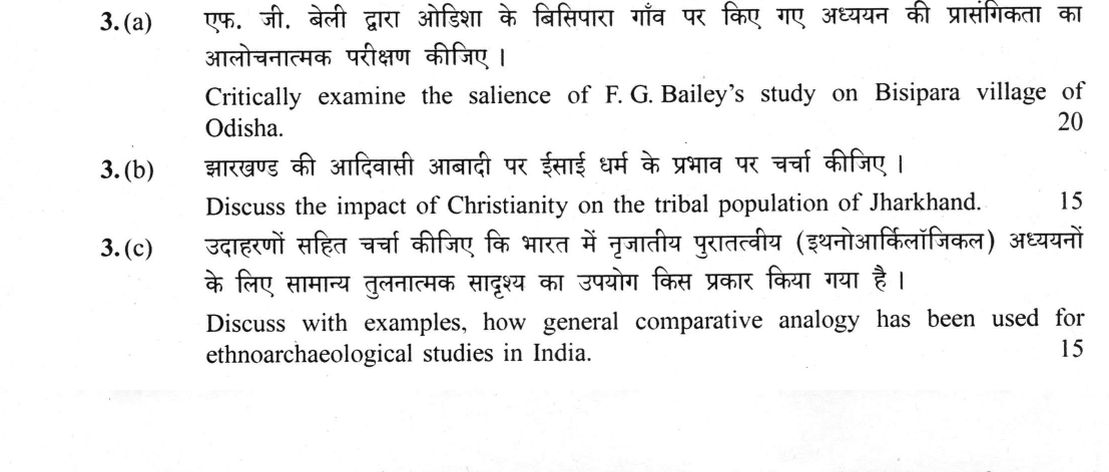
(a) Critically examine the salience of F. G. Bailey’s study on Bisipara village of Odisha. (20 marks) (b) Discuss the impact of…
Critically examine the salience of F. G. Bailey’s study on Bisipara village of Odisha. 20 marks
Discuss the impact of Christianity on the tribal population of Jharkhand. 15 marks
Discuss with examples, how general comparative analogy has been used for ethnoarchaeological studies in India. 15 marks
हिंदी में प्रश्न पढ़ें
एफ. जी. बेली द्वारा ओडिशा के बिसिपारा गाँव पर किए गए अध्ययन की प्रासंगिकता का आलोचनात्मक परीक्षण कीजिए । (20 अंक)
झारखण्ड की आदिवासी आबादी पर ईसाई धर्म के प्रभाव पर चर्चा कीजिए । (15 अंक)
उदाहरणों सहित चर्चा कीजिए कि भारत में नृजातीय पुरातत्वीय (इथनोआर्कियोलॉजिकल) अध्ययनों के लिए सामान्य तुलनात्मक सादृश्य का उपयोग किस प्रकार किया गया है । (15 अंक)
Model answer
Drafted with AI by UPSC Answer Check against this question's marking rubric, to the expected length. UPSC does not publish answers for Mains — this is one way to score well, not an official key. How we build rubrics and answers.
(a) Salience of F. G. Bailey's Bisipara study
Introduction: F. G. Bailey, Manchester-trained under Max Gluckman, studied Bisipara, a multi-caste Oriya village in the Kondmals of Odisha (now Kandhamal), in 1952-55, producing 'Caste and the Economic Frontier' (1957), 'Tribe, Caste and Nation' (1960) and 'Politics and Social Change' (1963).
Economic frontier: Caste rank rested on land held by the Warrior caste, and the closed village order could absorb mobility only while resources stayed internal. When outside wealth arrived, first the liquor trade enriching the distillers, then trade and salaried jobs, economic position and ritual rank came apart and newly rich low castes pressed status claims: ranking became contestable.
Tribe-caste continuum: Bailey made tribe and caste poles of one continuum defined by mode of access to land: direct through community membership at the tribal pole, mediated by a hierarchy of rights and the market at the caste pole. Kondh and Oriya thus sit on one scale, a materialist counterpart to Surajit Sinha's civilisational continuum.
Political anthropology: The political volumes gave Indian anthropology the 'arena', the 'encapsulated' political structure inside the state and bridge-actors linking village to state, generalised in 'Stratagems and Spoils' (1969) as a transactional model.
Salience: The study is processual, links village to state when village studies were dismissed as isolates, gives a material criterion for the tribe-caste question, and remains the baseline for Kandhamal's later Kondh-Pana-Oriya conflicts over land and reservation.
Critique: Dumont and Pocock, in Contributions to Indian Sociology, charged economic reductionism, insisting caste is constituted ideologically by the pure/impure opposition; Bailey replied in 'For a Sociology of India?'. Later critics add that transactionalism reduces politics to individual strategy, underplaying structure and class; that the 'closed economy' baseline is an idealisation; and that Kondh voices and gender get far less attention than Oriya caste actors.
Conclusion: Bisipara remains salient as method and concept-generator even where its closed-to-open economy model is too schematic: the concepts have outlived the model.
(b) Impact of Christianity on the tribes of Jharkhand
Introduction: Christianity reached Chotanagpur in 1845; its impact on Jharkhand's tribes has been transformative and two-edged.
Historical course: Four Gossner Evangelical Lutheran missionaries settled at Ranchi in 1845; the Anglican SPG followed; from 1885 the Jesuit Constant Lievens won mass adherence among Oraon and Munda by fighting their land cases against zamindars, so conversion was inseparable from the agrarian question. Christians are about 4 per cent of Jharkhand (Census 2011), mainly Oraon, Munda and Kharia.
Education and language: Mission schools and hospitals gave converts the region's highest literacy and its first professional class. Missionaries reduced Mundari, Kurukh, Ho and Santali to writing: J. B. Hoffmann's 'Encyclopaedia Mundarica', Bible translations. Missionisation eroded religion while conserving language.
Law and politics: Mission-backed litigation over khuntkatti and bhuinhari tenures fed the Chota Nagpur Tenancy Act, 1908. The educated Christian elite founded the Chotanagpur Unnati Samaj (1915), from which Jaipal Singh Munda's Adivasi Mahasabha (1938), the Jharkhand Party (1950) and statehood in 2000 descend.
Costs: Sarna religion declined: the sarna sthal grove, the pahan, bonga rites, the Oraon dhumkuria dormitory, Sarhul and Karam. Conversion split villages and khunts. Ghurye (1943) charged 'denationalisation', though others read conversion as rational escape from exploitation.
Contemporary cleavage: A durable Sarna-Christian division surfaces in the Sarna code demand (Jharkhand Assembly resolution, 2020), the Jharkhand Freedom of Religion Act, 2017 and the de-listing campaign. Article 342 attaches no religious test, so conversion does not remove ST status, unlike Scheduled Castes under the 1950 Presidential Order.
Conclusion: Christianity produced both Jharkhand's tribal leadership and its deepest religious cleavage: empowerment and loss in one process.
(c) General comparative analogy in Indian ethnoarchaeology
Introduction: Ethnoarchaeology studies living communities to model archaeological residues. The direct historical approach requires demonstrated continuity between living group and archaeological population; general comparative analogy claims none, reasoning from cross-cultural regularities among groups sharing ecology, technology or economy: Ascher's 'new analogy' (1961), Binford's middle-range theory, Wylie's relational analogy.
Subsistence and settlement: F. R. Allchin's 'Neolithic Cattle Keepers of South India' (1963) read the Deccan ashmounds at Utnur and Kupgal as burnt cattle-pen dung by analogy with living Deccan pastoralists, tested by K. Paddayya at Budihal (Hunsgi-Baichbal). V. N. Misra read Mesolithic Bagor against living foragers, and Nagar and Misra's Van Vagri study modelled Mesolithic camps.
Craft and technology: Kenoyer, Vidale and Bhan's study of the living agate bead industry at Khambhat reconstructed Harappan drilling and workshops at Chanhudaro and Lothal. Agaria and Asur iron smelting, recorded in Elwin's 'The Agaria' (1942), models early furnaces and slag. Carol Kramer's 'Pottery in Rajasthan' (1997) and Daniel Miller's Dangwara study link ceramic variability to social categories.
Ritual and symbol: Living megalith erection among the Khasi, Naga, Gadaba, Bondo and Maria Gond is a general, not historical, analogue for South Indian Iron Age megaliths; Saora and Warli painting has been invoked for Bhimbetka rock art.
Evaluation: The method assumes uniformitarianism and risks the ethnographic-present fallacy: these communities are state-embedded, not surviving prehistory. Equifinality means different behaviours leave identical residues, and formal resemblance is circular unless relational analogy is independently tested.
The method has been productive for Indian technology and subsistence, but yields hypotheses, not proof, and must never treat living tribes as fossils.
How this answer will be evaluated
Evaluation rubric
Each sub-part is marked on its own, against the marks and word limit printed on the paper.
- (a) 'Critically examine the salience' requires both an exposition of what F. G. Bailey's Bisipara work established and a judgement on how far it still matters. The concepts of the economic frontier, the tribe-caste continuum defined by access to land, and the political arena/encapsulation must be set out, and then weighed against the Dumont-Bailey debate and later criticism. 20 marks
Must cover
- F. G. Bailey; Manchester school / Max Gluckman
- Bisipara, Kondmals, Kandhamal district, Odisha
- 'Caste and the Economic Frontier' (1957)
- 'Tribe, Caste and Nation' (1960)
- the economic frontier and the rise of the distillers
- tribe-caste continuum defined by access to land
- political arena and encapsulated political structure; bridge-actors
- 'Stratagems and Spoils' (1969)
- the Dumont-Pocock critique and Bailey's 'For a Sociology of India?'
- M. N. Srinivas's dominant caste / Surajit Sinha for comparison
Loses marks
- Writing a general essay on village studies in India with Bailey mentioned only in passing, instead of examining the Bisipara study itself.
- Locating Bisipara in the wrong state (it is in Odisha, not Bihar or Bengal) or confusing Bailey's village with Srinivas's Rampura, Dube's Shamirpet or Lewis's Rampur.
- Stating the tribe-caste continuum without its defining criterion - the mode of access to land - which is Bailey's specific contribution.
- Omitting the critical half: 'critically examine' requires the Dumont-Bailey debate or an equivalent critique, not praise alone.
- Attributing 'dominant caste' or 'Sanskritisation' to Bailey; these are Srinivas's concepts, though Bailey engages with them.
- Ignoring the political trilogy and treating Bailey as purely a student of caste economics.
Earns more
- The political-anthropological yield: the concepts of the political 'arena', of the small 'encapsulated' political structure operating inside a larger state structure, and of bridge-actors or brokers who link village, district and state politics; generalised in 'Stratagems and Spoils' (1969) into a transactional model of politics with its distinction between normative and pragmatic rules, and in 'Gifts and Poison' (1971) into an analysis of reputation and gossip - making Bailey a founder of political anthropology in India
- Salience: the study is processual and diachronic rather than a static structural snapshot; it connects the village to state and national politics at a time when village studies were being criticised as isolates; it gives an empirical, material criterion for the tribe-caste question; and it remains the ethnographic baseline against which the later politics of Kandhamal - competition among Kondh, Pana and settler Oriya castes over land, status and reservation - can be read
- The critical side: Louis Dumont and David Pocock attacked Bailey in Contributions to Indian Sociology for economic reductionism, holding that caste is constituted ideologically by the pure/impure opposition, to which Bailey replied in 'For a Sociology of India?' - the exchange being the classic confrontation of the ideological and the politico-economic readings of caste; later critics add that transactionalism reduces politics to individual strategy and underplays structure, ideology, class and the state; that the 'closed economy' baseline is an idealisation; that the single-village canvas limits generalisation; and that Kondh voices and gender receive far less attention than the Oriya caste actors
Extra mark
- Bailey's later return to the Bisipara material in 'The Civility of Indifference' (1996)
- Comparison with N. K. Bose's 'Hindu method of tribal absorption' or Surajit Sinha's civilisational continuum
- (b) 'Discuss the impact' requires a balanced, evidence-based account of what Christian missionary activity has done to tribal society in Chotanagpur/Jharkhand - the historical course of missionisation, its educational, linguistic, legal and political consequences, its costs to indigenous religion and institutions, and the contemporary cleavages it has produced. A one-sided celebration or condemnation will not score. 15 marks
Must cover
- Gossner Evangelical Lutheran Mission, Ranchi, 1845
- Constant Lievens (1885) and land litigation
- J. B. Hoffmann, 'Encyclopaedia Mundarica'
- Chota Nagpur Tenancy Act, 1908
- Chotanagpur Unnati Samaj (1915); Jaipal Singh Munda; Adivasi Mahasabha (1938)
- Sarna religion, sarna sthal, pahan
- dhumkuria (Oraon youth dormitory); Sarhul and Karam
- Sarna code demand (Jharkhand Assembly resolution, 2020)
- Jharkhand Freedom of Religion Act, 2017
- Article 342 - conversion does not affect ST status
- G. S. Ghurye's denationalisation charge
Loses marks
- Writing a polemic for or against conversion instead of an anthropological assessment of impact.
- Getting the chronology wrong - placing the Gossner mission in the twentieth century, or dating Lievens before the Lutherans.
- Asserting that conversion causes loss of Scheduled Tribe status; it does not, because Article 342 contains no religious qualification (the restriction applies to Scheduled Castes under the 1950 Presidential Order).
- Ignoring the linguistic and documentary contribution (grammars, dictionaries, Bible translation) which is one of the best-attested effects.
- Omitting the political line running from the Chotanagpur Unnati Samaj through Jaipal Singh Munda to Jharkhand statehood.
- Failing to mention the Sarna-Christian cleavage and the Sarna code demand, which is the live contemporary issue.
Earns more
- Costs and cultural attrition: decline of Sarna religion - the sarna sthal sacred grove, the pahan/naeke priest, bonga and ancestor propitiation - and of associated institutions such as the akhra and the Oraon dhumkuria youth dormitory; reduced participation in Sarhul, Karam and the associated dance and song cycle; conversion split villages, khunts and households, weakening lineage-based land and ritual solidarities; critics from Ghurye ('The Aborigines - So-Called - and their Future', 1943, with its charge of denationalisation) to Verrier Elwin questioned missionary intervention, while others argue conversion was a rational response to exploitation rather than a loss of authenticity
- Contemporary cleavages and the legal position: a durable Sarna-Christian division within the same tribes, expressed in the demand for a separate Sarna religious code in the Census - endorsed by a Jharkhand Assembly resolution in November 2020 - in anti-conversion legislation such as the Jharkhand Freedom of Religion Act, 2017, and in the campaign to de-list converted tribals from Scheduled Tribe lists; constitutionally, since Article 342 attaches no religious condition to Scheduled Tribe status, conversion does not remove ST status, unlike the position of converts to Christianity or Islam under paragraph 3 of the Constitution (Scheduled Castes) Order, 1950
Extra mark
- Historians of mission education and identity, e.g., Joseph Bara or Sangeeta Dasgupta
- Conversion set beside Sanskritising Bhagat movements (e.g., Tana Bhagat) as alternative routes of mobility
- (c) Explain what general comparative analogy is - as distinct from the direct historical approach - and then show, with named Indian ethnoarchaeological studies, how it has actually been used to interpret archaeological remains. 'With examples' is mandatory: examples must be specific studies, communities and sites. 15 marks
Must cover
- general comparative analogy versus the direct historical approach
- Robert Ascher's 'new analogy' (1961)
- Lewis Binford, middle-range theory
- F. R. Allchin, 'Neolithic Cattle Keepers of South India' (1963); Deccan ashmounds, Utnur, Kupgal
- K. Paddayya; Budihal; Hunsgi-Baichbal
- V. N. Misra and Malti Nagar; Bagor; Van Vagri
- Kenoyer, Vidale and Bhan; Khambhat agate beads; Chanhudaro and Lothal
- Agaria/Asur iron smelting; Elwin's 'The Agaria' (1942)
- Carol Kramer, 'Pottery in Rajasthan' (1997); Daniel Miller, Dangwara
- living megaliths among Khasi, Naga, Gadaba, Bondo, Maria Gond
- equifinality; uniformitarianism; Wylie's relational analogy
Loses marks
- Not distinguishing general comparative analogy from the direct historical approach - the whole question turns on that contrast.
- Giving no Indian example, or vague ones such as 'tribal people still make stone tools' without naming a community, a scholar or a site.
- Misclassifying an example: using a case of demonstrated cultural continuity as an instance of general comparative analogy.
- Treating living tribal communities as literally Palaeolithic or Neolithic survivals, which is exactly the fallacy the question's critical dimension targets.
- Writing a general essay on ethnoarchaeology's definition and history with no evaluation of the method's limits.
- Attributing the ashmound interpretation or the Khambhat bead study to the wrong scholars.
Earns more
- Ritual and symbolic examples: living megalith-erecting traditions among the Khasi, Angami and Konyak Naga of the North-East and among the Gadaba, Bondo and Maria/Muria Gond of Bastar and highland Odisha have been used as a general - not historical - analogue for the South Indian Iron Age megaliths, since no continuity with the Iron Age builders is claimed; Saora (Sora) ittal wall paintings and Warli painting have been invoked to interpret prehistoric rock art such as that of Bhimbetka; and the camp organisation and mobility of the Birhor, Chenchu, Cholanaickan and Hill Pandaram have been used to model Mesolithic site structure
- Critical evaluation: general comparative analogy rests on a uniformitarian assumption that similar conditions produce similar behaviour, and risks the 'ethnographic present' fallacy of treating contemporary tribal communities as surviving prehistory when they are in fact enmeshed in markets, forest law and the state - a critique reinforced by the Kalahari revisionism debate over the !Kung; equifinality means different behaviours can leave identical residues; formal resemblance alone is circular, so Wylie's relational analogy, grounded in demonstrable causal or functional linkage and independently tested, is required; and the colonial trope of the tribe as living fossil makes the method ethically as well as methodologically hazardous, even as the rapid disappearance of craft traditions makes salvage ethnoarchaeology urgent
Extra mark
- Other genuine Indian cases, e.g., Harappan shell-working at Nageshwar or Gola Dhoro compared with living conch-shell craft
- Paddayya's use of present-day seasonal movement to model Acheulian settlement in the Hunsgi-Baichbal valleys
What "Critically examine" is asking you to do
Test the proposition the question puts to you and return a finding on how far it holds. Examine stems carry a claim, or ask whether something has happened, and expect evidence weighed both ways before the extent is stated — often with remedial measures attached. “Critically” is not a section added at the end: name the yardstick you are judging by — the evidence, the stated objective, a constitutional principle, a rival explanation — and let a verdict close each part of the body. Where the question quotes a claim, that verdict must land on the claim itself, accepted, qualified or rejected, and not on the theme in general.
Structure that answers it
Restate the claim as the question frames it → evidence that supports it → evidence that undercuts it → the conditions under which it holds → verdict on how far it stands
Where marks are lost
Merits in one paragraph, demerits in the next, and a conclusion calling for a balanced and holistic approach. That is a survey with the judgement left out and it holds the answer in the middle band. The opposite error is reading “critically” as permission to attack — and with the odd pairings, critically describe or critically explain, the exposition still carries most of the marks, the judgement being a layer on it rather than a substitute for it.
Practice this exact question
Write your answer and it is marked point by point against the model answer above — what you covered, what you missed, what you got wrong.
Evaluate my answer →More from Anthropology 2026 Paper II
- Q1 Write notes on the following in about 150 words each : (a) Dravidian language family and…
- Q2 (a) What are the major debates related to the concept of jajmani system ? (20 marks) (b)…
- Q3 (a) Critically examine the salience of F. G. Bailey’s study on Bisipara village of Odisha…
- Q4 (a) Write an account on the contribution of Verrier Elwin in developing policies for the…
- Q5 Write notes on the following in about 150 words each : (a) Buddhist tribes of India. (10…
- Q6 (a) Make a critical appraisal of the mesolithic culture of Ganga basin with reference to…