Paper II — Q5
(a) Buddhist tribes of India. (10 marks) (b) Debate regarding the phylogenetic position of Narmada Man. (10 marks) (c) Article…
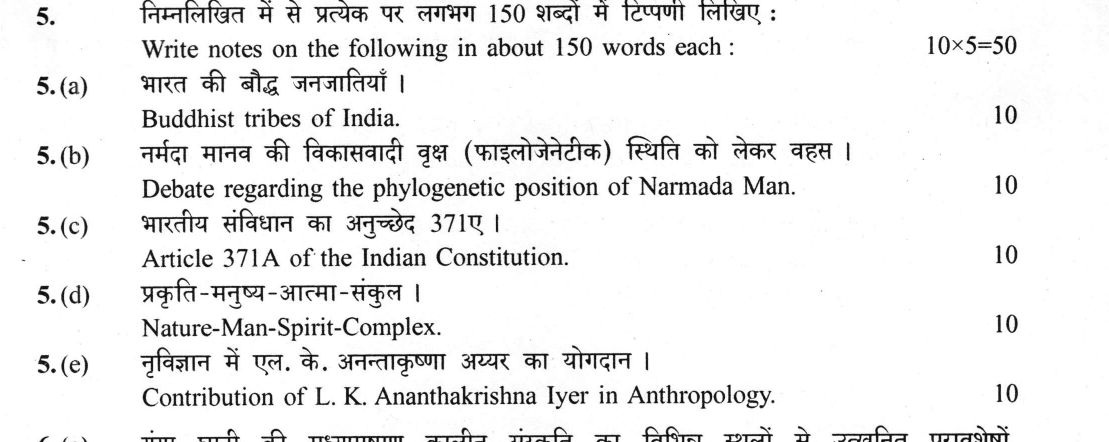
Write notes on the following in about 150 words each :
Buddhist tribes of India. 10 marks
Debate regarding the phylogenetic position of Narmada Man. 10 marks
Article 371A of the Indian Constitution. 10 marks
Nature-Man-Spirit-Complex. 10 marks
Contribution of L. K. Ananthakrishna Iyer in Anthropology. 10 marks
हिंदी में प्रश्न पढ़ें
निम्नलिखित में से प्रत्येक पर लगभग 150 शब्दों में टिप्पणी लिखिए :
भारत की बौद्ध जनजातियां । (10 अंक)
नर्मदा मानव की विकासवादी वृक्ष (फाइलोजेनेटिक) स्थिति को लेकर बहस । (10 अंक)
भारतीय संविधान का अनुच्छेद 371ए । (10 अंक)
प्रकृति-मनुष्य-आत्मा-संकुल । (10 अंक)
नृविज्ञान में एल. के. अनन्तकृष्ण अय्यर का योगदान । (10 अंक)
Model answer
Drafted with AI by UPSC Answer Check against this question's marking rubric, to the 150-word length. UPSC does not publish answers for Mains — this is one way to score well, not an official key. How we build rubrics and answers.
(a) Buddhist tribes of India
Distribution: Buddhist Scheduled Tribes lie along the Himalayan and north-eastern frontier and follow two traditions.
Mahayana/Vajrayana groups: In Ladakh the Bot/Boto, Changpa and Brokpa; in Himachal the Lahaula and Spiti Bhot; in Sikkim the Bhutia, Lepcha, Sherpa and Tamang; in western Arunachal the Monpa of Tawang, Sherdukpen, Memba and Khamba follow Tibetan Mahayana/Vajrayana centred on gompas such as Hemis and Tawang.
Theravada groups: The Khamti, Phake and Aiton and the Singpho of eastern Arunachal and Assam, and the Chakma and Mog of Mizoram and Tripura, follow Theravada.
Features: The gompa and lama anchor village life; monastic recruitment and Ladakh's former fraternal polyandry checked land fragmentation. Losar and Sangken mark the year; Bon and Lepcha Mun-Bongthing shamanism persist beneath Buddhism.
Status: All are STs under Article 342, religion being irrelevant; Chakma and Tripura councils are Sixth Schedule bodies, which Ladakh (UT since 2019) now demands.
Conclusion: They fuse Buddhist institutions with older nature-centred practice in sensitive border tracts.
(b) The phylogenetic position of Narmada Man
Find: In December 1982 Arun Sonakia (Geological Survey of India) recovered a partial calvaria at Hathnora on the Narmada (Sehore district, Madhya Pradesh) in the Middle Pleistocene Surajkund Formation, with Late Acheulian tools and Stegodon-Elephas namadicus fauna: India's only Pleistocene hominin cranium.
Taxonomic debate: Sonakia named it Homo erectus narmadensis. Kennedy, Sonakia, Chiment and Verma (1991) reassigned it to archaic Homo sapiens on a cranial capacity of roughly 1200 cc, above Asian erectus. De Lumley and Sonakia read an 'evolved Homo erectus' allied to Arago and Petralona (a Homo heidelbergensis grade).
Subsidiary disputes: Kennedy thought it possibly female, hence 'Narmada Human'; A. R. Sankhyan's clavicle and rib suggest a short, stocky body or second individual; a conglomerate fossil may be reworked. There is no secure absolute date and no ancient DNA.
Significance: It fills the gap between African and East Asian Middle Pleistocene hominins and bears on multiregional versus recent-African-origin models; it now usually rests as unassigned archaic Homo.
(c) Article 371A
Origin: The Constitution (Thirteenth Amendment) Act, 1962 inserted Article 371A to honour the Sixteen-Point Agreement (1960) with the Naga People's Convention; Nagaland became a State on 1 December 1963.
Clause (1)(a): No Act of Parliament applies to Nagaland in respect of (i) Naga religious or social practices, (ii) Naga customary law and procedure, (iii) civil and criminal justice under customary law, and (iv) ownership and transfer of land and its resources, unless the Nagaland Legislative Assembly so resolves: a conditional, not absolute, bar.
Other clauses: The Governor holds special responsibility for law and order while disturbances continue, and a regional council was provided for Tuensang.
Significance: It constitutionalises customary courts, village councils and community land ownership; Nagaland is outside both Fifth and Sixth Schedules; Article 371G does likewise for Mizoram. The live friction: one-third women's reservation in urban local bodies, resisted as contrary to custom until 2024.
Conclusion: India's strongest customary-law protection is thus its sharpest custom-versus-equality conflict.
(d) Nature-Man-Spirit Complex
Source: L. P. Vidyarthi formulated the concept in 'The Maler: A Study in Nature-Man-Spirit Complex of a Hill Tribe in Bihar' (1963), from fieldwork among the Maler (Sauria Paharia) of the Rajmahal hills under Redfield's influence.
Components: Nature is hill, forest and the kurwa swidden cycle; man is the settlement, kinship and the manjhi headman; spirit is Gosain, the supreme deity, and hill and ancestral spirits reached through the demano shaman.
Central claim: These form one interlocked complex, not three domains: clearing, sowing and harvesting are at once ecological, social and ritual, so altering any element dismantles the rest.
Status: An indigenous holistic model parallel to Steward's cultural ecology and companion to Vidyarthi's own sacred complex of Gaya (1961), it underlies the case against displacement, as at Niyamgiri.
Critique: Descriptive rather than explanatory, it pictures a static harmony and handles stratification, markets and change poorly.
Conclusion: It endures as the insistence that habitat, society and religion are inseparable.
(e) L. K. Ananthakrishna Iyer's contribution
Identity: L. K. Ananthakrishna Iyer (1861-1937) is called the father of Indian anthropology.
Surveys: In 1902 Cochin entrusted him with its ethnographic survey within H. H. Risley's all-India survey, yielding 'The Cochin Tribes and Castes' (1909, 1912), then the four-volume 'The Mysore Tribes and Castes' with H. V. Nanjundayya; 'The Travancore Tribes and Castes' is his son L. A. Krishna Iyer's.
Calcutta: Invited by Sir Asutosh Mookerjee to Calcutta in 1917, he was central to founding in 1920 the first Department of Anthropology in India, training B. S. Guha, K. P. Chattopadhyay, T. C. Das and D. N. Majumdar; he was honoured as Dewan Bahadur.
Method: Anthropometry plus descriptive ethnography gave the first records of the Kadar, Muthuvan, Nayadi and Paniyan and of Nayar matriliny (marumakkathayam, sambandham).
Assessment: Like Thurston's, it is colonial survey ethnography, carrying Risley's racial typology; yet its data are irreplaceable.
He gave Indian anthropology both its baseline record and its institutional base.
How this answer will be evaluated
Evaluation rubric
Each sub-part is marked on its own, against the marks and word limit printed on the paper.
- (a) Identify India's Buddhist tribal communities region by region, distinguish the two Buddhist traditions they follow, and note their characteristic social-religious features and constitutional position. A general note on Buddhism, or on Ambedkarite Navayana Buddhists (who are overwhelmingly Scheduled Castes, not Scheduled Tribes), does not answer it. 10 marks · 150 words
Must cover
- Monpa (Tawang) and Sherdukpen - Arunachal Pradesh
- Bot/Boto and Changpa - Ladakh
- Lahaula and Spiti Bhot - Himachal Pradesh
- Bhutia, Lepcha, Sherpa, Tamang - Sikkim
- Khamti and Singpho - Theravada
- Chakma and Mog - Theravada
- Mahayana/Vajrayana versus Theravada
- gompa and lama
- Bon and Mun/Bongthing substrata
- Article 342; Sixth Schedule councils; Ladakh's Sixth Schedule demand
Loses marks
- Writing about Ambedkarite Navayana Buddhists of Maharashtra, who are largely Scheduled Castes and not Scheduled Tribes, in a question about Buddhist tribes.
- Treating all Buddhist tribes as Mahayana and missing the Theravada groups - Khamti, Singpho, Phake, Chakma, Mog.
- Naming communities without their state, or misplacing them (Monpa are of Arunachal Pradesh, not Sikkim; Chakma are of Mizoram, Tripura and Arunachal, not Ladakh).
- Calling the Lepcha or the Monpa 'Hindu tribes', or asserting that conversion to Buddhism affects Scheduled Tribe status.
- Turning the note into an account of Buddhist doctrine instead of the ethnography of the communities.
Earns more
- Characteristic social and religious features: the gompa or vihara as the centre of village life, the lama or bhikkhu as ritual specialist and the dedication of a son to the monastery, which together with historically attested fraternal polyandry in Ladakh and Kinnaur (documented by Prince Peter of Greece and Denmark, 'A Study of Polyandry', 1963) restrained land fragmentation and population growth; festivals such as Losar, Saga Dawa, Hemis Tsechu, the Monpa Torgya and the Theravada Sangken water festival; and the persistence of pre-Buddhist substrata - Bon in the trans-Himalaya and among the Monpa, Mun/Bongthing shamanism among the Lepcha - producing a syncretic worship of mountain, lake and local deities
- Constitutional position and contemporary issues: these are Scheduled Tribes under Article 342, whose status is unaffected by religion; the Chakma, Lai and Mara Autonomous District Councils in Mizoram and the Tripura Tribal Areas Autonomous District Council function under the Sixth Schedule, while Ladakh - over ninety per cent Scheduled Tribe - has pressed since its conversion into a Union Territory in 2019 for inclusion in the Sixth Schedule; other live issues are the demand to include Bhoti in the Eighth Schedule, pasture loss and climate stress on Changpa pashmina pastoralism, border restrictions, out-migration and the tourism-driven transformation of the monastic economy
Extra mark
- Notes syncretic groups such as the Limbu of Sikkim or the Bhotia of Uttarakhand
- Links the Tai-Khamti to Shan Theravada Buddhism and the Khamti script
- (b) Set out the controversy over where the Narmada hominin belongs on the hominin family tree: the discovery facts, the successive taxonomic assignments and the evidence each rests on, the subsidiary disputes over sex, postcrania and dating, and why the question matters. The word 'debate' requires competing positions, not a single verdict. 10 marks · 150 words
Must cover
- Arun Sonakia, Geological Survey of India, 1982
- Hathnora, Sehore district, Madhya Pradesh; Narmada river
- partial calvaria; Surajkund Formation; Late Acheulian tools
- Stegodon / Elephas namadicus fauna
- Homo erectus narmadensis - original assignment
- K. A. R. Kennedy et al. (1991) - archaic Homo sapiens
- cranial capacity around 1200 cc
- de Lumley and Sonakia - evolved Homo erectus / Arago and Petralona affinity
- A. R. Sankhyan - clavicle and rib
- no absolute date, no ancient DNA
Loses marks
- Declaring a single answer ('Narmada Man is Homo erectus') when the question asks for the debate.
- Getting the find wrong - it is a partial calvaria, not a complete skull, a mandible or a skeleton.
- Placing the site in the wrong state or on the wrong river, or confusing Hathnora with the Belan valley or Bhimbetka.
- Quoting a precise absolute date as though one existed; the age is inferred from stratigraphy and fauna and is contested.
- Assuming the individual was male because of the conventional name; the sex is disputed.
- Omitting the significance - why an Indian Middle Pleistocene hominin matters for the Out-of-Africa and multiregional debate.
Earns more
- Why the phylogenetic position matters: the specimen is the sole Pleistocene hominin cranium from the subcontinent and occupies the geographic gap between the Middle Pleistocene hominins of Africa and West Asia and those of East Asia at Java and Zhoukoudian; its assignment therefore bears directly on whether South Asia held a resident archaic population, on the multiregional-continuity versus recent-African-origin debate, and on what modern humans encountered when they dispersed into South Asia, with speculation about Denisovan-related populations remaining wholly untested
Extra mark
- Sankhyan's reading of the postcranial bones as evidence of a short-statured population
- Comparison with other Asian Middle Pleistocene crania such as Dali and Jinniushan
- (c) State what Article 371A provides for Nagaland - its origin, the four subjects on which Parliament's laws do not apply without the State Assembly's consent, the Governor's special responsibilities and the Tuensang arrangements - and indicate its anthropological significance and present-day frictions. 10 marks · 150 words
Must cover
- Constitution (Thirteenth Amendment) Act, 1962
- Sixteen-Point Agreement, 1960; Naga People's Convention
- Nagaland statehood, 1 December 1963
- the four protected subjects - religious/social practices, customary law and procedure, administration of civil and criminal justice by customary law, ownership and transfer of land and its resources
- resolution of the Nagaland Legislative Assembly
- Governor's special responsibility for law and order
- Tuensang regional council
- Article 371G for Mizoram
- Nagaland is outside the Fifth and Sixth Schedules
- women's reservation in urban local bodies controversy
Loses marks
- Attributing Article 371A to the wrong state - it is Nagaland; 371G is Mizoram, 371F Sikkim, 371H Arunachal Pradesh, 371B Assam, 371C Manipur.
- Listing fewer than the four protected subjects, or omitting the crucial qualifier that Parliament's law can apply if the Nagaland Assembly resolves that it should.
- Saying Nagaland is under the Sixth Schedule; it is not - the Sixth Schedule covers tribal areas of Assam, Meghalaya, Tripura and Mizoram.
- Confusing the 1960 Sixteen-Point Agreement with the 1975 Shillong Accord or the 2015 Framework Agreement.
- Wrong amendment number or year (it is the Thirteenth Amendment, 1962, with statehood in 1963).
- Treating it as an absolute bar on Parliament rather than a conditional one subject to the Assembly's consent.
Earns more
- The remaining provisions: under clause (1)(b) the Governor has a special responsibility for law and order in the State so long as internal disturbances in the Naga Hills-Tuensang Area continue, exercising individual judgement after consulting the Council of Ministers, the responsibility being terminable by order of the President; under clause (1)(c) the Governor must ensure that money provided by the Union for a specified service or purpose is included in the demand for a grant for that purpose; under clause (1)(d) a regional council of thirty-five members was to be established for the Tuensang district, with clause (2) making transitional arrangements for its administration by the Governor, for a Minister for Tuensang affairs, and for the application of State laws to that district
Extra mark
- Nagaland Municipal Act, 2023 and the June 2024 urban local body elections held with women's reservation
- Contrast with Article 371G (Mizoram, 1986) and Article 371H (Arunachal Pradesh)
- (d) Explain L. P. Vidyarthi's concept of the Nature-Man-Spirit Complex: where it came from, what the three components are and how they interlock, why it counts as an indigenous conceptual contribution, and what its limitations are. 10 marks · 150 words
Must cover
- L. P. Vidyarthi
- 'The Maler: A Study in Nature-Man-Spirit Complex of a Hill Tribe in Bihar' (1963)
- Maler / Sauria Paharia of the Rajmahal hills
- nature, man and spirit as one interlocked complex
- Gosain (supreme deity)
- the demano (shaman) and the manjhi (headman)
- swidden / kurwa cultivation
- sacred complex ('The Sacred Complex in Hindu Gaya', 1961)
- Robert Redfield / cultural ecology influence
- critique of static harmony
Loses marks
- Attributing the concept to S. C. Roy, N. K. Bose, D. N. Majumdar or Surajit Sinha instead of L. P. Vidyarthi.
- Confusing the Nature-Man-Spirit Complex with Vidyarthi's Sacred Complex; the first is his tribal model, the second his study of a Hindu pilgrimage centre.
- Naming the wrong community - the study is of the Maler (Sauria Paharia) of the Rajmahal hills, not the Oraon, Munda or Santal.
- Describing the three components separately and never stating the interlocking claim, which is the whole point of the word 'complex'.
- Offering no critique at all, or romanticising tribal ecological harmony in the candidate's own voice.
Earns more
- Status and application: it is an indigenous, holistic and ecological model devised within Indian anthropology rather than imported, running parallel to Julian Steward's cultural ecology and complementing Vidyarthi's other well-known construct, the sacred complex of sacred geography, sacred performances and sacred specialists developed in 'The Sacred Complex in Hindu Gaya' (1961); it has since been applied to other tribes and to sacred groves such as the sarna and the Rajasthani oran, and supplies the standard argument that displacement from habitat dismantles religion and society together - the Dongria Kondh and Niyam Raja at Niyamgiri being the clearest contemporary case, and the habitat and community forest resource rights of the Forest Rights Act, 2006 the legal echo
- Critical evaluation: the model is descriptive and classificatory rather than explanatory or predictive; it presents a harmonious equilibrium and so risks the ecologically-noble-savage image; it handles stratification, market integration, conflict and historical change poorly; the very division into three components may impose an analytic separation alien to the world-view it describes; and it lacks the quantified energetics of Steward's or Rappaport's ecological anthropology
Extra mark
- Vidyarthi and Rai's 'The Tribal Culture of India' (1976)
- Comparison with Rappaport's ritual regulation or with sarna sacred groves
- (e) Assess L. K. Ananthakrishna Iyer's contribution to anthropology in India: the ethnographic surveys he produced, his role in founding academic anthropology at Calcutta, the character of his method, and a brief critical judgement. 10 marks · 150 words
Must cover
- L. K. Ananthakrishna Iyer (1861-1937); 'father of Indian anthropology'
- Cochin ethnographic survey, 1902; H. H. Risley's all-India survey
- 'The Cochin Tribes and Castes' (2 volumes, 1909 and 1912)
- 'The Mysore Tribes and Castes' (4 volumes, with H. V. Nanjundayya)
- University of Calcutta; Sir Asutosh Mookerjee; Department of Anthropology, 1920
- students - B. S. Guha, K. P. Chattopadhyay, T. C. Das, D. N. Majumdar
- Rao Bahadur; Royal Anthropological Institute
- Kadar, Nayadi, Muthuvan and other Kerala hill tribes
- Nayar matriliny (marumakkathayam)
- his son L. A. Krishna Iyer wrote 'The Travancore Tribes and Castes'
Loses marks
- Confusing him with his son L. A. Krishna Iyer and crediting him with 'The Travancore Tribes and Castes' or with the Kerala megalith studies.
- Confusing him with Edgar Thurston, whose 'Castes and Tribes of Southern India' belongs to the same genre but is a different work.
- Omitting the Calcutta phase, which is his single most consequential contribution - the founding of academic anthropology in India.
- Calling him the founder of the Anthropological Survey of India; the ASI was founded in 1945 and B. S. Guha was its first Director.
- Writing a purely laudatory note with no assessment of the colonial framework within which he worked.
Earns more
- Method and substantive content: he worked in the colonial 'tribes and castes' survey genre, combining somatometric and somatoscopic measurement on Risley's schedule with descriptive ethnography of kinship, marriage, inheritance, religion, occupation, magic and folklore, community by community; his volumes preserve the first systematic accounts of Kerala hill tribes such as the Kadar, Malayan, Muthuvan, Ulladan, Nayadi, Mannan and Paniyan, and detailed records of Nayar matriliny - marumakkathayam, the tali-kettu kalyanam and sambandham - that later fed the debates on Nayar marriage
- Critical judgement: his work is encyclopaedic and descriptive rather than theoretical, inherits the racial-typological assumptions of Risley's anthropometry and serves the enumerative purposes of the colonial ethnographic state, with a largely upper-caste vantage; nonetheless it remains an indispensable baseline record of communities since transformed, and his teaching gave Indian anthropology its institutional foundation
Extra mark
- Places him with Thurston, Russell and Hira Lal, and S. C. Roy as the founding generation
- His 'Anthropology of the Syrian Christians' (1926)
What "Write short notes" is asking you to do
Five or six self-contained answers, marked separately, typically 10 marks and about 150 words each. Each note must carry its own definition, its two or three defining features and a line on why it matters; a common introduction or conclusion across the notes earns nothing.
Structure that answers it
Per note: one-line definition or identification → two or three features, mechanisms or named examples → one line of significance or Indian application
Where marks are lost
Writing the first two notes at essay length and rationing the rest. Each note is marked on its own, so marks surrendered on a compressed or unattempted note cannot be won back by the long ones.
Practice this exact question
Write your answer and it is marked point by point against the model answer above — what you covered, what you missed, what you got wrong.
Evaluate my answer →More from Anthropology 2026 Paper II
- Q2 (a) What are the major debates related to the concept of jajmani system ? (20 marks) (b)…
- Q3 (a) Critically examine the salience of F. G. Bailey’s study on Bisipara village of Odisha…
- Q4 (a) Write an account on the contribution of Verrier Elwin in developing policies for the…
- Q5 Write notes on the following in about 150 words each : (a) Buddhist tribes of India. (10…
- Q6 (a) Make a critical appraisal of the mesolithic culture of Ganga basin with reference to…
- Q7 (a) Assess the contribution of colonial scholars in studying the tribal populations of No…
- Q8 (a) Make a critical appraisal of Surajit Sinha's line of argument that tribes and castes…